
Galen BSN Curriculum PDF: Courses, Credits, Clinicals, and How to Read the Plan of Study
🎓 Galen BSN curriculum PDF guide: core courses, credit hours, clinical rotations, and how to read a BSN plan of study before you enroll.

Searching for a galen bsn curriculum pdf usually means one thing: you want to see exactly what you will study, in what order, and how many credits stand between you and the NCLEX-RN. A curriculum document is the most honest preview of any nursing program. It lists courses, clinical hours, prerequisites, and sequencing, so you can judge workload and cost before committing. This guide explains how to read a Galen College of Nursing plan of study and how it compares with typical programs nationwide.
Galen College of Nursing is a US college focused on nursing, with campuses in several states and online options, and it offers pathways such as the BSN, RN-to-BSN, and LPN-to-BSN. Because course numbers, credit totals, and term lengths change between catalog years, always download the current official document from Galen's admissions or catalog pages instead of trusting a copy posted elsewhere. Use this article as a reading companion that explains what each section means and which questions to ask an advisor.
Every accredited BSN, regardless of school, is built from the same three layers. General education and science prerequisites come first, covering anatomy, physiology, microbiology, chemistry, statistics, and psychology. Next come the core nursing courses, which move from fundamentals to medical-surgical, maternal-newborn, pediatrics, mental health, and community health. Finally, a capstone or leadership course with a preceptorship ties everything together. Once you recognize these layers, any bsn curriculum document becomes much easier to scan and compare.
Credits and clinical hours are the numbers that matter most. A traditional four-year BSN generally totals around 120 semester credit hours, although some schools use quarter credits, which makes the totals look very different on paper. Clinical requirements often run from roughly 500 to well over 800 hours, split between hospital units, community sites, and simulation labs. When you open a curriculum PDF, find the credit total and the clinical hours first, then check how both are distributed across terms.
The type of student you are changes which curriculum applies to you. A first-time college student follows the full pre-licensure plan, an LPN or paramedic may receive bridge credit, and a working registered nurse completes a shorter RN-to-BSN track focused on leadership, research, and population health. Each track has its own PDF, its own course map, and its own admission requirements. Confusing them is a common mistake, and it can lead you to plan the wrong timeline, schedule, or budget.
A good curriculum also reveals how a school teaches. Look for early clinical exposure, simulation hours, integrated skills labs, and testing milestones such as standardized exams that must be passed before you progress. These details signal how supported you will be and how strictly you will be evaluated. A program that lists clear remediation policies and an NCLEX preparation course in its plan of study usually cares about graduate outcomes and not only about enrollment numbers.
In the sections below, you will find a stat snapshot, a map of a typical BSN sequence, guidance on reading each course category, a comparison of tracks, and a practical checklist for evaluating any plan of study. Between sections, practice quizzes let you test yourself on fundamentals, community health, and maternal-newborn content, which are subjects that appear repeatedly in nursing curricula and on licensure exams. Treat this guide as a working tool and keep the PDF open beside it as you read.
BSN Curriculum by the Numbers

Typical BSN Curriculum Structure: Four Building Blocks
Anatomy and physiology, microbiology, chemistry, nutrition, statistics, and psychology form the foundation. Most programs require a minimum grade, often a C or B, and many cap how old the science credits can be before they expire.
Fundamentals, health assessment, pharmacology, and pathophysiology teach core skills and clinical reasoning. These courses are usually taken first and often act as a gate, requiring a passing grade before you can enter specialty clinical courses.
Medical-surgical, maternal-newborn, pediatric, mental health, and community health nursing each pair classroom learning with supervised clinical placements. This block holds most of the clinical hours and makes up the heaviest part of the workload.
The final term usually includes leadership and management, evidence-based practice, a preceptorship with a practicing nurse, and an NCLEX-RN review course. It bridges the gap between student and entry-level registered nurse.
The core of any BSN plan of study starts with Fundamentals of Nursing, usually taken in the first or second nursing term. This course introduces vital signs, hygiene, safe patient handling, medication administration basics, documentation, infection control, and the nursing process. It pairs lectures with a skills lab and a first, low-acuity clinical placement. Students who master fundamentals early find later courses easier, because every specialty course assumes you can already assess, communicate, and perform basic procedures safely.
Health assessment and pharmacology come next, and they are often the courses students fear most. Health assessment teaches you to perform a head-to-toe examination, recognize normal findings, and report abnormal ones clearly. Pharmacology covers drug classes, mechanisms, side effects, and dosage calculation, and many programs require a dosage calculation exam with a near-perfect score, such as 90 or 100 percent. Review these sections of the curriculum PDF carefully to see how many attempts you are given.
Medical-surgical nursing is usually split into two or three courses and carries the largest share of credits and clinical hours. You will study cardiovascular, respiratory, renal, endocrine, neurological, and gastrointestinal conditions, along with perioperative care. Clinical rotations take place on hospital units such as telemetry, orthopedics, or general medicine. Because this sequence builds on pathophysiology, students who struggled with anatomy and physiology often benefit from reviewing those prerequisites before the first med-surg term starts.
Maternal-newborn and pediatric nursing shift the focus to special populations. Maternal-newborn covers prenatal care, labor and delivery, postpartum recovery, and newborn assessment, while pediatrics addresses growth, development, immunizations, and common childhood illnesses. Clinical sites may include labor and delivery units, pediatric clinics, or simulation labs when placements are limited. These courses are short but dense, so many students create flashcards for developmental milestones and obstetric terminology well before the term begins.
Mental health nursing introduces therapeutic communication, crisis response, and care for patients with depression, anxiety, schizophrenia, and substance use disorders. Clinical hours often take place in inpatient psychiatric units or community mental health centers. Unlike procedural courses, success here depends on listening, boundary setting, and self-awareness. Reading the course description in the curriculum PDF helps you see whether the program includes simulation or standardized patient encounters, which are valuable for practicing difficult conversations safely.
Community and public health nursing widens the lens from individual patients to entire populations. Students learn epidemiology, health promotion, disease prevention, and cultural competence, and they often complete a community assessment project or health fair. Clinical placements may occur in schools, health departments, or home health agencies. This course also supports the leadership content that follows, because understanding social determinants of health helps nurses advocate for patients and design interventions that actually fit the community.
The final stage typically combines leadership and management, nursing research or evidence-based practice, and a capstone preceptorship. During the preceptorship you work a set number of hours, often 120 or more, alongside a licensed nurse and gradually take on a full patient assignment. An NCLEX-RN review course often runs alongside it, with standardized assessments that predict your readiness. When comparing programs, confirm whether passing a predictor exam is required for graduation, since this policy varies widely.
Galen BSN Curriculum PDF: Pre-Licensure, LPN-to-BSN, and RN-to-BSN Tracks
The pre-licensure BSN is designed for students who do not yet hold a nursing license. The curriculum PDF for this track is the longest, because it includes prerequisites, foundational skills, every clinical specialty, and the capstone. Expect a term-by-term map showing which courses must be completed before others, such as fundamentals before medical-surgical nursing. Following that map exactly matters, since a failed course can delay your whole cohort sequence.
Plan for full-time study, particularly during clinical terms, when you may be on a hospital unit for twelve-hour shifts and still have lectures, labs, and exams. Many students reduce outside work hours to ten or fewer during the heaviest semesters. Ask whether classes are offered days, evenings, or hybrid, because the PDF often lists only the course titles and credits and not the actual schedule you will live with.

Is a Structured BSN Curriculum Worth the Commitment?
- +Clear course map shows exactly what you need and in what order.
- +Integrated clinical placements build real patient-care confidence.
- +Strong science foundation supports advanced nursing roles later.
- +Degree meets many hospital Magnet and leadership hiring preferences.
- +Graduates qualify to sit for the NCLEX-RN in every state.
- +Credits provide a direct path to MSN, NP, and DNP programs.
- −Fixed sequencing means one failed course can delay graduation.
- −Clinical hours and exams make working full time very difficult.
- −Prerequisites can add a semester before you even start nursing courses.
- −Tuition and fees vary widely and can be a major financial burden.
- −Credit transfer rules can be strict and confusing.
- −Some programs require minimum scores on standardized exams to progress.
Galen BSN Curriculum PDF Checklist: What to Verify Before You Enroll
- ✓Download the current catalog-year PDF from the official Galen website.
- ✓Find the total credit hours and note whether they are semester or quarter credits.
- ✓Locate the total clinical hours and their split between hospitals and simulation.
- ✓List every prerequisite course and its minimum required grade.
- ✓Check how old your science credits can be before they expire.
- ✓Confirm which prior credits transfer and get that decision in writing.
- ✓Note progression rules, such as minimum course grades and exam benchmarks.
- ✓Look for the dosage calculation exam policy and number of retakes allowed.
- ✓Verify the program's accreditation and its NCLEX-RN pass rate.
- ✓Ask an advisor for a realistic term-by-term schedule and total cost estimate.
The Credit Total Is Not the Whole Story
Two programs can both advertise a BSN yet differ by dozens of credits or hundreds of clinical hours. Always compare credit type, transferable credits, and progression rules side by side, because these details decide your real timeline and final cost.
Clinical education is where a curriculum becomes a career. In a typical BSN, you begin with supervised practice on a single unit, caring for one or two patients, and progress to managing a full assignment by the capstone term. State boards of nursing set minimum standards, and schools must meet them to remain approved. When reading a curriculum PDF, look for clinical hours listed by course, because a line such as 90 clinical hours in medical-surgical nursing tells you what weekly commitment to expect.
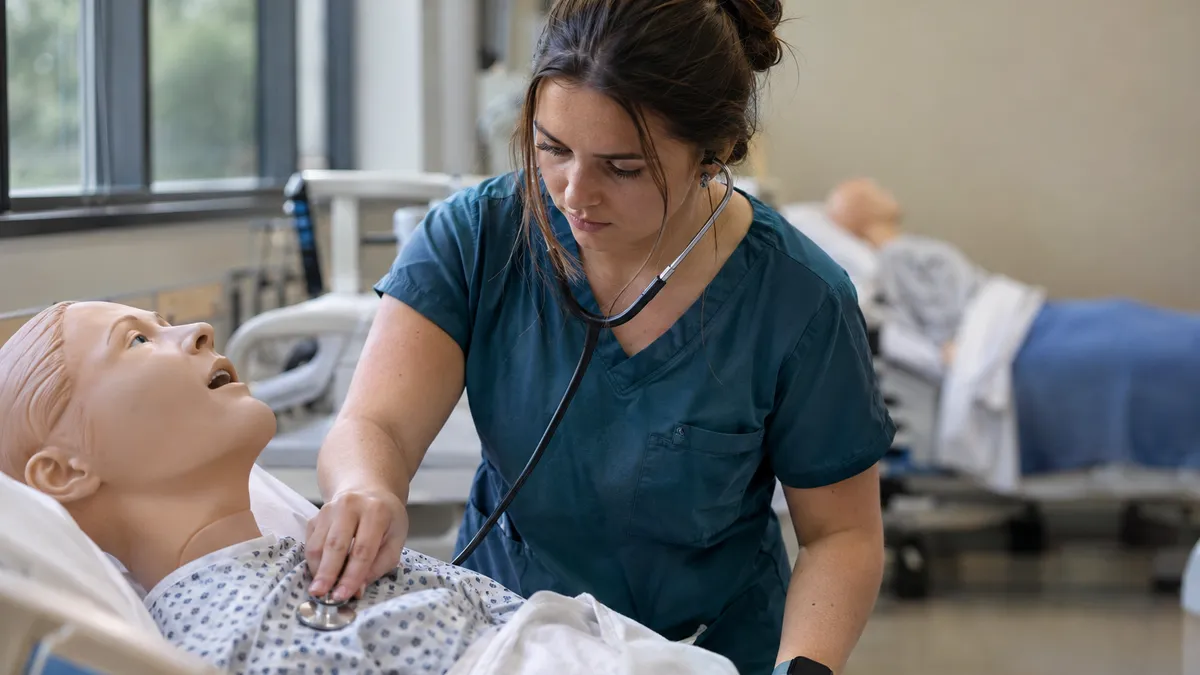
Simulation has become a major part of nursing education. High-fidelity manikins can breathe, bleed, and deteriorate, letting students practice responding to emergencies without risking real patients. Many state boards allow simulation to replace a portion of traditional clinical hours, sometimes up to 25 or even 50 percent, depending on the state. If a curriculum PDF mentions simulation, ask how the hours are counted, how debriefing works, and whether simulation supplements or substitutes for hospital placements.
Clinical placement logistics matter more than students expect. Some schools assign sites for you, while others require you to arrange your own, and travel distances can range from a few miles to more than an hour. Shifts may start at 6:30 a.m. or run into the night, and weekend rotations are common. A strong program provides clear placement policies, compliance requirements such as immunizations, background checks, and CPR certification, and a named coordinator you can contact when problems arise.
Performance in clinical courses is typically graded pass or fail, and failure can end your progression even if your exam scores are strong. Evaluators look at patient safety, professionalism, communication, documentation, and the ability to apply classroom knowledge. Medication errors, unsafe practice, or dishonesty can lead to immediate dismissal in many programs. Read the student handbook alongside the curriculum PDF, because the handbook explains the clinical evaluation tools and the consequences of unsatisfactory performance.
The NCLEX-RN is the final gate between graduation and licensure. It is a computer adaptive test that delivers between 85 and 150 questions, and it assesses safe, effective care, health promotion, psychosocial integrity, and physiological integrity. The Next Generation NCLEX also includes case studies that measure clinical judgment. Graduates apply to their state board, receive an authorization to test, and sit for the exam at a Pearson VUE testing center, usually within a few months of finishing.
Programs that prepare well weave NCLEX skills throughout the curriculum rather than leaving them for the end. You may see standardized assessments after each major course, remediation plans for low scores, and a dedicated review course in the final term. Ask for the program's recent first-time NCLEX pass rate and compare it with the national average. A consistently high rate suggests that the curriculum, teaching, and student support are aligned with what the licensure exam actually tests.
Finally, think about how the curriculum supports your life outside school. Clinical hours, labs, and study demands add up to a workload that is often described as a full-time job and then some. Students who succeed usually build routines early, form study groups, and use practice questions weekly rather than cramming before exams. Look for tutoring, faculty office hours, and mentoring in the program description, because those supports often matter as much as the course titles in the PDF.
Curriculum PDFs from older catalog years or third-party sites may list outdated courses, credits, or requirements. Confirm every detail with Galen's admissions office or the current official catalog before you make enrollment, financial aid, or scheduling decisions.
Bridge programs exist because nursing is a ladder profession, and many nurses begin as nursing assistants, LPNs, or associate-degree RNs. An RN-to-BSN curriculum recognizes that you already hold clinical competence and focuses on the broader skills a bachelor's degree adds. Typical courses include nursing research, health policy, leadership, informatics, and community health. The curriculum PDF for this track should list which courses are required, which are electives, and how many credits you must complete at the school itself.
Residency rules are easy to overlook. Many schools require that a minimum number of credits, often 25 percent or more of the degree, be earned in residence, even if you transfer in a large block from a community college. Others cap the number of transferable credits or require that prerequisite courses be recent. Before applying, request an unofficial transcript evaluation so you know exactly which courses count and which will need to be repeated or replaced.
Cost and time vary dramatically by track. A traditional four-year BSN can cost anywhere from under $40,000 at an in-state public school to well over $100,000 at a private college, while RN-to-BSN completion programs often cost between $10,000 and $30,000 in total. Employer tuition assistance can cover a large share, sometimes $5,000 per year or more. When you review a curriculum PDF, multiply the credit total by the per-credit rate and then add fees.
Pace is another key difference. Full-time pre-licensure students may complete about 15 credits per term, while working RNs often take two courses at a time in seven- or eight-week sessions. Accelerated formats compress material even further, which can be efficient but intense. Compare how many terms the plan of study shows and how many courses are offered each term, because a course that runs only once a year can create a hidden delay if you miss it.
Accreditation protects the value of your degree. Look for programmatic accreditation from the Commission on Collegiate Nursing Education (CCNE) or the Accreditation Commission for Education in Nursing (ACEN), as well as regional institutional accreditation. Graduate schools, employers, and the military often require a degree from an accredited program. If you may pursue a nurse practitioner role later, accreditation becomes even more important, because admissions committees routinely screen applicants on this basis alone.
Career outcomes also depend on the curriculum. Bachelor's-prepared nurses are more likely to qualify for roles in case management, public health, nurse education, quality improvement, and leadership. Many hospitals seeking or maintaining Magnet recognition prefer or require BSN-prepared staff. The leadership and research courses in your plan of study help build those qualifications, so read their descriptions to see whether they include projects that you can later describe on a resume or in an interview.
Finally, think about what comes after the bachelor's degree. A BSN is the standard entry point to MSN, DNP, and nurse practitioner programs, and strong grades in statistics, research, and leadership courses make your application stronger. If advanced practice is a goal, ask whether credits can count toward a graduate degree through an early admission or bridge option. Planning that step while you read the undergraduate curriculum can save both time and tuition later on.
Start your preparation by building a one-page map from the curriculum PDF. List every course by term, mark the ones with clinical hours, and highlight those that act as progression gates, such as fundamentals, pharmacology, and medical-surgical nursing. Seeing the entire sequence on a single sheet helps you spot heavy terms, plan work and family obligations, and decide when to take lighter prerequisites. Update the map each term so that it reflects your actual progress and any schedule changes.
Treat prerequisites as the first stage of your nursing education and not as obstacles. Anatomy and physiology, microbiology, and chemistry knowledge returns constantly in pharmacology and pathophysiology, so strong grades and real understanding pay off later. If your science credits are older or your grades are low, consider retaking a course before applying. A solid foundation is usually cheaper and less stressful than struggling through a progression course that depends on that knowledge.
Build daily study habits that match nursing exams. Questions often ask for the best or first action, which means you must prioritize, not simply recall facts. Practice with application-style questions weekly, read the rationale for every answer, and keep a list of mistakes by topic. Short sessions of 45 to 60 minutes with active recall, such as flashcards and teaching a concept aloud, generally beat long, passive reading sessions that feel productive but fade quickly.
Master dosage calculation early, because many programs require a passing score before clinical placement. Practice converting units, calculating weight-based doses, and working out IV drip rates until the steps feel automatic. Use dimensional analysis consistently and always check whether your answer makes clinical sense. A dose that looks unusually large or small should prompt you to recheck your math. Many students practice ten problems a day for several weeks to build speed and accuracy.
Prepare for clinicals as seriously as for exams. Review the patient's conditions, medications, and lab values the night before, bring a clear question for your instructor, and arrive early with required supplies. Learn to give a concise report using a structure such as SBAR. Ask for feedback after each shift and write down one improvement goal. Instructors notice preparation, honesty about what you do not know, and a willingness to ask for help.
Protect your wellbeing across a demanding program. Sleep, regular meals, movement, and time with supportive people are not luxuries, because fatigue directly affects learning and patient safety. Identify campus resources early, including tutoring, counseling, disability services, and financial aid advising. If you fall behind, speak with faculty before an exam, not after a failed one, since many programs offer remediation options that are only available when you act promptly and communicate openly.
Finally, finish strong by preparing for the NCLEX-RN well before graduation. Take a diagnostic test early, identify weak content areas, and then target them using question banks and review books. Aim to complete several thousand practice questions across the program, including Next Generation case studies. Use the quizzes on this site to check fundamentals, community health, and maternal-newborn knowledge regularly. Consistent practice, a clear curriculum map, and honest self-assessment make the path from the curriculum PDF to your RN license far more manageable.
BSN Questions and Answers

What Is a BSN in Nursing? Complete Guide to the Degree, Cost, and Career

Online Accelerated BSN Programs: A Practical Guide

BSN to NP Programs: Pathways from Bachelor's of Nursing to Nurse Practitioner, Program Types, Costs, and Career Outcomes

Capella RN to BSN: Full Guide to FlexPath, Cost, and Timeline

How to Get a BSN: Four Paths to Your Nursing Degree
How this page was made: written with AI tools and published by Nathan Beja, founder of Practice Test Geeks, who is responsible for its content. We have not yet matched this exam's facts to an official source, so confirm fees, dates and rules with the exam body. Not reviewed by a subject-matter expert. Editorial policy