
Border Patrol Agent Hiring Process: Step-by-Step Guide 2026 October
Get ready for your Border Patrol Agent Hiring Process: 🏆 Step certification. Practice questions with step-by-step answer explanations and instant scoring.
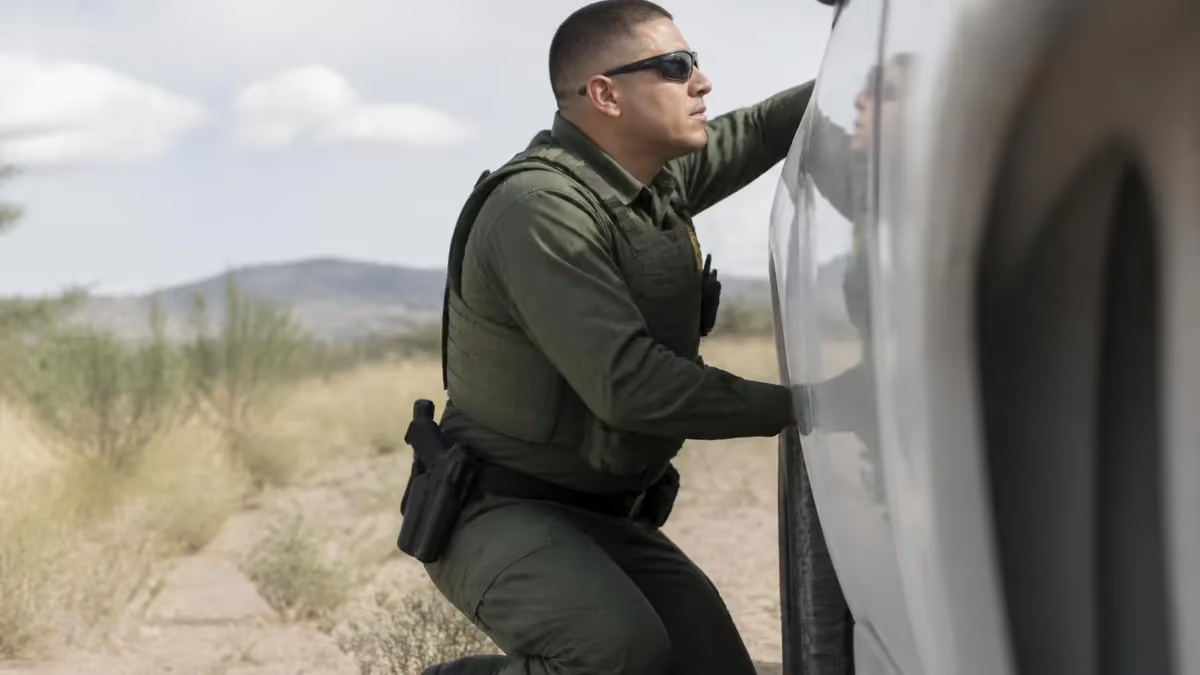
The border patrol agent hiring process is one of the most demanding federal law enforcement selection pipelines in the country. From the moment you submit your application to the day you pin on your badge, you're looking at anywhere from 12 to 18 months — and that's if everything goes smoothly. Understanding what's coming at each stage isn't just helpful; it's essential for making it through.
U.S. Customs and Border Protection (CBP) hires Border Patrol Agents under the GS-5 through GS-9 pay scale, with most entry-level agents entering at GS-7 or GS-9 depending on education and experience. The agency processes tens of thousands of applicants per year and advances a small fraction to academy. This guide covers every stage of the process so you know what to prepare for — and when.
Step 1: Meet the Basic Eligibility Requirements
Before you apply, confirm you meet the non-negotiable requirements. CBP is strict about these, and failing to meet them ends your application immediately.
- Citizenship: Must be a U.S. citizen at the time of appointment
- Age: Must be under 40 years old at the time of appointment (law enforcement officer retirement provisions apply). Veterans with preference rights may have the age limit waived.
- Driver's license: Must possess a valid driver's license
- Drug use: No illegal drug use within the past year; marijuana use within three years generally disqualifies you. Some prior drug use can be waived depending on recency and frequency.
- Criminal history: No felony convictions. Misdemeanor convictions, including domestic violence, are disqualifying under the Lautenberg Amendment.
- Selective Service: Males born after December 31, 1959, must be registered
Step 2: Submit Your Application via USAJOBS
All federal hiring flows through USAJOBS (usajobs.gov). Border Patrol Agent positions are listed under job series 1896. CBP opens competitive windows periodically — they don't maintain a perpetually open posting. Set up job alerts on USAJOBS so you're notified when positions open in your preferred locations.
Your application must include a complete federal resume (more detailed than a private-sector resume — CBP reviewers need to verify your eligibility from the resume itself), transcripts for any education-based qualification, and documentation of any veteran's preference you're claiming.
CBP uses an automated questionnaire to assess minimum qualifications. Answering questions accurately matters — CBP does verify claims during the background investigation, and discrepancies are flagged as integrity issues.
Step 3: Border Patrol Entrance Exam
Applicants who pass the initial resume review are invited to take the entrance exam. CBP uses an online assessment that tests three core areas:
- Logical Reasoning — Deductive and inductive reasoning problems, pattern recognition, and inference questions
- Artificial Language Test — You're given a fictional language system and must apply its grammar rules. This assesses your ability to learn Spanish (a requirement for Border Patrol Agents).
- Writing Skills Assessment — Grammar, punctuation, and written communication under time pressure
The exam is administered remotely with proctoring software. Plan to complete it in a quiet, well-lit room with a stable internet connection. Results are scored automatically — high scores accelerate your placement in the applicant pool.
The Artificial Language test trips up many candidates because it's unlike any conventional test. The key is to treat it like a logic puzzle — read the rules carefully, note patterns systematically, and apply them consistently. Rushing here costs points.
Step 4: Structured Interview
Candidates who score competitively on the entrance exam are invited to a structured interview, typically conducted in person or via video. CBP uses a behavioral interview format — expect questions like:
- Describe a time you made a difficult ethical decision under pressure.
- Tell me about a situation where you had to enforce a rule someone disagreed with.
- How have you handled conflict with a coworker or supervisor?
These are STAR-format questions (Situation, Task, Action, Result). Prepare 8–10 specific examples from your work or military history that demonstrate integrity, decisiveness, leadership, stress tolerance, and interpersonal skills. Vague answers score poorly — specificity is what evaluators are looking for.
Step 5: Polygraph Examination
The polygraph is where a significant number of applicants wash out — not because they're lying, but because they haven't disclosed information they should have. CBP requires a full-scope polygraph, which covers:
- Prior drug use (type, frequency, recency)
- Criminal activity not charged or convicted
- Prior contact with foreign intelligence services
- Undisclosed financial liabilities or fraud
- Any falsification on the application or background investigation forms
The polygraph examiner will ask you to complete a pre-test questionnaire. Answer it honestly and completely. Examiners are trained to detect nervousness-based deception versus anxiety, but the best way to pass is to have nothing to hide — and to have already disclosed everything on your forms.
Candidates who fail the polygraph typically do so because they withheld information hoping it wouldn't come up. CBP's background investigation is thorough. If something will be discovered, it's almost always better to self-disclose upfront.
Step 6: Medical Examination
All Border Patrol Agent candidates must pass a CBP-administered medical examination. The exam assesses:
- Vision: Distance vision must be correctable to 20/20 (contact lenses and glasses are accepted). Uncorrected vision cannot be worse than 20/200 in either eye in most cases.
- Color vision: Must be able to distinguish colors necessary for the job
- Hearing: Pure tone audiometry testing — thresholds must be within acceptable ranges
- Physical health: Cardiovascular, musculoskeletal, neurological, and psychiatric review
- Medications: Certain controlled substances and psychiatric medications may be disqualifying depending on the condition they treat
If you have a pre-existing condition, don't assume it disqualifies you. CBP makes individualized determinations. Conditions like controlled hypertension, past injuries with full recovery, and corrected vision are typically not barriers. However, conditions that affect cognitive function, physical capability, or situational awareness under stress are scrutinized carefully.
Step 7: Physical Fitness Test
The Border Patrol physical fitness test has four components, each with minimum passing standards:
- Push-ups: Minimum 20 in one minute (higher is expected for competitive scoring)
- Sit-ups: Minimum 25 in one minute
- 1.5-mile run: Completed in 13:30 or less
- Pull-ups: Part of some versions of the test — check the current CBP standard for the announcement you applied under
These standards aren't punishing for someone who's been consistently active. But candidates who've been sedentary for months often underestimate how much cardiovascular fitness degrades quickly. Start training 12+ weeks before your expected fitness test date. Run three times per week, focusing on 1.5-mile pace, and add push-up and sit-up practice daily.
Step 8: Background Investigation
CBP conducts one of the most comprehensive background investigations in federal law enforcement. Investigators will:
- Verify all employment history (including gaps)
- Contact references and neighbors (not just the ones you list)
- Review financial records, credit history, and any bankruptcies
- Check foreign travel and foreign contacts
- Verify education credentials
- Review social media and digital footprint
The background investigation is conducted using Standard Form 86 (SF-86), which you'll complete online through eQIP. The SF-86 is lengthy — give yourself several days to gather the information needed (addresses for every residence in the past 10 years, employment dates and supervisor names, foreign contacts, etc.).
Financial issues — particularly unresolved delinquencies, unpaid judgments, or signs of financial stress that create exploitation risk — are frequent disqualifying factors. Pay off outstanding debts before or during the application process if possible.
Step 9: Conditional Offer and Academy
If you pass all the above steps, you'll receive a conditional offer of employment (COE). This is contingent on completing remaining steps and maintaining all eligibility conditions. Don't make irreversible life changes (quitting your job, moving across the country) until the COE is in hand and your start date is confirmed.
New agents attend the Border Patrol Academy at FLETC in Artesia, New Mexico. The residential program runs approximately 117 days and covers:
- Spanish language instruction (intensive — agents must achieve a minimum proficiency before graduating)
- Firearms training and qualification
- Law, regulations, and immigration procedures
- Driving and vehicle operations
- Physical tactics, defensive driving, and arrest procedures
- First aid and emergency response
Academy training is paid — you receive your full salary while attending. However, it's demanding. The Spanish language component is the leading reason agents fail to graduate. If Spanish isn't your first language, start studying before you receive your academy date. Even basic conversational proficiency going in significantly improves your odds of passing the language exams.
Timeline and Common Disqualifiers
The full pipeline from application to academy start typically takes 12–18 months. Active follow-up with your CBP recruiter is appropriate and expected — check in every 3–4 weeks to confirm your file is moving.
Knowing where applications typically fail helps you address issues before they become problems:
- Undisclosed drug use — CBP's polygraph and investigation uncover this. Disclose accurately.
- Criminal history — Even arrests without conviction can delay or complicate your file. Be thorough on the SF-86.
- Financial irresponsibility — Unpaid debts, judgments, and delinquencies create security concerns. Address these early.
- Prior government employment issues — Terminations, resignations under investigation, or adverse actions at prior government jobs are heavily scrutinized.
- Foreign contacts or dual citizenship complications — Not automatically disqualifying but creates additional investigation requirements. Full disclosure is essential.
- Physical fitness failure — The most preventable cause. Train for the 1.5-mile run specifically — it catches more people off-guard than any other component.
The Border Patrol Agent hiring process demands patience, honesty, and physical preparation. Candidates who treat the application as an ongoing commitment — maintaining fitness, resolving financial issues, studying Spanish — fare significantly better than those who submit and wait passively.
Important: The BPA exam covers multiple domains. Allocate more study time to unfamiliar topics while maintaining review of strong areas.
- ✓Confirm you meet age (under 40), citizenship, and criminal history requirements
- ✓Register on USAJOBS and set up job alerts for Border Patrol Agent (series 1896) postings
- ✓Start a federal resume — more detailed than a private-sector resume
- ✓Begin training for the 1.5-mile run at least 12 weeks before your expected fitness test
- ✓Gather all 10-year history of addresses, employers, and references for the SF-86
- ✓Resolve any outstanding financial delinquencies or unpaid judgments
- ✓Begin Spanish language study if you're not already proficient
- ✓Prepare 8–10 STAR-format behavioral examples for the structured interview
- ✓Disclose all prior drug use, criminal history, and foreign contacts on your forms — fully and accurately
- ✓Follow up with your recruiter every 3–4 weeks to ensure your file is progressing
Sample BPA - Border Patrol Agent Practice Questions
Try these questions from our free BPA - Border Patrol Agent practice tests. The correct answer and an explanation follow each question.
What is the purpose of the polygraph examination in the Border Patrol hiring process?
- A. To measure intelligence and problem-solving ability
- B. To detect deception and verify accuracy of information provided in background documents
- C. To assess physical stress tolerance
- D. To evaluate language proficiency in Spanish
Answer: B. To detect deception and verify accuracy of information provided in background documents
The polygraph is used to detect deceptive responses and identify undisclosed information about criminal conduct, drug use, or security concerns not revealed during the written process.
Which form is used to initiate the federal background investigation process for a Border Patrol Agent candidate?
- A. SF-86 (Questionnaire for National Security Positions)
- B. OF-306 (Declaration for Federal Employment)
- C. I-9 (Employment Eligibility Verification)
- D. DS-5540 (National Security Questionnaire)
Answer: A. SF-86 (Questionnaire for National Security Positions)
The SF-86 is the standard form submitted to initiate a federal national security background investigation for positions requiring a security clearance.
Which of the following medical conditions would most likely disqualify a Border Patrol Agent candidate?
- A. Mild seasonal allergies controlled by antihistamines
- B. Color blindness correctable with contact lenses
- C. Uncontrolled epilepsy with frequent seizures
- D. A history of a broken arm fully healed 10 years ago
Answer: C. Uncontrolled epilepsy with frequent seizures
Uncontrolled epilepsy poses a direct safety risk in law enforcement operations and is a disqualifying medical condition for Border Patrol candidates.
Which hearing standard must Border Patrol Agent candidates meet during the medical examination?
- A. Perfect hearing in both ears without aids
- B. Ability to hear a whispered voice at 15 feet in both ears
- C. Sufficient hearing to understand normal conversational speech with or without aids
- D. No hearing loss greater than 10 decibels at any frequency
Answer: C. Sufficient hearing to understand normal conversational speech with or without aids
Candidates must be able to understand normal conversational speech, with hearing aids permitted, to meet the operational communication requirements of the job.
About the Author
Attorney & Bar Exam Preparation Specialist
Yale Law SchoolJames R. Hargrove is a practicing attorney and legal educator with a Juris Doctor from Yale Law School and an LLM in Constitutional Law. With over a decade of experience coaching bar exam candidates across multiple jurisdictions, he specializes in MBE strategy, state-specific essay preparation, and multistate performance test techniques.
Join the Discussion
Connect with other students preparing for this exam. Share tips, ask questions, and get advice from people who have been there.
View discussion (8 replies)