
Virginia DMV Practice Test: Complete Study Guide with VA DMV Test Questions and Answers PDF Resources
Master the Virginia DMV permit exam with our complete practice test guide. Get VA DMV test questions and answers PDF tips, study strategies, and prep ⏳
Searching for a reliable va dmv test questions and answers pdf can feel overwhelming when you are trying to prepare for the Virginia knowledge exam in the next few weeks. Virginia requires new drivers to pass a two-part written test covering road signs and traffic laws, and the questions are pulled directly from the Virginia Driver's Manual published by the Department of Motor Vehicles. A focused study plan that blends authentic practice questions, careful manual review, and short daily drills is far more effective than cramming the night before your appointment.
This guide explains exactly what to expect on test day, how Virginia structures the exam, and where official PDF study materials fit into a smart preparation routine. We will walk through the format, the most commonly missed topics, the passing score requirements, and how realistic practice questions reinforce the rules you need to remember when you sit in front of the testing terminal at the customer service center.
Virginia's permit test is not designed to trick you, but it does demand precision. You must answer questions about speed limits, right-of-way at intersections, alcohol-related laws, and the meaning of dozens of signs and pavement markings. Many first-time test takers fail because they rely on common sense instead of the specific rules Virginia codifies. Practice tests built from the official manual close that gap by exposing you to the exact phrasing and answer choices the DMV uses.
Beyond the written exam, this article also touches on the in-car road skills test, the documents you must bring to your appointment, and how the learner's permit pathway works for teens and adult applicants. Virginia treats applicants under age 18 differently than adults, with mandatory holding periods and supervised driving hours that must be logged before the road test. Understanding these requirements early prevents surprises at the counter.
If you have already booked your visit, take a look at our BMV Appointment Guide: How to Schedule, Prepare, and Pass Your Visit on the First Try for a checklist of what to bring. Pair that resource with the strategies below, and you will arrive confident in both the paperwork and the knowledge questions waiting for you on the touchscreen testing kiosk inside the office.
By the end of this guide, you will know the precise structure of the Virginia DMV practice test ecosystem, which study materials carry the highest return on time invested, and how to simulate test conditions at home so the real exam feels familiar. Whether you are a teen working toward a provisional license or an adult new to Virginia from another state, the path to passing on the first try comes down to repetition, accuracy, and respect for the official rules.
Let's break down the test, the resources, and a study schedule that has helped thousands of Virginia applicants walk out with a passing score on their first attempt.
Free BMV Study Tools
Interactive BMV resources on PracticeTestGeeks, free to start:
- BMV flashcards — review key terms and concepts card by card
- BMV study guide — topic-by-topic overview of what the exam covers
- BMV cheat sheet — one-page printable summary for last-minute review
Virginia DMV Test by the Numbers
Key Facts at a Glance
| Item | Value | Details |
|---|---|---|
| Total Questions | 35 | 10 signs + 25 traffic laws |
| Passing Score | 80% | 20 of 25 traffic + all signs |
| Required Practice | 45 hrs | Teens under 18, with 15 night hours |
| Learner Permit Fee | $3 | Plus $32 driver's license fee |
Virginia DMV Knowledge Test Format
| Section | Questions | Time | Weight | Notes |
|---|---|---|---|---|
| Road Signs Test | 10 | Untimed | Must pass all | 100% required to continue |
| Traffic Laws Test | 25 | Untimed | 80% required | Must answer 20 correctly |
| Vision Screening | 1 | 5 min | 20/40 minimum | Both eyes combined |
| Total Knowledge Exam | 35 | ~30 min average | Pass both parts | Sign test first, then laws |
| Total | 35 | No time limit | 100% |
Virginia DMV publishes the official Virginia Driver's Manual as a free downloadable PDF on the dmv.virginia.gov website, and it serves as the single source of truth for every question on the knowledge exam. The manual runs roughly 130 pages and covers every topic the test draws from, including signaling, sharing the road with motorcycles and bicycles, work zone rules, and the consequences of driving under the influence. Reading it cover to cover is the foundation of any serious study plan.
Many test takers search for a va dmv test questions and answers pdf hoping to find an exact copy of the actual exam, but no such legitimate document exists. The DMV rotates its question bank and uses dozens of variations, so memorizing a leaked list is both unreliable and ineffective. What does work is using practice tests that mirror the manual's content and phrasing, then cross-referencing missed questions back to the relevant chapter in the official PDF.
The Virginia Driver's Manual is organized into ten chapters, with the most heavily tested material concentrated in chapters three through six. Chapter three explains signs, signals, and pavement markings. Chapter four covers safe driving practices like following distance, lane changes, and turns. Chapter five details traffic laws including right-of-way rules and speed limits. Chapter six explains the consequences of driving under the influence and Virginia's implied consent law.
Supplementing the official manual with high-quality practice tests accelerates learning because immediate feedback corrects misconceptions before they harden into habits. After each practice quiz, review every incorrect answer carefully, look up the rule in the manual, and write a one-sentence note explaining why the correct answer is correct. This active recall technique improves retention dramatically compared with passive rereading of the manual alone.
If you are coming from another state and need a quick refresher on the specific test rules at Virginia DMV service centers, our DMV Testing Area No Cell Phones Allowed: Complete Rules Guide for Your Driving Exam walks through what you can and cannot bring into the testing room. Virginia strictly prohibits phones, smartwatches, and translation devices during the exam, so leave them in your car or with a companion in the waiting area.
For applicants who prefer audio learning, the Virginia DMV also offers the manual in Spanish and provides accommodations for applicants with reading difficulties, including oral exams in many locations. Request these accommodations when you book your appointment so the office can staff appropriately. Combining the manual, practice tests, and any accessibility supports you qualify for creates the most thorough preparation possible.
Bookmark the official PDF on your phone for quick reference during commutes or breaks, and treat practice tests as the workout while the manual is the textbook. Both are essential, and neither alone will get you to an 80% passing score with confidence.
BMV Practice Test Questions
Prepare for the BMV - Test exam with our free practice test modules. Each quiz covers key topics to help you pass on your first try.
BMV Basic BMV Practice
BMV Exam Questions covering Basic BMV Practice. Master BMV Test concepts for certification prep.
BMV Alcohol, Drugs, and Impaired Driving Laws
Free BMV Practice Test featuring Alcohol, Drugs, and Impaired Driving Laws. Improve your BMV Exam score with mock test prep.
BMV Licensing Requirements
BMV Mock Exam on BMV Licensing Requirements. BMV Study Guide questions to pass on your first try.
BMV Traffic Laws
BMV Test Prep for BMV Traffic Laws. Practice BMV Quiz questions and boost your score.
BMV Vehicle Operations
BMV Questions and Answers on BMV Vehicle Operations. Free BMV practice for exam readiness.
BMV Parking, Right-of-Way, and Intersections
BMV Mock Test covering Parking, Right-of-Way, and Intersections. Online BMV Test practice with instant feedback.
BMV Road Signs and Markings
Free BMV Quiz on Road Signs and Markings. BMV Exam prep questions with detailed explanations.
BMV Safe Driving and Hazard Awareness
BMV Practice Questions for Safe Driving and Hazard Awareness. Build confidence for your BMV certification exam.
Virginia DMV Practice Test Topic Areas
The road signs portion tests your ability to identify regulatory, warning, guide, and construction signs by shape, color, and symbol alone. Virginia uses the federal MUTCD standard, so red octagons mean stop, yellow diamonds warn of hazards, orange diamonds indicate work zones, and green rectangles provide directional guidance. You must score 100% on this section, meaning all ten questions correct.
Common mistakes include confusing the yield triangle with warning signs, misreading pennant-shaped no-passing-zone signs, and forgetting that pentagon shapes mark school zones. Study the full sign chart in the Virginia manual, and practice identifying each by silhouette without color cues, because some test questions present signs in black and white outlines only.
Should You Rely on a VA DMV Test Questions and Answers PDF Alone?
- +Free PDF manuals from the official DMV site are always current and authoritative
- +PDFs work offline on phones and tablets for studying anywhere
- +You can search the PDF instantly for specific terms like speed limit or implied consent
- +Reviewing the actual source document builds deeper understanding than memorized answers
- +PDF chapters are organized by topic so you can target weak areas efficiently
- +Highlighting and annotating the PDF reinforces memory through active engagement
- −PDFs alone do not simulate the multiple-choice format of the actual test
- −Reading without retrieval practice leads to weak recall under exam conditions
- −Unofficial PDFs claiming to be the actual exam are often outdated or inaccurate
- −PDF study lacks the immediate feedback that practice tests provide
- −Long PDFs are easy to skim without absorbing critical numerical rules
- −Static documents cannot adapt to your weak areas the way adaptive quizzes can
Virginia DMV Practice Test Preparation Checklist
- ✓Download the official Virginia Driver's Manual PDF from dmv.virginia.gov
- ✓Read chapters 3 through 6 of the manual at least twice before testing
- ✓Take a baseline practice test to identify weak topic areas
- ✓Memorize all regulatory sign shapes, colors, and meanings completely
- ✓Drill specific numerical rules like the 20-foot school bus distance
- ✓Complete at least 5 full-length practice tests scoring 90% or higher
- ✓Review every missed question and locate the rule in the manual
- ✓Schedule your DMV appointment online to avoid walk-in waits
- ✓Gather two proof-of-residency documents and one identity document
- ✓Get a full night of sleep before your test day and eat breakfast
The road signs section requires a perfect score
Unlike the traffic laws portion where you can miss five questions and still pass, the Virginia road signs test demands 100% accuracy on all ten questions. Spend extra time on the sign chart in chapter three of the manual. Many candidates who fail blame the signs section, not the laws section, so prioritize sign recognition in your final review.
After passing the written knowledge exam and completing any required holding period, the next milestone is the behind-the-wheel road skills test. Virginia conducts road tests at most DMV customer service centers, and applicants must provide their own vehicle that meets specific safety and insurance requirements. The vehicle must have working turn signals, brake lights, headlights, a functioning horn, two side mirrors, and current registration and inspection stickers.
Teens under 18 in Virginia are not required to take the DMV road test if they complete a state-approved driver education program that includes the in-car observation and behind-the-wheel hours. Instead, the driving school administers and certifies the road test. Adult applicants and teens who do not complete driver education must take the road test directly at a DMV service center, scheduled by appointment.
The road test typically lasts 15 to 20 minutes and covers basic vehicle control, signaling, lane changes, intersection navigation, parking, and obeying posted signs. Examiners watch for hand position on the wheel, smooth braking, full stops at stop signs, proper mirror and shoulder checks before lane changes, and maintaining appropriate speed for conditions. Critical errors like rolling stops, failing to yield, or hitting a curb result in automatic failure.
Parallel parking is included on some Virginia road tests but not all, depending on the service center location. Practice on residential streets with a parent or licensed driver over age 21 who has held a license for at least one year. Use traffic cones in an empty parking lot to simulate the parallel parking space dimensions, typically 24 feet long and 8 feet wide. Confidence and smoothness matter more than speed.
If you need a rental vehicle for the road test because your family car lacks current inspection or insurance, consult our guide on Driver Test Car Rental in Gastonia, NC: Complete BMV Road Test Vehicle Guide for general principles about vehicle requirements. The same checks apply across most states: dual brake access is not required, but the vehicle must be roadworthy and properly insured under your name or with you listed as an authorized driver.
Failed road tests in Virginia require a wait of at least two business days before retesting, and you must pay the road test fee again on each attempt. Three consecutive failures trigger a longer waiting period and a requirement to provide proof of additional supervised practice hours. To avoid this, take at least 50 hours of supervised practice driving in varied conditions including night, rain, and highway speeds before scheduling.
The road test is graded on a point system, and you can lose points for minor mistakes without failing outright. Build a buffer by practicing the maneuvers that examiners watch most closely: three-point turns, backing in a straight line, parking on a hill, and complete stops with full mirror checks. Smooth, deliberate driving impresses examiners far more than quick, confident motions that look casual but skip safety protocols.
Virginia allows you to retake the knowledge test the same day or next day after the first two failed attempts. However, after the third consecutive failure, you must wait 15 days before testing again. Take this seriously: do not walk in unprepared hoping to learn the test format. Each attempt costs you time and patience.
On test day, arrive at your Virginia DMV customer service center 15 to 20 minutes before your scheduled appointment time. Walk-ins are accepted at most offices but can result in waits of two hours or more, especially during summer and weekend rushes when teens flood the system to get permits before school resumes. Check current office hours before you leave home using our Hours of Ohio BMV: Complete Guide to Office Hours, Locations, and Visit Planning as a reference for how state DMV scheduling typically works.
Bring your full documentation packet in a folder so you do not fumble at the counter. You need one proof of identity such as a birth certificate or passport, one proof of legal presence, one proof of Social Security number, and two documents proving Virginia residency such as utility bills, bank statements, or a lease agreement dated within the last 60 days. Originals or certified copies only — photocopies are rejected.
The testing kiosk is a touchscreen terminal located in a designated quiet area of the office. You will not have access to your phone, books, or notes during the test. Read each question carefully, eliminate obviously wrong answers first, and choose the response that matches the exact wording of the Virginia Driver's Manual when in doubt. The DMV intentionally writes some answer choices that sound plausible but contradict specific statutes.
Manage test anxiety by taking three slow, deep breaths before starting and after every five questions. Virginia does not impose a time limit on the knowledge exam, so there is no penalty for pausing to think. Rushing causes careless errors on questions you actually know. If you genuinely do not know an answer, eliminate two options that are clearly wrong and choose between the remaining two based on what aligns with the manual's tone.
After you pass both parts of the written exam, the clerk will photograph you, collect the permit or license fee, and issue a temporary paper document. Your permanent card arrives by mail within seven to ten business days at the address on file. Verify that address before leaving the counter, because mail forwarding does not apply to DMV documents and a returned card must be replaced at additional cost.
Celebrate your success, but remember that the learner's permit phase carries restrictions. Permit holders under 18 must hold the permit for at least nine months before applying for a provisional license. During those nine months, you must drive only with a licensed driver age 21 or older in the front passenger seat, and you must log 45 hours of supervised practice including 15 hours after sunset.
The journey from permit to full license takes patience, but every supervised hour behind the wheel sharpens the skills that turn nervous beginners into confident drivers. Treat the practice test phase as the warm-up and the on-road learning phase as the main event. With consistent effort and the right resources, Virginia's driving privileges will be in your wallet sooner than you think.
Final preparation in the 48 hours before your Virginia DMV practice test should focus on review, not new learning. Trying to cram unfamiliar material the night before usually backfires because anxiety crowds out short-term memory. Instead, take two full-length practice tests under timed conditions, even though the real exam is untimed, and review only the questions you miss. This sharpens recall on weak spots without overwhelming your working memory.
Sleep is the single most underrated study tool. Adults need seven to nine hours, and teens need eight to ten. Memory consolidation happens during deep sleep, so a well-rested brain recalls the difference between a 20-foot school bus stopping distance and a 25-foot following distance far more reliably than an exhausted one. Skip caffeine after 2 p.m. the day before your test to protect sleep quality.
Eat a balanced breakfast on test morning, focusing on protein and complex carbohydrates rather than sugary cereals or pastries that cause blood sugar crashes. Oatmeal with eggs, whole grain toast with peanut butter, or yogurt with fruit and nuts all provide steady energy for the testing session. Hydrate normally but do not overdo it — the testing kiosks do not include breaks, and stepping away from the screen resets some test sessions.
Dress in comfortable layers because DMV offices vary widely in temperature. Bring a small bottle of water and a light snack for after you finish, especially if you plan to take the road test the same day. Some offices accommodate same-day road tests for adult applicants when the schedule permits, but most require a separate appointment, so confirm in advance with the local office.
If you fail the knowledge test on your first attempt, do not panic. Virginia allows immediate retakes for the first two failures, and the test draws from a large question bank so you will see different questions on each attempt. Use the time between attempts to review the topics that tripped you up. Ask the clerk which section you failed; they cannot show you the missed questions but can tell you whether the issue was signs or laws.
Long-term, the most valuable mindset is treating every practice test as a learning opportunity rather than a pass-fail performance. Scores climb steadily over a two to three week practice period for most applicants who put in 30 to 60 minutes of daily study. Aim to consistently score 90% or higher on practice tests before scheduling your appointment, which gives you a comfortable buffer against test-day nerves.
Virginia's licensing process rewards preparation and patience. The combination of the official Virginia Driver's Manual, targeted practice quizzes, and a structured study plan will get any motivated applicant across the finish line. Print this checklist, share it with a study buddy, and start your countdown today. The DMV is not your enemy — it is the gateway to a privilege that comes with real responsibility, and earning your license the right way sets the foundation for a lifetime of safe driving in the Commonwealth.
Sample BMV Practice Questions
Try these questions from our free BMV practice tests. The correct answer and an explanation follow each question.
When driving in a construction zone with workers present, what should you typically do with your speed?
- A. Maintain your current speed to avoid disrupting traffic flow
- B. Reduce speed and obey posted reduced speed limit signs
- C. Speed up to pass through quickly
- D. Slow to 10 mph regardless of posted signs
Answer: B. Reduce speed and obey posted reduced speed limit signs
Construction zones post reduced speed limits to protect workers, and fines are often doubled for violations there.
At a railroad crossing with flashing red lights, you must:
- A. Slow down but keep moving
- B. Stop and wait until the lights stop and it is safe
- C. Cross quickly before the train arrives
- D. Honk and proceed
Answer: B. Stop and wait until the lights stop and it is safe
Flashing red lights at a railroad crossing require a full stop until the lights cease and it is safe to proceed.
When must you stop for a school bus with flashing red lights on an undivided road?
- A. From both directions
- B. Only if behind the bus
- C. Only oncoming traffic
- D. Never, just slow down
Answer: A. From both directions
On an undivided road, traffic in both directions must stop for a school bus's flashing red lights.
When approaching a stopped school bus with flashing red lights on a two-lane road, you must:
- A. Slow to 20 mph
- B. Stop and wait until the lights stop flashing
- C. Pass carefully on the left
- D. Honk to alert children
Answer: B. Stop and wait until the lights stop flashing
You must stop for a school bus displaying flashing red lights until they are turned off.
BMV Questions and Answers
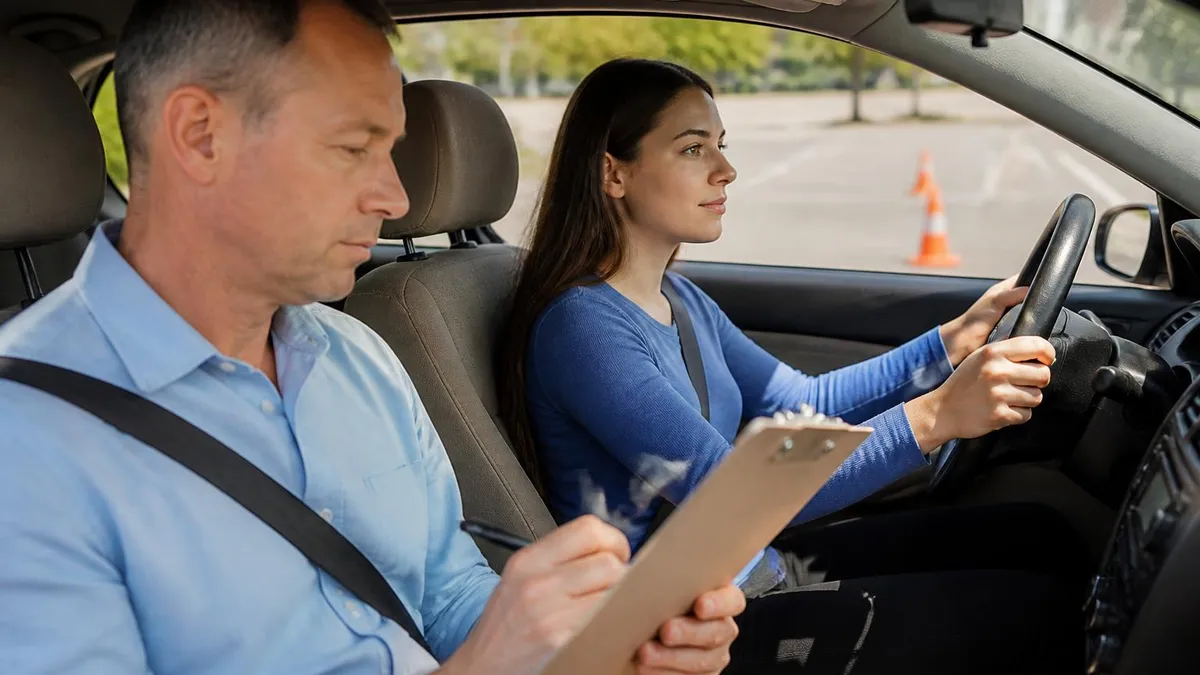
Driver Test Car Rental in Gastonia, NC: Complete BMV Road Test Vehicle Guide
Ohio BMV Driving Test: Maneuverability, Road and Pass Tips
DMV Testing Area No Cell Phones Allowed: Complete Rules Guide for Your Driving Exam
Hours of Ohio BMV: Complete Guide to Office Hours, Locations, and Visit Planning
BMV Appointment Guide: How to Schedule, Prepare, and Pass Your Visit on the First Try
About the Author
Licensed Driving Instructor & DMV Test Specialist
Penn State UniversityRobert J. Williams graduated from Penn State University with a degree in Transportation Management and has spent 20 years as a certified driving instructor and DMV examiner consultant. He has personally coached thousands of applicants through written knowledge tests, skills assessments, and commercial driver licensing programs across more than 30 states.
Join the Discussion
Connect with other students preparing for this exam. Share tips, ask questions, and get advice from people who have been there.
View discussion (9 replies)