
What Is an Emissions Test? Complete Guide to Vehicle Pollution Checks
What is an emissions test? Learn how the vehicle pollution check works, who needs one, what it costs, and how to pass on the first try.
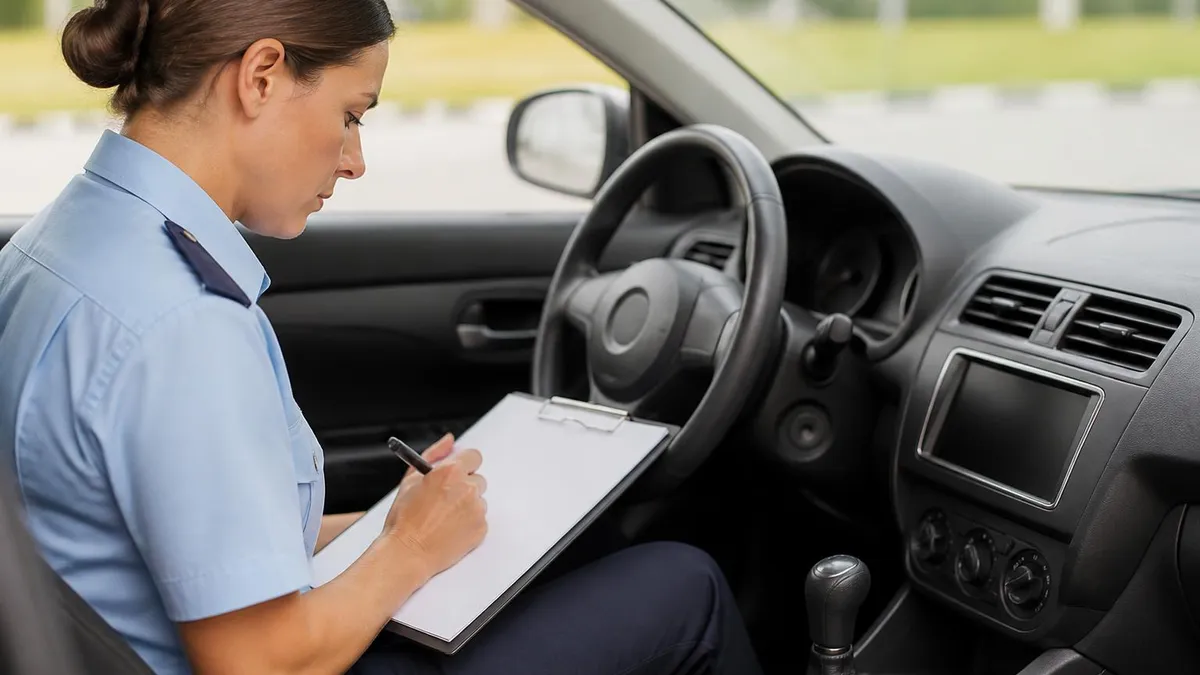
So you got that registration renewal notice in the mail. Right there in the fine print it says you need an emissions test before the state will renew your plates. What is an emissions test, exactly? In plain terms, it's a vehicle pollution check.
The test measures what's coming out of your tailpipe — or what your car's computer reports about its emissions controls. The goal is to make sure your vehicle isn't pumping illegal levels of pollutants into the air. It's a quick check with big consequences if you skip it.
Emissions testing goes by a few different names depending on where you live. Californians call it a smog check. Texans call it an emissions inspection. Pennsylvanians lump it in with the safety inspection.
Whatever the name, the goal is the same. Confirm that your car meets Clean Air Act limits before it gets to keep driving on public roads. Without a passing certificate, most states won't let you renew your DMV registration renewal, and driving on expired tags gets expensive fast.
An emissions test verifies that your vehicle's pollution control system works correctly and that exhaust gases stay below state and federal limits. It's required in 36 US states plus DC for vehicle registration renewal, typically every two years. Modern cars (1996 and newer) get an OBD-II computer scan that takes about 5-15 minutes. Older cars get a tailpipe test on a dynamometer. Average cost runs $20-$80. A glowing Check Engine Light is an automatic fail, so fix that first.
Emissions testing didn't appear out of nowhere. It traces back to the 1970 Clean Air Act, the federal law that finally said "enough" after decades of smog choking American cities. Los Angeles in the 1960s was famous for air so thick you couldn't see the Hollywood sign.
Congress gave the EPA authority to set vehicle emission standards. States with serious air-quality problems followed up with their own inspection programs. California led the way. Other states adopted similar checks as federal standards tightened over the next two decades.
Your car's engine produces three main pollutants the test cares about. Hydrocarbons (HC) are unburned fuel — they form smog when they meet sunlight. Carbon monoxide (CO) is the colorless, odorless killer that builds up from incomplete combustion.
Nitrogen oxides (NOx) come from high combustion temperatures. They create ground-level ozone, which is what makes your lungs burn on hot summer days. The catalytic converter under your car is supposed to convert these gases into less harmful stuff before they hit the atmosphere. The emissions test confirms it's actually doing its job.
Not every vehicle owner needs one. Whether you'll get a test depends on three things: what state you live in, how old your car is, and where in that state you park. Roughly 36 states plus DC run some form of emissions program.
The other 14 either gave up, never started, or have such clean air the EPA doesn't require it. Even within testing states, rural counties often skip the requirement. They focus only on dense urban metros where air pollution actually concentrates.
Emissions Testing By the Numbers
The patchwork of state rules can get confusing. Some states test every car. Others only test vehicles registered in specific counties — usually the metro areas around big cities. A few states have given up on testing entirely.
Florida, for example, killed its program years ago. Kentucky never restarted theirs. Meanwhile California runs the strictest program in the country, and you'll feel it in your wallet every renewal cycle.
States that test all vehicles in inspection areas include California, Massachusetts, New York, Pennsylvania, Ohio, Connecticut, Colorado, Maryland, plus the metro areas of Texas, Illinois, Georgia, and Missouri. Hybrid drivers, electric vehicle owners, and people with classic-plated antiques usually skate by with an exemption.
Diesel pickups often get a separate diesel-specific test. If you just moved across state lines, you've typically got 30-60 days to get tested before your new state's DMV will register your car.
Types of Emissions Tests Explained
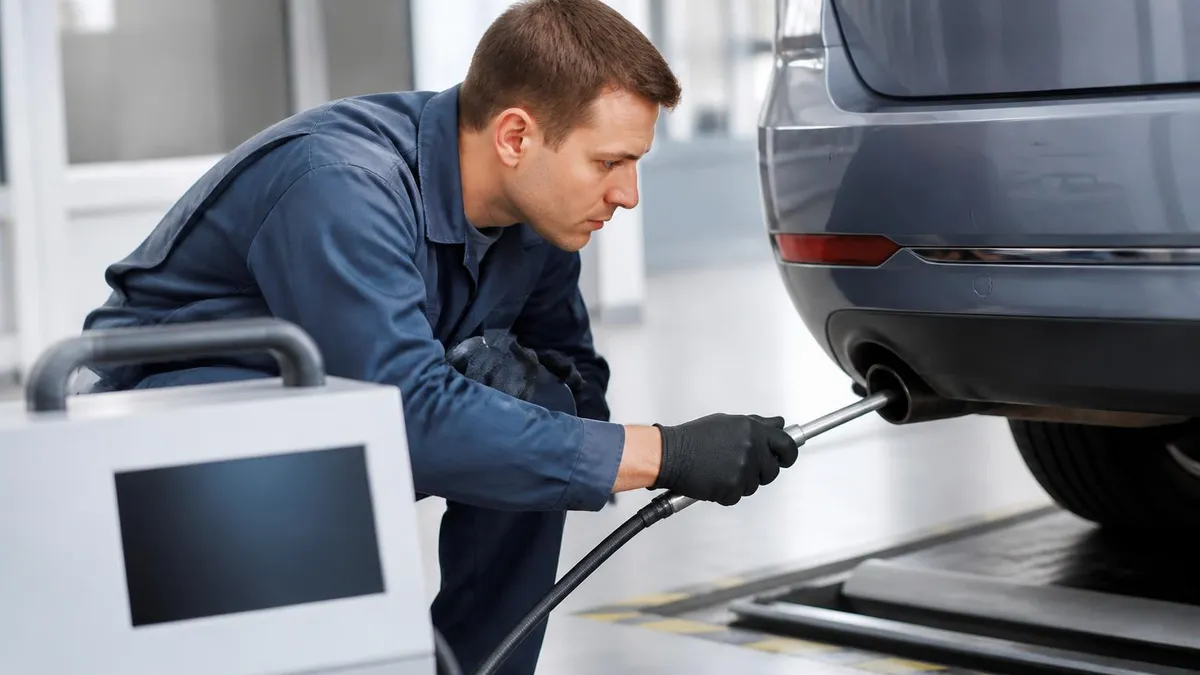
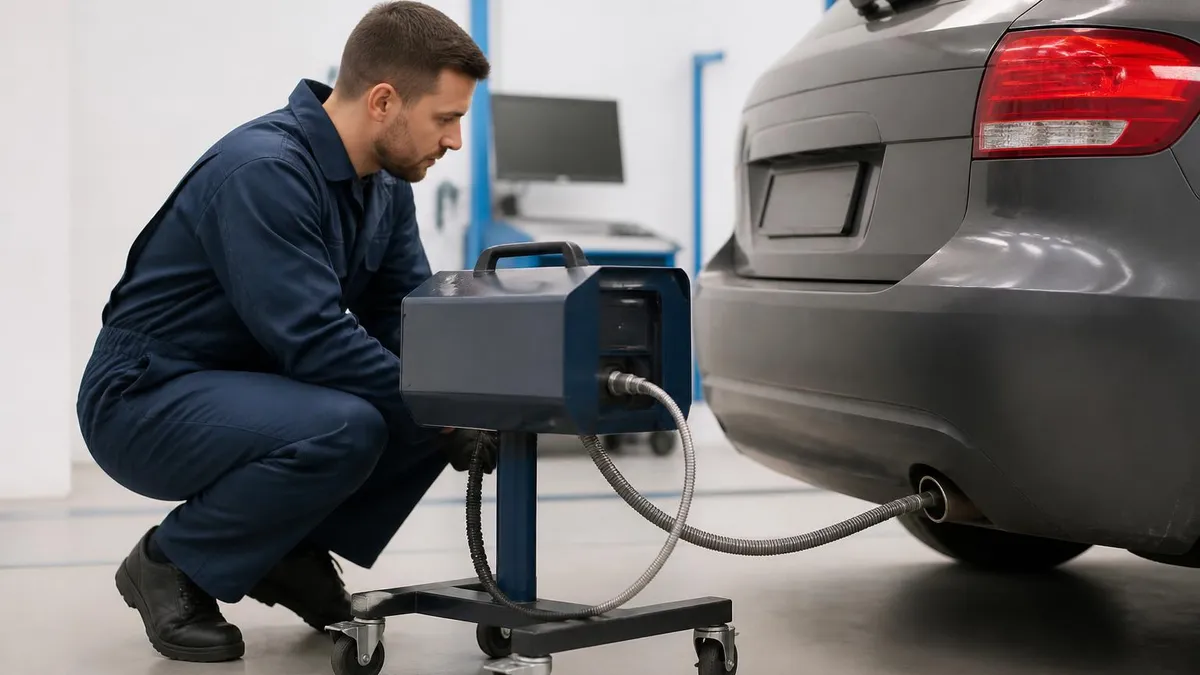
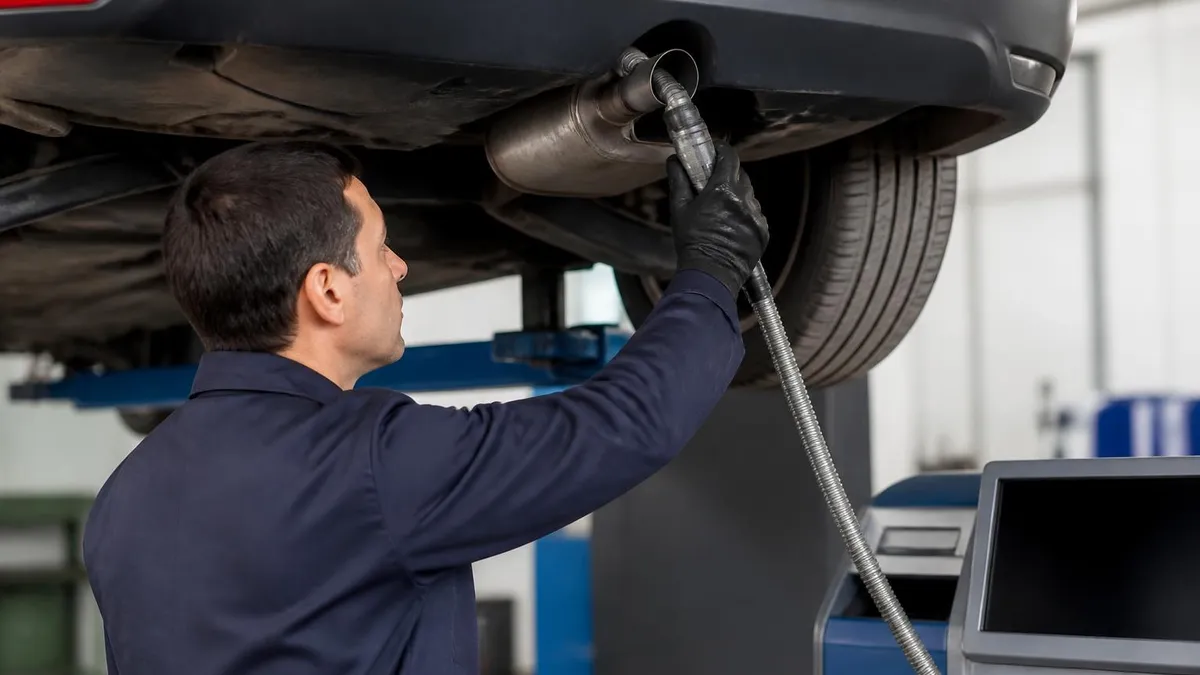
The classic emissions test uses a probe inserted right into your tailpipe. Your car gets strapped to a dynamometer — basically a treadmill for cars — and a technician runs it through a series of speeds, usually idle, 25 mph, and 35 mph. A computer analyzer reads the exhaust gases in real time and measures hydrocarbons, carbon monoxide, and nitrogen oxides. This test is mostly used for pre-1996 vehicles or any car that's missing a functional OBD-II port. It takes about 20-30 minutes total. The technician also does a visual check for things like missing catalytic converters, fuel leaks, and tampered emissions equipment.
OBD-II testing relies on something called readiness monitors. Your car's computer continuously runs eight self-checks while you drive: catalyst efficiency, evaporative system, EGR, fuel system, heated catalyst, misfire detection, oxygen sensor, and oxygen sensor heater.
Each one needs to complete a full cycle and report "Ready" before the test will pass. If you recently disconnected the battery, replaced it, or had the codes cleared at a repair shop, those monitors all reset to "Not Ready."
You'll need to drive 50 to 300 miles under varied conditions — city, highway, cold starts — before they all complete again. Don't go in for testing the same week you replaced your battery. That's a guaranteed fail before the tech even plugs in.
Each state sets its own tolerance for incomplete monitors. California, predictably, is the strictest — most monitors must read "Ready" with very few exceptions. Other states allow one or two incomplete monitors as long as the Check Engine Light is off.
And here's the universal rule: if your Check Engine Light is on when you pull into the bay, you fail. Period. No exceptions, no arguments. That little orange light means your car detected an emissions-related fault and stored a trouble code, and the test will catch it every time.
Pollutants Measured and Their Limits
- What it is: Unburned fuel vapor escaping the engine
- Typical limit: 100-220 ppm
- Health risk: Smog precursor, lung irritant
- Common cause of high HC: Misfire, bad O2 sensor, worn catalyst
- What it is: Toxic gas from incomplete combustion
- Typical limit: 0.5-1.0%
- Health risk: Blocks oxygen in bloodstream, deadly
- Common cause of high CO: Rich fuel mixture, dirty air filter
- What it is: Compounds formed at high combustion temps
- Typical limit: 800-1500 ppm
- Health risk: Creates ground-level ozone, respiratory issues
- Common cause of high NOx: Failed EGR valve, lean fuel mixture
- What it is: Greenhouse gas from normal combustion
- Typical limit: Measured but not regulated for passenger cars
- Health risk: Climate impact, not direct health
- Common cause: Standard byproduct of burning gasoline
Cost varies wildly state to state. California is the priciest at $50-$80 thanks to its STAR-certified station network and the deeper inspection it performs. Texas runs cheap at around $25 for combined safety and emissions in urban counties.
Pennsylvania falls in the middle at $30-$60. New York's NYC-area test runs $11-$27. Massachusetts charges $25-$35. Ohio sits at $32-$60. Illinois runs $20-$45 in the Chicago and St. Louis metros. Colorado is a flat $25. The national average lands somewhere between $20 and $50.
The cost question matters most when you fail — because then you're looking at repair bills on top of the test fee. The good news: most states offer at least one free retest within 30 days of your original test.
You'll need to bring documentation of the repair work. Some states go further and offer hardship waivers if repairs would cost more than $500-$1,000. California has the Consumer Assistance Program for low-income drivers. Get familiar with your state's specific rules before you panic about a fail.
Speaking of failing — let's talk about why cars flunk. The number-one reason is the Check Engine Light, which accounts for a huge chunk of failed tests.
Beyond that, the most common technical causes are a worn catalytic converter (the expensive one), failed oxygen sensors (the cheap fix), a stuck EGR valve, vacuum leaks, a too-rich or too-lean fuel mixture, or a tired engine that's just burning oil. Some cars fail the visual inspection because the previous owner cut the cats off for a louder exhaust.
Top Reasons Cars Fail Emissions
- ✓Check Engine Light is on — automatic fail in every state
- ✓High hydrocarbons from misfire, vacuum leak, or worn catalytic converter
- ✓High carbon monoxide from a too-rich fuel mixture or clogged air filter
- ✓High NOx from a stuck EGR valve or lean-running engine
- ✓Incomplete OBD-II readiness monitors after a recent battery disconnect
- ✓Visual failure — modified exhaust, missing catalytic converter, or removed emissions equipment
- ✓Smoking tailpipe from worn piston rings or burning oil
- ✓Loose or missing gas cap triggering an evaporative system fault
- ✓Pending diagnostic trouble codes even if the dash light isn't lit yet
- ✓A diesel that fails the opacity (smoke density) reading
If you fail, don't freak out. A failure isn't a death sentence for your car. Take the printed result sheet to a trusted mechanic or emissions specialist — not the test station itself, since they have a conflict of interest.
Most repair shops charge $50-$150 for a diagnostic to identify the actual cause. Common fixes range from cheap (a $30 air filter or $100 oxygen sensor) to ouch-level (a $1,500 catalytic converter replacement).
Get a second opinion if anyone quotes you more than $800. Catalytic converter scams are real, and some shops will replace a perfectly good cat just because the OBD-II threw a P0420 code that was actually caused by a bad O2 sensor upstream. Always ask for old parts back so you can verify the work was actually done. Reputable shops have no problem with that request.
Tailpipe Test Step-by-Step
Warm up the engine
Check in and pay
Roll onto the dyno
Probe the tailpipe
Run through speeds
Visual inspection
Get your certificate
Submit to DMV
Preparing your car ahead of time is the single best way to pass on the first try. Start with that 20-minute drive — a fully warmed catalytic converter operates at over 800 degrees Fahrenheit and converts pollutants way more efficiently than a cold one.
A fresh oil change helps too, especially if your old oil is dirty and contributing to elevated emissions. Slap a new air filter in if yours hasn't been changed in a year; airflow matters. Run premium gasoline on your last fill-up — debated trick, but the cleaner-burning detergents probably don't hurt.
Whatever you do, fix that Check Engine Light first. Don't go in hoping the tester won't notice — they will. Cycle the key, scan the codes with a $20 reader from a parts store (most chains will scan free), and figure out what's wrong.
Sometimes it's something dumb like a loose gas cap, which is a five-second tighten that turns the light off after a few drive cycles. Other times it's a real fault that needs proper diagnosis. And whatever you do, don't just disconnect the battery to clear codes — that resets your readiness monitors and you'll fail for a different reason.
Skim through permit test questions and the learners permit practice test while you're studying the rules of the road. Emissions compliance is part of the broader driver responsibility package your state expects you to handle.
Cash-only stations: Legitimate state-certified inspection stations almost always accept cards. Cash-only places are sometimes fronts for fake certificates or unnecessary upsells. Guaranteed pass promises: No honest station can guarantee a pass — the test results are what they are. Surprise repair demands: A station that tests AND repairs has a built-in conflict of interest. If they fail you and immediately quote $1,500 in repairs, get a second opinion at an independent shop before paying. Hidden fees: Ask for the total cost in writing before they touch the car. Watch for "convenience fees" and "diagnostic fees" that weren't quoted upfront.
State rules vary so much it's worth knowing the specifics of where you live. California runs the most thorough program in the nation. Smog Check is biennial after your car turns seven years old, costs $50-$80, and uses STAR-certified stations in enhanced areas.
The state's pass-fail rate runs around 90%, meaning roughly one in ten cars fails on the first try. California also tests visually for tampering with emissions equipment. It runs a full OBD-II scan plus tailpipe test on most pre-2000 vehicles.
The Bureau of Automotive Repair handles complaints and runs the consumer assistance program for low-income drivers facing big repair bills. The Smog Check website at smogcheck.ca.gov walks you through your specific obligations.
Texas takes a different approach. The Texas Department of Public Safety requires combined safety and emissions inspection annually in 17 urban counties. That covers Dallas-Fort Worth, Houston, Austin, El Paso, and a few others.
Cost runs $11.50-$25.50 depending on the type of vehicle. The state uses OBD-II only for 1996-and-newer vehicles. Rural Texans skip emissions entirely and only do the basic safety check. The state recently shifted to a digital inspection system, so there's no paper certificate to carry to the DMV.
Emissions Testing: Pros and Cons
- +Keeps high-polluting vehicles off the road, improving air quality
- +Catches engine problems early, often before they cause expensive damage
- +Standardized across each state, so the process is predictable
- +Many states offer free retests within 30 days of a fail
- +OBD-II tests are quick (5-15 minutes) and inexpensive
- +Hardship waivers exist for low-income drivers facing big repair bills
- −Adds $20-$80 to the cost of registration every 1-2 years
- −Failing means repair costs that can run $100-$2,500 or more
- −Recent battery disconnect resets monitors, requiring 50-300 miles of driving
- −Older vehicles fail more often due to natural wear of emissions components
- −Patchwork state rules confuse drivers who move or travel often
- −Honest mistakes (gas cap left loose) can cause an automatic fail
The visual inspection part of an emissions test catches more failures than people realize. Inspectors look at your catalytic converter to make sure it's still there. They check that the exhaust system isn't modified beyond legal limits.
They also look at your gas cap, your EGR system, your air pump if your car came with one, and your evaporative emissions canister. Anything missing, disconnected, or tampered with means an automatic fail until you put the parts back.
The lesson: if you buy a used car, peek under it before registration time rolls around. Confirm everything that should be there is actually there. Sketchy previous owners love to chop off catalytic converters for the scrap-metal payout.
Diesel owners get a different experience. Most states run diesel-specific tests that focus on opacity — basically how much black smoke comes out the tailpipe under load. Some states use the snap acceleration test where the technician revs the engine quickly.
Modern diesels with DPF (diesel particulate filters) and SCR (selective catalytic reduction with DEF fluid) usually pass easily because they barely smoke at all. Older diesels and any truck where someone deleted the DPF or EGR system will fail hard — and the fines can hit thousands of dollars. Don't do it.
Emissions testing is just one piece of the registration puzzle, and it's worth zooming out for a second. When you renew your tags, your state typically wants proof of valid insurance, a passing emissions certificate, the registration fee, and any unpaid tickets cleared.
Some states also do safety inspections in the same trip. Vision-impaired drivers sometimes need to redo a DMV vision test if their license requires it. Motorcycle owners might need a separate DMV motorcycle test renewal cycle. Knowing your full registration checklist ahead of time keeps you from making three trips.
Worth knowing too: emissions standards keep getting tighter every few years. The EPA's most recent updates for the 2025-2026 model years tighten standards on greenhouse gas emissions, particulate matter from gasoline direct-injection engines, and real-world driving emissions.
OBD-II monitoring is getting more comprehensive — newer cars run extra diagnostic routines that catch problems older systems missed. The shift toward electric vehicles is changing the program too, since EVs generally skip the test entirely. Some states are exploring road-use fees on EVs to make up for lost revenue.
One last practical point: timing matters. Don't show up at the busiest emissions station on the last day of the month at 5 PM — you'll wait an hour and the testers will be tired and grumpy. Mid-morning Tuesday through Thursday is the sweet spot at most stations.
Many states let you schedule appointments online now, which beats walk-in waits. Google Maps shows you the closest certified stations with reviews and current wait times. If you live in an area with mobile emissions stations (some California neighborhoods have them), that can save you a trip entirely.
Bottom line: an emissions test is annoying paperwork, but it takes 15 minutes. It keeps your car legal, your air cleaner, and your registration on time. Plan ahead, fix the Check Engine Light first, and you'll be back on the road with new tags in under an hour.
A few extra tips worth remembering. Keep a copy of your last passing certificate in your glove box for at least a year — useful if anyone ever questions your registration. Snap a phone photo of the printed result too, since paper certificates fade. If you sell your car privately, hand the buyer your most recent emissions certificate as part of the paperwork; it raises the resale value and saves the buyer a trip.
And one more thing about timing: don't put off the test until your registration is one week from expiring. If you fail and need repairs, you'll have to scramble. Most states let you test up to 90 days before your renewal deadline, so give yourself buffer room to handle any surprises calmly without late-fee pressure piling on.
Used car shoppers should pay close attention to emissions history. Ask the seller for a recent emissions certificate before you hand over money — especially in strict states like California. A car that just failed and got patched together to pass once might fail again the next renewal cycle. CarFax and AutoCheck reports sometimes include emissions test history, so pull a report before making any offers on a vehicle you're seriously considering.
If you own a fleet of vehicles for a small business, scheduling matters even more. Stagger your renewal dates so you're not driving five trucks to inspection in the same week. Some states offer fleet inspection programs that let businesses test multiple vehicles at preferred locations with volume discounts. Talk to your state's motor vehicle commercial division about options if you run more than three vehicles registered in your business name.
What about classic and collector cars? Most states exempt vehicles built before a specific cutoff year — commonly 1976 or 1980 — from emissions testing entirely. The reasoning: these cars predate modern emissions controls, can't realistically be retrofitted, and aren't driven enough to contribute meaningfully to air pollution. To qualify, you usually need historic vehicle plates or antique registration, which restricts how much you can drive the car annually. Check your state's antique plate rules carefully because the trade-off for emissions exemption is mileage limits and parade-use-only restrictions in some jurisdictions.
Emissions Test Questions and Answers
About the Author
Attorney & Bar Exam Preparation Specialist
Yale Law SchoolJames R. Hargrove is a practicing attorney and legal educator with a Juris Doctor from Yale Law School and an LLM in Constitutional Law. With over a decade of experience coaching bar exam candidates across multiple jurisdictions, he specializes in MBE strategy, state-specific essay preparation, and multistate performance test techniques.