
DMV Registration Renewal: Online, Mail, In-Person Guide 2026 October
📝 DMV registration renewal made simple. Online, mail, in-person methods, fees, smog rules, late penalties, and state-by-state notes for 2026 October.
Your DMV reg renewal sneaks up fast. One day the sticker on your plate looks fine, and the next you're staring at a citation because the month tag expired three weeks ago. This guide walks you through every method, every fee, and every gotcha so you can finish your dmv registration renewal in the next 15 minutes if you want to.
Whether you live in California with smog rules, Texas with annual safety inspections, or Florida where it's basically a credit card swipe, the steps are mostly the same. We'll cover online, mail, and in-person renewal, what documents you need, how to handle an expired tag, and how to fix a suspended registration so you can drive legal again. The goal here is to demystify the process so you stop dreading it. By the end, you'll know exactly which method fits your situation and what to do if the portal kicks you out.
Most drivers can finish a vehicle registration renewal online in under 10 minutes. You'll need your plate number, the last 4-5 digits of your VIN, current insurance on file, and a credit or debit card. New sticker arrives by mail in 7-10 days. Print the receipt and stash it in your glove box as your temporary proof.
Every state requires you to renew registration renewal on a regular cycle, usually annual or biennial. The renewal proves a few things at once: your car is street-legal, the state has been paid its fees and taxes, your insurance is active, and (in some states) your emissions and safety inspections passed. Skip any one of those, and the system blocks your renewal until you fix it.
Most states mail you a renewal notice 30 to 60 days before expiration. A few states have moved fully digital and only send email. Don't rely on the notice. Set a calendar reminder based on the month printed on your plate sticker, since lost mail is the most common reason people miss the deadline. If you're new to driving and want quick refreshers on rules of the road while you're at it, brushing up with permit test questions is a useful side trip.

Three Ways to Renew Your Registration
The fastest method by a mile. Go to your state DMV or BMV website, click Renew Vehicle Registration, enter your plate number and the last 4 or 5 digits of your VIN, confirm the vehicle and insurance details on file, and pay with a credit or debit card. The whole thing takes 5 to 15 minutes.
Your new sticker ships in 7 to 10 days. Print the confirmation page and keep it in your glove box as a temporary registration. Online works for the vast majority of renewals, but the system will block you if you have unpaid tickets, a missed smog test, lapsed insurance, an address change, or a suspended reg. Some states tack on a $1 to $5 convenience fee.
Before you start, gather everything in one place. Hunting for your VIN halfway through the process is annoying, and online portals usually time out after 10 to 15 minutes of inactivity. Your VIN is on the dashboard near the windshield (driver's side), on the door jamb sticker, and on your insurance card. Snap a photo of it on your phone so you've got it forever. Same with your plate number — most people don't have it memorized.
Have your insurance card open in another tab too. Some states show you the carrier and policy number they have on file, and you'll want to confirm those match your current policy. If they don't match — say you switched insurers a couple of weeks ago and the database hasn't caught up — the renewal will get rejected and you'll waste 20 minutes figuring out why.
What You Need to Renew
- ✓Current registration card or the renewal notice the DMV mailed you
- ✓License plate number
- ✓Vehicle identification number (VIN) — last 4 or 5 digits is usually enough
- ✓Driver's license (required if renewing in person)
- ✓Proof of current auto insurance — most states verify this electronically
- ✓Smog or emissions certificate, if your state and vehicle require one
- ✓Safety inspection certificate, if your state requires one
- ✓Payment: credit card, debit card, check, money order, or cash (in person)
- ✓Current odometer reading (a handful of states ask for this)
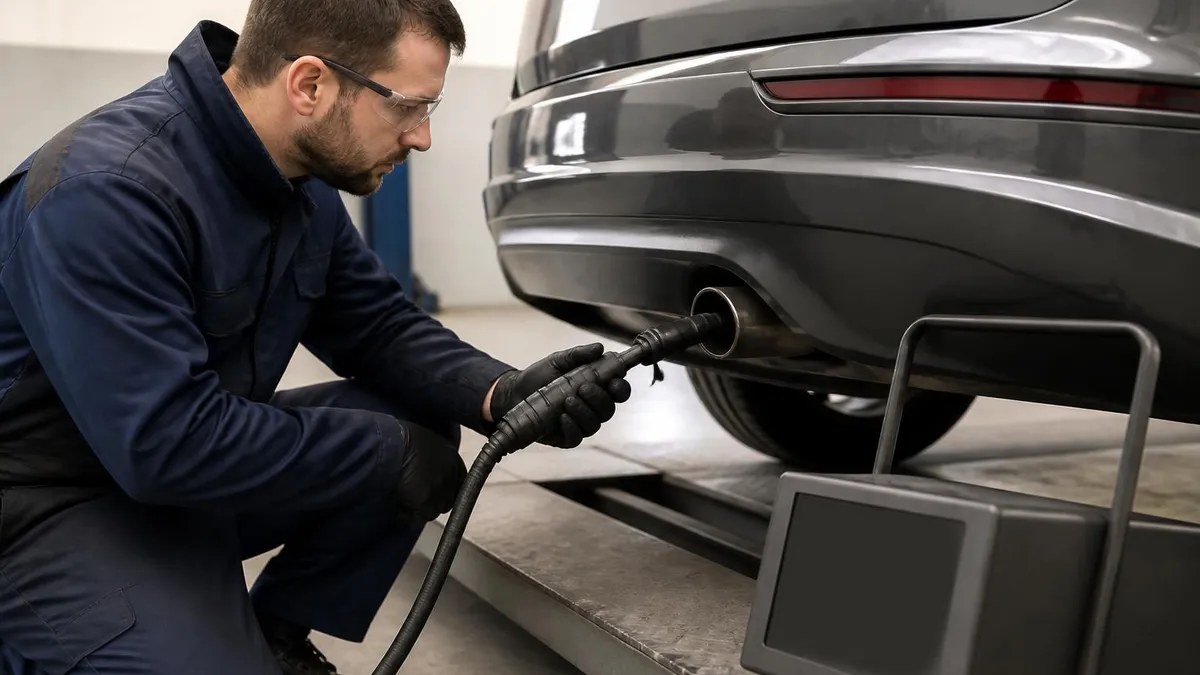
Smog and emissions testing trips up a lot of folks. Not every state requires it, and rules vary even within a state by county and vehicle age. Newer cars (typically the first 4 to 6 model years) are usually exempt, and electric vehicles skip emissions in most states. If your state runs an electronic database with the smog station, the system links your test result to your registration record automatically — you don't need to upload anything.
If you're studying for a road test or refreshing your road knowledge alongside the renewal grind, the learners permit practice test ca is a quick way to brush up on signs and right-of-way rules. It also helps if you're a parent helping a teen prep for their first license — you can compare answers together.
Smog and Emissions at a Glance
- Frequency: Every 2 years for vehicles 8+ model years old
- Cost: $30-$70 typical
- Exempt: Hybrids (some), EVs, vehicles under 8 yrs old
- Frequency: Annual emissions in major counties
- Cost: $11.50-$25.50
- Note: Bundled with annual safety inspection
- Frequency: Annual where applicable (urban counties)
- Cost: $25-$40
- Pair with: Mandatory annual safety inspection
- Frequency: Annual where applicable
- Cost: $11-$27 emissions, $21 safety
- Note: NYC area requires emissions
Some states require a separate safety inspection on top of (or instead of) emissions. The list includes PA, NY, VA, MA, NJ, NH, ME, MO, MS, NC, RI, TX, UT, and WV. Costs run $7 to $50, and you usually have to pass before the DMV will process your renewal. Inspection stickers and registration stickers are different things — your car may need both, on different schedules. If your state has both, peel off the old expired ones before applying the new pair so officers don't get confused at a glance.
Now let's talk fees. This is the part that surprises new car owners the most, since registration costs vary wildly between states. A $30 renewal in Florida and a $151 renewal in Illinois are both for the same plain old sedan. Some of the variance is base fee, some is local county tax, and some is a value-based formula tied to what your car is worth. Hybrids and EVs catch additional surcharges in many states.
Typical 2026 Renewal Fees
Electric vehicle owners get hit with an extra annual fee in most states to make up for the gas tax they're not paying. California adds about $100, Oregon $113, Washington $150. Pickup trucks and SUVs typically cost a bit more than sedans because of weight or horsepower formulas. Commercial vehicles and anything over 8,500 pounds gross weight pay considerably more — often double or triple the passenger-car rate.
States that levy a personal property tax on vehicles — CT, MA, MI, NC, SC, VA, MO, IA, NV — bolt that onto your renewal bill. Don't be surprised if your $50 base fee comes out to $400 once the property tax is included. The good news: it's tax-deductible if you itemize. Keep your receipt for tax season. Some states (like Virginia) bill the property tax separately through your county and only the registration fee through the DMV — read your renewal notice carefully so you don't double-pay.
Ready to actually do the renewal? Here's the typical online flow. The exact button labels and screen order vary slightly by state, but the bones are the same everywhere. Total time start to finish is usually 5 to 10 minutes if everything matches on the first try. Add another 10 to 15 minutes if you need to dig out paperwork or call your insurer to confirm a policy number.
Online Renewal in 7 Steps
Find your state DMV portal
Click Renew Vehicle Registration
Enter plate number and VIN
Confirm vehicle and insurance details
Smog or inspection check
Pay with credit or debit card
Print receipt and wait for sticker
Now for the part that catches people off guard: grace periods. Most states have none. The day after your registration expires, you can be ticketed. A few states are more forgiving — Florida gives 10 days, Texas gives 5 business days — but don't bet on it. The cop pulling you over isn't checking the calendar with sympathy. Plan your renewal at least a week before the last day of your expiration month, ideally two.
Late fees usually start at $10 to $50 in the first month, then climb. Wait six months or longer and you may be required to fully re-register your vehicle, which means new title fees on top of everything else. If you let it go a year, expect to pay several hundred dollars to get legal again. Some states will also cancel your plates entirely after a long lapse, forcing you to start over with new plate numbers.
Driving with an expired registration can cost you $50 to $500+ depending on the state, and many require a court appearance for repeat offenses. Some states will tow the vehicle if the registration is more than 6 months expired. If you're stopped, the officer may also cite you for no current insurance proof, since many drivers let both lapse together. Insurance companies often raise your rates after a registration-related citation, even if no accident was involved.
What if the online portal won't let you renew? It's almost always one of these reasons: insurance lapsed (call your insurer first), unpaid parking tickets or property taxes (pay them first), missed smog or safety inspection (test first), suspended registration (handle the suspension), recent move to a new address (update address first), lost title (request a duplicate first), or the vehicle is in the first year after purchase and never had its initial registration completed properly.
Each of those needs to be cleared before the system will accept your renewal payment. The DMV portal usually tells you exactly which one is blocking you. If you can't figure it out, call the DMV — most have phone hours and email support, even if the wait is long. Some states have a chat feature on their site that's faster than the phone, and a few cities run satellite DMV offices inside grocery stores or AAA branches that have shorter lines than the main office.
Address changes deserve their own paragraph. Most states require you to update your address within 10 to 30 days of moving. Online renewal usually doesn't let you change your address at the same time — it's a separate transaction. If your renewal notice went to your old place and you didn't get it, that's on you, not the post office. Update your address first, then renew. The same applies to your driver's license — most states want both updated within the same window, and they're separate forms.
Insurance proof is another quiet trap. Most states electronically verify your active policy with your insurer in real time. If you switched carriers in the last week or two, the database might still show the old (now canceled) policy, which will block your renewal. Wait 7 to 14 days after switching insurers before trying to renew, or bring a printed insurance card to the DMV in person. Some carriers will email a confirmation letter you can upload directly to the DMV portal as a workaround.
State-by-State Quick Reference
- Portal: dmv.ca.gov
- Fee: $60-$200 (varies by vehicle value)
- Smog: Every 2 yrs for cars 8+ years old
- Online: Yes, for most cases
- Portal: txdmv.gov
- Fee: $50-$80
- Inspection: Annual safety required
- Online: Yes
- Portal: flhsmv.gov
- Fee: $30-$50
- Smog/Inspection: None required
- Online: Yes
- Portal: dmv.ny.gov
- Fee: $26-$140
- Emissions: Annual in NYC area
- Online: Yes
- Portal: dmv.pa.gov
- Fee: $39-$84
- Inspection: Annual safety + emissions
- Online: Yes (mail also OK)
- Portal: ilsos.gov/cyberdriveillinois
- Fee: $151 flat
- Emissions: Chicago/St. Louis areas
- Online: Yes
- Portal: ncdot.gov/dmv
- Fee: $36 + property tax
- Inspection: Annual safety
- Practice: Use the <a href="/bmv/nc-dmv-practice-test">NC DMV practice test</a>
- Portal: bmv.ohio.gov
- Fee: $34.50 + county fee
- Online: Yes — see Ohio BMV online services
- Offices: Find Ohio BMV locations
A few special situations to flag. If you've moved out of state, you typically need to re-register in the new state within 30 to 60 days, not renew the old plates. The new state usually wants a vehicle inspection (a VIN verification at minimum), proof you own the car (title), and proof of insurance from a carrier licensed in that state.
Don't assume your old plates carry over — they don't, and driving on out-of-state expired plates is a fast ticket. Budget about $200 to $400 for the full re-registration: title transfer, plate fee, base registration, and inspection. Some states also require you to surrender your old plates back to the original state within a fixed window or face a small fine.
Active military stationed away from your home state can usually keep home-state plates during deployment by filing a simple affidavit with the DMV. Lease vehicles are registered in the leasing company's name, so the leasing company normally handles renewal — but you pay the bill via your monthly statement. Antique or classic plates often renew less frequently (every 3-5 years) or come with a one-time lifetime registration fee.
Check your state's classic vehicle rules — usually the car has to be 25+ years old and used only for shows, parades, or occasional drives. Similar rules apply to farm-use plates, motorcycles, RVs, and trailers, which all have their own renewal cycles and fee structures. If you own multiple vehicles, see if your state offers a multi-vehicle discount or staggered renewal so all your tags don't expire in the same month.
And then there are the avoidable mistakes. Procrastinating until the day before expiration leaves you no margin if mail is slow or your insurance hasn't synced. Ignoring the smog reminder doesn't earn you an extension. Letting your insurance lapse for even a few days can trigger an automatic registration suspension in many states. Forgetting to peel off the old expired sticker before applying the new one is a common reason cops pull people over by mistake. And paying a third-party site that looks official but charges a $20-$40 markup is depressingly common — always check the URL ends in .gov.
Online Renewal: The Trade-Off
- +Fastest method — 5 to 15 minutes
- +Available 24/7, no DMV hours to work around
- +Often a few dollars cheaper than the office
- +Zero travel time and no waiting in line
- +Confirmation receipt prints instantly
- −Can't fix address changes in the same transaction
- −Can't resolve insurance gaps or smog failures online
- −New sticker takes 7-10 days to arrive in the mail
- −Convenience fee of $1-$5 in some states
- −Some payment systems reject prepaid debit cards
Pros and Cons at a Glance
| Pros | Cons |
|---|---|
| Often a few dollars cheaper than the office | Can't fix address changes in the same transaction |
| Zero travel time and no waiting in line | Can't resolve insurance gaps or smog failures online |
| Confirmation receipt prints instantly | Some payment systems reject prepaid debit cards |
If your registration is already suspended, the road back is annoying but doable. You'll need to pay a reinstatement fee (usually $50 to $300+), provide proof of current insurance, pay all back fees and any late penalties, and in some states file an SR-22 form through your insurer if the suspension was insurance-related. Plan a half-day for this if you're doing it in person, since suspended-reg cases often can't be processed online.
Once everything is paid up and inspected, the DMV reactivates your registration on the spot (in person) or within a few business days (mail/online). You'll get a new sticker and a clean record. The smartest move is to set a phone reminder for next year's renewal a full month before the date so you never end up here again. Pair it with a calendar event for any required inspection too — that one is even easier to forget than the renewal itself.
DMV Registration Renewal Questions and Answers
The bottom line on dmv reg renewal: knock it out as soon as the notice arrives, do it online if your situation is straightforward, and keep digital copies of every receipt and inspection certificate in case the system loses something. Set a reminder for next year while you're at it. A 10-minute task today saves you a $200 ticket and a half-day at the DMV later. Bookmark your state's DMV portal so you never have to hunt for it again — search results are full of look-alike third-party sites that charge fees the official site doesn't.
Driving on an expired registration is one of the easiest ways to turn a routine traffic stop into a much bigger problem. You can face added fines, possible vehicle impound, and an insurance rate hike at your next policy renewal. None of that is worth the few minutes you saved by putting the renewal off another week.
The good news is that staying on top of your car registration renewal is genuinely simple once you know the routine. Save your VIN somewhere accessible, keep your insurance card current, and you'll never spend more than 15 minutes on this again. If you ever do hit a snag, walk into your local DMV with paperwork in hand — the staff would rather help you fix it than write you a ticket later. Treat your renewal date the same way you treat your birthday: it's coming, you know exactly when, and a little prep makes it painless.
About the Author

Licensed Driving Instructor & DMV Test Specialist
Penn State UniversityRobert J. Williams graduated from Penn State University with a degree in Transportation Management and has spent 20 years as a certified driving instructor and DMV examiner consultant. He has personally coached thousands of applicants through written knowledge tests, skills assessments, and commercial driver licensing programs across more than 30 states.
Join the Discussion
Connect with other students preparing for this exam. Share tips, ask questions, and get advice from people who have been there.
View discussion (9 replies)