
Driving Practice Test Free: Complete BMV Prep Guide for 2026 October
✅ Take a driving practice test free online with real BMV-style questions, instant scoring, and full answer explanations to pass on the first try.
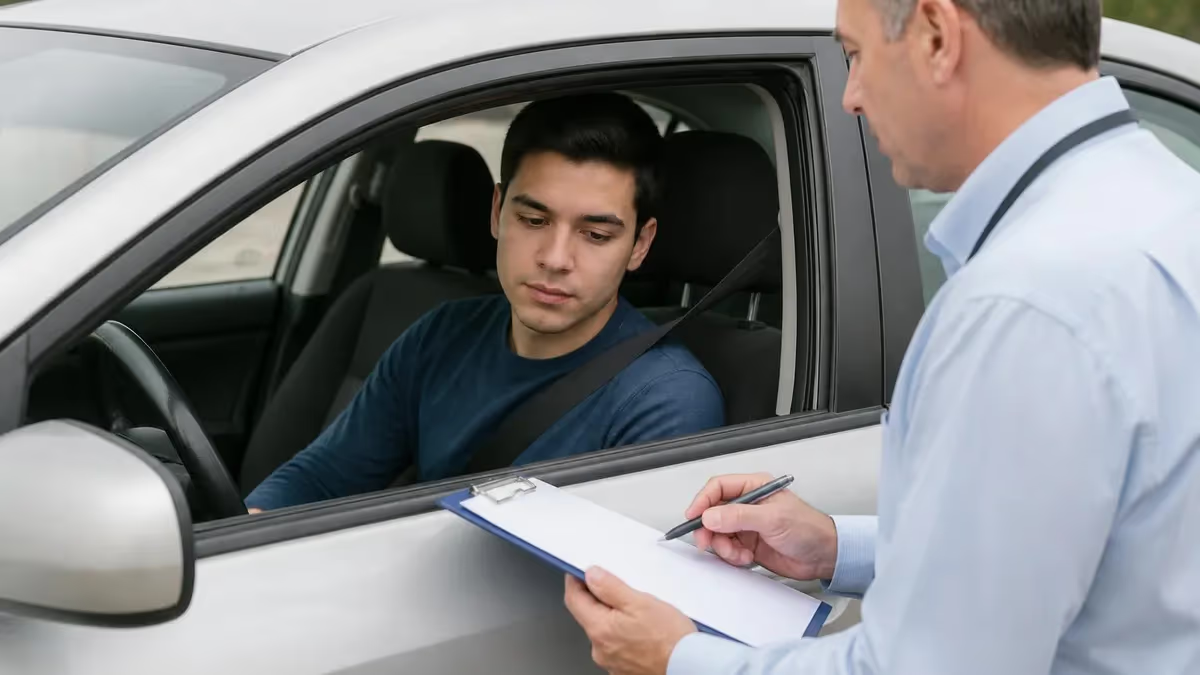
A driving practice test free of charge is the single most effective tool you can use before walking into your local Bureau of Motor Vehicles for the real written knowledge exam. Whether you are a 15-year-old preparing for your learner's permit, an adult finally getting around to a first license, or a recent transplant who needs to convert an out-of-state credential, repeated exposure to authentic BMV-style questions is what separates first-attempt passers from people who pay the retest fee twice.
This guide explains exactly how to use free practice tests strategically, what topics dominate the real exam, and how many practice questions you should clear before scheduling your appointment.
The BMV written test in most states pulls from the same five domains: road signs, traffic laws, right-of-way rules, safe driving behaviors, and alcohol or drug-impaired driving laws. A quality BMV practice test mirrors the wording, distractor patterns, and proportional weighting of the real exam. That means if 22 percent of your real test will involve signs, roughly 22 percent of your study time should focus on signs. Random studying produces random results; structured practice produces consistent scores in the 90s.
Most students underestimate how specific the questions are. The BMV is not interested in whether you understand traffic concepts in general; it wants to know whether you can recall an exact stopping distance, an exact blood alcohol concentration limit, or the precise color of a regulatory sign. Free online practice tests train your memory for those exact numbers because each question is reviewed, explained, and repeated until the recall becomes automatic rather than effortful.
The misconception that practice tests are just for failing students is wrong. Strong students use them as diagnostic tools. After one 40-question practice set, you immediately know which of the five domains is your weakest, and you can devote a focused 30-minute study block to closing that gap before your next attempt. This feedback loop, repeated three or four times, is more efficient than reading the driver handbook cover to cover twice.
This guide is built around the idea that you should not have to pay anything to be ready. Every quiz linked here is genuinely free, every explanation is written in plain English, and every question reflects the format the BMV currently uses in 2026. You will learn how to schedule your practice, how to interpret your scores, what passing thresholds to aim for at home, and the specific behavioral habits that consistently separate one-take passers from repeat test-takers.
By the end of this article you will know the optimal number of practice questions to complete, the best way to space them out across days, and which categories deserve extra attention. You will also understand how practice tests connect to the in-car road skills exam and how to transition from written prep to behind-the-wheel readiness. Bookmark this page, work through the linked quizzes, and treat each missed question as a personal study assignment rather than a failure.
Free practice testing works best when it is paired with the official driver manual for your state. The manual gives you the law in long form; the practice test forces you to retrieve that law under pressure. Use them together, in the order described below, and you will walk into your BMV appointment with the calm confidence of someone who has already passed the test eight or nine times in the comfort of their own home.
Driving Practice Test by the Numbers

How the BMV Written Test Actually Works
Every question offers three or four answer choices with exactly one correct response. Distractors are designed to look reasonable, so reading every option before selecting is essential to avoid careless errors.
Most BMV offices use touchscreen kiosks. You click the answer, confirm, and move forward. You typically cannot revisit earlier questions, which makes confident first answers more important than reviewing.
Several BMVs end your test the moment you accumulate enough wrong answers to make passing impossible, or enough right answers to guarantee a pass. Strong starts matter more than ever.
Roughly one-quarter of your test will show a sign and ask what it means or what you must do. Memorizing shapes and colors lets you answer these in two seconds, banking time for harder items.
Expect word problems about four-way stops, emergency vehicles, school zones, and merging. These require you to apply the rules rather than recite them, so practice questions are critical preparation.
Free does not mean low quality, and in the case of driving practice tests it often means higher quality. Paid apps frequently recycle the same hundred questions across every state, slapping different logos on top of identical content. A well-built free BMV practice test resource updates its question bank whenever a state legislature changes a law, whenever the BMV revises the handbook, and whenever community feedback identifies a confusing or outdated item. That kind of maintenance happens because the platform is supported by ads or by educational mission, not by trapping you behind a paywall after question ten.
The other advantage of free testing is volume. When you do not have to weigh whether each attempt is worth the cost, you take more attempts. More attempts produce more exposure to question variations, and exposure is what builds reliable recall. Students who take twelve free practice tests of forty questions each are answering 480 unique items, far more than the typical paid subscription delivers in a comparable timeframe.
Quality free platforms also explain answers thoroughly. When you miss a question about turning right on red at a flashing arrow, a good explanation will not just say the correct answer, it will tell you why the other options are wrong, what state code governs the rule, and what a real-world example looks like. That depth of explanation is what converts a missed question into a permanent piece of knowledge.
Another underappreciated benefit is the lack of account friction. You can take a free practice test on a phone while waiting at the dentist, on a laptop during your lunch break, or on a tablet before bed without creating an account, providing a credit card, or sitting through a sales pitch. That ease of access translates into more total study sessions, and total time on task is one of the strongest predictors of test performance in any domain.
Critics sometimes claim free tests are full of errors. In reality, the best free platforms are continuously corrected by users who flag mistakes, which leads to question banks that converge on accuracy faster than locked paid databases. Whenever you see an answer that contradicts your state handbook, flag it. The next student benefits, and you confirm your own knowledge by explaining why you disagree.
Free tests also allow you to compare different question styles. Some platforms favor short factual recall, others lean into scenarios, and a few specialize in road sign identification. By rotating among two or three free providers, you broaden the surface area of your preparation and you avoid the trap of memorizing one provider's specific wording rather than the underlying rules. The BMV exam will phrase things in ways no app exactly predicts, so variety in your practice is essential.
Finally, free practice respects your timeline. You may need only one week of cramming, or you may want to spread study across two months. Without a subscription clock ticking, you can engage at whatever pace fits your life. That flexibility is especially important for teenagers balancing high school, for adults working full-time, and for parents fitting study around childcare. Cost should never be a barrier to safe, prepared driving, and thanks to strong free resources, it is not.
BMV Practice Test Questions
Prepare for the BMV - Test exam with our free practice test modules. Each quiz covers key topics to help you pass on your first try.
BMV Basic BMV Practice
BMV Exam Questions covering Basic BMV Practice. Master BMV Test concepts for certification prep.
BMV Alcohol, Drugs, and Impaired Driving Laws
Free BMV Practice Test featuring Alcohol, Drugs, and Impaired Driving Laws. Improve your BMV Exam score with mock test prep.
BMV Licensing Requirements
BMV Mock Exam on BMV Licensing Requirements. BMV Study Guide questions to pass on your first try.
BMV Traffic Laws
BMV Test Prep for BMV Traffic Laws. Practice BMV Quiz questions and boost your score.
BMV Vehicle Operations
BMV Questions and Answers on BMV Vehicle Operations. Free BMV practice for exam readiness.
BMV Parking, Right-of-Way, and Intersections
BMV Mock Test covering Parking, Right-of-Way, and Intersections. Online BMV Test practice with instant feedback.
BMV Road Signs and Markings
Free BMV Quiz on Road Signs and Markings. BMV Exam prep questions with detailed explanations.
BMV Safe Driving and Hazard Awareness
BMV Practice Questions for Safe Driving and Hazard Awareness. Build confidence for your BMV certification exam.
Driving Practice Test Free: Topics You Must Master
Road signs are the highest-yield study category because they make up about a quarter of the exam yet are the easiest to master. The test pulls from regulatory signs like stop and yield, warning signs in their classic yellow diamond shape, construction signs in orange, guide signs in green or blue, and school-zone signs in fluorescent yellow-green. Learning shape and color first lets you predict meaning before reading any text on the sign.
Spend at least one full practice session focused exclusively on signs. Most free platforms offer sign-only quizzes that show only the image and four meanings. After 80 to 100 reps you will recognize every common sign instantly. Pay special attention to lesser-known signs like the pentagonal school crossing sign, the round railroad advance warning, and the diamond-shaped no-passing zone sign that often appears as a pennant.
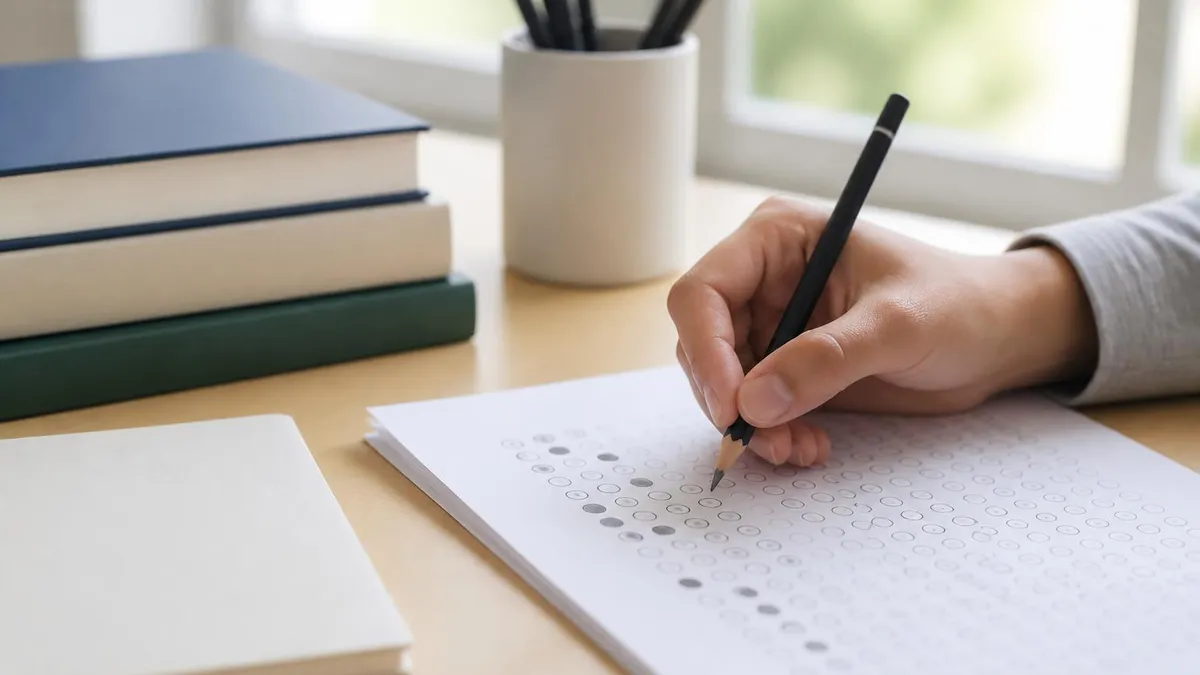
Should You Take Multiple Practice Tests?
- +Repeated exposure cements rules into long-term memory faster than reading alone
- +Each test reveals weak categories so you can target study time efficiently
- +Builds test-taking stamina and reduces anxiety on exam day
- +Familiarizes you with question wording and common distractor patterns
- +Free platforms let you practice unlimited times without financial pressure
- +Tracks score improvement over time, giving measurable confidence
- +Mirrors the touchscreen format of actual BMV testing kiosks
- −Some free apps include outdated questions if the platform is not maintained
- −Heavy reliance on practice alone without the handbook can create blind spots
- −Repeating the same provider too often risks memorizing wording instead of rules
- −Quality varies widely between free providers, requiring some upfront vetting
- −Mobile-only platforms can feel different from BMV desktop kiosks
- −Practice tests cannot replicate the pressure of a proctored testing environment
Pros and Cons at a Glance
| Pros | Cons |
|---|---|
| Repeated exposure cements rules into long-term memory faster than reading alone | Some free apps include outdated questions if the platform is not maintained |
| Each test reveals weak categories so you can target study time efficiently | Heavy reliance on practice alone without the handbook can create blind spots |
| Builds test-taking stamina and reduces anxiety on exam day | Repeating the same provider too often risks memorizing wording instead of rules |
| Familiarizes you with question wording and common distractor patterns | Quality varies widely between free providers, requiring some upfront vetting |
| Free platforms let you practice unlimited times without financial pressure | Mobile-only platforms can feel different from BMV desktop kiosks |
| Tracks score improvement over time, giving measurable confidence | Practice tests cannot replicate the pressure of a proctored testing environment |
Your Free Driving Practice Test Checklist
- ✓Download or open your state driver handbook and skim the table of contents
- ✓Take one diagnostic practice test cold to identify your weakest category
- ✓Read the handbook chapter that matches your weakest category in full
- ✓Complete a focused 20-question quiz on that single category and review every miss
- ✓Repeat the diagnostic and confirm your score in that category improved by at least 15 percent
- ✓Take three full-length practice tests across two days and aim for 90 percent or higher
- ✓Memorize all common road signs by shape and color until recognition is instant
- ✓Lock in exact numbers for speed limits, BAC thresholds, and following distances
- ✓Review every wrong answer with an explanation rather than skipping past it
- ✓Schedule your BMV appointment only after scoring 90 percent on three consecutive practice tests
Three scores of 90 percent or higher means you are ready
Do not schedule your BMV appointment until you have hit 90 percent or better on three separate full-length practice tests. This buffer accounts for test-day nerves, unfamiliar wording, and the fact that some real-exam questions cover edge cases practice tests do not always include. Students who follow this rule pass on the first try roughly 92 percent of the time.
Building a smart study schedule turns scattered practice into reliable mastery. The single most common mistake students make is cramming all their preparation into the day before the test. The brain consolidates memory during sleep, so a study plan that spans at least five days produces dramatically better recall than the same total hours crammed into one evening. Even spreading two hours of work across three short sessions outperforms a single two-hour marathon. Spacing is the cheat code that nobody on social media talks about.
A realistic minimum is one week of preparation with thirty to forty-five minutes of focused study each day. Day one is your diagnostic and handbook overview. Days two through four are category drills, one weak topic per day, with a short full-length test at the end of each session to measure improvement. Days five and six are full-length practice tests under timed conditions. Day seven is a light review of your missed-question log followed by a good night's sleep, not more cramming.
Active recall outperforms passive review. That means closing the handbook and trying to list, from memory, the steps for safely passing another vehicle on a two-lane road. If you can do it, great. If you cannot, reopen the book and try again in an hour. This effortful retrieval is what neuroscientists call desirable difficulty, and it strengthens memory traces in a way that highlighting and re-reading never will. Practice tests are essentially formal active recall sessions packaged into a comfortable format.
Keep a missed-question log. Every time you get a practice question wrong, write the topic in a single line in a notes app or on paper. After a few sessions you will see clusters: maybe four entries about merging, three about flashing yellow arrows, two about emergency vehicle right of way. Those clusters tell you exactly where the next thirty minutes of study should go. The log is more valuable than any study guide because it is customized to your specific weaknesses in real time.
Sleep, hydration, and meals matter more than most students believe. The night before your BMV appointment, aim for at least seven hours of sleep. On the morning of the test, eat a normal breakfast with some protein. Skip excessive caffeine if it makes you jittery; a mild stimulant is fine, but a triple espresso right before a timed test usually backfires. Your brain performs best when your body is in steady state, not when it is fighting stomach grumbles or a sugar crash.
Mix providers and question styles. If you have been practicing on one platform for several days, switch to a different one for at least one session before exam day. New phrasing forces you to rely on understanding rather than memorized wording. If you can score 90 percent on two completely different question banks, you have demonstrated real knowledge rather than test-specific pattern matching. That portability is what carries through to the BMV's wording.
Finally, simulate the real test conditions during at least one practice session. Put your phone in another room, sit at a desk rather than on the couch, set a timer for the same length as your actual exam, and do not pause or look anything up mid-quiz. This dress rehearsal is uncomfortable, which is exactly why it is valuable. The first time you feel test pressure should be at home, not in the BMV waiting area with a number called.

Practice tests are powerful, but they do not contain every fact your state may test. The driver handbook is the source of truth, and a small percentage of real exam questions cover material that rarely appears in practice banks. Read it at least once cover to cover, even if you skim sections you already know well. Free practice tests plus the handbook is the unbeatable combination.
Test day mindset is something most guides ignore, but it determines whether your weeks of practice translate into a passing score. Arrive at the BMV thirty minutes early. Parking, check-in, and document verification can swallow more time than you expect, and rushing into the testing kiosk with your pulse already at 110 beats per minute is not how you want to begin. The extra thirty minutes also lets you take a few deep breaths, mentally rehearse common rules, and use the restroom before the timer starts.
Bring every required document. For first-time licenses you typically need proof of identity, proof of residency, proof of legal presence, and a signed parental consent form if you are under 18. The exact list varies, so check your state's BMV website the day before your appointment. If you also plan to handle a DMV registration renewal while you are there, bring those documents too and save yourself a second trip. Missing paperwork is the leading cause of wasted appointments.
On the test itself, read every question and every answer choice fully before selecting. Distractor answers are designed to look right when scanned quickly. Slow reading prevents nearly all careless errors, and most BMV tests give you far more time than you actually need. There is no bonus for finishing first, and there is no penalty for taking a full thirty minutes when only ten are required. Pace yourself like you would on a final exam, not a race.
If a question stumps you, eliminate the clearly wrong options first. Even a partial elimination from four choices to two raises your odds from 25 percent to 50 percent. Most multiple-choice tests reward this approach because at least one distractor is usually absurd in context. Trust your preparation; if you have been hitting 90 percent on practice tests, your gut feeling on a tough question is probably the right one. Second-guessing is responsible for more missed points than ignorance.
Watch for absolutes and qualifiers. Words like always, never, and only narrow the truth of a statement, while words like usually, generally, and most often broaden it. The correct answer to a driving question is rarely an absolute because real-world driving has exceptions. When two options seem close, the more flexible wording is often correct unless your handbook clearly states an unconditional rule.
Manage your emotions if you feel a wave of nerves. Pause, take three slow breaths in through your nose and out through your mouth, and remind yourself you have already passed this test many times at home. The BMV kiosk does not know how you feel; it only records your answers. Calm hands click better than shaky hands, and a calm mind retrieves facts better than a panicked one. You earned this attempt through preparation, so let that preparation do its job.
After you pass the written test, you will move toward the road skills exam. Begin preparing for that as soon as your written test is done, ideally the same week. The skills you tested on paper, like following distances and right-of-way rules, become physical actions in the car. Many candidates find practical practice with a parent or instructor invaluable, and structured prep mirrors the same spaced-practice principles that worked for the written test.
The transition from written practice to real driving readiness is where many candidates stumble. Knowing that the legal following distance is three to four seconds is one thing; actually maintaining that gap on a crowded interstate is another. Once you pass the written exam and earn your permit, start logging supervised driving hours immediately. Build a habit of narrating your decisions aloud so the rules you memorized become verbal commentary. This bridges the gap between knowledge and skill faster than silent driving ever will.
Bookmark a driving test driving preparation resource and read through the maneuvers list before your first behind-the-wheel session. Parallel parking, three-point turns, lane changes, and controlled stops are tested almost universally, and knowing the examiner's scoring criteria removes the mystery from practice. Each maneuver has a precise rubric, and rubrics are easier to study than vague concepts like good driving. Treat the road test like the written test: there is a checklist, and you can master every box on it.
Use a parent or experienced driver as your in-car coach. Resist the temptation to argue when corrected. The goal of supervised driving is to develop habits before they harden into mistakes. If your coach says you are drifting toward the center line, fix the drift and ask what visual cue would have helped you catch it earlier. Curious coachability beats defensive arguing every time, and it shortens the path from permit to license by weeks or months.
Drive in varied conditions before your road test. A candidate who has only ever practiced in sunny afternoon conditions on the same three streets will fall apart the first time it rains, the first time traffic is heavy, or the first time the examiner picks an unfamiliar route. Aim to log at least fifty hours, with ten hours at night, before scheduling your skills exam. Many states require this minimum by law, but the value is real even where it is not mandated.
Maintain the car you will use for the road test. Examiners can fail a candidate before driving begins if a turn signal does not work, if a brake light is out, or if the windshield is too cracked to see through clearly. Run a pre-test walkaround the night before. Confirm headlights, taillights, blinkers, brake lights, horn, windshield wipers, and seat belts all function. If you can, also have a quick car battery test done to make sure the vehicle starts reliably on test day.
Carry confidence into the in-car exam. You have proven you understand the rules on the written test; the road test asks you to execute those rules behind the wheel. Smooth, controlled, predictable driving impresses examiners far more than aggressive or hesitant driving. If you make a small mistake mid-test, do not dwell. Examiners deduct points for individual errors but they only fail candidates who accumulate too many or commit critical safety violations. One missed mirror check is recoverable. Panicking and missing five more is not.
After you pass the road test and hold a full license, your responsibility shifts to lifetime learning. Laws change, vehicles change, and your reflexes change with age. Take a refresher practice test every couple of years just to make sure your knowledge stays current. Insurance companies sometimes offer discounts for defensive driving certification, so the habit of periodic review can save money as well as keep you safe. Free practice tests are not just for new drivers; they are for anyone who wants to drive responsibly for life.
Sample BMV Practice Questions
Try these questions from our free BMV practice tests. The correct answer and an explanation follow each question.
When driving in rain, you should increase your following distance to at least:
- A. 2 seconds
- B. 3 seconds
- C. 4 seconds
- D. 6 seconds
Answer: D. 6 seconds
In wet conditions, stopping distances increase significantly, so you should double your following distance to at least 6 seconds.
When driving in fog, you should use your:
- A. Low-beam headlights
- B. High-beam headlights
- C. Parking lights only
- D. Hazard lights while moving
Answer: A. Low-beam headlights
Low beams reduce glare and give better visibility in fog than high beams.
When driving in dense fog, you should use:
- A. High-beam headlights
- B. Hazard lights only
- C. Low-beam headlights
- D. No lights — they reflect back
Answer: C. Low-beam headlights
Low-beam headlights should be used in fog because high beams reflect off the fog and reduce visibility further.
When driving in a construction zone with workers present, what should you typically do with your speed?
- A. Maintain your current speed to avoid disrupting traffic flow
- B. Reduce speed and obey posted reduced speed limit signs
- C. Speed up to pass through quickly
- D. Slow to 10 mph regardless of posted signs
Answer: B. Reduce speed and obey posted reduced speed limit signs
Construction zones post reduced speed limits to protect workers, and fines are often doubled for violations there.
BMV Questions and Answers
About the Author
Licensed Driving Instructor & DMV Test Specialist
Penn State UniversityRobert J. Williams graduated from Penn State University with a degree in Transportation Management and has spent 20 years as a certified driving instructor and DMV examiner consultant. He has personally coached thousands of applicants through written knowledge tests, skills assessments, and commercial driver licensing programs across more than 30 states.
Join the Discussion
Connect with other students preparing for this exam. Share tips, ask questions, and get advice from people who have been there.
View discussion (9 replies)