
Where to Get a COVID Test in 2026: Locations, Cost & Options
Find where to get a COVID test near you in 2026 — pharmacies, urgent care, free clinics, at-home kits, prices, insurance, and which test type to choose.
If you're searching where can I get a COVID test in 2026, the good news is that testing is still widely available across the United States. The bad news is that the landscape has changed a lot since the early pandemic years. Free, government-run drive-through sites have mostly closed. Insurance no longer has to reimburse at-home kits the way it did before. And many people don't realize they have several legitimate options ranging from a $10 antigen kit at the drugstore to a fully insured PCR test at a clinic.
This guide walks you through every realistic place to get tested today — pharmacy chains, urgent care, primary care, community health centers, at-home tests, and the public health programs that still exist. You'll also find current pricing, what insurance does and doesn't cover after the federal Public Health Emergency ended, and which test type makes sense for your situation, whether you're symptomatic, planning travel, or confirming a positive home result.
Quick reality check on terminology. When people search covid test near me, they usually mean one of three things: a rapid antigen test you can run at home in 15 minutes, a PCR (also called NAAT) sent off to a lab for the most accurate result, or a same-day test at a clinic that combines speed with provider involvement. Each has a different price tag, turnaround time, and use case. Knowing which one you actually need saves money and avoids unnecessary trips.
Fastest at-home option: Buy an antigen kit (BinaxNOW, iHealth, FlowFlex, QuickVue) at any major pharmacy or Amazon for $8–$25. Result in 15–30 minutes.
Insured in-person test: Book at CVS, Walgreens, Walmart, or Rite Aid pharmacy. Antigen or PCR. Often $0 with insurance.
Free or low-cost (uninsured): Find a Federally Qualified Health Center at findahealthcenter.hrsa.gov, or call your state/county health department.
Travel PCR result needed: Book a lab PCR through CVS, Walgreens, or an urgent care 48–72 hours before departure.
Symptoms and need fast care: Walk into urgent care or telehealth visit with home antigen kit included.
Let's start with the question of test type, because the right place to go depends entirely on which test you need. There are basically four flavors of COVID test in circulation right now, and they're not interchangeable. Some give answers in minutes, others take days. Some need a clinician to order them, others you do at the kitchen table. Pricing varies wildly between them too.
At-home antigen rapid tests are the cheapest and most common. You can grab them off the shelf at any major pharmacy without a prescription. Results show up in 15 to 30 minutes on a small paper strip. Cost runs $8 to $25 per test depending on brand and whether you buy a single or multipack. They're sensitive enough to catch most symptomatic infections but can miss early or low-viral-load cases, which is why a single negative result isn't always definitive when you're symptomatic.
COVID Test Types & Pricing 2026
- Result time: 15-30 minutes
- Cost (no insurance): $8-$25 per test
- Where to get: Pharmacies, Amazon, Costco, grocery stores
- Best for: Symptomatic at home, screening before events
- Result time: 24-72 hours
- Cost (no insurance): $50-$200+
- Where to get: Pharmacies (CVS, Walgreens), urgent care, clinics
- Best for: Travel requirements, gold-standard accuracy
- Result time: Same day, often 1-2 hrs
- Cost (no insurance): $50-$150
- Where to get: MinuteClinic, urgent care, some pharmacies
- Best for: When you need speed and high accuracy
- Result time: 15-30 minutes
- Cost (no insurance): $25-$75
- Where to get: Urgent care, clinics, pharmacies
- Best for: Symptomatic, want a clinical record
Lab PCR (also called NAAT, for nucleic acid amplification test) is the gold standard. It detects tiny amounts of viral genetic material and is what you want when accuracy matters most — international travel, confirming a positive at-home result for medical records, or pre-procedure clearance. The catch is turnaround time. Most labs return PCR results in 24 to 72 hours, though some offer expedited 24-hour service for an extra fee. Without insurance, expect $50 to $200 or more, depending on the facility.
Point-of-care (POC) tests bridge the gap. Rapid molecular POC tests give you PCR-level accuracy with same-day results, usually within an hour or two. They're typically run at clinics like MinuteClinic, urgent care centers, and some pharmacy locations. Rapid antigen POC tests are essentially the at-home antigen kit but performed by clinical staff, with the advantage of producing an official result in your medical record. That last part matters if your employer or school requires clinical documentation.
For broader test type background and how results get interpreted, our COVID test types and results guide explains the science behind each method, false negative rates, and what your results actually mean. The COVID-19 test guide goes deeper into when each test type is most accurate based on days since exposure.
Where to Get Tested by Location Type
The most convenient option for most people. Major chains have COVID testing baked into their pharmacy services, often with online booking and insurance billing handled in the background.
- CVS Pharmacy: ~5,000 locations offer testing. Walk-in or appointment. Antigen and PCR available. $0 with most insurance. CVS MinuteClinic at select stores adds clinical PCR with provider involvement.
- Walgreens: ~7,000 locations. Drive-through testing at many sites, in-store at others. Antigen and PCR. Insurance widely accepted. Online scheduling at walgreens.com/covidtesting.
- Walmart: In-store pharmacy testing at most locations. Drive-through at select stores. Both antigen and PCR. Walmart Care Clinic in some states offers visit-plus-test bundles.
- Rite Aid: Appointment-based testing at participating pharmacies. Antigen and PCR. Pharmacist-administered.
- Sam's Club, Costco, Kroger, Albertsons, Publix, Safeway: Pharmacy-based testing at most locations. Regional availability varies — call ahead or check the chain's website.
For pharmacy testing, always book online if possible. Walk-in is often available but appointment slots get priority. Bring your insurance card and a photo ID. Most chains text or email results once they're back from the lab.
Insurance coverage for COVID testing in 2026 is more limited than it used to be, and a lot of people get confused by the rules. Here's the short version. Most private insurance still covers provider-ordered tests with no patient cost-sharing — that includes both antigen and PCR done at a pharmacy, urgent care, or clinic where a clinician orders the test. The cost is processed through your medical benefit, not your prescription benefit, so you usually won't see a copay at the counter.
What insurance is generally not required to cover anymore is at-home tests you buy off the shelf. The federal mandate that required private plans to reimburse eight at-home tests per person per month ended with the Public Health Emergency in May 2023. Some plans still voluntarily cover them, but most don't. If you want reimbursement, check your specific policy before you buy.
Medicare follows similar rules. Medicare Part B covers provider-ordered PCR and antigen tests at no cost to the beneficiary. Medicare no longer covers at-home tests as of mid-2023. Medicare Advantage plans vary — some include limited at-home test benefits, but it's not universal. Medicaid is the most variable. Coverage depends on your state and plan. Many state Medicaid programs still cover at-home tests, but you'll need to check your specific plan documents.
COVID Test Cost Reference 2026
For the uninsured, the situation is harder than it was during the pandemic. The HRSA Uninsured Program that paid for free testing for people without coverage ended along with the federal Public Health Emergency. That doesn't mean you're out of options — it just means you have to work a little harder to find them.
Federally Qualified Health Centers are your best first stop. These community-based clinics receive federal funding to provide care on a sliding fee scale based on income. Many have COVID testing built into their services. Use the HRSA finder at findahealthcenter.hrsa.gov to locate one near you. State and county health departments are another option — many still run free or low-cost testing programs, especially in areas with higher rates of uninsurance. Calling 211 (the United Way community resource line) connects you with local options you might not find online.
You can also call your local hospital's COVID hotline if they have one — many hospital systems still maintain low-cost or charity care testing programs for community members in need. Religious and community organizations sometimes partner with health departments to host periodic free testing events, particularly in underserved neighborhoods.
How to Find COVID Testing Near You
Step 1: Check covidtests.gov
Step 2: Use pharmacy locators
Step 3: Call your insurance
Step 4: HRSA Health Center Finder
Step 5: State health department site
Step 6: Call 211
Choosing the right test type comes down to a few practical questions. Are you symptomatic and need to know quickly? A rapid antigen test at home or at a pharmacy will get you a usable answer in under an hour. Are you flying internationally? Most countries that still require COVID testing want a PCR taken within 72 hours of departure — book that at a pharmacy or urgent care with documented results.
Returning to work or school after exposure? An antigen test is usually acceptable, and it's faster and cheaper than PCR. Had a high-risk exposure but you're not yet symptomatic? PCR is more sensitive than antigen during the early incubation window, so it's worth the wait if you can get one. Confirming a positive at-home result for medical records or insurance? You'll want a clinical PCR or rapid molecular test with provider documentation.
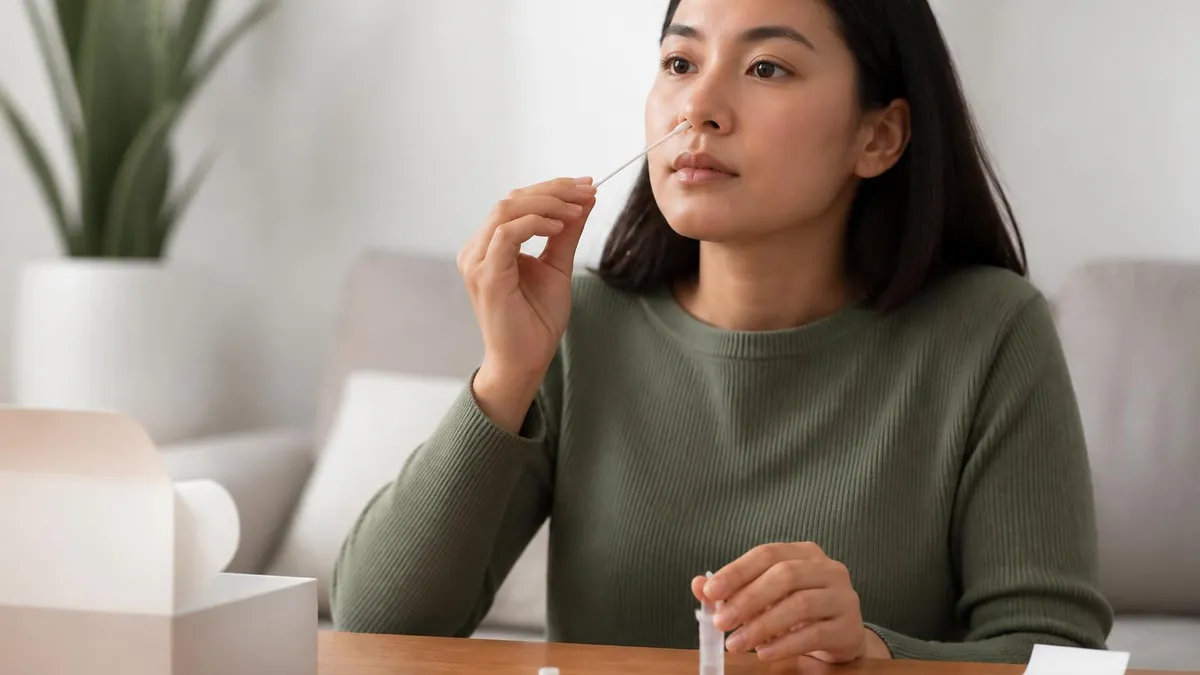
If you're using an at-home test, the technique matters more than people realize. Wash your hands first. Open the kit and read the instructions all the way through before starting — different brands have slightly different timing and steps. Swab both nostrils with five rotations each, about 15 seconds per nostril. You don't need to go deep into the turbinate — about an inch in is enough. Insert the swab into the solution tube, swirl as the instructions indicate, then add the specified number of drops to the test cassette.
At-Home COVID Test Step by Step
- ✓Wash your hands thoroughly and lay out all kit components on a clean surface
- ✓Read the entire instruction sheet before opening any sealed components
- ✓Check the test expiration date (FDA has extended shelf life on most brands — verify online)
- ✓Blow your nose if needed, then swab both nostrils with 5 full rotations each, ~15 seconds per side
- ✓Insert swab into the solution tube and swirl as the instructions specify
- ✓Add the exact number of drops to the test cassette window
- ✓Set a timer for the kit's specified read time (usually 15-30 minutes)
- ✓Read the result strictly within the time window — too early or too late gives wrong answers
- ✓Two lines (C and T) means positive, even if T is faint. One line at C only is negative.
- ✓Report positive results to your state health department portal if available
- ✓Dispose of test components in regular trash and wash hands again
The most common at-home test mistakes are easy to avoid once you know them. Reading results outside the time window tops the list — a faint line that appears 45 minutes after the test is run is not a valid positive. Not swabbing deep enough or with enough rotations under-collects sample and can produce a false negative. Skipping the wait time and trying to read too early misses positives that need full reaction time to develop.
Testing too early after exposure is another big one. The virus needs time to replicate to detectable levels. If you test within 24 hours of a known exposure, you're likely to get a false negative even if you're going to develop a positive infection. Wait at least three to five days after exposure for the most reliable result, or test immediately if symptoms appear.
Using expired tests is a common worry, but the FDA has extended the shelf life of most major brands. Check the FDA's COVID-19 test extended expiration date list online before you toss old kits. Many tests originally labeled to expire in 2023 or 2024 are still authorized for use through later dates.
The C and T line confusion catches people too. C stands for control and always shows up if the test ran correctly. T stands for test and shows up only if positive. One line at C means negative. Two lines (C and T both visible) means positive, no matter how faint that T line appears.
When to test depends on the situation. If symptoms appear, test as soon as practical. If that first test is negative but symptoms persist, retest in 48 hours — the virus may not have built up to detectable levels yet. After a known exposure but no symptoms, the sweet spot is around day five — early enough to catch infection before you spread it widely, late enough to get reliable results. Pre-event or pre-travel testing should happen 24 to 48 hours before, not earlier (results can change), and not the morning of (no buffer for re-test if positive).
If your test comes back positive, isolate per current CDC guidance. As of the latest update, that means staying home until you've been fever-free for at least 24 hours without medication and your overall symptoms are improving. Mask in public spaces for an additional five days after returning to normal activity. Notify recent close contacts so they can monitor for symptoms and test if they develop any.
Talk to your healthcare provider about Paxlovid (nirmatrelvir/ritonavir) if you're at higher risk for severe illness — older adults, immunocompromised, certain chronic conditions. Paxlovid works best when started within five days of symptom onset, so don't delay the conversation. Hydrate, rest, and watch for warning signs that need urgent care: severe shortness of breath, persistent chest pain, confusion, bluish lips or face, or inability to stay awake.
At-Home COVID Testing Pros & Cons
- +Privacy — no clinic visit, no waiting room, no awkward conversations
- +Convenient — test on your schedule, at home, in pajamas if you want
- +Fast — results in 15 to 30 minutes, no lab wait
- +Affordable when you stock up — multipacks reduce per-test cost
- +Widely available without a prescription at any pharmacy or online
- +No appointment needed and no scheduling friction
- −No medical record — some employers and schools require clinical documentation
- −User error possible — incorrect swabbing or timing produces wrong results
- −Less sensitive than PCR — can miss early or low-viral-load infections
- −Out of pocket since 2024 — most insurance no longer reimburses
- −Limited tracking — positive results aren't automatically reported to public health
- −Must self-interpret — no clinician available to discuss what the result means
For uninsured and underinsured patients, the free or low-cost testing landscape requires more legwork than it used to but still exists. Federally Qualified Health Centers serve as the backbone — they're required by federal funding rules to provide care regardless of ability to pay. Sliding scale fees mean you might pay nothing or a small amount based on your income. Many also have on-site pharmacies for follow-up care if you test positive.
State and county health departments vary enormously in what they offer. Some still run regular free testing days at libraries, community centers, and churches. Others have wound down their COVID-specific programs entirely. Your state's department of health website is the best source of current information — search for the COVID-19 hub. Examples include covid19.ca.gov in California, ny.gov/coronavirus in New York, and doh.wa.gov in Washington. Most state hubs include testing locator tools.
Community organizations often fill gaps where official programs have ended. Local NAACP chapters, Latino health initiatives, faith-based health ministries, and immigrant resource centers have hosted testing events in many areas. Your local public library or community center may have flyers or know where current testing happens. Workplace testing programs persist in healthcare, food production, education, and some manufacturing settings — if you're employed in these industries, ask your HR contact whether your employer still distributes free at-home kits.
Emergency room COVID testing can run $200 to $1,000 or more depending on facility billing — even with insurance you may face significant out-of-pocket costs. The ER is for emergencies: severe shortness of breath, chest pain, confusion, bluish lips, or inability to stay awake. For routine COVID testing, even when you have symptoms, urgent care is the right level of care. A simple positive test result doesn't justify ER costs unless you have actual emergency symptoms alongside it.
Long COVID — symptoms persisting beyond 12 weeks after acute infection — is a clinical diagnosis, not a test result. There's no specific blood or swab test that confirms it. If you're dealing with persistent fatigue, brain fog, shortness of breath, or other symptoms long after your acute infection cleared, work with a primary care provider who can rule out other causes and refer you to specialists if needed. Some academic medical centers have dedicated long COVID clinics with multidisciplinary teams.
COVID antibody testing has largely fallen out of routine use. Antibody levels don't reliably predict immunity to current variants, and they don't help diagnose acute infection. Most labs no longer offer routine COVID antibody testing outside of specific research or clinical situations. Reinfection remains common — the virus has continued to evolve, and prior infection or vaccination provides only partial and temporary protection against new variants. Treat each new symptomatic episode as a fresh case rather than assuming you're immune.
For international travelers, the testing requirements landscape changed dramatically by mid-2023. Most countries dropped their COVID test entry requirements. A small number — China, North Korea, and a few others — have intermittent requirements. Always check current entry requirements through the destination country's embassy website or the IATA Travel Centre before booking. Don't rely on what you remember from the pandemic years; rules change frequently.
Workplace and school testing policies have largely returned to pre-pandemic norms in most settings. Healthcare workers may still face routine screening requirements depending on facility policy. Schools generally don't require routine testing anymore but may ask for testing before return after illness. International students and some travel-heavy professions may still encounter testing requirements. Check with your specific employer or institution rather than assuming policies match the broader public.
If you have ongoing health conditions that put you at higher risk — immunocompromised status, advanced age with comorbidities, pregnancy with complications — talk to your primary care provider about how to handle COVID exposure and testing. Higher-risk patients may benefit from earlier testing, faster access to antiviral treatment, and more aggressive isolation. Your provider can help you build a plan in advance so you're not scrambling at the moment of exposure or first symptoms.
Insurance reimbursement claims for at-home tests purchased during the federal mandate period (2022 to May 2023) may still be processable for some plans. If you have receipts from that era and never submitted them, check with your insurance — there may be a window for retroactive submission. Most plans had time limits, but it doesn't hurt to ask.
The bigger picture for COVID testing in 2026 is that it has become a normalized part of healthcare rather than a public emergency. Tests are widely available, generally affordable when you have insurance or know where to look, and the science around when and how to use them is well-understood.
The main hurdles now are knowing your options, picking the right test for your situation, and dealing with the gaps in coverage that opened up since the federal emergency programs ended. With this guide, you should have what you need to find a test wherever you are in the United States.
One last practical note. If you're driving to a testing site, especially when symptomatic, mask up and consider letting someone else drive if possible. If you've recently completed your driver permit testing — or are still preparing for it — you can find more on the DMV vision test requirements that often come up alongside health screenings. For broader BMV permit prep including practice questions and study guides, check our learners permit practice test resources.
COVID Test Location Questions and Answers
About the Author
Attorney & Bar Exam Preparation Specialist
Yale Law SchoolJames R. Hargrove is a practicing attorney and legal educator with a Juris Doctor from Yale Law School and an LLM in Constitutional Law. With over a decade of experience coaching bar exam candidates across multiple jurisdictions, he specializes in MBE strategy, state-specific essay preparation, and multistate performance test techniques.