
Indiana BMV Hours and Locations: What to Know Before Your DMV Written Test 2026
Plan your Indiana BMV visit with confidence. 🎯 Learn BMV hours, locations, and how to prep for the DMV written test to pass on your first try.

If you have been wondering when does Indiana BMV open so you can schedule your DMV written test, you are not alone. Thousands of Indiana drivers visit Bureau of Motor Vehicles branches every week to take knowledge exams, renew licenses, and handle title transfers. Most full-service branches open at 8:30 a.m. on weekdays, but hours vary by location, and some branches keep Saturday hours while others do not. Checking your specific branch before making the drive can save you considerable frustration.
The DMV written test — officially called the BMV knowledge exam in Indiana — is one of the most important hurdles between you and a learner's permit or full driver's license. The exam tests your understanding of road signs and markings, traffic laws, safe driving practices, and situational judgment. Whether you are a first-time applicant or a teen working toward a learner's permit, walking into the branch prepared means you are far more likely to pass on the very first attempt rather than scheduling a costly return visit.
Indiana operates more than 140 BMV branch offices spread across 92 counties, making it one of the more accessible state motor vehicle systems in the Midwest. However, not every branch offers every service. Smaller rural locations may handle only licensing and registration, while larger urban branches in Indianapolis, Fort Wayne, and Evansville process everything from commercial driver's license road tests to passport photos. Knowing which services your nearest branch provides before you arrive is essential.
Beyond standard weekday access, Indiana has expanded BMV online services significantly over the past few years. Many tasks that once required a branch visit — such as address changes, standard renewals for qualified drivers, and vehicle registration renewal — can now be completed through the myBMV online portal at any hour of the day. This shift has reduced in-branch wait times for services that still require a physical visit, including first-time knowledge testing.
Your preparation strategy matters just as much as showing up on the right day at the right time. The Indiana driver's manual is the definitive source for every topic covered on the knowledge exam, and supplementing your reading with a structured dmv test online practice routine dramatically improves retention. Studies consistently show that spaced repetition — reviewing questions across multiple short sessions rather than one long cram — produces substantially higher pass rates on licensing exams.
Understanding the full picture of Indiana BMV operations, from branch hours to exam content to study resources, puts you in a position to move through the licensing process efficiently. This guide covers everything you need to know: when branches open and close, what the knowledge test actually covers, how to use online tools to prepare, and what to bring on exam day so your visit goes smoothly from start to finish.
Whether you are a new Indiana resident converting an out-of-state license, a parent helping a teenager navigate the graduated licensing process, or someone returning to driving after a license suspension, the information in this article will help you approach the Indiana BMV system with clarity and confidence. Let's walk through every step together.
Indiana BMV by the Numbers
Key Facts at a Glance
| Item | Value | Details |
|---|---|---|
| Typical Opening Time | 8:30 AM | Most full-service weekday branches |
| Knowledge Test Questions | 50 | Must answer 42 correctly to pass (84%) |
| Minimum Age for Permit | 16 | Indiana learner's permit eligibility |

Indiana BMV Branch Hours: What to Expect
Monday – Friday: Core Hours
Saturday Hours at Select Branches
Sunday and Holiday Closures
Online Services: Always Available
BMV Connect Kiosks
The Indiana DMV written test — known formally as the BMV knowledge examination — is a 50-question multiple-choice assessment that every first-time applicant must pass before receiving a learner's permit or a new driver's license. You need to answer at least 42 questions correctly to achieve the required 84 percent passing score. The test is administered on computer terminals at all full-service Indiana BMV branches, and most applicants complete the exam in under 30 minutes. For a complete breakdown of testing locations, review the guide to bmv hours indiana and services available at Indianapolis branches specifically.
The knowledge exam is not a simple memorization exercise. Indiana's exam is designed to evaluate whether you genuinely understand how to apply traffic laws in real-world situations. Questions are drawn from the Indiana Driver's Manual and cover topics ranging from basic right-of-way rules to more nuanced scenarios involving highway merging, school zone speeds, and what to do when your vehicle's lights fail on a dark rural road. Rote memorization of sign shapes and colors is a starting point, but situational questions require deeper understanding.
First-time applicants under 18 applying for a learner's permit must also meet additional requirements beyond passing the knowledge test. Indiana's graduated driver licensing program requires teens to hold a learner's permit for at least 180 days and log a minimum of 50 supervised driving hours — including at least 10 hours of nighttime driving — before they become eligible for a full operator's license. The knowledge test is step one in a longer journey for teen drivers, making a strong first attempt critically important for keeping the timeline on track.
Adults 18 and older applying for their first Indiana license follow a slightly different path. After passing the knowledge test and receiving a learner's permit, adult applicants are not subject to the same mandatory 180-day wait period imposed on minors. However, they are still required to pass both a vision screening and a skills road test before receiving a full operator's license. The knowledge test remains the gateway that must be passed before any other testing can occur, regardless of age.
Out-of-state license holders moving to Indiana face a simplified process in most cases. If your current license is valid and you have held it for at least two years, Indiana generally waives the knowledge test requirement for standard Class D passenger vehicle licensing. However, drivers converting to commercial driver's licenses, motorcyclists seeking an M endorsement, and applicants from certain foreign countries may still need to complete a knowledge exam. Checking Indiana's specific reciprocity rules before your BMV visit prevents unpleasant surprises on the day.
One factor that trips up many first-time test takers is underestimating the exam's emphasis on road signs and markings. Roughly 20 to 25 percent of knowledge test questions involve identifying signs by shape, color, and meaning. Indiana uses the standard MUTCD sign system, which means the shapes are consistent with other states — but the specific regulatory and warning signs tested reflect Indiana's road conditions, including questions about railroad crossings, deer crossing zones, and state highway speed limit signs unique to rural Indiana corridors.
If you do not pass on your first attempt, Indiana allows you to retake the knowledge test after a 24-hour waiting period. You may retake the exam up to three times before you are required to wait 30 days before your next attempt. Each retake carries the same $9 examination fee as the initial attempt. Preparing thoroughly with a dmv knowledge test practice routine before your first visit is the smartest way to avoid repeat fees and scheduling delays that push your licensing timeline weeks into the future.
What the DMV Knowledge Test Covers
Road signs and markings make up a substantial portion of the Indiana BMV knowledge exam, typically accounting for 20 to 25 percent of all questions. You will need to identify regulatory signs such as stop, yield, and speed limit markers by shape and color, as well as warning signs that alert drivers to upcoming hazards like sharp curves, pedestrian crossings, and railroad grade crossings. Diamond-shaped orange signs indicate construction zones where fines are doubled for violations.
Pavement markings are equally important on the exam. Questions often ask about the difference between solid and dashed yellow center lines, what a solid white edge line means, and when you are permitted to cross a double yellow line. Indiana also tests knowledge of school zone markings, bike lane designations, and the flashing yellow arrow signals increasingly common at state intersections. Spending dedicated time with the sign identification section of the Indiana Driver's Manual is essential for reaching the 84 percent passing threshold.

Online BMV Practice vs. Reading the Manual Only
- +Immediate feedback on wrong answers reinforces correct knowledge faster than passive reading
- +Timed practice sessions simulate real exam pressure and build test-taking confidence
- +Question variety exposes you to wording patterns the actual BMV exam frequently uses
- +Progress tracking helps you identify weak topic areas before the real test day
- +Available 24/7 from any device so you can study during short breaks or commute time
- +Repeated exposure to sign identification improves visual recall on the actual computer-based exam
- −Practice questions cannot cover every possible question variation on the actual exam
- −Some third-party practice sites use outdated or inaccurate questions not aligned with current Indiana law
- −Over-reliance on practice tests without reading the manual can leave conceptual gaps in understanding
- −Screen fatigue from extended online sessions can reduce retention compared to varied study methods
- −Practice tests alone do not prepare you for the road skills test that follows the knowledge exam
- −Free practice sites may lack explanations for wrong answers, slowing the learning process
DMV Written Test Exam Day Checklist
- ✓Bring your Social Security card or an acceptable alternative document proving your Social Security number.
- ✓Bring a primary identity document such as a U.S. passport, birth certificate, or permanent resident card.
- ✓Bring two proofs of Indiana residency such as utility bills, bank statements, or lease agreements dated within 60 days.
- ✓Arrive at least 20 minutes before your target visit time to allow for check-in, document verification, and any queue.
- ✓Pay the $9 knowledge test fee — Indiana BMV accepts cash, check, money order, and most major debit or credit cards.
- ✓Complete a vision screening at the branch before or immediately after your knowledge test check-in.
- ✓Review your weakest topic areas using a practice test the morning of your exam for a final confidence boost.
- ✓Bring your glasses or contact lenses if you need them — the vision screening at the BMV uses a standard Snellen chart.
- ✓Confirm your branch's hours and services at bmv.in.gov the day before your visit to avoid unexpected closures.
- ✓If you are under 18, bring a parent or legal guardian who can sign your application for a learner's permit on the spot.
You Need 42 Out of 50 Correct to Pass
Indiana's BMV knowledge test requires a minimum score of 84 percent — that means answering at least 42 of the 50 questions correctly. First-time test takers who complete at least three full-length practice exams before their branch visit pass at significantly higher rates than those who study the manual alone. Targeting 90 percent or above on practice tests gives you a meaningful buffer against exam-day nerves.
Building an effective study strategy for the Indiana DMV written test means understanding how the exam is structured and then systematically addressing every topic area it covers. The Indiana Driver's Manual is divided into clear chapters that map directly to exam question categories: licensing requirements, road signs, traffic laws, special driving situations, and vehicle equipment regulations. Reading each chapter once is a starting point, but active recall — covering a paragraph and then trying to remember its key points from memory — produces far stronger retention than passive re-reading.
Spaced repetition is the most evidence-backed study technique for knowledge tests like Indiana's BMV exam. Instead of studying for four hours the night before your test, spread your preparation across one to two weeks with 30 to 45-minute daily sessions. On day one, review road signs. On day two, cover traffic laws and add a brief review of day one material. By day seven, you are reviewing all content together, and the repeated exposure has moved the information from short-term recall to durable long-term memory — the kind of memory that holds up under exam-day pressure.
Taking a dmv test online before your branch visit is one of the highest-ROI steps you can take. The best online practice tests are structured to mirror the actual Indiana BMV exam format: 50 multiple-choice questions, similar wording to real exam questions, and instant feedback on incorrect answers with explanations drawn from the Indiana Driver's Manual. Aim to complete at least five full-length practice exams and consistently score above 90 percent before scheduling your actual knowledge test visit.
Sign identification deserves dedicated study time separate from your general manual review. Create a simple flashcard set — either physical cards or a free app — featuring Indiana's most commonly tested signs. Include the sign's shape, color, and meaning on each card. Test yourself daily, removing cards you consistently get right and focusing more time on the ones you miss. Road signs and markings appear on virtually every administration of the Indiana BMV knowledge exam, making them among the highest-use areas for your study time investment.
Many test takers find that forming a study group with other first-time applicants helps with both motivation and knowledge retention. Explaining a traffic law or sign meaning to another person forces you to organize your own understanding clearly, which strengthens recall. Even a 30-minute session twice a week with a study partner reviewing practice questions aloud can close knowledge gaps that solo studying sometimes misses — particularly on the nuanced situational questions that require understanding why a rule exists, not just what the rule is.
The night before your exam is not the time for intensive new studying. Instead, take one complete online dmv permit test under timed conditions and review any questions you missed. Then get a full night of sleep. Sleep is when the brain consolidates newly learned information into long-term memory, and research consistently shows that well-rested test takers outperform sleep-deprived ones regardless of how much time each group spent studying. Arriving at the BMV branch alert, confident, and having already passed several practice tests is the ideal state for your actual exam day.
If you have test anxiety, practicing under simulated exam conditions is especially important. Set a 30-minute timer, sit at a desk without distractions, and complete a full practice test without looking up any answers. Getting comfortable with the feeling of the exam before you are actually sitting at the BMV terminal reduces the performance-degrading effects of anxiety on test day. The driving knowledge test covers material you have studied thoroughly — trust your preparation and approach each question calmly and methodically for the best possible outcome.
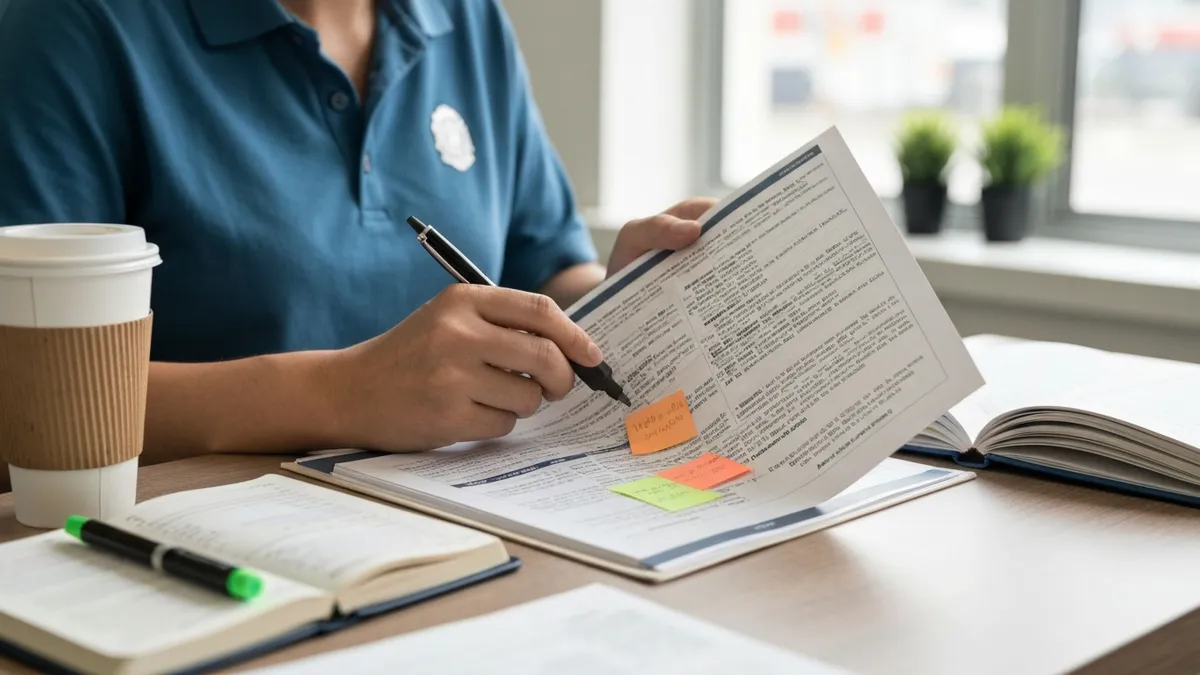
Indiana BMV policy allows you to retake the knowledge test after 24 hours if you do not pass on your first or second attempt. However, if you fail three times within a 30-day period, you must wait a full 30 days before taking the exam again. Each attempt costs $9. This makes thorough preparation before your first visit both financially and logistically important — a 30-day delay can push back your road test and full licensing date by more than a month.
Once you pass your Indiana BMV knowledge test and receive your learner's permit, the real-world driving preparation phase begins. For teen drivers under Indiana's graduated licensing system, the next 180 days represent a structured supervised driving period designed to build genuine road competence before independent driving privileges are granted. During this period, your supervising driver must be a licensed Indiana driver age 25 or older sitting in the front passenger seat whenever you drive. The 50-hour supervised driving requirement — including 10 nighttime hours — is self-reported but taken seriously by Indiana BMV.
Adult applicants who have already completed the knowledge test and received their permit face a shorter road to a full license. While Indiana does not impose a mandatory waiting period on adults over 18 before taking the road skills test, scheduling a road test typically takes one to three weeks depending on branch availability and the time of year. Spring and early summer — when large numbers of teen drivers are pursuing licenses — represent the highest-demand scheduling periods. Booking your road test as soon as your permit is issued is always the smartest move.
The Indiana BMV road skills test evaluates your ability to perform basic vehicle operations safely in a real-world traffic environment. The examiner will assess your pre-drive vehicle check, smooth acceleration and braking, proper mirror usage, lane changes, right and left turns, parallel parking, and appropriate response to traffic control devices. Common reasons for failing the road test include failure to come to a complete stop at stop signs, drifting out of lane during turns, and not checking mirrors frequently enough. Practice each of these maneuvers deliberately during your supervised driving period.
For drivers with specific licensing needs — commercial driver's licenses, motorcycle endorsements, or chauffeur's licenses — the Indiana BMV process involves additional knowledge exams beyond the standard Class D operator's test. Commercial applicants must pass the General Knowledge CDL exam plus any applicable endorsement tests covering hazardous materials, tanker vehicles, passenger transport, or school bus operation. Each of these endorsements has its own study materials and separate fees, making early planning essential for commercial license applicants who have work-start-date deadlines to meet.
Indiana also offers a REAL ID-compliant driver's license for those who need to use their license as federal identification for air travel or access to federal buildings. Obtaining a REAL ID requires bringing additional documentation to your BMV branch, including proof of your Social Security number, two proofs of Indiana residency, and a document proving your legal name if it differs from your identity document. The REAL ID designation does not change your driving privileges but adds a gold star to your license indicating federal compliance — increasingly important as federal REAL ID enforcement at airports expands.
Veterans and active military members should be aware of Indiana's special BMV provisions for service members. Indiana waives certain fees for eligible veterans, and active-duty members stationed outside Indiana can request out-of-state extensions on expiring Indiana licenses. The Indiana BMV also recognizes military training and experience for certain CDL requirements, which can simplify the licensing process for veterans transitioning out of military service and entering civilian transportation careers.
Seniors renewing an Indiana driver's license after age 75 should note that Indiana requires an in-person renewal with a vision test at that milestone age — online renewal is not available for this group. Indiana does not currently require road retesting for senior drivers as a routine renewal requirement, but vision and medical standards must be met at each renewal cycle. For information on specific branch services near you, the detailed resource on bmv hours indiana provides branch-level service details for the Indianapolis metro region.
Practical preparation for the Indiana driver's license test goes beyond reading the manual and taking practice quizzes online. One of the most overlooked aspects of preparation is understanding the physical layout and process of the BMV branch you plan to visit. Some branches have longer average wait times than others, and visiting during off-peak hours — typically mid-morning on Tuesdays through Thursdays — results in shorter queues and a more relaxed testing environment. Avoiding Mondays and the last week of the month, when renewal traffic spikes, is a simple strategy that can save you an hour or more of waiting.
Document preparation is another area where applicants frequently create unnecessary delays. Indiana uses the REAL ID document checklist as its standard identity verification framework, meaning you need a primary identity document, proof of Social Security number, and two proofs of Indiana residency.
Gathering these documents before you visit and organizing them in a folder prevents the frustrating scenario of being turned away after a long wait because one document was left at home. Many applicants are surprised to learn that Indiana requires residency documents dated within 60 days — a month-old bank statement may not suffice if it is dated 61 days ago.
For teen applicants specifically, the Indiana BMV requires a parent or guardian's signature on the initial learner's permit application if the applicant is under 18. This means a parent or legal guardian must be physically present at the BMV branch during the application process — a note or prior signature on the form is not sufficient. Scheduling the BMV visit on a day when a parent can take time off work is logistically important and worth planning weeks in advance during busy periods like spring school breaks and early summer.
Indiana's myBMV online portal is an excellent resource that many drivers underutilize. Beyond basic renewals, the portal allows you to check your current driving record, verify your license status, view points on your record, and access your vehicle registration information. Before visiting a branch for a renewal or transaction, checking your myBMV account status can confirm whether there are any outstanding issues — such as unpaid fees, suspended status, or required documents — that would prevent the transaction from being completed on the day you planned to visit.
Many Indiana residents discover during the licensing process that they have unresolved items from past traffic violations or administrative actions that must be cleared before their license can be issued or renewed. Common clearance requirements include paying outstanding court costs from traffic citations, completing court-ordered defensive driving courses, or satisfying SR-22 insurance filing requirements following certain violations. The Indiana BMV's online portal allows you to check for clearance holds before your branch visit so you can resolve them proactively rather than discovering them at the counter.
For drivers who are nervous about the road skills test that follows the knowledge exam, professional driving school instruction can significantly improve outcomes. Indiana does not require teen drivers to complete a formal driver's education course, but many high schools and private driving schools offer programs that include both classroom instruction and behind-the-wheel training. Completing a state-recognized driver's education program may also make teens eligible for lower auto insurance rates — a benefit worth investigating when shopping for coverage after licensure.
Finally, remember that passing the Indiana BMV knowledge exam is not just about earning a license — it is about building the foundational knowledge that keeps you and everyone around you safe on Indiana roads for decades to come. The traffic laws, safe driving practices, and road sign standards you master during your study period become second nature over time, but they start with the deliberate effort you invest right now. Use every resource available to you, approach your preparation with consistency, and you will be ready to pass with confidence on your very first attempt.
Sample BMV Practice Questions
Try these questions from our free BMV practice tests. The correct answer and an explanation follow each question.
What does it mean when your vehicle's ABS (Anti-lock Braking System) activates?
- A. The system is preventing wheel lockup during hard braking — maintain firm pedal pressure
- B. The brakes have failed completely
- C. You should release the brake pedal immediately
- D. The vehicle is accelerating uncontrollably
Answer: A. The system is preventing wheel lockup during hard braking — maintain firm pedal pressure
ABS activation (felt as pedal pulsation) means the system is rapidly modulating brake pressure to prevent wheel lockup, maintaining steering control. Keep firm, steady pressure on the brake pedal.
What does OWI stand for in Indiana?
- A. Operating While Intoxicated
- B. Operating With Impairment
- C. Offense of Willful Intoxication
- D. Operating Without Insurance
Answer: A. Operating While Intoxicated
In Indiana, the charge for drunk or drugged driving is OWI — Operating While Intoxicated — rather than DUI or DWI.
At night, you must dim your high-beam headlights when within how many feet of an oncoming vehicle in Indiana?
- A. 150 feet
- B. 300 feet
- C. 500 feet
- D. 1,000 feet
Answer: C. 500 feet
Indiana law requires drivers to dim high beams within 500 feet of an oncoming vehicle to avoid blinding the other driver.
When driving in a construction zone with workers present, what should you typically do with your speed?
- A. Maintain your current speed to avoid disrupting traffic flow
- B. Reduce speed and obey posted reduced speed limit signs
- C. Speed up to pass through quickly
- D. Slow to 10 mph regardless of posted signs
Answer: B. Reduce speed and obey posted reduced speed limit signs
Construction zones post reduced speed limits to protect workers, and fines are often doubled for violations there.
BMV Questions and Answers
Indianapolis BMV: Locations, Services, and What to Expect
DMV Driver's License Written Test Questions: Complete Study Guide and Practice Strategy for 2026

BMV Hours of Operation: Everything You Need to Know Before Your DMV Written Test

Ohio BMV License Renewal: Online, In-Person, and Cost Guide

Crown Point BMV Appointment: Complete Guide to Scheduling, Testing, and Getting Your Indiana License
About the Author

Licensed Driving Instructor & DMV Test Specialist
Penn State UniversityRobert J. Williams graduated from Penn State University with a degree in Transportation Management and has spent 20 years as a certified driving instructor and DMV examiner consultant. He has personally coached thousands of applicants through written knowledge tests, skills assessments, and commercial driver licensing programs across more than 30 states.
Join the Discussion
Connect with other students preparing for this exam. Share tips, ask questions, and get advice from people who have been there.
View discussion (9 replies)