
BLS Certification Meaning: What It Is, Who Needs It, and How to Get Yours
BLS certification meaning: 🏆 Basic Life Support training covers CPR, AED, rescue breaths, choking. Required for nurses, EMTs, and most healthcare jobs.
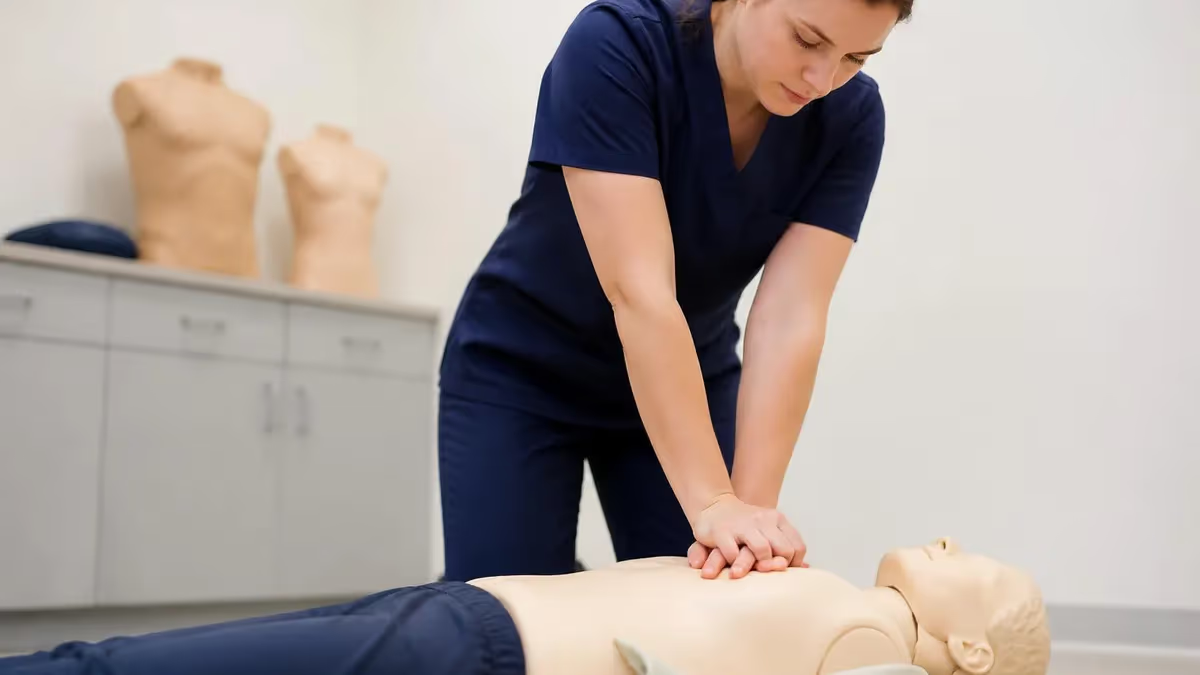
You see those four letters on a healthcare job posting and pause. BLS certification meaning trips up new nurses, EMTs, dental assistants, and lifeguards every hiring season. It is not a fancy nursing degree. It is not an advanced cardiac course. BLS stands for Basic Life Support, and the certification proves you can keep a person alive when their heart stops or they cannot breathe, until paramedics or a hospital team take over.
BLS sits at the foundation of every emergency response chain. Hospitals require it. Dental offices require it. Schools, gyms, daycare centers, and most healthcare employers in the US require it before your first shift. Some employers will not even schedule an interview until the card sits in your file. The training itself runs short, usually four to five hours, but what it covers is genuinely life-saving: chest compressions, rescue breaths, AED use, choking response for adults, children, and infants, and the team dynamics that turn a panicked bystander group into a coordinated rescue.
This guide breaks down what BLS certification actually means, who needs it, what the card looks like, how long it lasts, how the exam works, and what to expect on test day. By the end you will know if you need it, where to take it, and how to pass the first time.

BLS Certification at a Glance
So what does that 4 to 5 hour window actually buy you? A wallet-sized card from a recognized provider, most often the American Heart Association (AHA), Red Cross, or American Safety and Health Institute (ASHI). The card is dated, signed by your instructor, and valid for two years. After that you renew, usually in a shorter recert class.
The card is the credential. Without it, an HR manager flagging your file before orientation will pull you out of the schedule. With it, you check a box and move on. That said, the card is shorthand for something real. You have practiced compressions on a manikin, you have shocked a training AED, you have cleared an obstructed airway on an infant dummy. Employers trust the certification because the standards behind it come from the International Liaison Committee on Resuscitation (ILCOR), which updates guidelines every five years based on resuscitation science.
Most cards include a QR code or a serial number that employers can verify online. That verification piece matters more than people think. HR systems flag mismatches, and a fake card can cost you the job before your first shift.
BLS = Basic Life Support. It is the first tier of emergency response. Think compressions, rescue breaths, AED, and choking relief. It is the layer underneath ACLS (Advanced Cardiac Life Support) and PALS (Pediatric Advanced Life Support), which add medications, rhythm interpretation, and airway tools that only advanced providers can use.
The confusion usually shows up here. People hear BLS and think it must mean something more elaborate, maybe stitches, IV starts, or paramedic-level work. None of that. BLS is deliberately basic. The point is that anyone, with a few hours of training, can perform it. A janitor, a receptionist, a teacher, a parent. The compressions a layperson delivers in the first three minutes of a cardiac arrest are statistically the strongest predictor of survival, more powerful than anything paramedics do later.
That is the philosophy. Push hard, push fast, push early. Get the AED on the chest. Get oxygen in the lungs. Keep the brain perfused. Hand off to advanced providers. The certification trains you in exactly those four moves and tests whether you can do them under pressure on a manikin with an instructor watching.
Now compare that to ACLS. An ACLS course assumes you already passed BLS and adds 12-lead ECG reading, code drugs like epinephrine and amiodarone, advanced airway placement, and team leadership during a cardiac arrest in a hospital setting. PALS does the same for pediatrics. Neonatal Resuscitation Program (NRP) handles newborns. Each layer adds tools, but they all rest on the BLS foundation. Without BLS, the advanced courses do not function. You cannot run a code if you cannot run compressions.
The Four Skills BLS Tests
Chest compressions at 100-120 per minute, 2-2.4 inches deep on adults, allowing full recoil between pushes. Minimal interruptions. Tested on adult, child, and infant manikins with an instructor watching your hand placement and timing.
Power on, pads on bare dry chest, clear the patient, shock if advised, resume compressions immediately. You will demo this in pairs with a partner running compressions while you handle the device.
Bag-valve-mask technique for healthcare providers, mouth-to-mask for lay responders. Two breaths after every 30 compressions in single-rescuer scenarios. Mask seal is harder than it looks and takes a few attempts to master.
Abdominal thrusts for conscious adults and children, back blows and chest thrusts for infants, CPR for any unconscious choking victim. Three distinct algorithms by age, tested on the written exam and skills station.
Each of those four skills gets a station in the hands-on portion of the class. You rotate through them with a partner. The instructor watches, corrects your hand placement, your compression rate, the depth of your pushes, and your timing. A metronome usually clicks in the background at 110 beats per minute, which sounds suspiciously like the song Stayin' Alive. That is not a coincidence, it is the AHA's official mnemonic.
The rescue breathing piece is where healthcare students often struggle first. Mask seal is harder than it looks. You have to tilt the head, lift the jaw, clamp the mask with two hands using the EC clamp grip, and squeeze the bag just enough to make the chest rise visibly. Squeeze too hard and you push air into the stomach, which causes vomiting. Squeeze too soft and the lungs do not inflate. Practice fixes it within a few attempts.
Choking is the skill people forget the most, because it does not get drilled as often. Conscious adult choking gets the Heimlich. Conscious infant choking gets five back blows then five chest thrusts. Unconscious choking victims get full CPR with a quick mouth check before each breath cycle. The exam will ask about all three scenarios, often as scenario-based questions where you pick the next action.
BLS vs Other Life Support Certifications
Basic Life Support. Compressions, AED, breaths, choking. Required for almost all healthcare jobs and many non-healthcare positions like teachers and lifeguards. 4-5 hour course covering single and two-rescuer scenarios across adult, child, and infant patients.
Picking the right certification matters because employers do not accept substitutes. A Heartsaver card will not get you hired as a nursing assistant. An ACLS card without an underlying BLS card raises eyebrows, since BLS is normally a prerequisite. If your job posting says BLS for Healthcare Providers, get exactly that, the AHA's BLS Provider course or an equivalent from the Red Cross or ASHI.
The phrase BLS for Healthcare Providers used to be the AHA's official name. The organization dropped the longer phrase in 2015 and the course is now simply called BLS Provider, but the older name still appears on some job postings and orientation paperwork. They refer to the same credential. If you see BLS-HCP, BLS for Healthcare Providers, or BLS Provider, those are interchangeable. Do not let a job listing with outdated terminology spook you.
Some websites sell BLS certificates for $15 with no hands-on testing. Hospitals will reject these on sight. Legitimate BLS certification always includes an in-person or blended-learning skills check on a manikin. If you can complete the whole course on a laptop without ever touching a manikin, the card is not real and will get flagged at orientation.
Here is how the scam works. A vendor sells a multiple-choice quiz and emails you a PDF certificate. No instructor watches you compress. No one checks your AED placement. The certificate looks official, even has a holographic seal. Then your nurse manager scans the QR code or calls the provider listed, and the credential does not verify. You are sent home from orientation, sometimes terminated, sometimes asked to retake the course on your own dime within 48 hours.
The AHA, Red Cross, and ASHI all maintain online verification portals. Your card has a unique ID. HR can look you up. If the provider on the card is not searchable, the card is not real. The fix is simple. Take the course through a hospital, a community college, a Red Cross chapter, or an AHA Training Center. Blended learning is acceptable. You do the cognitive portion online, then attend a 2-3 hour in-person skills session. That hybrid model is legitimate and convenient.
Cost runs roughly $50 to $90 for a first-time BLS Provider course in the US. Renewals run $30 to $70. Hospitals often pay for their staff, and many community colleges include it in nursing program tuition. If you are paying out of pocket, shop AHA Training Centers in your area or check the Red Cross website for class schedules. Avoid Craigslist instructors and unfamiliar URLs.
Who Needs BLS Certification?
- ✓Registered nurses (RN), LPNs, and nursing students before clinicals
- ✓Doctors (MD, DO) and physician assistants
- ✓EMTs, paramedics, and firefighters
- ✓Dental assistants, hygienists, and dentists
- ✓Respiratory therapists and pharmacy technicians in clinical settings
- ✓Medical assistants and patient care techs
- ✓Lifeguards and pool managers
- ✓Police officers and corrections staff in many states
- ✓Athletic trainers and physical therapy aides
- ✓Daycare workers and school nurses in regulated states
- ✓Anyone applying to nursing, dental, PA, or medical school
Top 5 Things to Memorize Before Exam Day
- ✓Adult compression rate: 100-120 per minute, depth 2-2.4 inches
- ✓Child and infant compression depth: about 1/3 of chest depth
- ✓Single-rescuer ratio: 30 compressions to 2 breaths for all ages
- ✓Two-rescuer ratio on a child or infant: 15 compressions to 2 breaths
- ✓AED sequence: power on, pads on bare dry chest, clear, analyze, shock if advised, resume compressions

The exam piece confuses new test takers more than the skills piece. The written test is 25 multiple-choice questions. You need 84% to pass, which means missing no more than four. The questions cover compression rate and depth, AED operation, two-rescuer choreography, choking algorithms by age group, and team dynamics like closed-loop communication. The AHA provides a free study guide along with the eBook included in your course fee. Read the algorithms in the back, they are the source of most exam questions verbatim.
A practice test before exam day pulls your score up significantly. Most candidates who fail the first attempt failed because they confused adult and pediatric compression depths, mixed up the BLS algorithm with the choking algorithm, or guessed the wrong cycle ratio. Two rounds of practice questions usually fix that.
Test-day nerves are real but manageable. The questions are scenario-based rather than trick questions. If you know the four key numbers (rate, depth, ratio for one rescuer, ratio for two rescuers on a child), you will recognize the right answer on most items. Read each question twice, eliminate two wrong choices, and pick from the remaining two. The 84% threshold sounds tight but most people clear it on the first attempt.
Both AHA and Red Cross meet ILCOR guidelines and both are accepted at the overwhelming majority of US healthcare employers. The differences are mostly cultural. Academic hospitals lean AHA, community settings and corporate first-aid programs sometimes prefer Red Cross. Before you sign up, check with HR or your nursing program. They will tell you which one they require. If neither is specified, AHA is the safer default.
Renewal works on a two-year clock. The card lists an expiration date in the month it was issued. If you renew before expiration, the new card runs two years from the old expiration date, you do not lose time by renewing early. If you let the card lapse, most employers want the full provider course again, not the shorter recert.
Recert classes run about 3 hours and skip the basics. You re-test on skills and pass the written exam again. Many employers run on-site recert classes for staff at no charge. If your facility does, take advantage, it is the easiest path. Some states and employers also accept Skills Verification Visits where an authorized instructor checks your competency without a full classroom session.
The Four Numbers That Matter
- ✓100-120 compressions per minute
- ✓2 to 2.4 inches deep for adult chest compressions
- ✓30:2 single-rescuer compression-to-breath ratio (all ages)
- ✓15:2 two-rescuer ratio for child or infant resuscitation
- ✓Switch compressors every 2 minutes to maintain quality
Worth pausing on what the actual day of class looks like, because students often picture something more clinical than it is. You walk into a community room, a hospital classroom, or sometimes a fire station bay. Manikins are lined up on the floor or low tables. An instructor introduces themselves, hands out the eBook if you did not get it ahead of time, and runs you through a brief video introduction. After that, almost everything is hands-on. You will spend more time on your knees over a manikin than you will sitting in a chair.
The instructor demonstrates each skill, then you copy it. They walk around correcting hand position, depth, and rate. Most classes run two to three students per manikin in rotation, so you push for two minutes, then rotate to AED pads, then to the bag-valve-mask. By hour three, the skills feel automatic. By hour four, you can run a single-rescuer adult code from start to finish without prompting.
Pair work is critical because the two-rescuer scenarios make up a significant portion of the exam. One rescuer manages the airway with bag-valve-mask while the other compresses. Switching every two minutes is part of the protocol because compressions degrade in quality after that point. You also practice talking to each other out loud, calling out switches, confirming shock advisories, and asking for the next round of compressions before the AED reanalyzes. That verbal choreography is closed-loop communication, and the exam will quiz you on it.
Skills testing happens at the end of the class, usually one student at a time at a private station with the instructor and a checklist. You walk through a full single-rescuer adult scenario, then a two-rescuer adult scenario, then an infant scenario. The instructor marks pass or fail on each step.
If you miss a critical action — checking for responsiveness, calling for help, starting compressions within 10 seconds — they will stop you, coach you through the fix, and let you retry the same day. Failing outright on a single skill is rare. Most students pass the skills check on the first try.
What to Expect on Class Day
Instructor demonstrates each skill on a manikin. You repeat in rotation with a partner. Hand placement, compression depth, and rate get corrected in real time. Most learners click into the rhythm after the second drill set.
Two-rescuer codes. One person runs the bag-valve-mask while the other compresses. You practice switching every two minutes and calling actions out loud using closed-loop communication.
One-on-one with the instructor at a private station. Single-rescuer adult, two-rescuer adult, and infant scenarios. Pass or fail marked on a checklist. Failures get same-day coaching and a retry.
25 multiple-choice questions. 25 minutes typical. 84% passing. Most students finish in 15 minutes. Cards issued the same day or via digital e-card within 48 hours.
For the written test, a few tips beyond the obvious. Read every question fully before looking at the answers, because the exam authors often hide the key word in the second clause. Words like adult, child, infant, witnessed, unwitnessed, single rescuer, and two rescuer change which algorithm applies. A question that starts with the same scenario can have a different correct answer depending on those qualifiers. Train yourself to circle or mentally flag them.
Common trick distractors include answers that are technically correct in a different context. For example, on a question about a witnessed cardiac arrest in a hospital with an AED nearby, the correct first action is to grab the AED. In an unwitnessed arrest in a field setting without an AED nearby, the correct first action is two minutes of CPR before going for the AED. The same words appear in both answer choices. Read the scenario closely.
One more practical detail. Bring water and a snack. You will burn calories doing compressions for hours, and low blood sugar can fog your thinking during the written portion. Most instructors give a short break midway through the class. Use it. Step outside, stretch your wrists and shoulders, eat something, and come back fresh for the second half.
BLS Questions and Answers
Walk into exam day knowing the four numbers that will get you 80% of the way there: 100-120 compressions per minute, 2-2.4 inches deep for adults, 30:2 compression-to-breath ratio for single rescuer, and 15:2 for two rescuers on a child or infant. Those four numbers anchor every algorithm. Memorize them cold and the rest falls into place.
After class, your instructor uploads your completion to the provider's database. You either get a printed card on the spot or a digital e-card within a few days. Save the digital version somewhere you will not lose it, employers commonly ask for a copy at orientation and again during annual compliance audits. Cloud storage or a dedicated email folder works well.
One last thing worth saying. The BLS card itself is just paperwork. The skill behind it can save a life. A bystander who pushes hard and fast on a stranger's chest after a cardiac arrest at the gym, the grocery store, or a family barbecue has a real chance of bringing that person back. The training is short. The card lasts two years. The skill stays with you. Get certified, keep it current, and walk through the world a little more useful than you were before.
If you have not booked your class yet, search AHA Training Centers or Red Cross BLS in your zip code. Pick a Saturday morning slot if your schedule allows, eat before you go, wear comfortable clothes (you will be kneeling on the floor for chunks of it), and bring a notepad. Most students walk out with the card in hand the same day.
About the Author

Registered Nurse & Healthcare Educator
Johns Hopkins University School of NursingDr. Sarah Mitchell is a board-certified registered nurse with over 15 years of clinical and academic experience. She completed her PhD in Nursing Science at Johns Hopkins University and has taught NCLEX preparation and clinical skills courses for nursing students across the United States. Her research focuses on evidence-based exam preparation strategies for healthcare certification candidates.
Join the Discussion
Connect with other students preparing for this exam. Share tips, ask questions, and get advice from people who have been there.
View discussion (8 replies)