
California Bar Exam Difficulty: What Every Aspiring Lawyer Needs to Know
California bar exam difficulty explained 🏆 — pass rates, format, prep strategies, and what makes it the hardest bar exam in the US.
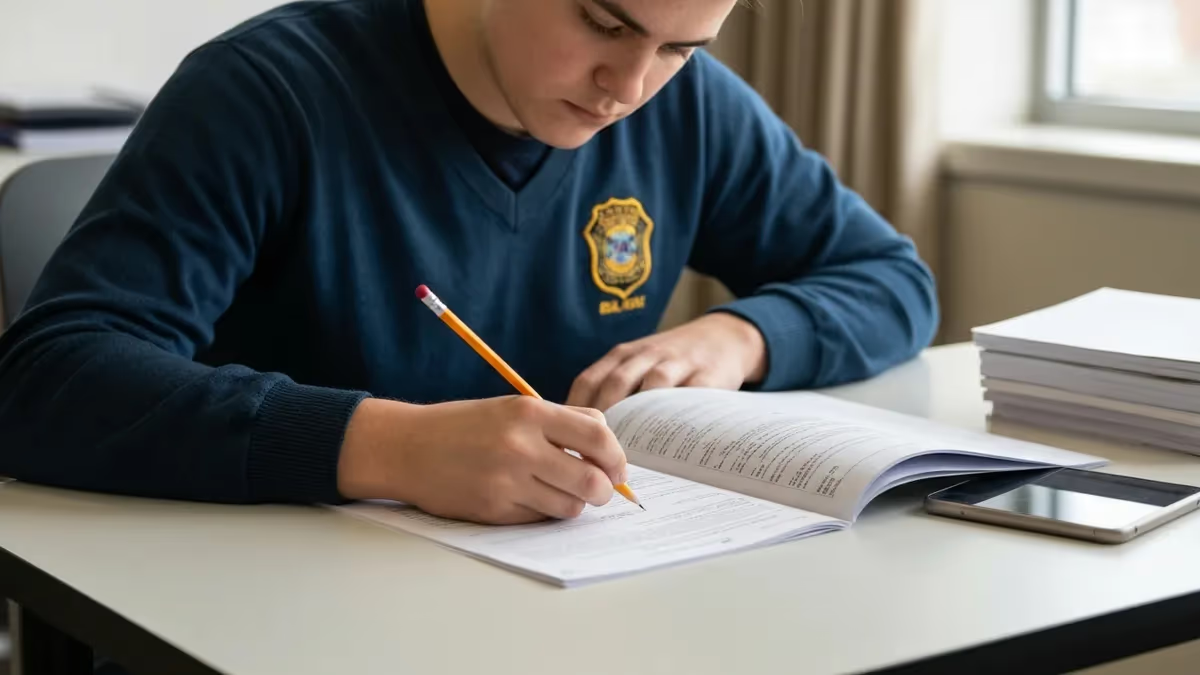
The california bar exam difficulty is legendary among law students and practicing attorneys alike. Consistently ranked as one of the hardest bar exams in the United States, California's licensing test has humbled even the most accomplished graduates from top law schools. With first-time pass rates hovering around 40–55% depending on the year, the exam demands more than just knowing the law — it requires strategic preparation, mental endurance, and a deep understanding of how California tests legal reasoning differently from every other state.
Understanding what is the bar exam and exactly what the California version entails is the essential first step for anyone planning to practice law in the Golden State. The exam spans two full days and tests candidates across a sweeping range of subjects including contracts, torts, constitutional law, criminal law, evidence, real property, civil procedure, and several subjects unique to California's legal system. The sheer breadth of material covered is enough to overwhelm even the most diligent studier if approached without a structured plan.
California's bar exam is administered twice each year — in February and July — by the State Bar of California. The July administration typically draws a larger pool of recent law school graduates, while the February exam tends to attract repeat takers and foreign-educated attorneys seeking licensure. Historically, the July pass rate is slightly higher, though both administrations present formidable challenges that should not be underestimated by any candidate.
One reason the California bar exam has earned its fearsome reputation is the essay component. Unlike states that use the Uniform Bar Exam (UBE), California designs its own essay questions that frequently test California-specific nuances in law — distinctions that can catch applicants trained in other jurisdictions completely off guard. A candidate who aced the bar exam in New York may still find California's essays demanding a different level of doctrinal precision and issue-spotting acuity.
The exam also includes the Multistate Bar Examination (MBE), a 200-question multiple-choice test that covers core federal law subjects. California weights the MBE at roughly 50% of the overall score, meaning strong performance on the essay and performance test components alone is not sufficient for a passing result. Candidates must demonstrate balanced competency across every component, making the preparation journey that much more demanding and multidisciplinary.
High-profile stories have brought public attention to the California bar exam in recent years. Kim Kardashian's journey to pass the baby bar — the First-Year Law Students' Examination — after multiple attempts underscored just how seriously the State Bar takes its licensing standards. Her persistence resonated widely and sparked national conversation about bar exam accessibility and the challenges faced by non-traditional law students who pursue legal education through apprenticeship programs rather than accredited law schools.
Whether you are a recent law school graduate facing the California bar for the first time, a repeat taker regrouping after a difficult result, or an attorney from another state seeking admission, this comprehensive guide breaks down everything you need to know about California bar exam difficulty — from pass rate data and exam format to study strategies and the mindset shifts that separate candidates who pass from those who do not.
California Bar Exam by the Numbers
California Bar Exam Format
| Section | Questions | Time | Weight | Notes |
|---|---|---|---|---|
| Multistate Bar Examination (MBE) | 200 | Day 2 (full day) | 50% | 200 scored multiple-choice questions |
| Essay Questions | 5 | Day 1 (AM session) | ~26% | 5 essays, 1 hour each |
| Performance Tests (PT) | 1 | Day 1 (PM session) | ~24% | 1 PT, 90 minutes |
| Total | 205 | 2 Days (approx. 9–10 hrs of testing) | 100% |
California bar exam pass rates have remained stubbornly low for decades, and understanding the historical trend is critical for setting realistic expectations. In July 2022, the overall pass rate was approximately 54%, one of the higher results in recent years following pandemic-era adjustments. However, the February 2023 administration saw pass rates dip to around 37%, reflecting the typical seasonal variation between first-time takers in summer and repeat takers in winter. The consistent pattern across years reveals that fewer than half of all candidates pass on any given administration.
First-time takers from ABA-accredited California law schools generally perform better than repeat takers and candidates from unaccredited schools. According to State Bar data, first-time takers from ABA schools regularly achieve pass rates in the 55–65% range, while candidates from California-accredited (state-accredited but not ABA) law schools average pass rates closer to 25–35%. Foreign-educated attorneys seeking California admission face some of the steepest odds, with pass rates often falling below 30% for first-time attempts.
Repeat takers represent a significant portion of every California bar exam administration. The State Bar reports that a substantial minority of seats in each exam cycle are occupied by candidates attempting the exam for the second, third, or even fourth time. This dynamic depresses the overall pass rate statistic, but it also reflects the reality that many competent candidates simply need additional preparation cycles before achieving a passing score. The exam is demanding enough that even capable attorneys sometimes require multiple attempts.
The results of new york bar exam and other state bar exams paint a useful comparison. States that use the Uniform Bar Exam typically report higher pass rates — New York's first-time pass rate often exceeds 65%, and many Midwestern states regularly post rates above 70%. California's deliberate choice to maintain its own exam format and higher difficulty standards reflects a policy decision that the state's complex legal market demands more rigorous vetting of incoming practitioners.
Scaled scoring is another dimension of California bar exam difficulty that candidates must understand. California uses a 2000-point scale, and a total score of 1440 is required to pass. The MBE component is scaled nationally by the National Conference of Bar Examiners and contributes approximately 50% of the total score. Essay and performance test components are graded by California attorney readers on a scale that is then converted to the 2000-point system, making it impossible to compensate for a weak MBE performance with brilliant essays alone.
The passing score of 1440 out of 2000 represents California's deliberate positioning as a high-bar jurisdiction. For context, most UBE states set their passing score between 260 and 273 on the 400-point UBE scale — roughly equivalent to performing in the upper-middle range of all test takers nationally. California's 1440 threshold is generally considered more demanding, though direct comparisons are complicated by differences in exam structure and scoring methodology.
Year-over-year data also reveals that the February administration is statistically harder to pass than the July sitting. The February cohort skews heavily toward repeat takers who have already struggled with the exam, which accounts for much of the lower pass rate. However, some bar exam analysts argue that the February questions themselves trend slightly more difficult, and candidates planning their timeline should account for this reality when deciding which administration to target for their initial attempt.
What Makes the California Bar Exam So Hard
California tests more subjects than nearly any other bar exam jurisdiction. In addition to the seven MBE subjects — civil procedure, constitutional law, contracts, criminal law and procedure, evidence, real property, and torts — California essays can draw from professional responsibility, community property, trusts, wills and succession, corporations, remedies, and criminal procedure. Candidates must be genuinely fluent in more than a dozen distinct bodies of law, each with its own doctrinal framework and California-specific nuances that diverge from common law baselines.
The breadth problem is compounded by the unpredictability of subject testing. Unlike some predictable exams, California essays can combine two or more subjects within a single question — a fact pattern might implicate both community property and trusts simultaneously, requiring seamless issue-spotting across subject lines. This cross-subject complexity demands that candidates build integrative legal thinking skills, not just rote memorization of rules. Candidates who only memorize rules without understanding how doctrines interact are frequently caught off guard by California's multi-subject essay combinations.
California Bar Exam: Pros and Cons of the Challenge
- +Passing California's exam earns respect nationwide as a mark of genuine legal competency
- +Rigorous preparation builds transferable skills in legal analysis applicable throughout your career
- +California admission opens doors to the largest and most lucrative legal market in the United States
- +The exam's difficulty filters out underprepared candidates, protecting client standards
- +Successful candidates develop superior issue-spotting and time-management skills
- +Strong bar prep for California often prepares candidates to pass other states' exams more easily
- −First-time pass rates below 50% create significant financial and emotional risk for candidates
- −California does not accept UBE scores, requiring a full exam even for admitted attorneys from other states
- −Exam prep costs including bar review courses frequently exceed $3,000–$4,500
- −The two-day format requires sustained physical and mental endurance that many candidates underestimate
- −California-specific subject matter requires supplemental study beyond standard bar prep programs
- −Repeat takers face mounting financial pressure from exam fees, delayed employment, and ongoing study costs
California Bar Exam Preparation Checklist
- ✓Register for a comprehensive bar review course (Barbri, Themis, or Kaplan) at least 10 weeks before the exam
- ✓Create a master outline for each of the 13+ subjects tested on the California bar exam
- ✓Complete at least 1,500 MBE practice questions spread across all seven MBE subject areas
- ✓Write at least 30 full-length timed essay responses under realistic exam conditions
- ✓Complete at least 5 full Performance Tests timed to 90 minutes with no outside materials
- ✓Identify your three weakest subjects using diagnostic testing and allocate extra study hours there
- ✓Study California-specific law distinctions separately from general common law outlines
- ✓Review released California bar exam questions from the past five years for subject frequency patterns
- ✓Practice the IRAC structure until your essay organization is automatic and consistent
- ✓Schedule at least two full two-day simulated exam sessions during the final two weeks of prep
The Average Passing Candidate Studies 400+ Hours
Research and anecdotal data from California bar exam communities — including discussions on bar exam Reddit threads and law school forums — consistently suggest that candidates who pass on their first attempt average between 400 and 500 hours of dedicated study. That translates to roughly 10–12 weeks of full-time preparation at 40–50 hours per week. Candidates who try to cram this preparation into fewer weeks, or who study fewer total hours, dramatically reduce their odds of passing.
Developing an effective study strategy for the California bar exam requires understanding how the scoring system rewards and penalizes different types of performance. Because the MBE and written components each contribute roughly half the total score, a candidate who is brilliant at essays but weak at multiple-choice will not pass — and vice versa. Truly successful preparation treats both components with equal urgency and allocates study time accordingly, rather than doubling down on whichever format feels more comfortable.
For the MBE, the most effective preparation strategy is high-volume practice with rigorous review. Completing 30–50 practice questions daily and carefully analyzing every wrong answer — including understanding why the correct answer is right and why the other three choices are wrong — builds the pattern recognition and legal reasoning agility that the MBE demands. Passive reading of outlines without active practice is one of the most common and costly mistakes that MBE underperformers make. The MBE rewards tested knowledge, not merely read knowledge.
Essay preparation requires a different cognitive approach. The core skill is issue spotting — seeing all the legally relevant issues buried in a complex fact pattern before writing a single word of analysis. Experienced bar exam coaches recommend spending the first 5–10 minutes of every essay question creating a brief issue map before beginning to write. This pre-writing discipline pays dividends by preventing candidates from missing key issues or spending disproportionate time on secondary issues at the expense of major ones that carry more grading weight.
A how hard is the bar exam compared to law school final exams? The consensus among bar exam veterans is that the bar exam is substantially harder — not because the individual legal questions are necessarily more complex than a challenging law school exam, but because the sheer volume of material tested, the time pressure, and the two-day endurance factor combine to create a qualitatively different challenge. Law school exams typically test one or two subjects in a three-hour window; the bar exam tests everything you have ever learned about law across two back-to-back days.
Community property deserves special attention from every California bar candidate, regardless of where they attended law school. California is one of only nine community property states, and the California community property rules appear on bar exam essays with remarkable frequency. Topics including the presumption of community property, separate property contributions to community property assets, transmutation requirements, quasi-community property rules, and the division of debts and assets on divorce are all fair game. Candidates who gloss over community property in their preparation regularly find themselves surprised by how prominently it appears.
Time management during the actual exam is a skill that must be practiced, not just planned. Each of the five essay questions should consume approximately one hour, and candidates who allow one essay to run long will compress the time available for subsequent questions. Similarly, the Performance Test's 90-minute window feels longer than it is when candidates are dealing with a voluminous file and a multi-part task. Experienced test-takers recommend strict time discipline with a watch or timer visible at all times during the exam, and pre-committed time checkpoints for each essay and PT section.
Mental health and physical preparation during the bar prep period are often undervalued by candidates who treat bar study as a pure intellectual exercise. The 10–12 week preparation period is genuinely exhausting, and candidates who neglect sleep, exercise, and basic nutrition frequently experience cognitive fatigue that undermines the quality of their study. Bar prep is an athletic endeavor as much as an academic one — the best-prepared candidates treat their health as an exam performance variable, not a luxury to be deferred until after the exam is over.
The State Bar of California imposes strict application deadlines for each exam administration, and missing the deadline can bar you from that exam cycle entirely — forcing you to wait six months for the next administration. The July exam typically requires applications in the February–March window, while the February exam requires applications in the October–November window. Check the State Bar's official website for exact dates each year, as deadlines can shift. Late fees apply for applications submitted after the initial deadline but before the final cutoff.
Scoring on the California bar exam is a nuanced process that many candidates misunderstand, and a clear grasp of how scores are calculated can meaningfully inform your preparation strategy. The final score is calculated on a 2000-point scale, with the MBE contributing approximately 50% (scaled to 1000 points), the five essays contributing roughly 26% (scaled to approximately 520 points), and the single Performance Test contributing approximately 24% (scaled to approximately 480 points). A total scaled score of 1440 or higher earns a pass.
The scaling process means that raw scores are converted based on the performance of all test takers nationally and statewide, which introduces a comparative element to the scoring. On the MBE, a raw score of approximately 119–125 correct out of 200 questions typically yields a scaled score in the passing range for California purposes, though this varies slightly by administration depending on overall candidate performance that day. Essay and PT grading by California readers uses a 1–6 scale that is then converted to the 2000-point system.
Essay readers grade holistically using a set of model answers and scoring rubrics prepared before the exam. A score of 65 on an essay represents roughly average performance among passing candidates, while scores of 70 and above represent strong performance. Scores below 60 on multiple essays can be fatal to an otherwise borderline candidate.
The graders reward clarity, organization, and accurate rule statements, but the highest scores go to essays that demonstrate sophisticated legal reasoning — candidates who go beyond just stating rules to thoughtfully applying those rules to the specific facts and recognizing the tensions and ambiguities in the scenario.
One of the most actionable pieces of score intelligence comes from understanding which components offer the greatest opportunity for improvement. For most candidates, the MBE is the highest-use area for score improvement because gains from disciplined practice are predictable and measurable. Moving from 115 correct to 130 correct on the MBE — a realistic improvement for a candidate who completes 1,500+ practice questions — can translate to 20–30 additional scaled points, often the margin between passing and failing for borderline candidates.
The bar exam practice test resources available for California-specific preparation have expanded dramatically in recent years, with commercial bar prep companies offering California-specific essay banks, PT simulations, and MBE question libraries. The State Bar itself releases past essay questions and model answers on its website, providing an invaluable window into the graders' expectations and scoring standards. Candidates who study released answers carefully develop a precise sense of what a passing essay looks like versus what a failing or barely-passing essay looks like.
Repeat takers face unique challenges in their preparation strategy. After failing the California bar exam, many candidates struggle to identify what went wrong and how to change their approach. The State Bar provides a diagnostic score report that breaks performance down by MBE subject area and written component, giving repeat takers essential data about where their weaknesses lie. Candidates who use this data to fundamentally restructure their study approach — rather than simply doing more of the same preparation that failed them previously — are significantly more likely to pass on their next attempt.
The Supreme Court bar exam results and national statistics consistently show that California stands apart as an outlier in difficulty, but it is important not to let this statistical reality become psychologically paralyzing. Thousands of candidates pass the California bar exam every year, including many who struggled academically in law school or who are attempting the exam for the second or third time. The exam is hard, but it is passable — and candidates who prepare strategically, maintain consistent discipline, and treat the exam with appropriate seriousness are well-positioned to join the ranks of California-admitted attorneys.
In the final weeks of California bar exam preparation, the most effective candidates shift from learning new material to consolidating and testing what they already know. Adding new subjects or diving deep into obscure doctrinal corners in the last two weeks is generally counterproductive — the time is better spent on intensive practice, error review, and reinforcing the foundational rules and analytical frameworks that will carry you through every essay, PT, and MBE question you encounter during the exam itself.
Simulated full-length exam days are non-negotiable in the final preparation phase. Sitting down and completing five essays plus a Performance Test in a single day — then spending the next day completing 200 MBE questions — reveals stamina gaps that no amount of shorter practice sessions can expose.
Many candidates discover during simulations that their concentration and writing quality deteriorate significantly by the fourth and fifth essays of the day, or that MBE accuracy drops noticeably during the afternoon session compared to the morning. These are problems that can be addressed before exam day only if they are identified before exam day.
Bar exam Reddit communities and online forums offer a wealth of real-world candidate experience that can complement formal bar prep courses. Threads on bar exam Reddit document individual candidates' study schedules, score reports, and emotional journeys through multiple exam cycles, providing a realistic picture of what the preparation process actually looks like. While every candidate's experience is unique, patterns emerge in these discussions — the candidates who pass tend to share certain habits: consistent daily study schedules, high practice question volume, active essay writing rather than passive reading, and disciplined time management during the actual exam.
The kim kardashian bar exam story — specifically, her experience with the First-Year Law Students' Examination (the "baby bar") rather than the full California bar — illustrated something important about the exam's design philosophy. The baby bar is a preliminary licensing exam for students in non-ABA law school programs, and its difficulty, while less than the full California bar, is formidable.
Kardashian's public discussion of her multiple attempts humanized a process that many candidates feel ashamed to discuss openly, particularly after failing. Her ultimate success after persistence reinforced the message that tenacity and willingness to genuinely change one's approach are as important as raw intellectual ability.
Candidates barred from exam attempts in other jurisdictions due to character and fitness issues face an additional layer of complexity in California. The State Bar conducts its own thorough character and fitness investigation, and issues that might be forgiven in other states — prior criminal convictions, academic dishonesty, financial irresponsibility — can result in extended delays or denial of admission in California.
Candidates with any concerns about character and fitness should consult with an attorney specializing in bar admission matters well before submitting their application, as addressing these issues proactively is far easier than doing so reactively after an adverse determination.
Technology-assisted study tools have become increasingly central to effective California bar exam preparation. Spaced repetition flashcard systems, AI-powered practice question generators, and video lecture libraries allow candidates to customize their preparation in ways that traditional bar review courses alone do not provide. The most effective candidates layer these tools on top of — not in place of — a structured commercial bar review course, using technology to reinforce weak areas, maintain recall of previously studied material, and add flexibility to their daily study routine.
The final piece of practical advice for California bar candidates is deceptively simple but frequently overlooked: take the exam itself seriously from the very first question. The California bar exam is a marathon, not a sprint, but it is also a test where every point matters. Candidates who approach early essays or early MBE questions with less than full intensity — thinking they have time to warm up — risk surrendering points they will desperately need in the final score calculation. Walk into that testing room prepared, rested, and ready to perform at your absolute best from minute one.
Bar Questions and Answers

TN Bar Exam Results: Everything You Need to Know About Tennessee's Bar Exam

Ohio Bar Exam: Complete Guide to Requirements, Format, and How to Pass
Bar Exam Practice Test PDF (Free Printable 2026)

UBE Bar Exam: Structure, Scores, States, and How to Pass

Hardest Bar Exams in the US: Which States Are the Toughest to Pass?
About the Author
Attorney & Bar Exam Preparation Specialist
Yale Law SchoolJames R. Hargrove is a practicing attorney and legal educator with a Juris Doctor from Yale Law School and an LLM in Constitutional Law. With over a decade of experience coaching bar exam candidates across multiple jurisdictions, he specializes in MBE strategy, state-specific essay preparation, and multistate performance test techniques.