
HESI Practice Exams 2026: Free A2 Practice Tests & Questions
Free HESI practice exams with realistic HESI A2 practice test questions, 🗨️ timed quizzes, score reports, and study tips to pass your nursing entrance exam.

If you are applying to nursing school in 2026, taking realistic hesi practice exams is the single most reliable way to walk into test day calm and prepared. The HESI A2 (Admission Assessment) decides whether thousands of applicants advance, and the gap between a passing and a failing score often comes down to how many practice questions a candidate worked through beforehand. This page gives you free, full-length practice sets that mirror the real hesi exam in format, timing, and difficulty so nothing surprises you.
The word "hesi" gets thrown around loosely, so let us be precise. HESI stands for Health Education Systems Incorporated, a company owned by Elsevier that builds standardized nursing assessments. The HESI A2 is the entrance version most schools require before admission, while exit and specialty exams come later in your program. When people search for the famous no hesi resource, they are usually hunting for free, accurate practice material exactly like what you will find on this page.
A genuine hesi practice test does more than quiz you on facts. It trains pacing, builds reading stamina, and exposes the specific vocabulary and math operations the test rewards. Many first-time candidates underestimate the math and grammar sections because they assume a nursing exam is purely science. In reality the HESI A2 blends academic core subjects with reading comprehension and critical thinking, and each section is scored separately, so a single weak area can sink an otherwise strong application.
Our practice exams are organized to match how schools actually score you. You will see anatomy and physiology, biology, chemistry, math, vocabulary, grammar, reading comprehension, and critical thinking items, all written in the HESI style. Each question includes an explanation so you learn the reasoning, not just the answer key. That feedback loop is what turns a 70% into an 85% across two or three weeks of focused review rather than months of aimless cramming before your nursing entrance exam.
Whether your program demands a composite of 75%, 80%, or higher, the strategy is the same: diagnose your weak sections early, drill them with targeted practice hesi a2 test questions, and re-test under timed conditions until your scores stabilize above your school's cutoff. Below you will find timed quizzes, a section-by-section format breakdown, study checklists, and answers to the questions applicants ask most often before sitting the real assessment.
Treat this page as your home base for the weeks leading up to the exam. Bookmark it, work a section a day, and track your percentages so you can see momentum building. The candidates who pass comfortably are rarely the ones who studied the longest; they are the ones who practiced under realistic conditions and learned from every miss. Start with a quick diagnostic quiz, then come back and build a plan around your weakest scores.
HESI: upcoming dates and official changes
- Updated Oct 20, 2026: Delivery (HESI Next Generation) is now Onsite school proctor or remote proctoring (school proctor or 3rd-party vendor) (previously Onsite school proctoring or remote vendor proctoring).
- Updated Oct 20, 2026: Score release (HESI Admission Assessment (A2) — Legacy platform) is now Within 24 hours after completing test sections (previously Within 24 hours after completing test sections).
- Updated Oct 20, 2026: Score release (HESI Specialty and Exit exams — Legacy platform) is now 24–48 hours after exam closure (previously 24–48 hours after exam closure).
Facts verified Oct 20, 2026 against Elsevier. Dates that have passed are removed automatically.
- For the HESI A2 in HESI Next Generation, the estimated exam duration depends on which sections the school selects, and the school can adjust it manually. (Elsevier)
- In HESI Next Generation, schools schedule the HESI A2 as Version 1 for first-time testers or Version 2 for second-time testers, so a retake uses a different exam version. (Elsevier)
- HESI Next Generation exams can be proctored onsite by a school proctor or remotely, either by a school proctor over a group meeting platform or by a third-party proctoring vendor. (Elsevier)
- When a HESI Next Generation exam is set up as student-pay, the student must pay before testing and cannot test until payment is received. (Elsevier)
- On the HESI Legacy platform, HESI Admission Assessment (A2) results show within 24 hours after the student completes the test sections. (Elsevier)
- On the HESI Legacy platform, HESI Specialty and Exit exam results appear 24 to 48 hours after the exam is closed. (Elsevier)
Facts verified Oct 20, 2026 against Elsevier. Dates that have passed are removed automatically.
HESI Exam at a Glance
| Item | Detail | Official source |
|---|---|---|
| Time limit (HESI Admission Assessment (A2) — HESI NG) | Set by the school based on the sections selected | Elsevier |
| Retake policy (HESI Admission Assessment (A2) — HESI NG) | Separate exam version for second-time testers | Elsevier |
| Delivery (HESI Next Generation) | Onsite school proctor or remote proctoring (school proctor or 3rd-party vendor) | Elsevier |
| Eligibility (HESI Next Generation — student-pay exams) | Payment required before testing | Elsevier |
| Score release (HESI Admission Assessment (A2) — Legacy platform) | Within 24 hours after completing test sections | Elsevier |
| Score release (HESI Specialty and Exit exams — Legacy platform) | 24–48 hours after exam closure | Elsevier |
| Registration deadline (HESI Distance Testing — retake registration) | Wait 24 hours before re-registering with the same Department ID | Elsevier |
Facts verified Oct 20, 2026 against Elsevier. Dates that have passed are removed automatically.
HESI Practice Exams by the Numbers

HESI A2 Exam Format & Sections
| Section | Questions | Time | Weight | Notes |
|---|---|---|---|---|
| Math | 55 | 50 min | Core | Includes ratios & dosage basics |
| Reading Comprehension | 55 | 60 min | Core | Passage-based questions |
| Vocabulary & General Knowledge | 55 | 50 min | Core | Medical & everyday terms |
| Grammar | 55 | 50 min | Core | Usage and sentence structure |
| Biology | 30 | 25 min | Science | Cells, metabolism, genetics |
| Chemistry | 30 | 35 min | Science | Reactions, atomic structure |
| Anatomy & Physiology | 30 | 25 min | Science | Body systems |
| Critical Thinking | 30 | 30 min | Optional | Scored on a 900-point scale |
| Total | 326 | 4-5 hours | 100% |
Knowing how to use a hesi practice test is just as important as having one. Most applicants open a quiz, answer randomly, glance at the score, and move on, which wastes the most valuable feedback the exam can give. Instead, start every prep cycle with a diagnostic: take one full section untimed, mark which questions you guessed on even if you got them right, and note the topics that triggered hesitation. Those flagged items, not just the wrong answers, are your real study list for the week ahead.
Once you have a diagnostic, build a rotation. Spend two or three days on your weakest section using untimed, explanation-heavy practice, then switch to timed mode to rebuild pace. The HESI A2 punishes slow readers, so timing matters as much as accuracy. A useful benchmark is roughly one minute per question on the academic sections; if you consistently run long, you are over-reading, and timed practice hesi a2 test questions are the fix. Pair this page with our practice hesi a2 test questions hub for deeper drills.
Track your numbers in a simple spreadsheet: date, section, score, and one note on what went wrong. Patterns emerge fast. Maybe your chemistry dips whenever stoichiometry appears, or your grammar score swings on comma rules. When you can name the pattern, you can fix it in a single focused session rather than re-reading an entire textbook chapter. This is how strong candidates compress months of vague studying into three or four high-yield weeks of targeted, measurable improvement.
Resist the temptation to only practice what you are good at. It feels productive to score 90% on reading comprehension five times in a row, but those points are already banked. Your score ceiling is set by your worst section, because most schools look at section minimums, not just the composite. A candidate with a 92% reading score and a 68% math score may still be rejected if the program requires 75% in every academic area. Spend your time where the points are.
Use explanations as mini-lessons. Every question on these hesi practice exams comes with reasoning, so when you miss an item, read the explanation, then close it and re-explain the concept out loud in your own words. If you cannot, you have not learned it yet. This active-recall step feels slow but dramatically improves retention compared to passively highlighting. It also surfaces shaky foundations, like confusing mitosis and meiosis, before they cost you on the real biology section.
Finally, simulate the real environment at least twice before test day. Sit in a quiet room, set a timer, silence your phone, and complete multiple sections back to back to build stamina. The HESI is long, and mental fatigue causes careless errors in the final sections. A full-length dry run tells you whether your endurance, hydration, and snack plan actually hold up across four hours. Adjust based on what you learn, then repeat the simulation once more closer to your appointment.
Subjects Covered on the HESI A2 Exam
The core academic block covers math, reading comprehension, vocabulary, and grammar, and it carries the most weight at nearly every program. Math focuses on fractions, decimals, ratios, percentages, basic algebra, and conversions you will later use for dosage calculations. There are no calculators on many versions, so mental and paper arithmetic speed matters more than candidates expect when they first sit down.
Reading comprehension uses passages with questions on main idea, inference, tone, and supporting detail. Vocabulary blends everyday words with medical terminology, and grammar tests usage, sentence structure, and commonly confused words. Because these sections are long, stamina and pacing decide your score as much as raw knowledge does, which is exactly why timed practice under realistic conditions is so essential before test day.

Should You Rely on Free HESI Practice Exams?
- +Completely free, so you can practice as often as you need without paywalls
- +Every question includes an explanation that teaches the reasoning, not just the key
- +Timed quizzes build the pacing and stamina the real HESI A2 demands
- +Section-by-section format lets you target your single weakest area first
- +Realistic difficulty mirrors the actual Elsevier exam style closely
- +Instant score feedback helps you track progress week over week
- −Free banks cannot perfectly predict the exact questions on your test form
- −No official remediation reports like paid Elsevier products provide
- −You must self-discipline your schedule without an instructor
- −Some specialty programs add sections not covered in general practice
- −Question pools rotate, so memorizing items will not help you
- −Math sections require honest paper practice, not just clicking answers
Your HESI A2 Practice Test Checklist
- ✓Take a full diagnostic to find your weakest section first.
- ✓Confirm exactly which sections your nursing program requires.
- ✓Look up your school's minimum score for each section.
- ✓Build a weekly rotation that prioritizes your lowest scores.
- ✓Practice math by hand to mirror the no-calculator format.
- ✓Read every answer explanation, even on questions you got right.
- ✓Re-explain each missed concept out loud using active recall.
- ✓Switch to timed mode once accuracy improves to rebuild pace.
- ✓Run at least two full-length simulations before test day.
- ✓Track your section scores in a simple spreadsheet weekly.
- ✓Review medical vocabulary and common grammar rules daily.
- ✓Schedule your real exam only after scores stabilize above cutoff.
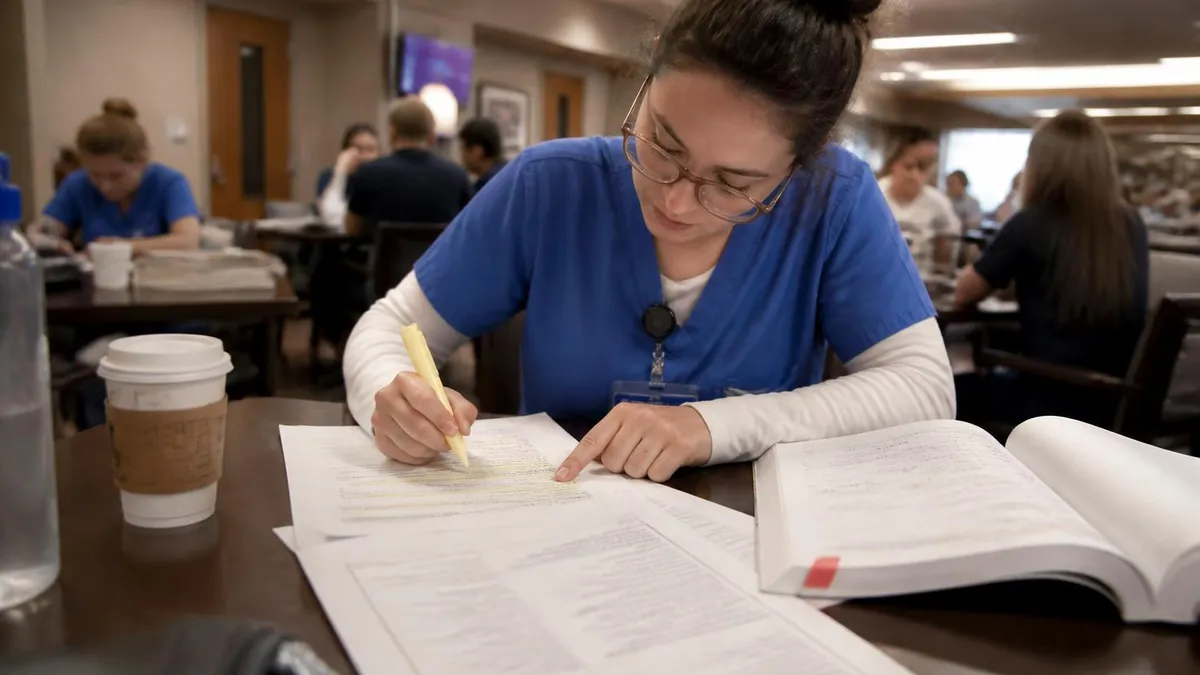
Your weakest section sets your ceiling
Most nursing programs evaluate section minimums, not just your composite average. That means a 95% in reading cannot rescue a 65% in math if the school requires 75% everywhere. Spend the bulk of your practice time on your single lowest section, because that is where every additional point actually changes your admission odds.
Scoring on the HESI A2 confuses many first-time applicants because there is no single universal passing grade. Elsevier reports a percentage for each section you take, and your nursing program decides what counts as passing. Some schools accept a composite of 75%, others demand 80% or higher, and a number of competitive programs set separate minimums for math and the sciences. Before you build a study plan, find your school's exact requirements in writing, because preparing for the wrong target wastes weeks of effort.
The most commonly required cutoff sits around 75% to 80%, but "required" and "competitive" are different numbers. A program might technically admit at 75% while the average accepted applicant scored 85%. If admission is competitive in your area, treat the published minimum as a floor, not a goal, and aim ten points higher. That buffer protects you against an unusually hard test form and strengthens an application competing against many qualified candidates for limited seats.
Section scores are reported individually, which is why balance matters so much. The exam does not let a brilliant reader coast through weak math. Each section stands alone on your report, and admissions committees see the breakdown. This is also why diagnostic testing is so valuable early on: it tells you which sections already clear the bar and which ones need urgent attention before you book the official appointment and start a retake clock you cannot easily stop.
Retakes are allowed but governed by waiting periods set by Elsevier and your school, often 30 to 60 days, with a cap on attempts per admission cycle. A failed or low section can therefore delay your application by a full term, which is the strongest argument for not rushing the real exam. It is almost always smarter to spend two extra weeks on hesi practice exams than to sit the test underprepared and burn one of your limited attempts on a preventable mistake.
Understand how your school combines scores, too. Some average every section into one composite; others weight the sciences more heavily for clinical programs; a few only look at math, reading, and vocabulary and ignore the rest. Knowing the formula tells you where each practice hour earns the most return. A program that ignores chemistry should not have you spending nights on stoichiometry while your reading score quietly sits below the cutoff line.
Finally, keep your official score report and any score-sharing requirements in mind. Many schools require results sent directly through Elsevier rather than self-reported screenshots, and processing takes time. Build that delay into your application timeline so a slow report does not cause you to miss a deadline. The goal is simple: hit every section minimum with a comfortable margin, on the first attempt, well ahead of your program's stated cutoff date.
HESI A2 retakes carry mandatory waiting periods and a cap on attempts per admission cycle, and the rules vary by school. A rushed, underprepared attempt can lock you out for an entire term. Confirm your program's retake policy and required score before scheduling, and only book once your practice scores clear the cutoff with margin.
Test-day performance is built in the final two weeks, and the candidates who pass comfortably treat that stretch differently from the early study phase. Early on, your job is learning content; in the last fortnight, your job is rehearsing execution. Stop introducing brand-new topics and start running full, timed simulations that mirror the real conditions. This shift from learning to performing is what separates applicants who know the material from applicants who can actually deliver it under a ticking clock and real fatigue.
Sleep and logistics matter more than one more cram session. A rested brain reads passages faster and makes fewer careless math slips than an exhausted one that studied until 2 a.m. In the two nights before the exam, protect your sleep, confirm your test center location and check-in time, and pack your ID and any permitted materials the night before. Arriving early and unhurried preserves the mental bandwidth you will need for the long academic sections. Round out your plan with a structured hesi a2 study guide for the final review.
Develop a per-question discipline you can repeat automatically. Read the full question before scanning answers, eliminate clearly wrong options first, and commit to a choice rather than agonizing. If a question stalls you for more than about ninety seconds, flag it, lock in your best guess, and move on. There is no penalty structure that rewards leaving items blank, so never surrender easy points later in a section because you bled time on one hard early question you could have skipped.
Manage the reading and vocabulary sections with a light touch. Over-reading passages is the most common time sink on the HESI A2. Skim for structure, then dive into detail only for the specific information a question asks about. For vocabulary, trust your first instinct on familiar words and use root-word logic on unfamiliar ones; prefixes like hyper-, hypo-, and suffixes like -itis unlock dozens of medical terms even when the full word is new to you on the screen.
For math, write everything down. Mental math feels fast but invites transcription errors under pressure, and many forms forbid calculators. Show your conversions, line up your decimals, and double-check ratio and percentage setups before solving. Dosage-style problems reward a slow, deliberate setup far more than speed. The handful of seconds you spend writing a clean equation almost always costs less than the minute you would spend re-solving a sloppy one that produced an answer not among the choices.
In the sciences, lean on understanding over memorized lists. When a biology or anatomy question stumps you, reason from function: what is this structure for, and what would logically follow? That approach often eliminates two wrong answers immediately. Keep your composure across the whole exam, because momentum is real; a strong, steady rhythm through early sections builds the confidence that carries you through the harder ones and onto a score that clears your program's cutoff.
With a plan in place, the last piece is turning practice into reliable test-day habits. The most practical tip is to build a fixed pre-question routine and use it on every single item, because consistency under pressure prevents the small lapses that quietly drain points. Read, eliminate, decide, move. Drilling that loop on hundreds of practice questions makes it automatic, so on the real exam your energy goes into the content itself instead of into deciding how to attack each new question.
Spaced repetition beats marathon cramming for the memory-heavy sections. Reviewing medical vocabulary, anatomy terms, and grammar rules for twenty focused minutes a day across two weeks embeds far more than a single six-hour weekend binge. Your brain consolidates information during the gaps between sessions, so short daily contact with the material outperforms long, exhausting blocks. Pair these review snippets with a few timed quiz questions each day and your scores climb steadily rather than spiking and crashing unpredictably.
Simulate stress, not just questions. Take at least one practice exam in conditions that feel slightly uncomfortable: a timer running, a public library instead of your quiet bedroom, no phone within reach. Training your focus against mild distraction makes the real testing center feel easy by comparison. Candidates who only ever practice in perfect calm sometimes panic when a neighbor coughs or the clock feels loud, so deliberately rehearsing imperfect conditions builds the composure that protects your score.
Do a targeted error review after every practice set. Instead of moving straight to the next quiz, spend ten minutes categorizing your misses: was it a content gap, a careless slip, a misread question, or a timing crunch? Each category has a different fix. Content gaps need study; careless slips need slowing down; misreads need a re-reading habit; timing crunches need pacing drills. Naming the cause turns a frustrating wrong answer into a precise, actionable improvement for next time.
Mind your physical readiness in the final stretch. Hydrate well in the days before, eat a steady, protein-containing meal beforehand, and avoid loading up on caffeine that spikes then crashes mid-exam. The HESI is long enough that blood sugar and hydration genuinely affect concentration in the later sections. Treat the exam like an athletic event: the preparation is mental, but the performance still runs on a rested, fueled, well-managed body that can hold focus for several hours straight.
Above all, trust the process you have built. By the time you sit the real exam, dozens of timed practice sets should have your pacing, your routine, and your weakest sections under control. Confidence on test day is not a personality trait; it is the natural byproduct of having already faced this exact challenge many times in practice. Walk in knowing you have done the work, execute the routine you rehearsed, and let your preparation carry you to the score your nursing program requires.
ATI Questions and Answers




How this page was made: written with AI tools and published by Nathan Beja, founder of Practice Test Geeks, who is responsible for its content. Exam facts are checked against the official sources listed below. Not reviewed by a subject-matter expert. Editorial policy
Sources & references
Exam facts on this page (fees, format, dates, passing scores) are checked against these official sources; the date is our last check. Editorial policy
- service.elsevier.com — Score release, registration deadline, eligibility, test delivery · verified Oct 2026
- evolve.elsevier.com — Retake policy, time limit · verified Oct 2026