
Free HESI A2 PDF: Download Practice Questions, Answers & Study Notes (2026)
Get a free download HESI A2 PDF with practice questions, answers and study notes. Full HESI A2 practice test prep for math, reading and science in 2026. 🏆

If you searched for a free.download.hesi.a2.pdf you are almost certainly preparing for one of the most consequential gatekeeping tests in American nursing education. The HESI A2 (Admission Assessment Exam) decides whether thousands of applicants advance into nursing programs each year, and a downloadable PDF of practice questions, answer keys and study notes is the single most requested resource we hear about. This page gives you exactly that resource plus a complete walkthrough of how to use it so the PDF actually moves your score instead of sitting unused in a downloads folder. Practice with the free HESI (ATI) practice test on PracticeTestGeeks (300+ questions with answer explanations).
Let us be honest about why a HESI A2 PDF is so appealing. A printable file works offline, prints onto paper you can mark up, and travels with you whether you study on a lunch break, a bus, or at a kitchen table. But a PDF alone is not a strategy.
The students who pass the hesi exam on their first attempt pair printed review material with timed, interactive drilling. Throughout this guide we show you how to combine our free downloadable notes with the live practice hesi a2 test questions on this site for a feedback loop that mirrors test day.
The HESI is not a single subject. It bundles math, reading comprehension, vocabulary, grammar, biology, chemistry, anatomy and physiology, and sometimes physics into one sitting. Each school chooses which sections to require and sets its own passing cutoff, usually between 75 and 80 percent. That means a HESI A2 PDF needs to cover a wide span of material, and a quality study plan has to triage your weak areas fast. We have built this resource so you can identify gaps within the first week and spend the remaining weeks closing them.
A common trap is treating the hesi like a high-school final you can cram for the night before. It is not. The math section alone expects fluency with fractions, ratios, proportions, decimals, percentages, military time, Roman numerals, and basic dosage-style conversions. The science sections assume you remember cellular biology, the periodic table, and the organ systems. A printable PDF helps you see the full scope on paper, and a good practice test reveals which topics you only think you understand.
This article is written for a United States audience applying to ADN, BSN, and accelerated nursing pathways. Whether your school calls it the Evolve Reach exam, the A2, or simply the hesi, the content and the strategy are the same. We will cover the exam format, a section-by-section breakdown, the smartest way to use a free PDF, pros and cons of printable prep, a study checklist, and ten of the questions applicants ask us most often before test day.
By the end you will know precisely how to download, print, and drill the HESI A2 PDF, how many weeks of prep a realistic score jump requires, and where to find full-length interactive questions when paper is not enough. Bookmark this page, grab the PDF when the download box appears below, and start with the diagnostic quiz so you have a baseline number to beat. A measured starting point is worth more than a week of unfocused reading, and it keeps your study sessions honest from day one.
Free HESI (ATI) Study Tools
Interactive HESI (ATI) resources on PracticeTestGeeks, free to start:
- HESI Chemistry Practice Test 1 — 16 questions with instant scoring and answer explanations
- HESI (ATI) flashcards — review key terms and concepts card by card
- HESI (ATI) study guide — topic-by-topic overview of what the exam covers
- HESI (ATI) cheat sheet — one-page printable summary for last-minute review
HESI A2 by the Numbers
HESI: upcoming dates and official changes
- Updated Oct 20, 2026: Delivery (HESI Next Generation) is now Onsite school proctor or remote proctoring (school proctor or 3rd-party vendor) (previously Onsite school proctoring or remote vendor proctoring).
- Updated Oct 20, 2026: Score release (HESI Admission Assessment (A2) — Legacy platform) is now Within 24 hours after completing test sections (previously Within 24 hours after completing test sections).
- Updated Oct 20, 2026: Score release (HESI Specialty and Exit exams — Legacy platform) is now 24–48 hours after exam closure (previously 24–48 hours after exam closure).
Facts verified Oct 20, 2026 against Elsevier. Dates that have passed are removed automatically.
- For the HESI A2 in HESI Next Generation, the estimated exam duration depends on which sections the school selects, and the school can adjust it manually. (Elsevier)
- In HESI Next Generation, schools schedule the HESI A2 as Version 1 for first-time testers or Version 2 for second-time testers, so a retake uses a different exam version. (Elsevier)
- HESI Next Generation exams can be proctored onsite by a school proctor or remotely, either by a school proctor over a group meeting platform or by a third-party proctoring vendor. (Elsevier)
- When a HESI Next Generation exam is set up as student-pay, the student must pay before testing and cannot test until payment is received. (Elsevier)
- On the HESI Legacy platform, HESI Admission Assessment (A2) results show within 24 hours after the student completes the test sections. (Elsevier)
- On the HESI Legacy platform, HESI Specialty and Exit exam results appear 24 to 48 hours after the exam is closed. (Elsevier)
Facts verified Oct 20, 2026 against Elsevier. Dates that have passed are removed automatically.
HESI Exam at a Glance
| Item | Detail | Official source |
|---|---|---|
| Time limit (HESI Admission Assessment (A2) — HESI NG) | Set by the school based on the sections selected | Elsevier |
| Retake policy (HESI Admission Assessment (A2) — HESI NG) | Separate exam version for second-time testers | Elsevier |
| Delivery (HESI Next Generation) | Onsite school proctor or remote proctoring (school proctor or 3rd-party vendor) | Elsevier |
| Eligibility (HESI Next Generation — student-pay exams) | Payment required before testing | Elsevier |
| Score release (HESI Admission Assessment (A2) — Legacy platform) | Within 24 hours after completing test sections | Elsevier |
| Score release (HESI Specialty and Exit exams — Legacy platform) | 24–48 hours after exam closure | Elsevier |
| Registration deadline (HESI Distance Testing — retake registration) | Wait 24 hours before re-registering with the same Department ID | Elsevier |
Facts verified Oct 20, 2026 against Elsevier. Dates that have passed are removed automatically.
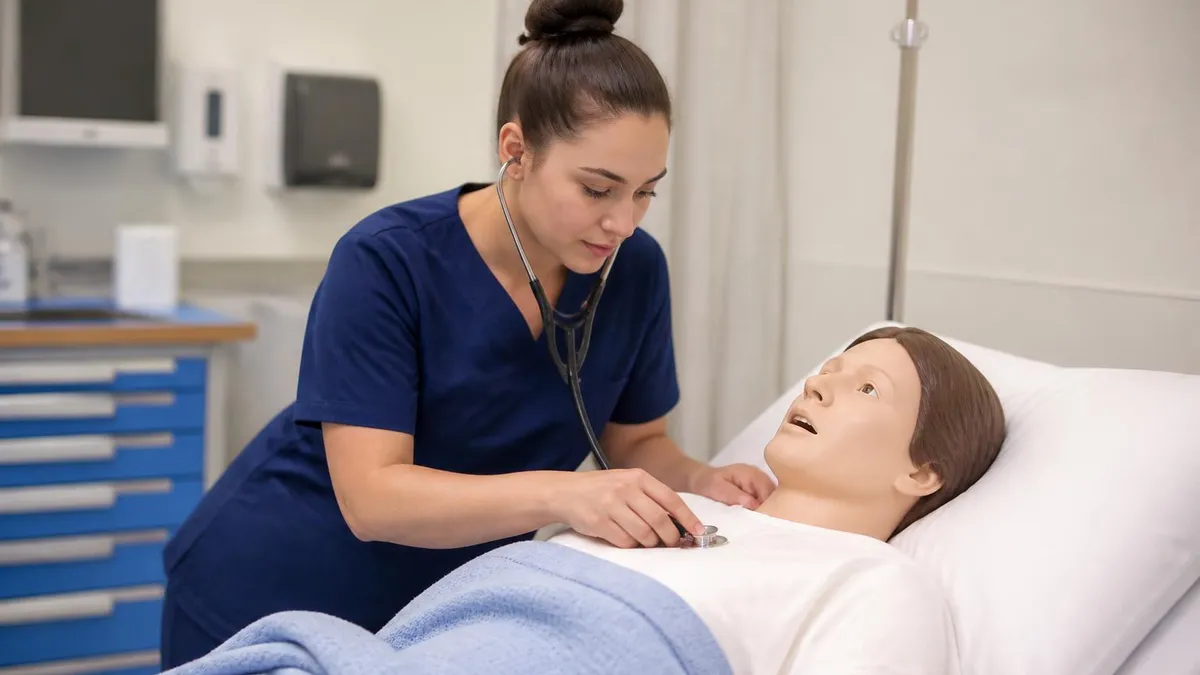
HESI A2 Exam Format
| Section | Questions | Time | Weight | Notes |
|---|---|---|---|---|
| Mathematics | 50 | 50 min | Core | Fractions, ratios, dosage conversions |
| Reading Comprehension | 47 | 60 min | Core | Main idea, inference, tone |
| Vocabulary & General Knowledge | 50 | 50 min | Core | Medical and everyday terms |
| Grammar | 50 | 50 min | Common | Usage, parts of speech |
| Biology | 25 | 25 min | Science | Cells, metabolism, genetics |
| Chemistry | 25 | 25 min | Science | Atoms, reactions, periodic table |
| Anatomy & Physiology | 25 | 25 min | Science | Organ systems and function |
| Total | 326 | Approx. 4-5 hours | 100% |
A free HESI A2 PDF only helps if you use it deliberately. The biggest mistake students make is reading the PDF cover to cover like a novel, highlighting everything, and never testing recall. Instead, treat the document as a structured workbook. Start by skimming the table of contents, then jump straight to a diagnostic set of questions so you collect a baseline score. That number, even if it stings, tells you where to spend your hours. Pair the printed questions with the interactive hesi pretest here to confirm the gaps are real.
Print only what you will actually mark up. Most students waste paper printing every page when they only need the math conversion charts, the A&P diagrams, and the question banks. Keep the answer key on a separate sheet so you cannot peek mid-drill. Self-honesty during practice is the whole point; a score you inflate by glancing at answers is a score you will not reproduce on test day. Fold the answer key away, work the full set, then grade in one pass and log every miss.
Build a simple error log next to your printed PDF. For every question you miss, write one line: the topic, why you missed it, and the correct reasoning. After a week you will have a personalized weakness map that is far more valuable than any generic study list. Most applicants discover their misses cluster in two or three areas, usually math conversions, chemistry nomenclature, and reading inference. Concentrating your remaining time on those clusters produces the fastest score gains for the least effort.
Use the PDF for spaced repetition rather than one marathon session. Research on memory is unambiguous: three thirty-minute sessions across three days beat one ninety-minute block. Mark each printed question set with the date you completed it, then revisit missed items two days later. The physical paper makes this easy because you can literally flip back to your annotations. This rhythm of test, review, and re-test is what converts short-term recognition into the durable recall the hesi exam demands under time pressure.
Combine the static PDF with timed digital drills to simulate real conditions. Paper is excellent for learning and annotation, but it cannot enforce a clock or shuffle questions the way the computerized HESI does. Once you can answer printed sets comfortably, move to full-length timed quizzes on this site. The transition from untimed paper to timed screen is where many students realize pacing, not knowledge, is their real obstacle. Practicing both formats removes that surprise before it can cost you points.
Finally, keep the PDF accessible but not your only resource. A downloadable file is perfect for offline study during commutes, breaks, or anywhere Wi-Fi is unreliable. Treat it as the portable backbone of a plan that also includes interactive quizzes, video review for stubborn concepts, and at least two full-length timed simulations in your final week. Students who blend formats this way report calmer test days and more consistent scores than those who relied on a single PDF or a single app alone.
HESI A2 Practice Test: Section-by-Section Breakdown
The math section is the most coachable on the entire exam because it rewards procedure over insight. Expect fractions, decimals, percentages, ratios, proportions, military time, Roman numerals, and household-to-metric conversions. Many programs treat math as the single most important section, so a printed conversion chart in your PDF is gold. Drill until you can convert 1/4, 0.25, and 25 percent without thinking, and memorize that 1 teaspoon equals 5 milliliters.
Reading comprehension on the HESI tests main idea, supporting details, inference, author tone, and vocabulary in context. Passages are short and clinical, similar to patient-education handouts. The trick is to answer from the passage, never from outside knowledge. Practice identifying the single sentence that states the main idea, then predict the answer before reading the choices. This discipline prevents the cleverly worded distractors from pulling you toward a wrong but tempting option.

Is a Free HESI A2 PDF Enough to Pass?
- +Works completely offline for study anywhere, anytime
- +Printable so you can annotate, highlight and mark misses
- +Free, with no subscription or account required to start
- +Great for spaced repetition and building an error log
- +Portable backbone for commutes, breaks and travel
- +Lets you see the full scope of all sections on paper
- −Cannot enforce a timer the way the real HESI does
- −No automatic scoring or instant answer feedback
- −Questions do not shuffle, so order memorization can mislead
- −May be outdated if the file is from an old test cycle
- −No analytics to track weak topics over time
- −Tempts students to peek at answers without discipline
HESI A2 Practice Test Prep Checklist
- ✓Download the free HESI A2 PDF and print only the pages you will mark up.
- ✓Take a diagnostic practice test to record your honest baseline score.
- ✓List which sections your school actually requires and ignore the rest.
- ✓Build an error log with topic, reason missed, and correct reasoning.
- ✓Memorize core math conversions like 1 tsp equals 5 mL.
- ✓Make flashcards for the twenty vocabulary words you miss most.
- ✓Label A&P diagrams from memory, then quiz yourself on function.
- ✓Schedule three short study sessions instead of one long cram block.
- ✓Run at least two full-length timed simulations in your final week.
- ✓Confirm test logistics: date, location, ID, and calculator policy.

Your timed practice average beats any single study hour count.
Students who score their final two full-length timed practice tests within five points of their school's cutoff pass at far higher rates than those who only studied untimed. If your timed average is below the cutoff, delay your real attempt and drill weak sections rather than gambling on test day.
Understanding how the HESI A2 is scored removes a surprising amount of test-day anxiety. Each section is scored as a percentage of correct answers, and your school sets the cutoff you must hit. There is no universal passing score; one program may accept 75 percent overall while another demands 80 percent on math and A&P specifically. Before you build a study plan, find your program's exact requirement in writing. Studying to the wrong target is one of the most common and avoidable mistakes applicants make every cycle.
Some sections carry more weight than others depending on the program. Nursing schools frequently prioritize math and anatomy and physiology because those subjects map directly onto safe clinical practice and dosage calculation. If your program weights math heavily, a 90 percent in vocabulary will not rescue a 68 percent in math. This is why your error log and diagnostic score matter so much: they let you pour time into the sections that actually decide your admission rather than spreading effort evenly.
The HESI also reports a set of secondary scores that students often misread. You may see a Learning Style and a Personality Profile section that are not pass-fail and do not affect admission at most schools. Do not waste prep time worrying about these. Your energy belongs on the academic sections that produce the percentage your school evaluates. If an advisor tells you the profiles matter for your specific program, address them, but treat them as low priority until then.
Retake policies vary widely and you must know yours before your first attempt. Many programs allow two or three attempts within a twelve-month window, and some impose a mandatory waiting period of thirty to sixty days between tries. A few schools average your attempts rather than taking your best score, which dramatically raises the stakes of a rushed first sitting. Read the policy carefully, because a single sentence about averaging can change your entire strategy for when to test.
If you do need to retake, resist the urge to immediately re-register and try again. Use the score report to diagnose precisely which sections fell short, then dedicate at least two to three focused weeks to those areas before testing again. A retake with the same preparation that failed the first time usually produces the same result. Targeted improvement, guided by your printed PDF and timed digital drills, is what turns a near miss into a comfortable pass on attempt two.
Finally, give yourself a realistic timeline. Most students who start below the cutoff need eight to twelve weeks of consistent study to cross it reliably. If you are within a few points already, three to four focused weeks may suffice. Map your remaining weeks against your weakest sections, schedule your real exam only after your timed practice scores stabilize above the target, and treat the registration date as a commitment you earn through practice rather than an arbitrary deadline you hope to meet.
A minority of nursing programs average all your HESI A2 attempts instead of taking the highest score. If yours does, a rushed first attempt can permanently drag down your composite. Confirm the policy in writing and never sit the exam until your timed practice scores consistently clear the cutoff.
With your diagnostic done and your weak sections mapped, the final stretch is about consolidation, not new material. In the last two weeks, stop trying to learn unfamiliar topics and instead reinforce what you nearly know. The HESI rewards reliable recall of fundamentals far more than fragile knowledge of edge cases. Work through your printed PDF question banks one more time, focusing on the items in your error log, and pair them with a full-length hesi practice exam to confirm your timing holds under pressure.
Build your stamina deliberately. The full HESI battery can run four to five hours, and mental fatigue late in the exam causes careless errors on questions you would normally answer correctly. Simulate this by doing back-to-back timed sections in a single sitting at least twice before test day. If you only ever practice one short section at a time, the real exam's length will feel like a wall. Training your endurance is as important as training your knowledge for this particular test.
Master the on-screen calculator and the interface early. Some HESI versions provide an on-screen four-function calculator while others do not, and your school's testing center sets the rules. Find out which applies to you and practice accordingly. If no calculator is allowed, your math drills must include longhand division and fraction work until it is fast and accurate. Discovering a no-calculator policy on test morning is a shock you can completely eliminate with one email to your advisor.
Manage your pacing with a simple rule: never spend more than ninety seconds on a single question during the real exam. Flag anything that stalls you, move on, and return if time allows. Most sections give you roughly a minute per question, so a single problem that eats four minutes can cost you three easier points elsewhere. Practicing this discipline on timed digital quizzes makes it automatic, so you protect your score instead of sinking it on one stubborn item.
Take care of the logistics that quietly sink unprepared test takers. Confirm your exam date, arrival time, accepted photo ID, and what you may bring into the room. Many centers prohibit phones, smartwatches, and scratch paper of your own. Plan your travel so you arrive at least fifteen minutes early, sleep a full night before, and eat a real meal. These boring details have nothing to do with content yet routinely cost rattled applicants the calm they need to perform.
On the morning of the test, trust your preparation and resist last-minute cramming. Reviewing dense new notes an hour before the exam tends to raise anxiety without raising scores. Instead, glance at your highest-value flashcards, your math conversion chart, and a few A&P diagrams to warm up, then close the materials. Walk in confident that your printed PDF, your error log, and your timed practice have already done the heavy lifting. Calm, rested recall is what carries you across the cutoff.
Let us turn everything above into a concrete, day-by-day approach you can start tonight. Begin with a single honest diagnostic across the sections your school requires, then divide your remaining weeks into a learning phase and a consolidation phase. During the learning phase, spend roughly seventy percent of your time on your two weakest sections and thirty percent maintaining your stronger ones. This split prevents the common failure of over-studying comfortable material while your real liabilities stay untouched until it is far too late to fix them.
For math, drill conversions until they are reflexive and keep a printed cheat sheet beside every practice set. Knowing that 1 kilogram equals 1000 grams, 1 liter equals 1000 milliliters, and 1 teaspoon equals 5 milliliters should require zero thought. Practice multi-step word problems that combine a conversion with a calculation, because that is how the HESI raises difficulty. The goal is not to be clever but to be fast and accurate, leaving mental bandwidth for the trickier reasoning questions that appear later in the section.
For reading and vocabulary, read short clinical passages daily and force yourself to summarize each in one sentence. This single habit sharpens main-idea recognition more than any worksheet. For vocabulary, lean on spaced repetition with a small rotating flashcard deck rather than long lists you skim once. Twenty words reviewed daily for two weeks stick far better than two hundred words crammed in one weekend. Quality of repetition beats quantity of exposure every time on memorization-heavy sections like these.
For the science sections, prioritize the systems and concepts that appear most often. In A&P, the cardiovascular, respiratory, and nervous systems are perennial favorites, so know their structures and functions cold. In biology, the cell, cellular respiration, and basic genetics dominate. In chemistry, atomic structure, the periodic table, and acid-base basics carry the most weight. Use your PDF diagrams to label and re-label until you can reproduce them from a blank page without hesitation or hints.
Throughout, alternate between your printed PDF and timed digital quizzes so you build both knowledge and test-taking stamina. Paper is where you learn and annotate; the screen is where you rehearse the real conditions of a timed, computerized exam. Students who only do one or the other consistently underperform those who blend them. The no hesi html game style of interactive drilling on this site is a perfect complement to quiet, focused paper review during your learning phase.
End every week with a short self-audit. Look at your error log, count how many of last week's misses you now answer correctly, and adjust your time split for the coming week toward whatever still lags. This weekly loop of test, log, review, and re-test is the engine behind every reliable score gain we see. It is unglamorous and it works. Trust the process, keep your sessions short and frequent, and let the accumulating small wins carry you confidently to test day.
Sample HESI (ATI) Practice Questions
Try these questions from our free HESI (ATI) practice tests. The correct answer and an explanation follow each question.
How many pints are in 80 ounces?
- A. 16 pints
- B. 1,280 pints
- C. 15 pints
- D. 5 pints
Answer: D. 5 pints
To convert ounces to pints, you need to know that 1 pint (pt) is equal to 16 ounces (oz). Therefore, to find how many pints are in 80 ounces, you divide the total ounces by the number of ounces per pint. This calculation is 80 ÷ 16, which equals 5 pints.
After the storm, telephone poles ____________ all over the street.
- A. were lying
- B. were laying
- C. lied
- D. laid
Answer: A. were lying
The verb 'to lie' (meaning to recline or rest) is intransitive, meaning it does not take a direct object. Its present participle is 'lying.' The sentence describes telephone poles resting on the street. 'To lay' (meaning to place something down) is transitive and requires a direct object, while 'lied' is the past tense of 'to lie' (to tell an untruth).
How many teaspoons are there in 5 tablespoons?
- A. 1.67 Tsps.
- B. 0.6 Tsps
- C. \t15 Tsps.
- D. 1.5 Tsps
Answer: C. \t15 Tsps.
To convert tablespoons to teaspoons, you use the standard conversion factor where 1 tablespoon (tbsp) is equal to 3 teaspoons (tsp). Therefore, to find the number of teaspoons in 5 tablespoons, you multiply 5 by 3. This calculation yields 15 teaspoons.
Which sentence contains a dangling modifier?
- A. Running down the hallway, the nurse reached the patient in time.
- B. After reviewing the labs, the doctor ordered a new medication.
- C. Exhausted from the long shift, the break room offered some relief.
- D. Having finished her charting, she clocked out for the night.
Answer: C. Exhausted from the long shift, the break room offered some relief.
In 'Exhausted from the long shift, the break room offered some relief,' the modifier 'exhausted from the long shift' incorrectly modifies 'break room' rather than a person. A break room cannot be exhausted. The sentence should read: 'Exhausted from the long shift, she found some relief in the break room.'
📝 What is the HESI A2 and why does it matter?
The HESI A2 (Admission Assessment Exam) is a pre-admission test from Elsevier/HESI used by nursing programs to screen applicants. It measures academic readiness across math, reading, vocabulary, grammar and science. Strong scores help you earn a seat in a competitive program.
START A&P PRACTICE TEST🔢 How many questions are on the HESI A2?
A full HESI A2 has up to about 326 items, but most schools choose a subset of sections. Each academic section typically holds 25 to 55 scored questions plus unscored pilot items. Always confirm which sections your program requires before using any practice questions PDF.
START A&P PRACTICE TEST🧮 What math is tested on the HESI A2?
The math section covers basic operations, fractions, decimals, percentages, ratios, proportions and simple algebra, plus dosage and measurement conversions nurses use daily. A printable practice set helps you drill conversions like ounces to pints by hand before test day.
START MATH PRACTICE TEST🫀 What does the Anatomy & Physiology section cover?
The A&P section tests organ systems, body structures and how they function together, from the cardiovascular and respiratory systems to the skeletal and nervous systems. Many programs weight A&P heavily, so free printable study notes and timed drills are worth repeating until recall is automatic.
START A&P PRACTICE TEST🧬 Is Biology part of the HESI A2 science block?
Yes. The Biology section covers cells, metabolism, cellular respiration, photosynthesis, genetics and basic molecules. It is one of several optional science sections, so check whether your nursing program requires it and target your HESI A2 practice questions PDF accordingly.
START BIOLOGY PRACTICE TEST⚗️ What chemistry topics appear on the exam?
HESI A2 chemistry covers atomic structure, the periodic table, chemical bonding, reactions, the metric system and basic stoichiometry. These concepts support medication math and lab work in nursing school, so pair chemistry drills with your math practice for the best study plan.
START CHEMISTRY PRACTICE TEST📖 How is Reading Comprehension scored?
The reading section gives you passages and asks you to find the main idea, identify supporting details, draw inferences and understand word meaning in context. There is no outside knowledge required. Practicing with a free printable study guide trains you to read quickly and answer precisely under time.
START CRITICAL THINKING TEST🔤 What is on the Vocabulary and Grammar sections?
Vocabulary tests general and health-related word meanings, while Grammar checks parts of speech, sentence structure, common usage errors and punctuation. Both reward steady review of word lists and rules, which is why many students print flashcards and quiz themselves daily before the HESI A2.
START CRITICAL THINKING TEST🧠 Is there a Critical Thinking section?
Yes. The Critical Thinking section measures clinical reasoning, judgment and decision-making with scenario questions. Unlike academic sections, it is scored separately and is not always required. Practicing scenario questions sharpens the reasoning you will use throughout nursing school and on the NCLEX.
START CRITICAL THINKING TEST🎓 How does the HESI A2 differ from the HESI LPN Exit Exam?
The HESI A2 is an admission test taken before nursing school, while the HESI LPN Exit Exam is a predictor taken near graduation to gauge NCLEX-PN readiness. They test different content, so a free HESI A2 PDF prepares you for entry, not for the exit exam.
START BIOLOGY PRACTICE TESTATI Questions and Answers
Official Resources
- Elsevier HESI Exam Solutions — the official publisher page for the HESI Admission Assessment (A2) exam, with details on sections, formats and the testing program.
- Evolve by Elsevier — the official platform where students register for, schedule and take HESI exams and access results.

HESI Exam Study Guide: Complete A2 Prep, Practice Tests & Score Targets

Free HESI Practice Test 2026: Full-Length Questions, Answers & Score Predictor

HESI Practice Test Free: Complete 2026 A2 Study Guide & Question Bank
HESI A2 Study Guide: Sections, Score Targets and Prep Plan

HESI A2 Practice Test Free: Complete 2026 Question Bank, Answers & Score Predictor
How this page was made: written with AI tools. Exam facts are checked against the official sources listed below. Not reviewed by a subject-matter expert. Editorial policy
Sources & references
Exam facts on this page (fees, format, dates, passing scores) are checked against these official sources; the date is our last check. Editorial policy
- service.elsevier.com — Score release, registration deadline, eligibility, test delivery · verified Oct 2026
- evolve.elsevier.com — Retake policy, time limit · verified Oct 2026