
ASE Practice Test 2026 September — Automotive Service Excellence Exam Prep
💯 Boost your ASE exam score with practice questions and detailed answer explanations. Track progress with instant feedback.

What Is ASE Certification?
The National Institute for Automotive Service Excellence (ASE) is an independent nonprofit organization that tests and certifies automotive technicians and other professionals in the auto service industry. Founded in 1972, ASE certification is the most widely recognized professional credential in the automotive repair field.
Unlike a license, ASE certification is entirely voluntary — but it carries enormous weight with employers, customers, and industry peers. When a technician holds an ASE certification, it signals to everyone that they've met a rigorous national standard of knowledge and hands-on competence.
More than 300,000 automotive professionals currently hold active ASE certifications. Whether you're just entering the field or a seasoned technician looking to advance, preparing with an ASE practice test is one of the most effective ways to validate your skills and boost your career prospects.
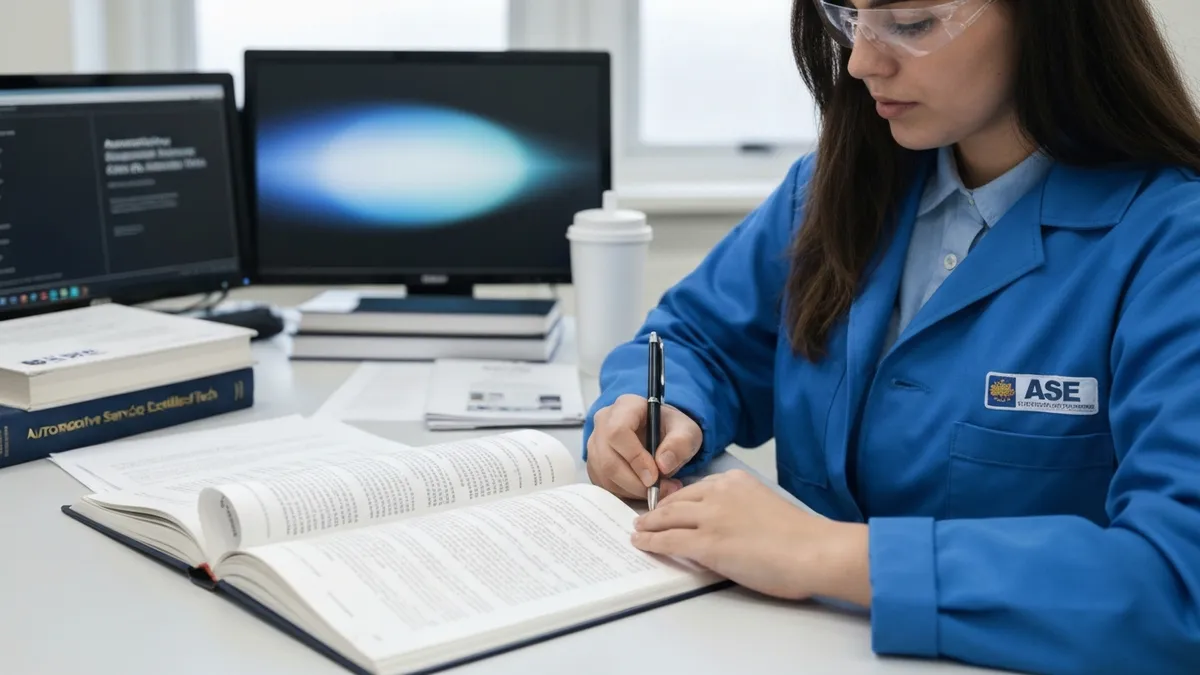
ASE Exam Format & Structure
Every ASE certification exam follows a consistent, computer-based format administered at authorized Prometric testing centers across the United States. Understanding the structure before test day removes surprises and lets you focus entirely on your automotive knowledge.
- Question count: 40–80 multiple-choice questions depending on the specific test
- Time limit: 30–50 minutes per test (varies by series)
- Delivery: Computer-based testing (CBT) at Prometric centers
- Question style: Single-best-answer multiple choice; many questions use diagnostic scenarios that require you to interpret symptoms and recommend the correct repair
- Calculator: Not required or permitted — all calculations are straightforward
Unlike some trade exams, the ASE does not use trick wording. Questions are written by active automotive professionals and are reviewed by industry panels to ensure they reflect real-world shop situations. That means the best preparation is a combination of hands-on experience and structured practice with realistic questions through an ASE automotive technician test simulator.

Passing Scores & Exam Cost
ASE does not publish a universal cut score, but industry guidance consistently cites approximately 70% correct answers as the passing threshold. The exact number of questions you must answer correctly varies slightly by test because each exam is independently scaled based on the difficulty of its question pool.
ASE Exam Fees (2026)
- Registration fee: ~$36 (one-time per testing window)
- Per-test fee: $27–$56 per exam depending on the series
- Retake: Full per-test fee applies; no waiting period for a second attempt
Many dealerships and independent shops reimburse ASE testing fees as an employee benefit. Check with your employer before paying out of pocket. Some vocational schools also cover fees for students in ASE-accredited programs.
Consistent practice with a quality ASE certification exam prep tool is the most reliable way to hit that 70% threshold on your first attempt and avoid retake costs.
ASE Key Concepts
What is the passing score for the ASE exam?
Most ASE exams require 70-75% to pass. Check the official exam guide for exact requirements.
How long is the ASE exam?
The ASE exam typically allows 2-3 hours. Time management is critical for success.
How should I prepare for the ASE exam?
Start with a diagnostic test, create a 4-8 week study plan, and take at least 3 full practice exams.
What topics does the ASE exam cover?
The ASE exam covers multiple domains. Review the official content outline for the complete list.
- ✓Download the official ASE Preparation Guide for your specific test series and review all task lists
- ✓Target electrical/electronic systems (A6) first — it has the highest failure rate across all A-series tests
- ✓Complete at least 3 full-length timed ASE practice tests under exam conditions before test day
- ✓Review your wrong answers by topic and create a short note card for each weak area
- ✓Use ASE's official study guides alongside hands-on practice to reinforce diagnostic reasoning
- ✓Schedule your Prometric appointment at least 2 weeks in advance to secure your preferred location and time

ASE Blue Seal & Recertification
The ASE Blue Seal of Excellence is awarded to technicians who pass every exam within a complete series. For most automotive technicians, earning all nine A-series certifications (A1 through A9) qualifies for Blue Seal status. The designation is also available to shops: if at least 75% of a shop's technicians are ASE certified and the shop employs at least one master technician, the entire shop can display the Blue Seal logo.
Blue Seal status signals the highest level of professional competence in the industry and is frequently a prerequisite for senior technician or shop foreman positions at major dealerships and fleet operators.
Recertification Every 5 Years
ASE certifications expire every 5 years. To recertify, technicians must pass updated exams that reflect changes in vehicle technology. This keeps the credential meaningful — an ASE-certified tech from 2015 cannot simply rest on that credential as hybrid, electric, and advanced driver assistance systems (ADAS) technology has fundamentally changed the industry.
Starting your recertification preparation early with an ASE certified technician practice resource ensures you're current on updated content before your window closes.
Salary Impact of ASE Certification
The financial return on ASE certification is well documented. According to Bureau of Labor Statistics (BLS) data, the median annual wage for automotive service technicians and mechanics is approximately $47,930. ASE-certified technicians consistently earn 10–20% more than their non-certified counterparts in comparable roles.
Beyond the direct salary premium, certification opens doors to:
- Senior technician and diagnostic specialist roles at dealerships
- Fleet maintenance positions with government agencies and logistics companies
- Instructor and training roles at vocational schools
- Independent shop ownership — customers actively seek shops staffed by certified technicians
The cost of the entire A-series certification (registration + all nine tests) runs under $600. For the career earnings premium that follows, it's one of the strongest returns on investment available in the skilled trades.
Study Tips & Strategies for the ASE Practice Test
Automotive technicians who score well on ASE exams consistently use a few proven strategies. Whether you're attempting your first certification or recertifying after five years, these approaches maximize your preparation time.
1. Focus on Electrical Systems First
The A6 Electrical/Electronic Systems exam has the industry's highest failure rate. Modern vehicles run on increasingly complex electrical architectures, and many experienced technicians have gaps in circuit diagnosis and CAN bus systems. Prioritize this area in every study session regardless of which exam you're targeting.
2. Study System by System, Not Question by Question
ASE exams test understanding, not memorization. Instead of grinding through random questions, study each task in the ASE task list as a complete system — understand how it works, how it fails, and how to diagnose it. Then validate your understanding with timed ASE practice test questions.
3. Use the Process of Elimination
ASE questions always have one clearly correct answer. When uncertain, eliminate the two most obviously wrong options and reason through the remaining two using what you know about the system in question. This approach alone can improve your score by several percentage points.
4. Simulate Real Exam Conditions
Take your practice tests timed and without interruptions. The 30–50 minute window feels short when you're working through diagnostic scenarios. Building exam stamina through timed practice prevents time-pressure mistakes on the real test.
- +Industry-recognized credential boosts your resume
- +Higher earning potential (10-20% salary increase on average)
- +Demonstrates commitment to professional development
- +Opens doors to advanced career opportunities
- −Exam preparation requires significant time investment (4-8 weeks)
- −Certification fees can be $100-$400+
- −May require continuing education to maintain
- −Some employers may not require certification
Join the Discussion
Connect with other students preparing for this exam. Share tips, ask questions, and get advice from people who have been there.
View discussion (7 replies)