

UKATA Practice Test
Updated October 2026Facts verified Oct 28, 2026 against United Kingdom Asbestos Training Association
- The UKATA Asbestos Awareness course learning outcomes are assessed by a multiple-choice examination consisting of at least 15 questions taken from the UKATA question bank.[1]
- The UKATA Asbestos Awareness exam has a guideline completion time of approximately 20 minutes.[1]
- Candidates must achieve a passing score of at least 12 out of 15 (80%) in the UKATA Asbestos Awareness exam.[1]
- Learners failing the UKATA Asbestos Awareness exam are required to re-sit the exam under exam conditions, and failing a second attempt requires retaking the entire course.[1]
- Certification for the UKATA Asbestos Awareness training course is valid for one year.[1]
- UKATA recommends that Asbestos Awareness renewal or refresher training is carried out annually, with a duration of at least 1.5 learning hours determined by a training needs analysis.[1]
- The approved training delivery methods for UKATA Asbestos Awareness along with the maximum tutor to learner ratios are classroom (1:15), virtual classroom (1:12), or self-paced e-learning.[1]
- There are no prerequisites required to undertake the UKATA Asbestos Awareness course or its examination.[2]
Numbers in brackets link to the official sources listed under Sources & last verified. Dates that have passed are removed automatically.
UKATA Exam at a Glance
| Item | Detail | Source · Verified |
|---|---|---|
| Number of questions (AA01 - Asbestos Awareness) | At least 15 multiple-choice questions[1] | United Kingdom Asbestos Training Association · Oct 27, 2026 |
| Time limit (AA01 - Asbestos Awareness) | Approximately 20 minutes (guideline)[1] | United Kingdom Asbestos Training Association · Oct 27, 2026 |
| Passing score (AA01 - Asbestos Awareness) | 12 out of 15 (80%)[1] | United Kingdom Asbestos Training Association · Oct 27, 2026 |
| Retake policy (AA01 - Asbestos Awareness) | One exam re-sit; a second fail requires retaking the course in its entirety[1] | United Kingdom Asbestos Training Association · Oct 27, 2026 |
| Validity (AA01 - Asbestos Awareness) | 1 year[1] | United Kingdom Asbestos Training Association · Oct 27, 2026 |
| Renewal (AA01 - Asbestos Awareness) | Annual refresher, minimum 1.5 learning hours[1] | United Kingdom Asbestos Training Association · Oct 27, 2026 |
| Delivery (AA01 - Asbestos Awareness) | Classroom (1:15), virtual classroom (1:12), or self-paced e-learning[1] | United Kingdom Asbestos Training Association · Oct 27, 2026 |
| Eligibility (AA01 - Asbestos Awareness) | No prerequisites[2] | United Kingdom Asbestos Training Association · Oct 27, 2026 |
What changed for UKATA in 2026
- Oct 27, 2026: Delivery (AA01 - Asbestos Awareness) changed to Classroom (1:15), virtual classroom (1:12), or self-paced e-learning (previously Classroom (1:15), virtual classroom (1:12) or self-paced e-learning).[1]
- Oct 27, 2026: Time limit (AA01 - Asbestos Awareness) changed to Approximately 20 minutes (guideline) (previously About 20 minutes (guideline)).[1]
- Oct 27, 2026: Retake policy (AA01 - Asbestos Awareness) changed to One exam re-sit; a second fail requires retaking the course in its entirety (previously One exam re-sit; a second fail means retaking the whole course).[1]
- Oct 27, 2026: Validity (AA01 - Asbestos Awareness) changed to 1 year (previously Valid for 1 year).[1]
What are the key eligibility requirements for the UKATA?
Candidates must meet the educational and professional requirements set by the UK certification body. Check official prerequisites before applying.
Start FREE TestWhat is the best strategy for UKATA exam preparation?
Combine official study materials with practice tests, focus on weak areas, and create a structured revision timetable leading up to exam day.
Start FREE TestHow is the UKATA exam scored?
The UKATA uses a standardised scoring system. Results are typically provided as pass/fail, with detailed score reports available for each domain area.
Start FREE TestWhat should I bring on UKATA exam day?
Bring valid photo identification, your exam confirmation, and any approved materials. Arrive early and review the testing centre rules beforehand.
Start FREE TestWhat the UKATA is and how it works
According to United Kingdom Asbestos Training Association, “Attainment of the learning outcomes will be assessed by a multiple-choice exam consisting of at least 15 questions taken from the UKATA question bank and sat under exam conditions.”[1]
Asbestos Awareness (AA01) is the entry-level asbestos course from the United Kingdom Asbestos Training Association. It covers the properties, risks and health effects of asbestos exposure, an outline of the legislation, and how to avoid the risks. There are no learner prerequisites.
The course can be delivered in a classroom (maximum tutor to learner ratio 1:15), in a virtual classroom (1:12), or as self-paced e-learning with tutor support available as needed. Delivery and any fee depend on the training provider you book with, so check with them directly.
The assessment is a multiple-choice exam of at least 15 questions drawn from the UKATA question bank and sat under exam conditions. The pass mark is at least 12 out of 15 (80%). The completion time is approximately 20 minutes, which UKATA describes as a guideline rather than a hard limit.
If you fail, you may re-sit the exam under exam conditions. If you fail the second attempt, you must retake the course in its entirety. Certification is valid for 1 year. UKATA recommends annual refresher training, and the refresher length is set by the provider's training needs analysis, with a minimum of 1.5 learning hours. The syllabus on the UKATA website is the authority for all of this.
UKATA content outline and where to practise each area
The content areas below are copied from the official UKATA content outline published by United Kingdom Asbestos Training Association. The right-hand column shows which of our practice sets covers it.
| Official content area | Practice on this site |
|---|---|
| How to avoid the risks from asbestos[1] | UKATA Safe Working Practices Practise what to do before, during and after work near suspect materials, including stopping work, reporting and emergency steps. |
| Outline of legislation relating to asbestos[1] | UKATA Legal Framework (CAR 2012) Practise who holds which duty under the regulations, what an asbestos register and management plan are for, and what has been banned. |
| Outline the properties, risks and its effects on health of asbestos exposure[1] | UKATA Health Risks Practise how fibres behave once released or inhaled, which diseases are linked to exposure, and why damage appears long after the exposure. |
UKATA Practice Test Questions
Prepare for the UKATA Asbestos Awareness exam with our free practice test modules. Each quiz covers key topics to help you pass on your first try.
UKATA Asbestos-Containing Materials (ACMs)...
UKATA Exam Questions covering Asbestos-Containing Materials (ACMs) in Buildings. Master UKATA Test concepts for certification prep.
UKATA Asbestos Types and Properties
Free UKATA Practice Test featuring Asbestos Types and Properties. Improve your UKATA Exam score with mock test prep.
UKATA Emergency Procedures
UKATA Mock Exam on Emergency Procedures. UKATA Study Guide questions to pass on your first try.
UKATA Health Risks
UKATA Test Prep for Health Risks. Practice UKATA Quiz questions and boost your score.
Worked examples: how to reason through UKATA questions
These are practice questions written for this site, not questions from the real exam. Each explanation shows why the right answer is right and why the others are wrong.
Example 1
Question: What happens to asbestos fibres once they are inhaled into the lungs?
- They dissolve within a few weeks
- They are coughed out naturally within months
- They become permanently lodged in the lung tissue
- They are absorbed into the bloodstream and excreted
Answer: C. They become permanently lodged in the lung tissue
Explanation:
The correct answer is that the fibres become permanently lodged in the lung tissue. Asbestos fibres are very durable and the body has no effective way to break them down or clear them, so they stay and keep irritating the tissue, which is why disease can appear many years after exposure.
Dissolving within weeks is wrong because asbestos does not dissolve in body fluids. Being coughed out naturally within months is wrong because coughing may clear some larger particles from the airways, but it does not remove fibres that reach deep lung tissue. Being absorbed into the bloodstream and excreted is wrong because the fibres are not processed and passed out that way.
Rule to remember: asbestos fibres do not break down in the body, so the only reliable protection is preventing exposure in the first place.
Example 2
Question: An asbestos register should contain which of the following information?
- Only the address of the building
- Location, type, condition, and extent of all known or presumed ACMs
- Just photographs of the exterior
- The names of all building occupants
Answer: B. Location, type, condition, and extent of all known or presumed ACMs
Explanation:
The correct answer is location, type, condition and extent of all known or presumed asbestos-containing materials. An asbestos register is a working record that helps anyone planning work on a building decide whether materials could be disturbed, so it needs detail about where the materials are, what they are, what state they are in and how much there is.
Only the address of the building is wrong because an address tells a worker nothing about the materials. Photographs of the exterior are wrong because the risk sits in the fabric of the building, not its outside appearance. The names of building occupants are wrong because who is in the building does not describe what the materials are.
Rule to remember: a register records the materials, and it must be available to people who may disturb them, including those who presume materials contain asbestos until shown otherwise.
Example 3
Question: In which year was the use of all forms of asbestos finally banned in the UK?
- 1985
- 1992
- 1999
- 2006
Answer: C. 1999
Explanation:
The correct answer is 1999. The Asbestos (Prohibitions) (Amendment) Regulations 1999 banned the use, supply and importation of the remaining asbestos types in the UK from November 1999.
1985 is wrong because earlier restrictions dealt with particular types and uses, not every form. 1992 is wrong for the same reason: it was a step along the way, with some types still permitted afterwards. 2006 is wrong because it is later than the full ban; that date is associated with later rules on managing the risk and the duty to manage, not with prohibition.
Rule to remember: the ban stopped new use and supply, but it did not remove asbestos already in buildings. That is why registers, management plans and awareness training still matter.
How to use these practice tests
Start with the official AA01 syllabus on the UKATA website and your provider's course notes, so you know the three content areas the exam is built from. Then take the free UKATA practice test to find where you are weakest.
- Work through the topic sets that match the weak areas: asbestos types and properties, health risks, legal framework and safe working practices.
- Use identification methods and emergency procedures to check that you can apply the rules to a scenario, not just recall them.
- Do the asbestos-containing materials set to connect the registers, locations and materials covered in the legislation area.
After each set, read the explanation for every question you missed and write down the rule behind it in your own words. Re-take the sets that gave you trouble. Because the real exam is multiple choice and the pass mark is demanding, aim to explain why each wrong option is wrong. In the last days before the exam, re-read your own notes and the official syllabus rather than starting new material.
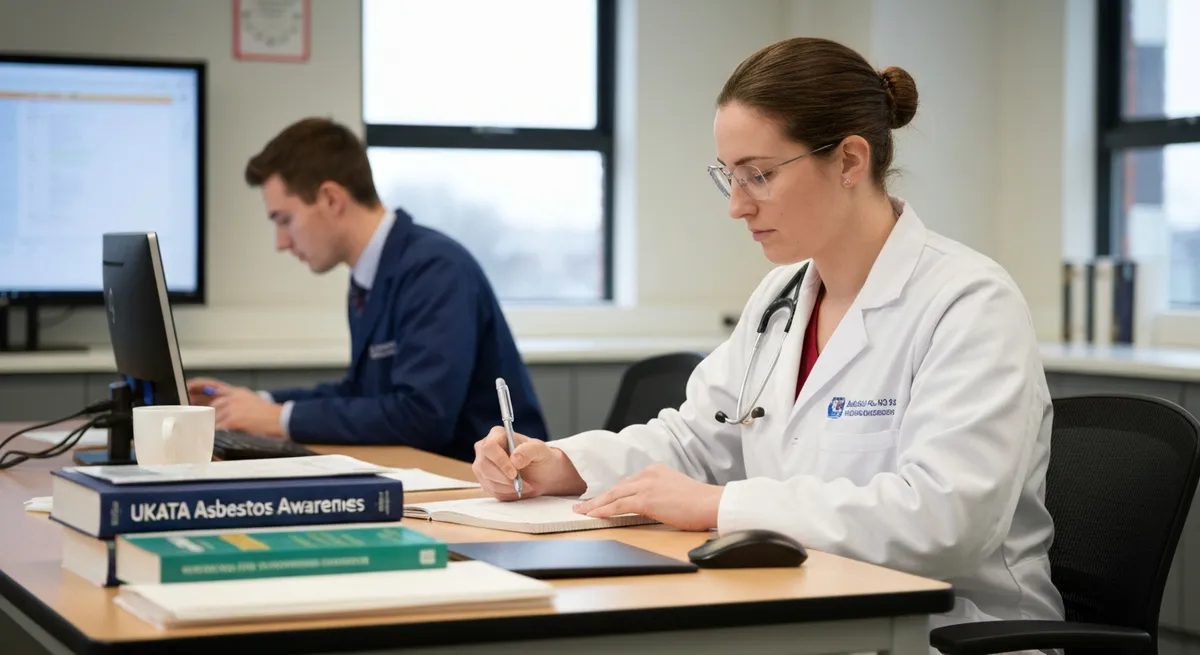
UKATA FAQ
Sources & last verified
- United Kingdom Asbestos Training Association — number of questions, time limit, passing score, retake policy (official source). “Attainment of the learning outcomes will be assessed by a multiple-choice exam consisting of at least 15 questions taken from the UKATA question bank and…” Verified Oct 28, 2026.
- United Kingdom Asbestos Training Association — eligibility (official source). “There are no learner pre-requisites as part of this syllabus.” Verified Oct 27, 2026.
How we verify: editorial & fact-checking policy. Report an error: contact us.
How this page was made: written with AI tools and published by Nathan Beja, founder of Practice Test Geeks, who is responsible for its content. Exam facts are checked against the official sources listed below. Not reviewed by a subject-matter expert. Editorial policy
Sources & references
Exam facts on this page (fees, format, dates, passing scores) are checked against these official sources; the date is our last check. Editorial policy
- ukata.org.uk — Test delivery, exam format, passing score, renewal, retake policy, time limit, score validity, eligibility, exam information · verified Oct 2026