
ARRT Results: What to Expect, How to Read Your Score, and What Comes Next
Understand your ARRT results — when scores arrive, how to read them, and what to do next. Pass or retake, we cover it all. 📝
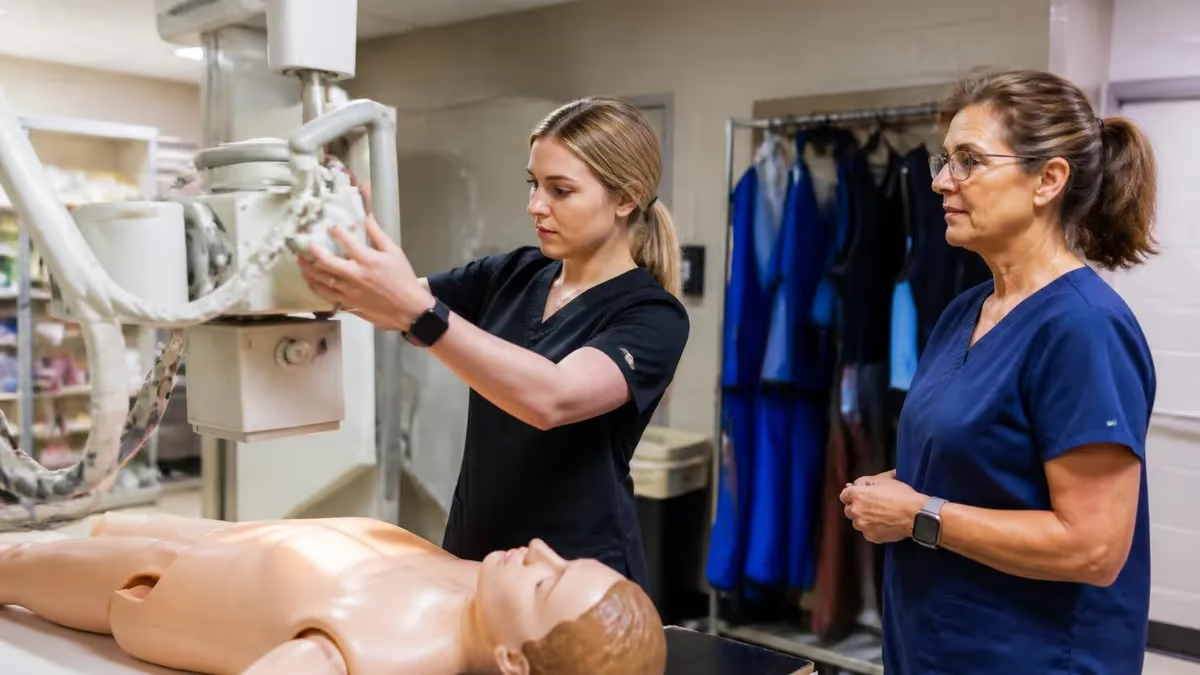
Understanding your ARRT results is one of the most nerve-wracking — and ultimately rewarding — parts of the radiologic technology certification journey. The American Registry of Radiologic Technologists (ARRT) administers examinations across more than a dozen disciplines, from Radiography to Computed Tomography, and every candidate wants to know exactly when their score will be available, what the numbers mean, and what steps to take immediately after testing. Whether you passed on your first attempt or are planning a retake, having a clear roadmap for interpreting your results makes all the difference.
The ARRT examination is delivered via computer at Prometric testing centers across the United States. Unlike some credentialing exams that release scores weeks later, ARRT candidates typically receive a preliminary pass/fail result on-screen at the test center immediately after completing the exam. This on-screen result is unofficial, but it gives candidates an immediate indication of how they performed before the formal score report is processed and posted to their online ARRT account, usually within two to four business days of testing.
Your official score report contains more than just a pass or fail designation. It includes a scaled score ranging from 1 to 99, a content category performance breakdown, and information about your eligibility status going forward. Knowing how to read each section of that report empowers you to celebrate intelligently if you passed — or to build a targeted remediation plan if you did not. Many candidates focus only on the final number and miss the diagnostic value buried in the category-level performance data.
Timing matters enormously for new graduates. Most states require candidates to hold a temporary license or limited permit while awaiting ARRT certification, and employers often set conditional hire agreements contingent on passing. The sooner you understand your arrt results and the processes attached to them, the faster you can transition from student to credentialed professional and start your career in medical imaging without unnecessary delays.
For candidates who do not pass, ARRT's post-exam policies include structured retake windows and clearly defined eligibility rules. Understanding those rules in advance — rather than scrambling after a disappointing result — allows you to book a retake date strategically, focus your additional study on the content areas where your report flagged weakness, and approach the second attempt with significantly more confidence and preparation than the first.
This guide walks through every stage of the ARRT results process: the on-screen result, the official score report timeline, how to interpret your scaled score and category breakdowns, what happens if you pass, what happens if you do not, and the practical study strategies that top scorers use to ensure they walk out of the Prometric center with a passing result the first time. Whether you are weeks away from your exam or already holding a score report in your hands, the information here is designed to help you move forward with clarity.
Beyond the immediate question of pass or fail, your ARRT results also set the foundation for your entire career as a radiologic technologist. Your certification record, once established, must be maintained through continuing education and periodic renewal, making this exam the gateway to a professional credential that you will carry — and build upon — for decades. Starting that journey with a thorough understanding of how the results process works ensures you begin on the strongest possible footing.
ARRT Results by the Numbers

ARRT Radiography Exam Format
| Section | Questions | Time | Weight | Notes |
|---|---|---|---|---|
| Radiation Protection | 34 | Included in total | 17% | Shielding, dose limits, ALARA principles |
| Equipment Operation & QA | 30 | Included in total | 15% | X-ray production, image receptors, quality control |
| Image Acquisition & Evaluation | 55 | Included in total | 28% | Exposure factors, image quality, digital imaging |
| Patient Care & Education | 27 | Included in total | 14% | Contrast media, patient assessment, infection control |
| Radiographic Procedures | 74 | Included in total | 26% | Positioning for chest, abdomen, extremities, spine |
| Total | 220 | 3.5 hours | 100% |
When your official ARRT score report becomes available in your online account, the first thing you will see is your scaled score — a number between 1 and 99. A score of 75 or higher means you have passed the examination. It is critically important to understand that this is a scaled score, not a raw percentage.
The ARRT uses a statistical process called equating to adjust for slight differences in difficulty between exam forms, so a 75 on one version of the exam represents the same level of competency as a 75 on any other version, even if the underlying raw scores differ.
Below your overall scaled score, the report includes a content category performance summary. This section breaks down your performance across the major exam domains — categories like Image Acquisition and Evaluation, Patient Care, Radiation Protection, and Radiographic Procedures. For each category, the report indicates whether your performance was above the passing standard, at the passing standard, or below the passing standard. These designations use language like "Above," "Near," or "Below" rather than numeric subscores, which is why many candidates initially find the breakdown harder to interpret than the overall number.
Understanding what "Below" means in a specific category is where the real diagnostic value lies. If you did not pass the exam overall, the category breakdown tells you exactly where your knowledge gaps are concentrated. For example, if you scored below the standard in Radiation Protection but above it in Radiographic Procedures, your study plan for the retake should heavily emphasize dosimetry concepts, shielding calculations, ALARA principles, and regulatory dose limits rather than repositioning techniques you already demonstrated competency in. Targeted studying beats a general review every time.
Even if you passed, reviewing the category breakdown is worthwhile. Categories where you performed near — rather than clearly above — the standard represent areas of relative weakness. As you move into clinical practice, these are the knowledge domains you will want to reinforce through continuing education, hands-on experience, and supplemental reading. The ARRT examination is designed not just as a gatekeeping mechanism but as a professional competency benchmark, and treating the results as actionable feedback makes you a better technologist regardless of the final outcome.
The score report also confirms your eligibility status. If you passed, the report reflects that your certification is pending administrative processing, which typically completes within a few weeks. Your name becomes searchable in the ARRT's online registry once certification is officially granted. Many employers and state licensing boards require candidates to provide verification directly from the ARRT registry rather than simply presenting a personal copy of the score report, so understanding how to navigate the ARRT verification system is an important part of using your results effectively.
For candidates who tested under an eligibility window tied to a state licensure application or employer requirement, the timeline for official results matters enormously. If your state licensing board requires submission of certification documentation within a specific number of days after testing, you need to monitor your ARRT account closely and download your official results as soon as they are posted. Most state boards accept the official score report as interim documentation while full certification processing completes, but verify this directly with your state's regulatory agency, because policies vary considerably from state to state.
It is also worth noting that the ARRT maintains a permanent record of your examination history, including all attempts. This record is part of your professional profile and is accessible to employers and licensing bodies who request verification. If you tested multiple times before passing, that history remains part of your record, though only the passing result is reflected in your active certification status. Transparency about your exam history, when asked, is always the appropriate professional approach — most employers care far more about your current credential than the number of attempts it took to earn it.
ARRT Results: Pass, Fail, and Retake Policies Explained
Congratulations — a scaled score of 75 or higher means you have met the ARRT's competency standard. Your certification status will move from "pending" to "certified" within a few weeks of your exam date as the ARRT completes its administrative review. During this processing window, your official score report serves as evidence of your passing result, and most employers and state licensing boards will accept it as interim documentation while you await your wallet card and certificate.
Once your name appears in the ARRT online registry, you can begin using the R.T.(R) credential after your name — or the appropriate designation for your specialty. Employers can verify your status at no cost through the public registry search on the ARRT website. Make sure to check your mailing address in your ARRT account so your physical credentials arrive without delay. Your certification will be valid for a two-year period, after which you must complete continuing education requirements to renew.

Advantages and Challenges of the ARRT Results Process
- +Preliminary pass/fail result available immediately on-screen at the test center
- +Official score report posted to your account within 2-4 business days — among the fastest in healthcare credentialing
- +Category-level performance breakdown helps identify specific knowledge gaps for targeted remediation
- +Scaled scoring ensures fair comparison across different exam forms administered on different dates
- +ARRT online registry allows instant employer verification once certification is granted
- +Three retake attempts per calendar year provides multiple opportunities within a single eligibility period
- −On-screen result is unofficial and not accepted as documentation by employers or state boards
- −Category performance reported as Above/Near/Below rather than numeric subscores, limiting diagnostic precision
- −90-day mandatory wait between retake attempts can delay career entry for candidates who do not pass
- −Lifetime six-attempt limit creates significant pressure on each individual attempt
- −Score verification requests must be filed within 30 days and require a fee, with no guarantee of a score change
- −State licensing timelines vary widely, creating uncertainty about when you can legally begin clinical work after passing
ARRT Results Action Checklist: What to Do After Your Exam
- ✓Log into your ARRT online account within 2-4 business days to check for your official score report.
- ✓Download and save a PDF copy of your score report immediately after it becomes available.
- ✓Review your category performance breakdown to identify Above, Near, and Below designations for each content area.
- ✓Notify your employer or clinical supervisor of your result as soon as the official report is available.
- ✓Submit your score report to your state licensing board if required for a temporary or full radiographer license.
- ✓If you passed, verify that your name appears correctly in the ARRT public registry within 4-6 weeks.
- ✓Confirm your mailing address in your ARRT account so your wallet card and certificate are delivered correctly.
- ✓If you did not pass, mark your calendar 90 days out and begin building a targeted study plan immediately.
- ✓Focus retake preparation on the content categories flagged as Below the passing standard in your report.
- ✓Schedule a retake appointment through your ARRT account once the 90-day waiting period has elapsed.

Use Your Score Report as a Study Roadmap
Candidates who do not pass often focus exclusively on the overall scaled score and miss the most actionable part of their results. The category performance breakdown tells you precisely which content domains need the most attention before a retake. Candidates who target their weakest categories — rather than reviewing all material equally — consistently improve their scores more dramatically on subsequent attempts.
Building an effective study plan for the ARRT examination — whether you are preparing for your first attempt or planning a retake — requires a clear understanding of which content domains carry the most weight. For the Radiography exam, Image Acquisition and Evaluation accounts for 28 percent of the total score, making it the single most heavily weighted category. Radiographic Procedures follows at 26 percent. Together, these two categories represent more than half the exam, which means that strong performance in just these two areas can significantly elevate your overall scaled score even if other categories are less polished.
Practice tests are one of the most reliable tools for ARRT preparation, but not all practice resources are created equal. The most effective practice questions mirror the style and cognitive level of actual ARRT items, which require you to apply clinical knowledge rather than simply recall isolated facts. Look for practice materials that include scenario-based questions — the kind that describe a specific patient situation and ask you to determine the most appropriate exposure technique, positioning modification, or patient care intervention. These applied questions build the type of thinking that the ARRT examination actually rewards.
Spacing your study sessions across multiple weeks is far more effective than cramming in the days immediately before your exam. Cognitive science research on the spacing effect consistently shows that information reviewed in distributed sessions is retained significantly longer than information studied in single marathon sessions. A practical approach is to study for 60 to 90 minutes per day, five to six days per week, across an eight to twelve week preparation period. This schedule gives your brain time to consolidate new material between sessions and makes retrieval during the actual exam far more automatic.
Active recall is another evidence-based technique that dramatically outperforms passive review methods like rereading textbook chapters or watching videos without pause. Active recall means testing yourself on material rather than simply exposing yourself to it. Flashcards, practice quizzes, and self-explanation exercises — where you try to explain a concept aloud in your own words without looking at notes — force your brain to retrieve information, which strengthens the neural pathways associated with that knowledge and makes it far more accessible under exam pressure.
For candidates retaking the exam, the category breakdown from your previous attempt is the most important study input you have. If your report flagged Radiation Protection as Below the passing standard, spend the first two weeks of your retake preparation working exclusively through dosimetry concepts, shielding calculations, regulatory dose limits under 10 CFR Part 20, and ALARA principle applications. Only after you can consistently answer practice questions in that category correctly should you move on to reviewing other content areas. Unfocused review wastes limited study time and fails to address the specific deficits that caused the unsuccessful result.
Another underutilized study strategy is timed practice. Many candidates report that time management was unexpectedly challenging during the actual exam — not because the questions were too difficult, but because the pacing felt different from untimed practice. The ARRT Radiography exam gives you 3.5 hours for up to 220 questions, which works out to roughly 57 seconds per question. Practicing under timed conditions — using a stopwatch or a timed quiz platform — trains you to read questions efficiently, identify key clinical details quickly, and move on from difficult items rather than spending excessive time on any single question.
Finally, review your knowledge of digital imaging systems, CR and DR technology, image processing parameters, and quality control procedures. This content area has grown more prominent on the ARRT exam in recent years as digital equipment has become the standard of care in clinical imaging departments across the United States. Candidates trained on older equipment or who completed programs with limited digital imaging exposure may find these questions more challenging than positioning or patient care items, making targeted digital imaging review an especially high-value investment of study time.
After an unsuccessful ARRT exam attempt, a mandatory 90-day waiting period must pass before you can sit for the examination again. Candidates who attempt to book a retake sooner will find their application rejected. Use this waiting period to build a structured study plan based on your category performance breakdown — arriving at the retake underprepared is the most common reason candidates continue to fall short of the 75 passing score on subsequent attempts.
Once you have passed the ARRT examination and your certification has been officially granted, the first priority is understanding the requirements for maintaining your credential. ARRT certification operates on a two-year renewal cycle, and you must earn a specific number of continuing education credits during each cycle to remain in good standing. The exact credit requirement depends on your certification type, but for most primary pathway certifications — including Radiography — candidates must complete 24 continuing education credits per biennium. Staying current on these requirements from your very first renewal cycle prevents the administrative complications that arise when credits lapse.
Your ARRT certification also interacts with your state licensure in ways that can vary significantly depending on where you work. Most states require radiologic technologists to hold both ARRT certification and a state-issued license, and the license renewal requirements may differ from the ARRT's biennium cycle. Some states align their license renewal with ARRT renewal; others have independent timelines and separate CE requirements. Mapping out both sets of deadlines shortly after you pass your exam — and setting calendar reminders well in advance of each — is a simple but highly effective strategy for avoiding lapses in either credential.
For technologists who are considering specialty certifications beyond the primary pathway, understanding how your initial ARRT results connect to specialty eligibility is important. The ARRT offers post-primary certifications in areas including Computed Tomography, Magnetic Resonance Imaging, Mammography, Interventional Radiology, and many others. Most post-primary pathways require candidates to hold an active primary certification in good standing and to accumulate a defined number of clinical hours in the specialty area before they can sit for the specialty examination. Your strong foundation from the primary exam makes specialty preparation significantly more manageable.
Employers in larger health systems and academic medical centers frequently pay for or reimburse the cost of specialty examinations and continuing education, viewing multi-credentialed technologists as especially valuable contributors to imaging department flexibility. If career advancement and salary growth are goals — and for most radiologic technologists they are — building your credential portfolio strategically over the first five to ten years of your career is one of the highest-return investments you can make. Researching which specialty certifications are most valued in your geographic market and clinical setting helps you prioritize.
It is also worth maintaining copies of all your ARRT documentation in a secure personal file — score reports, CE certificates, renewal confirmations, and any correspondence with the ARRT regarding eligibility or score verification. While the ARRT maintains an official digital record of your certification history, having your own organized documentation protects you in situations where you need to verify credentials quickly for a new employer, a locum tenens position, or a state licensing application without waiting for official ARRT verification to process.
Peer community and professional organization membership can also amplify the value of your ARRT credential over the long term. Organizations like the American Society of Radiologic Technologists (ASRT) offer CE resources, practice guidelines, and advocacy support that help working technologists stay current in a field that evolves rapidly with advances in imaging technology, dose management protocols, and clinical practice standards. Staying connected to the professional community is as important as maintaining your CE credits — it keeps you informed of changes to scope of practice, reimbursement policy, and clinical best practices that affect your day-to-day work.
The path from your initial ARRT results to a long and successful career in radiologic technology is built on a foundation of continuous learning, professional engagement, and careful attention to credentialing requirements. Passing the exam is the beginning, not the end, of that journey. Technologists who treat their certification as a living credential — actively managing renewals, pursuing specialty credentials, and engaging with continuing education as genuine professional development rather than a compliance checkbox — consistently report the highest levels of career satisfaction and professional advancement in this rewarding and technically demanding field.
One of the most effective ways to simulate the actual ARRT testing experience during your preparation is to use a consistent, distraction-free study environment. Set up your practice sessions in a quiet space, use a laptop or desktop rather than a phone, and practice answering questions under time pressure without pausing to look up answers mid-question.
This mirrors the conditions at a Prometric testing center, where you will have access only to the exam interface — no notes, no textbooks, no internet. The more familiar that environment feels when you arrive on exam day, the less cognitive energy you spend managing anxiety and the more you can devote to answering questions accurately.
Understanding the anatomy of a well-constructed ARRT question is another skill that improves with deliberate practice. ARRT exam items typically present a clinical scenario — a patient position, a technique selection, a patient care situation, or an equipment setting — and ask you to identify the best course of action or the most accurate statement. Distractors (incorrect answer choices) are carefully written to be plausible, which means you cannot rely on eliminating obviously wrong answers. Instead, focus on identifying the precise clinical principle at stake and selecting the answer that most completely and accurately reflects best practice.
Radiation protection questions deserve special attention in any ARRT study plan because they appear across multiple content categories and require a strong grasp of both quantitative concepts (dose units, inverse square law calculations, HVL thickness) and qualitative principles (ALARA, occupational dose limits, gonadal shielding indications). Many candidates find that working through 15 to 20 radiation protection practice questions daily — spread across the full range of subtopics — is the fastest way to build the fluency needed to answer these items quickly and confidently under exam conditions.
Patient care and management questions often trip up candidates who are technically strong but less confident in the clinical assessment and pharmacology content. Reviewing contrast media reactions, their classification as mild, moderate, or severe, and the appropriate nursing and technologist responses to each type is particularly important. The ARRT exam includes questions about premedication protocols, documentation requirements, and the legal and ethical dimensions of informed consent — areas that require a different kind of knowledge than the physics and positioning content that dominates most radiography coursework.
Image evaluation questions — asking you to identify the cause of a specific artifact, determine whether a repeat exposure is necessary, or select the technique adjustment that will best correct an overexposed or underexposed image — are both highly practical and commonly tested.
These questions reward candidates who have spent significant clinical time critically evaluating their own images rather than simply producing them. If you are still in your clinical internship when you begin exam preparation, make a habit of explaining to yourself why each image you produce looks the way it does and what you would change if you had the opportunity to repeat it.
In the days immediately before your exam, shift your preparation from learning new material to reviewing and consolidating what you already know. Take one or two full-length timed practice exams under realistic conditions and review every question you answered incorrectly — not just the ones you flagged during the exam, but all of them. Getting the right answer by guessing is not the same as getting it right because you understand the underlying concept, and the only way to distinguish between the two is to read the explanation for every answer choice on every question you were uncertain about.
On exam day itself, arrive at the Prometric center at least 15 minutes before your scheduled appointment time. Bring your ARRT Authorization to Test (ATT) letter and a valid government-issued photo ID. The check-in process involves biometric verification, and you will be required to store all personal belongings in a locker before entering the testing room.
The testing interface includes a flagging feature that lets you mark questions for review and return to them after you have worked through the full exam — use this strategically to ensure you do not spend excessive time on difficult items at the expense of questions you could answer quickly and correctly.
ARRT Questions and Answers

How Many CE Credits Do I Need for ARRT? Complete Continuing Education Guide

Mosby ARRT Review: The Complete Study Guide for Radiologic Technology Certification

ARRT Membership: Complete Guide to Joining, Renewing, and Maximizing Your Registration

ARRT Practice Test PDF (Free Printable 2026)

ARRT Passing Score: What You Need to Know to Pass the Registry Exam
About the Author

Medical Laboratory Scientist & Clinical Certification Expert
Johns Hopkins UniversityDr. Sandra Kim holds a PhD in Clinical Laboratory Science from Johns Hopkins University and is certified as a Medical Technologist (MT) and Medical Laboratory Scientist (MLS) through ASCP. With 16 years of clinical laboratory experience spanning hematology, microbiology, and molecular diagnostics, she prepares candidates for ASCP board exams, MLT, MLS, and specialist certification tests.