
Aptis Web Practice: How to Prepare Online for Every Part of the Test 2026
🎯 Aptis web practice means timed online drills for all five skills. See the format, timings, mock exam tips and a study routine to prepare.
Aptis web practice means working through timed, browser-based tasks that mirror the Aptis test: grammar and vocabulary, reading, listening, writing, and speaking. The real exam is computer-delivered in supervised sessions, so practicing online on a laptop with headphones and a microphone is the closest preparation you can do at home before booking.
Aptis Web Practice: Key Facts (Updated October 2026)
| Fact | Details | Source |
|---|---|---|
| Delivery | Taken on computer in supervised sessions | British Council |
| Eligibility (General) | General English test for candidates over 16 years old | British Council |
| Grammar and Vocabulary | 50 questions (25 grammar, 25 vocabulary) in 25 minutes | British Council |
| Other General components | Reading 35 min, Listening 40 min, Speaking 12 min, Writing 50 min | British Council |
| Scoring | A detailed profile of language ability, not a simple pass/fail grade | British Council |
| Results | England: 48 hours after the test. Spain and Italy: 48 to 72 hours, excluding weekends and holidays | British Council |
| Fee (General) | Spain: 95 euros. Italy: 135 euros. Fees differ by country and center | British Council Spain |
| Validity | Certificates have no expiry date, but reflect skills on one particular date | British Council FAQ |
Not sure where to begin? Our aptis free practice test hub collects the best drills in one place, and this guide shows how to turn them into a routine. Think of web practice as three layers: short skill drills, full timed sections, and a final complete mock. Each layer answers a different question about your readiness, so skipping one leaves a blind spot that only shows up on exam day.
What does Aptis actually test? The General version measures English across five parts. Grammar and vocabulary has 50 questions, split evenly between 25 grammar and 25 vocabulary items, in 25 minutes. Reading takes 35 minutes, listening 40, speaking 12, and writing 50. Because the format is fixed, web practice works well: you can rehearse the same task types, the same time pressure, and the same typing and recording steps you will meet at the center or on screen at home.
Why practice in a browser instead of on paper? Aptis is taken on computer, so mechanics matter. You type your writing answers, click and drag in reading tasks, listen to audio under controlled conditions, and record spoken answers against a countdown. Candidates who only use printed worksheets often lose points to interface surprises, such as running out of time while scrolling or hesitating before a recording starts. Online practice removes those surprises before they cost you marks.
Who is this guide for? Mostly adult learners in the United States who need an English certificate for study, work, or an employer requirement, and who want a realistic way to prepare without paying for a full course. Some candidates are teachers or healthcare workers, since Aptis also has variants for teachers and advanced users. Whatever your goal, the method is the same: measure, drill weak spots, and repeat under timed conditions until your results stabilize.
Many learners first meet aptis through a school or employer requirement, and then discover that the official exam and unofficial practice are separate things. The British Council controls the real test, whether in a supervised center or remotely. Practice sites, including this one, are unofficial and cannot replace the exam. Use them to build skill and speed, and use official pages to confirm current rules, fees, and dates.
How is it scored? Aptis does not give a simple pass or fail. Instead it reports a profile of your language ability, usually discussed in CEFR levels such as A2, B1, B2, or C. That matters for practice, because your goal is not a magic number of correct answers but consistent performance at the level your institution asks for. Check the required level first, then judge every mock result against that target rather than a generic percentage.
Finally, plan around results. In England, results are available 48 hours after the test date, and in Spain and Italy they arrive within 48 to 72 hours, excluding weekends and public holidays. Aptis Remote results come within five days after a successful upload. Certificates do not expire, but they describe your skills on one date, so many employers still prefer recent results. Build your study calendar backward from any deadline, leaving room for a possible second sitting.
APTIS: upcoming dates and official changes
- Updated Oct 16, 2026: Eligibility (Aptis ESOL General) is now Candidates over 16 (previously Candidates over 16).
- Updated Oct 16, 2026: Delivery (Aptis ESOL) is now Computer-based, supervised sessions (previously Computer-based, supervised sessions).
- Updated Oct 16, 2026: Time limit (Aptis ESOL Advanced — Speaking) is now 12 minutes (previously 12 minutes).
Facts verified Oct 18, 2026 against British Council. Dates that have passed are removed automatically.
- The Aptis General Grammar and Vocabulary component has 50 questions (25 grammar, 25 vocabulary). (British Council)
- The Aptis ESOL Advanced Grammar and Vocabulary component lasts 25 minutes. (British Council)
- The Aptis ESOL Advanced Listening component lasts 30 minutes. (British Council)
- Aptis reports a detailed profile of language ability rather than a simple pass/fail grade. (British Council)
- Aptis ESOL certificates do not have an expiry date, although the result reflects skills on a particular date. (britishcouncil.es)
- Aptis ESOL is taken on computer in supervised sessions. (British Council)
- Aptis ESOL General is a general English test for candidates over 16 years old. (British Council)
- Aptis Remote results are available within 5 days after the test is taken and successfully uploaded. (British Council)
Facts verified Oct 18, 2026 against British Council. Dates that have passed are removed automatically.
APTIS Exam at a Glance
| Item | Detail | Official source |
|---|---|---|
| Number of questions (Aptis ESOL General — Grammar and Vocabulary) | 50 questions | British Council |
| Time limit (Aptis ESOL Advanced — Grammar and Vocabulary) | 25 minutes | British Council |
| Time limit (Aptis ESOL Advanced — Listening) | 30 minutes | British Council |
| Time limit (Aptis ESOL Advanced — Reading) | 60 minutes | British Council |
| Time limit (Aptis ESOL Advanced — Speaking) | 12 minutes | British Council |
| Time limit (Aptis ESOL Advanced — Writing) | 45 minutes | British Council |
| Time limit (Aptis ESOL General — Grammar and Vocabulary) | 25 minutes | British Council |
| Time limit (Aptis ESOL General — Listening) | 40 minutes | British Council |
| Time limit (Aptis ESOL General — Reading) | 35 minutes | British Council |
| Time limit (Aptis ESOL General — Speaking) | 12 minutes | British Council |
| Time limit (Aptis ESOL General — Writing) | 50 minutes | British Council |
| Passing score | No pass/fail; CEFR proficiency profile | British Council |
| Validity (Aptis ESOL) | No expiry date | britishcouncil.es |
| Delivery (Aptis ESOL) | Computer-based, supervised sessions | British Council |
| Eligibility (Aptis ESOL General) | Candidates over 16 | British Council |
| Score release (Aptis Remote) | Within 5 days after completion and upload | British Council |
Facts verified Oct 18, 2026 against British Council. Dates that have passed are removed automatically.
Aptis General by the Numbers
How Do You Build an Aptis Web Practice Routine?
Take a diagnostic
Drill your weakest skill
Add the clock
Sit a full mock
Review and repeat
Which Skills Should You Practice First in Aptis Web Practice?
Start with the skill that scares you most, usually speaking. The aptis speaking test lasts 12 minutes in the General version, and it is recorded, so nobody interrupts or encourages you. Web practice lets you rehearse that exact setup: read a prompt, wait a few seconds, record, and stop when the timer ends. Playing the recording back is uncomfortable but effective, because you hear hesitations, repeated words, and unfinished sentences that feel invisible while you speak.
Writing deserves second place because it has the longest time block: 50 minutes in the General test. Practice typing, not handwriting, since the exam is on a keyboard and your speed matters. Aim to write a short informal message, a longer formal message, and an opinion piece within the allotted time. Afterward, count your words against each task limit and check that every point in the prompt was actually answered.
Listening runs 40 minutes in the General test, and the key habit is note-taking while the audio plays. Online drills should force you to answer without replaying more than the exam would allow. Healthcare candidates who search for aptis medical preparation will find that listening is often the highest-stakes skill, because clinical work relies on understanding names, numbers, and instructions delivered quickly. Our listening guide breaks down the question types.
Reading takes 35 minutes, which feels generous until you meet the longer passages. Online practice helps because you learn to scan for the answer location instead of reading every word. Practice sentence ordering, matching headings to paragraphs, and gap-filling with a visible clock. If you finish early, use the remaining minutes to re-check the tasks where two answers looked plausible; those are the places where careful rereading changes a mark most often.
Grammar and vocabulary is the quickest component: 50 questions in 25 minutes, which is thirty seconds per question. That pace leaves no room for overthinking. Use short web drills of ten questions at a time, and review every miss by writing the rule or word family in a notebook. Over two weeks, patterns appear, such as prepositions after verbs, conditional forms, or collocations, and you can target them directly instead of reviewing grammar at random.
Spanish-speaking candidates often search for examen aptis or aptis examen resources, and the advice is identical: the test itself is in English, and only the surrounding booking pages may be offered in another language. Practice with English-only materials so that your brain does not switch back and forth. Keep a small bilingual glossary for exam words such as task, prompt, and section, so instructions never slow you down.
Rotate the skills through the week instead of studying one per day in isolation. A balanced weekly pattern might include two speaking recordings, two writing tasks, two listening sets, one reading set, and one grammar drill, followed by a Sunday review. This spacing helps memory, keeps motivation high, and lets you notice cross-skill links, for example how vocabulary learned in reading shows up in your speaking answers.
Track results in a simple table with the date, skill, task type, time used, and a confidence score from 1 to 5. After three weeks you will see which task types stay low even when you feel prepared, and those become your priority list. Without that record, most learners drift toward the tasks they already enjoy and avoid the ones that would raise their profile the most.
What Does an Aptis Speaking Test Practice Session Look Like?
A good speaking session begins with a quiet room and a recorder. Read the prompt once, take a few seconds to organize ideas, and answer for the full time allowed. Because the General speaking component is only 12 minutes long in total, each answer is brief, so clarity and organization matter more than rare vocabulary. Aim for a simple structure: direct answer, one reason, one example, and a closing sentence.
After recording, listen back with a checklist. Did you answer the question asked? Did you pause for more than three seconds? Did you repeat the same connector too often? Write down two fixes and rerun the same prompt. Repeating a task twice in a row is more effective than moving on, because you hear your own improvement and build confidence quickly, which is exactly what the aptis speaking test rewards.
Is Aptis Web Practice Better Than Paper Practice?
- +Matches the computer-delivered format of the real exam
- +Lets you rehearse typing, clicking, and recording steps
- +Provides built-in timers that train pacing
- +Gives instant feedback on objective questions
- +Can be done anywhere, in short sessions
- +Makes it easy to repeat weak task types
- −Quality and format accuracy vary between unofficial sites
- −Speaking and writing still need human or rubric-based scoring
- −Home distractions can weaken exam-like focus
- −Technical problems such as a poor microphone can distort results
- −Easy practice sets may give an inflated sense of readiness
- −Screen fatigue can build up during long study sessions
What Should Be on Your Aptis Web Practice Checklist?
- ✓Confirm which Aptis version and CEFR level you need.
- ✓Read the official British Council preparation page for your test.
- ✓Test your headset, microphone, and browser before each session.
- ✓Set a visible timer for every drill.
- ✓Record at least two speaking answers every week.
- ✓Type your writing answers instead of handwriting them.
- ✓Keep an error log with the cause of each mistake.
- ✓Practice listening with audio played only as often as the exam allows.
- ✓Sit one full timed mock before your exam date.
- ✓Confirm ID, location or remote link, and start time the day before.
Review beats repetition
Learners who log the cause of every mistake improve faster than those who simply do more questions. One hour of review after a mock is usually worth more than a second mock taken straight away.
Is an Aptis Mock Exam Worth Taking Before the Real Test?
Yes, an aptis mock exam is worth taking at least once, and ideally twice, before your booked date. A mock reveals problems that short drills hide, such as fatigue during the final writing task, or a pronunciation habit that only appears after ten minutes of speaking. The full General test has about 162 minutes of working time across five components, so stamina is a real factor that only a complete run can measure.
Schedule the mock like the real thing. Choose a quiet room, close other tabs, silence your phone, and use the same headset you will use on exam day. Do the sections in one sitting with only the breaks you expect, and start at the time of day your exam is booked. If your test is at 9 a.m., a mock at 9 p.m. tells you very little about how your brain will perform.
Take the sections in the order your center uses, because order affects how you feel. Ask your center or check your booking confirmation rather than assuming. Practicing in the same order means no section catches you with a cold start, and you learn when your energy dips. If you cannot confirm the order, rotate it between mocks so that no single skill is always tackled while you are tired.
Scoring your own mock needs honesty. Objective sections, such as grammar, reading, and listening, can be marked quickly against an answer key. Speaking and writing are harder, so use a short rubric covering task completion, range of vocabulary, grammar accuracy, and coherence. If possible, ask a teacher, tutor, or fluent friend to rate those two skills. Self-scores tend to run one level higher than a trained rater would assign, so subtract a little when you plan.
If you need a refresher on what the General version includes, read our test aptis general guide, which covers format, timing, and preparation steps. Compare its component list with the mock you used, because a poor mock can mislead you. A mock that has twice as many questions, or lacks a recorded speaking part, trains the wrong habits. Treat any practice set as a rough guide and weigh it against official sample material.
After the mock, spend more time on review than on taking it. For each wrong answer, classify the cause: vocabulary gap, grammar rule, careless reading, misheard audio, or time pressure. Time-pressure errors need pacing changes, while vocabulary gaps need new study material. Without the classification, learners tend to just redo more questions, which feels productive but repeats the same mistakes. A one-hour review after a long mock usually delivers more improvement than another mock.
Do not take more than one full mock per week. Two mocks in a single week tire you out and leave no time to fix what the first one exposed. A sensible pattern is a diagnostic mock four weeks out, a progress mock two weeks out, and a final light mock one week before. In between, use sectional drills so you stay fresh and keep the focus on your weakest component.
Finally, interpret the result as a range, not a verdict. Aptis reports a profile rather than pass or fail, so your mock may show strong reading but weaker speaking. That is useful information. If the institution asks for B2 overall, a single weak skill might hold you back, and you can redirect the final weeks toward it. A balanced profile is safer than one spectacular score surrounded by gaps.
Fees, dates, formats, and retake rules differ by country and test center. Always confirm current details with the British Council or your registered center before you book or pay.
What Mistakes Make Aptis Web Practice Less Effective?
The most common mistake is practicing without a clock. Aptis is a timed test, and a reading passage that feels easy when you are relaxed becomes harder when you must also watch a countdown. Set a visible timer for every drill, even a five-minute one. Stop when it ends, mark what you finished, and note what you left blank. Those blanks tell you more than the correct answers do.
The second mistake is relying on unofficial materials alone. Practice sites vary in quality, difficulty, and accuracy of format, and some older tests no longer match the current layout. Check the official British Council preparation pages for current task descriptions, then use independent practice to build volume. Our aptis simulator: how to run a realistic timed practice test at home guide explains how to combine both safely.
Third, many learners ignore the technical setup. A poor microphone can make your recording hard to rate, a loud fan can mask listening audio, and an unstable connection can interrupt a remote session. Test your headset, browser, and internet speed several days ahead. For Aptis Remote, results are available within five days after the test is taken and successfully uploaded, so a failed upload is not a minor issue; it delays everything.
Fourth, candidates memorize template answers. Templates for writing and speaking can help structure ideas, but raters notice when an answer sounds recycled and does not address the prompt. Learn flexible frameworks instead, such as opinion, reason, example, and conclusion, and fill them with fresh content. A natural, slightly imperfect answer that responds to the exact question usually scores better than a polished paragraph that answers a different one.
Fifth, people practice only what they enjoy. Strong readers read more, confident speakers speak more, and weak areas stay weak. Counter this with a rule: every study week must include at least one task from your lowest-scoring skill before any favorite activity. Even twenty minutes of focused speaking practice is more valuable than another hour of easy reading, because the improvement per minute is far higher in a weak area.
Sixth, ignoring costs and retake rules leads to poor planning. Fees vary by country: the British Council charges 95 euros for Aptis ESOL General in Spain and 135 euros in Italy, and fees elsewhere depend on the local center. In Spain, a new Aptis ESOL Advanced session can only be booked at least three months after the previous one. Ask your center about retakes before you register.
Seventh, avoid burning out. Studying three hours a day for a week feels heroic but fades quickly. Short, daily sessions of 30 to 60 minutes, with one longer weekend block, build retention without exhaustion. Sleep also matters: speaking fluency and listening comprehension both drop sharply when you are tired. Treat rest days as part of the plan, not as a failure to follow it.
A final warning concerns false certainty. Scoring well on a practice website does not guarantee the same result at the center, because the website may be easier and your stress level will differ. Keep a margin of safety by aiming for one level above your target in practice. If a mock shows you only barely reaching the required level, schedule additional preparation rather than booking the exam immediately.
How Should You Prepare for Aptis in the Last Week?
In the last week, shift from learning to consolidating. Review your error log, redo the questions you missed, and finish one short drill per skill each day. Avoid new textbooks or unfamiliar websites, because new material at this stage creates anxiety instead of progress. The goal is to enter the exam with familiar routines, a clear pacing plan for every section, and confidence that your weak points have already been addressed.
Speaking deserves daily attention. Use aptis speaking practice prompts and record yourself for the full 12 minutes spread across the tasks. Aim to speak without long pauses, using linking phrases such as 'on the other hand' or 'for example' to keep your answer moving. If you stumble, keep going instead of restarting mentally; the recording does not let you stop, and neither does the exam. Fluency beats perfection.
For writing, rehearse three scenarios: a short message to a friend, a formal message to an organization, and an opinion piece or longer response. Time yourself, keep a clear paragraph structure, and spend the final two minutes proofreading for spelling, capital letters, and punctuation. Many lost marks are small errors that a quick scan would catch. Reading your answer slowly in your head helps you spot missing words.
For listening, lean on short daily sets and the format described in our aptis test listening guide. Train yourself to read the questions before the audio starts, because predicting what you need to hear reduces panic. Take brief notes with keywords instead of full sentences. If you miss an answer, move on; dwelling on one item usually costs you the next two.
Prepare the logistics the day before. Confirm the test center address or remote session link, check your photo ID requirements, charge your laptop, and test the headset and microphone one more time. Arrive early, or log in early for remote sessions. Small stresses compound, and removing them in advance frees your attention for the English itself rather than for the setup around it.
On exam day, manage your energy. Eat something light, avoid last-minute cramming, and do a two-minute warm-up by reading a short English paragraph aloud. During the test, follow your pacing plan: if a question takes too long, mark your best guess and move on. Aptis components are timed independently, so a bad section does not need to damage the next; reset your focus between parts.
Afterward, wait for the results and plan the next step. In England results arrive 48 hours after the test date, and in Spain and Italy within 48 to 72 hours, excluding weekends and holidays. If the profile falls short of your target, study the weakest component for several weeks before booking again, and confirm the retake rules with your center. One result is a snapshot, and focused work can change it.
Keep perspective throughout. Aptis measures practical English, and the habits you build, such as recording yourself, keeping an error log, reading actively, and writing under time pressure, help well beyond the exam. Whether you are applying for a program, a job, or meeting another requirement, steady web practice over several weeks almost always beats a last-minute rush. Start today with one short drill and let consistency do the rest.
APTIS Questions and Answers

The Best APTIS Practice Tests to Improve Your English

Aptis Listening Practice Test: Format, Key Facts and a Study Plan
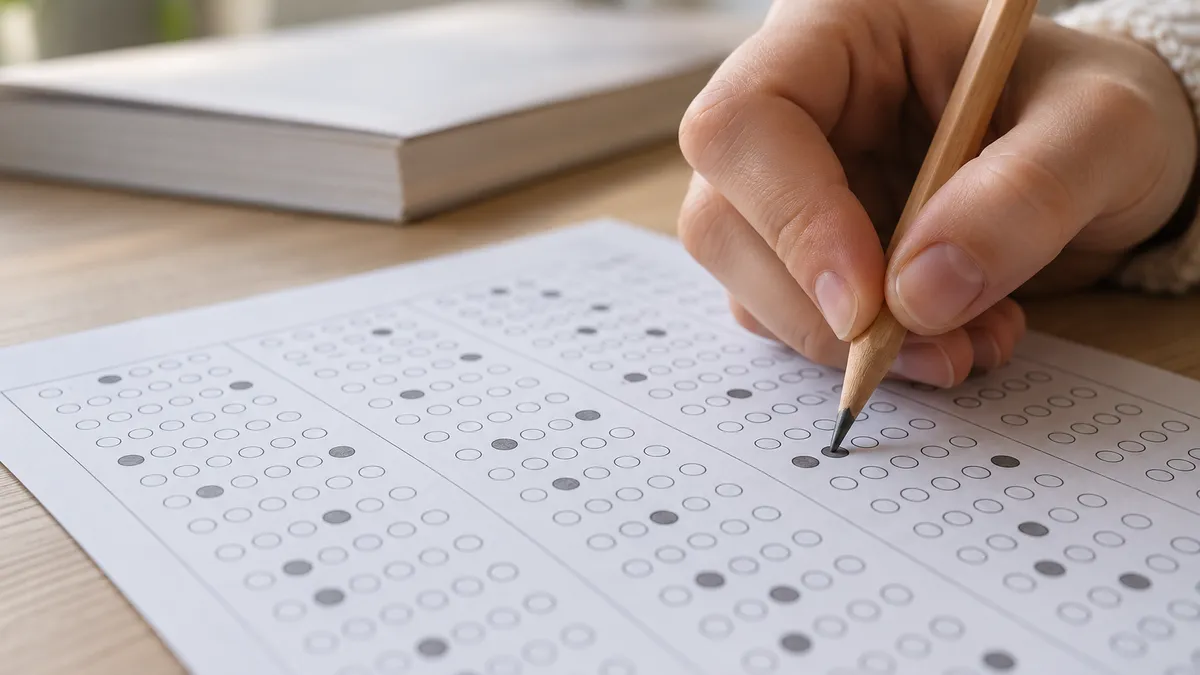
Aptis General Exam Practice: Format, Timing and How to Prepare

Aptis Simulator: How to Run a Realistic Timed Practice Test at Home

APTIS English Assessment Practice Test PDF (Free Printable 2026)
How this page was made: written with AI tools. Exam facts are checked against the official sources listed below. Not reviewed by a subject-matter expert. Editorial policy
Sources & references
Exam facts on this page (fees, format, dates, passing scores) are checked against these official sources; the date is our last check. Editorial policy
- britishcouncil.org — Time limit, exam format, score release, test delivery, eligibility · verified Oct 2026
- britishcouncil.it — Score release, fees · verified Oct 2026
- britishcouncil.es — Score validity, score release, fees, retake policy · verified Oct 2026
- britishcouncil.in — Score release · verified Oct 2026
- england.britishcouncil.org — Score release · verified Oct 2026
- ethiopia.britishcouncil.org — Passing score · verified Oct 2026