
Unit 3 Progress Check Mcq Part A Ap Physics: Complete 2026 September Guide
Free Unit 3 Progress Check Mcq Part A Ap practice test with questions and answer explanations. 🗨️ Prepare for the 2026 September exam with instant scoring.
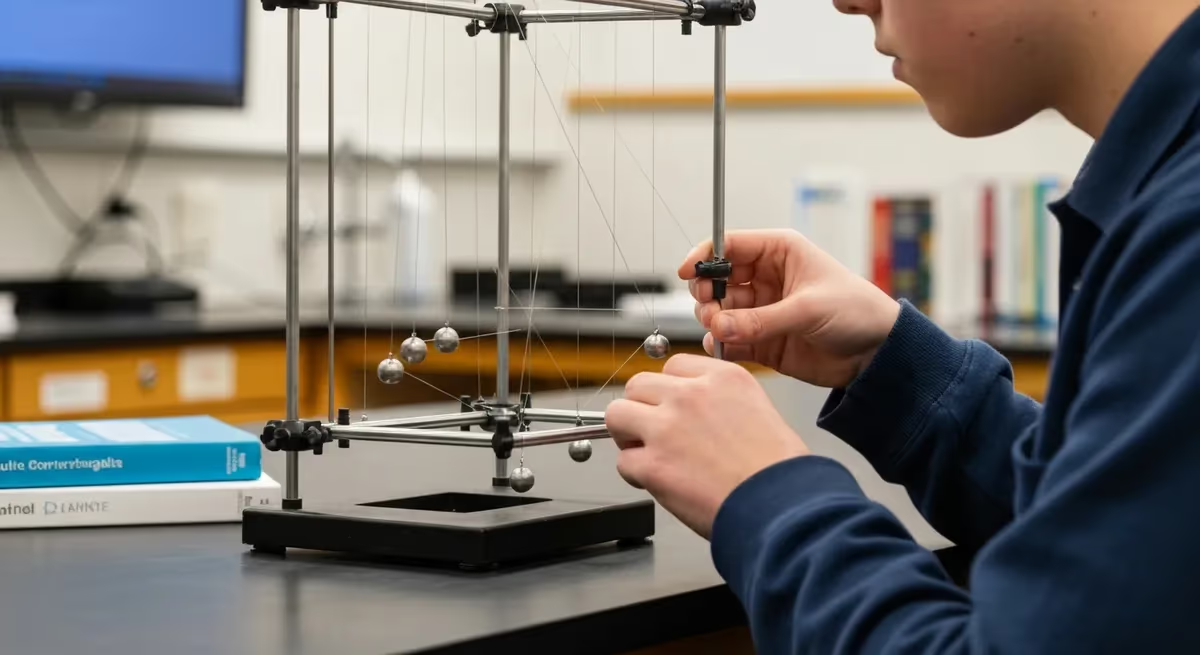
The AP Physics 1 Unit 3 Progress Check: MCQ Part A is a formative assessment on the College Board's AP Classroom platform. It features 15 multiple-choice questions evaluating a student's understanding of Circular Motion and Gravitation, covering concepts like centripetal force, uniform circular motion, and Newton's law of universal gravitation.
Unit 3 Progress Check Mcq Part A Ap Physics
Unit 3 Progress Check Mcq Part A Ap Physics: Complete 2026 Guide
Welcome to your essential guide for mastering the unit 3 progress check mcq part a ap physics. This section of the AP Physics curriculum marks a critical transition, moving from linear motion to the complexities of circular motion and gravitation. Successfully navigating this progress check is a key indicator of your readiness for more advanced topics and the final AP exam. These assessments, provided directly by the College Board through AP Classroom, are designed to pinpoint your strengths and weaknesses in applying concepts like centripetal force, universal gravitation, and orbital mechanics. Think of it less as a test and more as a diagnostic tool to sharpen your understanding before it's time for the final exam.
The multiple-choice questions (MCQs) in Part A specifically target your conceptual grasp and problem-solving skills in these new rotational contexts. You will be asked to analyze scenarios involving objects moving in circles, calculate gravitational forces between masses, and interpret the motion of satellites. Excelling here requires more than just memorizing formulas; it demands a deep, intuitive understanding of the underlying principles. This guide is structured to break down every aspect of the unit 3 progress check mcq part a ap physics, ensuring you can tackle each question with confidence.
To fully prepare, it's vital to supplement your review with a wide range of problems. While this guide focuses on the specific progress check, broadening your exposure to different question styles is crucial. Utilizing comprehensive resources, including free AP practice tests, can provide the diverse practice needed to build mastery. As we delve deeper into this guide, we will explore common question types, effective problem-solving strategies, and detailed explanations for the core topics you'll encounter on the unit 3 progress check mcq part a ap physics.
USABO biology olympiad candidates often also prepare with our AMC 8 math competition practice test for the same rigorous science olympiad mindset and problem-solving approach.

AP Requirements and Preparation
What is uniform circular motion?: Uniform circular motion describes the movement of an object traveling at a constant speed along a circular path. Although the speed is constant, the velocity is continuously changing because the direction of motion is changing.
What is centripetal acceleration and how is it calculated?: Centripetal acceleration (a_c) is the acceleration of an object in uniform circular motion, directed towards the center of the circle. It is calculated using the formula a_c = v^2 / r, where 'v' is the tangential speed and 'r' is the radius of the circular path.
What provides the centripetal force for a satellite orbiting Earth?: The gravitational force between the satellite and the Earth provides the necessary centripetal force to keep the satellite in its orbit. This is a key concept for the unit 3 progress check mcq part a ap physics.
To excel on the unit 3 progress check mcq part a ap physics, a targeted study plan is essential. While focusing on physics, broaden your AP prep with resources like our FREE AP US Politics & Power Questions and Answers to stay sharp across subjects.
Tips and Study Strategies
- ✓🪐 Review core Unit 3 concepts: circular motion, universal gravitation, and orbital mechanics.
- ✓🧠 Focus on conceptual understanding of centripetal force vs. centrifugal force.
- ✓📝 Work through official College Board practice problems to master question styles and pacing.
- ✓✏️ Draw free-body diagrams for every problem involving forces to visualize interactions.
- ✓🔄 Practice applying key formulas like F_c = mv²/r and F_g = Gm₁m₂/r² in various scenarios.
- ✓⏱️ Time yourself on practice sets to simulate the pressure of the real AP exam.

AP Career and Salary Outlook
Physicist
Conducts research to expand knowledge in areas like quantum mechanics, thermodynamics, and cosmology. Average Salary: $152,430/year.
Mechanical Engineer
Designs, develops, and tests mechanical and thermal sensors and devices, including tools, engines, and machines. Average Salary: $96,310/year.
Aerospace Engineer
Applies principles from physics and engineering to design, build, and test aircraft, spacecraft, satellites, and missiles. Average Salary: $122,270/year.
Data Scientist
Uses advanced analytical skills honed in physics to extract insights from complex data, influencing business and research decisions. Average Salary: $127,340/year.
Medical Physicist
Applies physics concepts to develop and manage technologies for medical diagnosis and treatment, such as MRI and radiation therapy. Average Salary: $128,780/year.
Unit 3 Pros and Cons
- +Understanding the specific AP section structure allows candidates to allocate preparation time proportional to question count and difficulty
- +Section-specific practice is more efficient than full-length practice at the start of preparation when targeting identified weaknesses
- +Section performance data shows exactly which sub-topics require additional review before taking the full exam
- +Many section-specific free resources exist that provide deep content coverage for the highest-weight tested areas
- +Mastering one section thoroughly provides a score floor that reduces the pressure on other sections
- −Isolated section practice may not develop the stamina and pacing skills needed for the full-length exam
- −Some section content overlaps with other sections — studying in isolation may miss interdependencies
- −Section difficulty varies by test date, making section-specific performance comparison across test dates imprecise
- −Official practice material for individual sections is often more limited than full-length practice tests
- −Over-focusing on a single section can lead to neglecting other sections that also contribute to the overall score
AP Questions and Answers
More AP - Advanced Placement Resources
AP US History Exam
AP Practice Tests 2026 | Free Practice Questions

AP Psychology Exam 2026: Format, Dates, Practice Tests & Study Tips
AP Government And Politics Exam
AP Chemistry Exam

AP Exam Schedule 2026: Test Dates, Format & Study Tips
About the Author

Licensed Psychologist & Mental Health Licensing Exam Expert
Northwestern UniversityDr. Nicole Warren holds a PhD in Clinical Psychology from Northwestern University and is licensed as both a Professional Counselor (LPC) and Clinical Social Worker (LCSW). She has 14 years of clinical practice in cognitive-behavioral therapy and trauma-informed care, and coaches psychology and counseling graduates through the EPPP, ASWB, NCE, and state mental health licensing examinations.
Join the Discussion
Connect with other students preparing for this exam. Share tips, ask questions, and get advice from people who have been there.
View discussion (3 replies)