
ACSM Exam Practice Tests – Free CPT & GEI Questions 2026 October
📝 Prepare for the ACSM certification. Practice questions with answer explanations covering all exam domains.

The American College of Sports Medicine offers some of the most respected fitness certifications in the industry — and passing an ACSM exam takes more preparation than most candidates expect. Whether you're pursuing the ACSM Certified Personal Trainer (CPT), the Group Exercise Instructor (GEI), or one of the advanced credentials, free ACSM practice tests are one of the most efficient study tools you can use.
This guide explains what the ACSM exam covers, how to structure your preparation, and which specific content areas trip up the most candidates.
ACSM Certifications: Which One Are You Taking?
ACSM offers several certification levels. The most common are:
- ACSM Certified Personal Trainer (CPT) — the entry-level credential for personal training. Covers exercise programming, client assessment, health screening, and exercise science fundamentals.
- ACSM Certified Group Exercise Instructor (GEI) — for fitness professionals leading group classes. Covers class design, music timing, participant monitoring, and motivational techniques.
- ACSM Exercise Physiologist (EP) — an advanced credential for exercise testing and prescription in clinical and health promotion settings, typically requiring a degree in exercise science or related field.
- ACSM Certified Clinical Exercise Physiologist (CECP) — the highest-level clinical credential, for working with patients who have chronic disease or disability.
The CPT is by far the most popular. If you're a fitness professional looking to start or advance a personal training career, that's likely the exam you're preparing for. Our practice tests cover CPT content extensively, along with GEI and exercise physiology.
ACSM CPT Exam: What It Tests
The ACSM CPT exam is 150 questions, delivered as a computer-based test. You have three hours to complete it. The content spans four main domains:
- Initial Client Consultation and Assessment (~25%) — health history screening (PAR-Q+), resting measurements (blood pressure, heart rate, body composition), fitness assessments, goal setting
- Exercise Programming and Implementation (~35%) — the largest domain. Covers FITT-VP principles, periodisation, resistance training, cardiovascular training, flexibility, and special populations
- Exercise Leadership and Client Education (~20%) — communication, motivation, behaviour change models, instructional techniques
- Legal and Professional Responsibilities (~20%) — scope of practice, liability, documentation, emergency procedures, professional development
The exercise programming domain is where most candidates spend the majority of their study time — and rightly so. FITT-VP (Frequency, Intensity, Time, Type, Volume, Progression) and the ACSM guidelines for different training modes are tested thoroughly. Know the specific recommendations for cardiorespiratory fitness, muscular strength, and flexibility training inside out.
Key Content Areas to Master
Health Screening and Risk Stratification
The ACSM exam requires you to know how to stratify cardiovascular risk using current guidelines. The 2015 ACSM guidelines shifted away from light/moderate/high risk categories toward a simpler medical clearance model using known cardiovascular, metabolic, or renal disease, signs and symptoms, and desired exercise intensity. Know the PAR-Q+ and when to refer clients to a physician before starting exercise.
FITT-VP Prescription
FITT-VP is the framework for writing exercise prescriptions. You need to know the recommended ranges for each component across different training modalities:
- Cardiorespiratory: 150–300 min/week moderate intensity or 75–150 min/week vigorous intensity
- Resistance: 2–4 days per week, 1–4 sets, 8–12 reps for hypertrophy (60–70% 1RM for novice/intermediate)
- Flexibility: 2–3 days per week, static stretch held 10–30 seconds, 2–4 repetitions per stretch
These guidelines come directly from ACSM's Guidelines for Exercise Testing and Prescription (GETP) — the official reference for the exam. If you haven't read the relevant sections of GETP, you're not fully prepared.
Energy Systems and Exercise Physiology
Understanding how the body produces energy is foundational to programming. The three energy systems — phosphocreatine (immediate), glycolytic (short-term), and oxidative (long-term) — supply ATP at different rates and durations. Exercise intensity determines which system predominates. Know the approximate work:rest ratios for training each system.
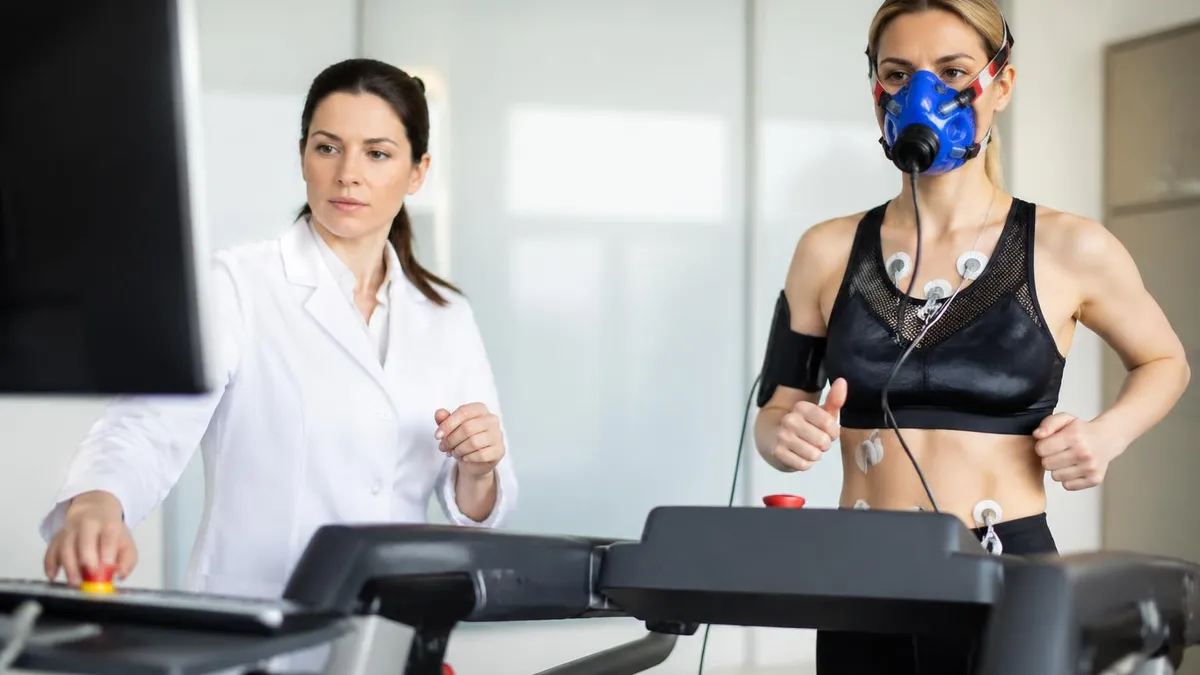
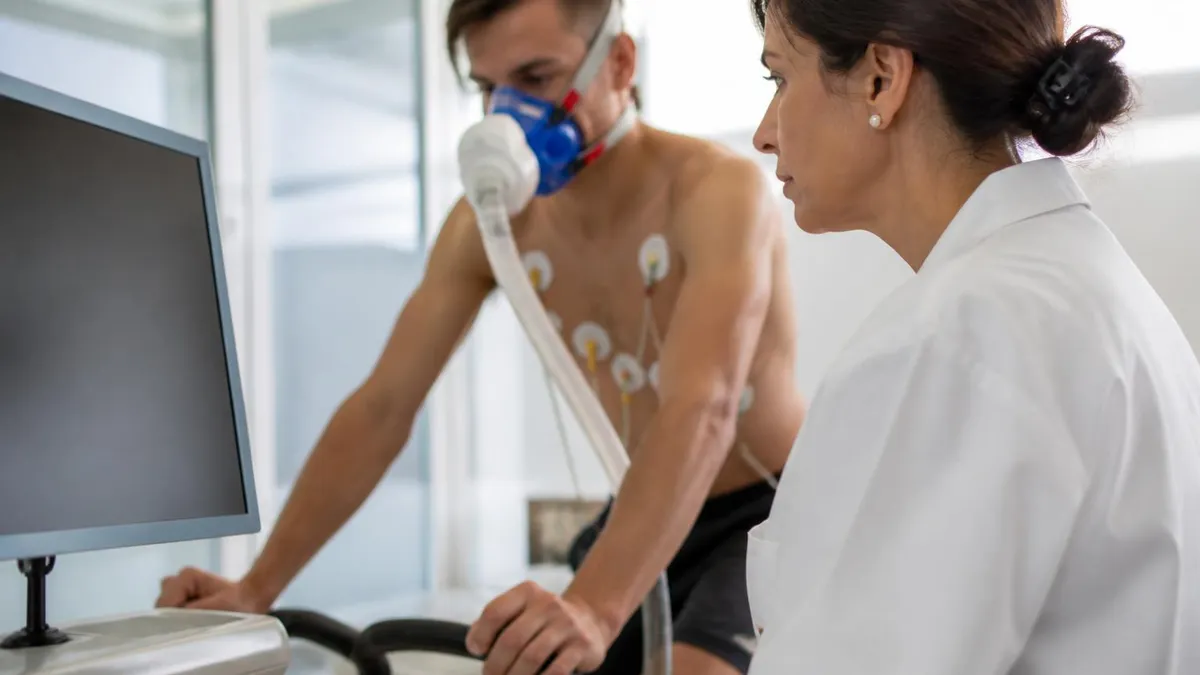
Cardiovascular physiology questions appear regularly: cardiac output, stroke volume, heart rate, oxygen consumption (VO2), and the relationship between them. VO2max as a measure of cardiorespiratory fitness and the MET system for expressing exercise intensity are both heavily tested.
Muscular Anatomy and Biomechanics
You'll need to know major muscle groups, their functions, and common exercise movements. Expect questions on joint actions — flexion, extension, abduction, adduction, rotation — and the prime movers for common exercises. Understanding the difference between open and closed kinetic chain exercises, and when each is appropriate, is regularly tested.
ACSM GEI Exam: Key Differences
The GEI exam has a similar structure to the CPT but with different content emphasis. The domains cover group exercise leadership, exercise science applied to group formats, class design and music use, and participant monitoring. If you're pursuing the GEI, you'll focus more on cueing techniques, format transitions, intensity modifications for mixed groups, and the physiological demands of different class types (aerobics, cycling, HIIT, mind-body).
Our free ACSM GEI practice questions focus on these specific competencies — use them to identify which areas of group exercise instruction need the most revision before your exam.
How to Structure Your ACSM Exam Preparation
Most candidates need 3–6 months of preparation for the ACSM CPT, spending 10–15 hours per week. Here's a structure that works:
- Get ACSM's GETP. The exam is based on it. Chapters on exercise prescription, fitness assessment, and special populations are the priority chapters. Highlight and annotate as you read.
- Take a diagnostic practice test. Before structured studying, work through 50–75 practice questions. Note which domains you're weakest in — that's where to spend the most time.
- Study by domain. Work through each of the four CPT domains systematically. Use the exam content outline (available from ACSM) as your checklist — if it's on the outline, understand it.
- Do timed practice tests. In the final 3–4 weeks, complete full-length timed practice tests. Aim for 80%+ on practice before your exam date — the real exam is harder than most practice materials.
- Review wrong answers in depth. Don't just note what you got wrong — understand why. Most ACSM questions have a specific GETP reference. If you can't link a wrong answer to a principle, you haven't understood it yet.

- +Validates your knowledge and skills objectively
- +Increases job market competitiveness
- +Provides structured learning goals
- +Networking opportunities with other certified professionals
- −Study materials can be expensive
- −Exam anxiety can affect performance
- −Requires dedicated preparation time
- −Retake fees apply if you don't pass
Pros and Cons at a Glance
| Pros | Cons |
|---|---|
| Validates your knowledge and skills objectively | Study materials can be expensive |
| Increases job market competitiveness | Exam anxiety can affect performance |
| Provides structured learning goals | Requires dedicated preparation time |
| Networking opportunities with other certified professionals | Retake fees apply if you don't pass |
Sample ACSM Practice Questions
Try these questions from our free ACSM practice tests. The correct answer and an explanation follow each question.
What is the best practice for documenting assessment results in ACSM practice?
- A. Record only abnormal findings
- B. Document all findings objectively and completely
- C. Use subjective descriptions only
- D. Document results from memory at end of day
Answer: B. Document all findings objectively and completely
Best practice requires documenting all findings objectively and completely at the time of assessment for accuracy and legal protection.
In ACSM practice, what is the best approach to quality improvement in behavioral strategies?
- A. Make changes without measuring results
- B. Use data-driven methods with measurable outcomes
- C. Wait for problems to occur before acting
- D. Copy what other organizations do without analysis
Answer: B. Use data-driven methods with measurable outcomes
Data-driven quality improvement with measurable outcomes ensures that changes actually produce the intended improvements and can be verified.
Which factor MOST significantly affects the quality of technical outcomes in ACSM practice?
- A. The speed at which procedures are completed
- B. The practitioner's training, preparation, and attention to detail
- C. The brand of equipment being used
- D. The time of day the procedure is performed
Answer: B. The practitioner's training, preparation, and attention to detail
The quality of technical outcomes depends primarily on the practitioner's level of training, thorough preparation, and careful attention to detail. While equipment matters, the professional's competence is the most significant factor.
In ACSM practice, what is the best approach to quality improvement in cardiovascular fitness?
- A. Make changes without measuring results
- B. Use data-driven methods with measurable outcomes
- C. Wait for problems to occur before acting
- D. Copy what other organizations do without analysis
Answer: B. Use data-driven methods with measurable outcomes
Data-driven quality improvement with measurable outcomes ensures that changes actually produce the intended improvements and can be verified.



Special Populations: A Priority Study Area
Questions about special populations appear throughout the ACSM CPT exam — they're spread across the programming and assessment domains, not confined to a single section. Common special populations include:
- Older adults — modified intensity recommendations, fall prevention, balance training, bone health
- Pregnant and postpartum clients — exercise safety guidelines, contraindications, exercise intensity monitoring using RPE (Borg scale) rather than heart rate
- Youth — appropriate resistance training guidelines, growth plate considerations, aerobic training recommendations
- Individuals with obesity — weight loss vs. fitness programming, caloric expenditure calculations, modified equipment use
- Clients with hypertension — pre-exercise BP cut-offs, appropriate exercise intensity, medications that affect exercise response
The key with special populations is knowing both the modifications and the rationale. ACSM exam questions often test whether you understand why a modification is recommended, not just what the modification is.
Use our free ACSM practice tests to work through special population scenarios, exercise prescription calculations, and anatomy questions in an exam-format setting. Consistent practice — particularly timed practice in the final weeks — is what bridges the gap between knowing the content and performing under exam pressure.
About the Author

Registered Dietitian & Fitness Certification Coach
University of FloridaAmanda Foster holds a Master of Science in Kinesiology from the University of Florida and is a Registered Dietitian and NASM Certified Personal Trainer. She has helped over 1,000 fitness professionals prepare for their ACE, NASM, ACSM, and specialty nutrition certifications, specializing in evidence-based exercise science and macro nutrition coaching methodology.
Join the Discussion
Connect with other students preparing for this exam. Share tips, ask questions, and get advice from people who have been there.
View discussion (8 replies)