
ACLS Certification Near Me: How to Find Local Classes, Costs & Fast-Track Options in 2026 October
ACLS certification near me: 🏆 find local AHA classes, costs ($175-$300), same-day options, online hybrid courses, and how to pass on your first try.
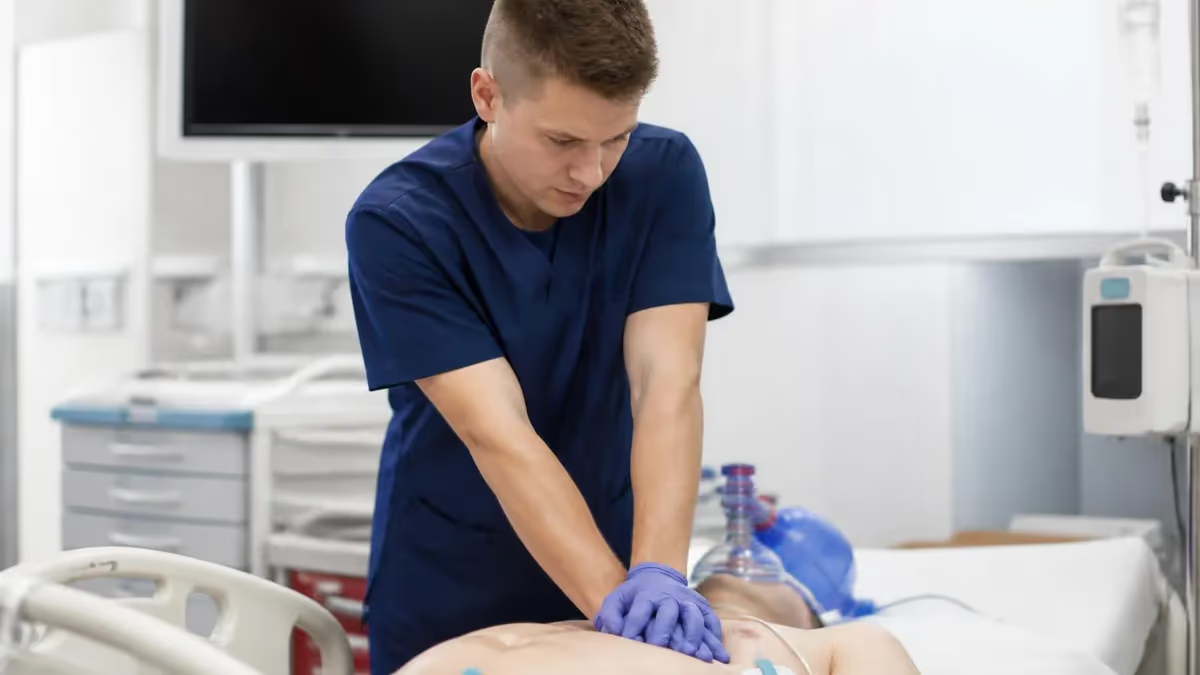
Searching for ACLS certification near me is one of the most common queries among nurses, paramedics, respiratory therapists, and physicians who need their card fast. Whether your current ACLS provider card expires in two weeks or your new employer demands proof before orientation, finding a legitimate, AHA-aligned course within driving distance has become surprisingly competitive in 2026. Hospitals, community colleges, fire stations, and independent training centers all run classes — but availability, price, and quality vary enormously between zip codes.
The good news is that ACLS access has expanded dramatically over the past five years. Most metro areas now host at least 8 to 12 training sites within a 20-mile radius, and hybrid options let you knock out the cognitive portion online before showing up for a 4-hour skills check. The bad news? Pricing has crept up to between $175 and $325 for initial certification, and walk-in availability is rare. Planning two to four weeks ahead is realistic for nearly every U.S. region.
This guide breaks down exactly how to evaluate local providers, what credentials to verify, how to compare in-person vs. blended formats, and what to expect on test day. We'll cover same-day options for last-minute renewals, AHA Training Center verification, employer reimbursement strategies, and the specific questions to ask before swiping your card. Whether you live in Los Angeles, rural Idaho, or anywhere between, the path to a valid ACLS card looks similar — but the tactics differ.
If you're brand new to advanced cardiac care, expect a course that runs roughly 12 to 16 hours total across one or two days, with renewal courses compressing that to 5 to 8 hours. You'll need to demonstrate competency in BLS skills, lead a megacode simulation, interpret core rhythms, and pass a 50-question written exam with at least 84 percent accuracy. None of this is impossible, but walking in unprepared is a recipe for failing the megacode and having to retest.
Many candidates underestimate the prep work and rely on showing up cold. That strategy backfires. Instructors increasingly report that 15 to 25 percent of students fail the megacode on first attempt when they skip the pretest. A few hours of focused review on the algorithms, drug doses, and rhythm strips will save you the embarrassment — and the retest fee. Free resources like our ACLS practice test mirror the official format and help diagnose weak spots before class day.
Throughout this article, we'll prioritize accurate, AHA-aligned information and flag any provider patterns that should make you pause. Not every "ACLS certification" sold online qualifies for hospital credentialing — and the difference between a real AHA course card and a knockoff certificate can mean losing a job offer. Let's start with what local classes actually look like and how to evaluate the ones in your area.
By the end of this guide, you'll know how to filter search results, identify red flags, choose between in-person and blended formats, budget realistically, and walk into your skills session confident enough to pass on day one. The keyword phrase is simple, but the decision matters: your license, your job, and several hundred dollars all ride on picking the right local provider.
ACLS Certification by the Numbers
Key Facts at a Glance
| Item | Value | Details |
|---|---|---|
| Initial Course Length | 12-16 hrs | Spread over 1-2 days |
| Passing Score | 84% | Written exam minimum |
| Card Validity | 2 years | Renewal required |
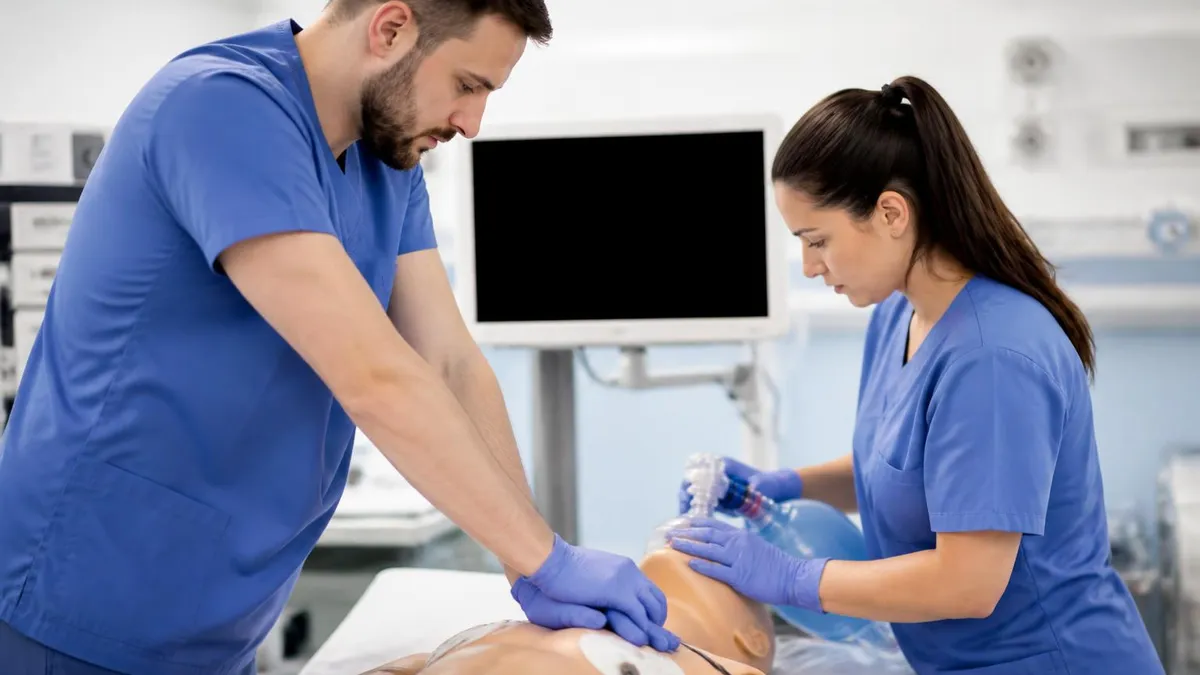
Where to Find ACLS Classes Near You
Most major hospitals run monthly ACLS courses open to outside professionals, often at competitive rates. Call the staff development or clinical education office directly — these classes rarely show up on general search engines.
Use the official AHA Course Connector at heart.org to locate verified training sites within your zip code. Only AHA Training Centers can issue genuine eCards accepted by hospital credentialing committees nationwide.
Many community and technical colleges offer ACLS through continuing education programs at lower prices, typically $175 to $225. Schedules align with semesters, so book 4 to 6 weeks ahead during busy enrollment periods.
Local fire and EMS agencies frequently host classes for paramedics that accept outside RNs, MDs, and RTs on a space-available basis. Pricing is often $50 to $100 lower than commercial providers.
Private ACLS providers run frequent weekend and evening classes with the most flexible scheduling, including same-day card options. Verify their AHA Training Center affiliation before paying any deposit.
Cost is one of the biggest variables when searching for ACLS certification near me. The same provider card — an AHA eCard valid in all 50 states — can run as little as $165 in the rural Midwest or as much as $325 in San Francisco, Boston, or New York City. Coastal metropolitan areas consistently price 30 to 40 percent above the national average, while community college and hospital-based courses tend to undercut commercial training centers by $50 to $100. Renewal courses average $145 to $250 depending on region and provider type.
Don't focus only on the sticker price. Some courses bundle the AHA provider manual ($55 retail) and online pretest access, while others charge those as add-ons. A $200 class that requires you to buy a $55 manual and pay a $35 retest fee if you fail is effectively a $290 course. Always ask exactly what's included. Reputable providers will email a written breakdown without hesitation, and any reluctance to itemize charges is itself a warning sign worth heeding before booking.
Employer reimbursement is the smartest way to neutralize the cost entirely. Roughly 70 percent of hospital employers cover ACLS as part of mandatory credentialing, but reimbursement rules vary. Some pay directly, some require you to front the cost and submit receipts, and some only reimburse approved vendors. Check your benefits portal or ask HR before booking — paying $300 out of pocket when your employer would have paid $200 directly through a preferred vendor is an avoidable mistake many new hires make in their first month.
Travel nurses and per diem clinicians should also research stipends and continuing education allowances. Many staffing agencies allocate $500 to $1,500 annually for certifications, and ACLS qualifies in nearly every case. If you're between contracts, time your renewal to align with a new assignment so the agency absorbs the cost. Independent contractors and locum physicians often write off ACLS as a legitimate business expense on Schedule C, recovering 22 to 32 percent at tax time depending on their effective rate.
Beware of suspiciously cheap online-only ACLS courses that advertise full certification for $59 to $99 with no skills check. These are typically not AHA-issued and will be rejected by hospital credentialing offices, JCAHO surveyors, and most state nursing boards. A real ACLS provider card requires hands-on competency demonstration in front of a certified instructor — it cannot be earned entirely online, regardless of what a flashy landing page claims. Always verify the issuing organization before paying.
If budget is genuinely tight, consider scheduling during off-peak months. January, February, and September tend to have lower demand than the year-end rush in October through December, when nurses scramble to use expiring CE budgets. Some providers offer 10 to 15 percent discounts for early registration or group bookings of three or more colleagues. Reach out to coworkers whose cards expire around the same time and negotiate a group rate — splitting a private session at your facility can save everyone $40 to $75 each.
If you're weighing whether to invest in the full course or only the cognitive prep materials, our ACLS course breakdown compares the formal options and what each delivers for the money. Spending an hour comparing real costs against your specific situation is almost always worth it, especially if you can stack employer reimbursement with a community college rate to land your card for under $100 net.
ACLS Practice Test Questions
Prepare for the ACLS Advanced Cardiovascular Life Support Practice exam with our free practice test modules. Each quiz covers key topics to help you pass on your first try.
ACLS Cardiac Rhythms & ECG Interpretation
ACLS Exam Questions covering ACLS Cardiac Rhythms & ECG Interpretation. Master ACLS Test concepts for certification prep.
ACLS Pharmacology & Medications
Free ACLS Practice Test featuring ACLS Pharmacology & Medications. Improve your ACLS Exam score with mock test prep.
ACLS Best Practices & Methodologies
ACLS Mock Exam on Best Practices & Methodologies. ACLS Study Guide questions to pass on your first try.
ACLS Communication & Stakeholder Relations
ACLS Test Prep for Communication & Stakeholder Relations. Practice ACLS Quiz questions and boost your score.
ACLS Core Concepts & Fundamentals
ACLS Questions and Answers on Core Concepts & Fundamentals. Free ACLS practice for exam readiness.
ACLS Data Analysis & Reporting
ACLS Mock Test covering Data Analysis & Reporting. Online ACLS Test practice with instant feedback.
ACLS Documentation & Record Keeping
Free ACLS Quiz on Documentation & Record Keeping. ACLS Exam prep questions with detailed explanations.
ACLS Industry Regulations & Compliance
ACLS Practice Questions for Industry Regulations & Compliance. Build confidence for your ACLS certification exam.
ACLS Leadership & Team Management
ACLS Test Online for Leadership & Team Management. Free practice with instant results and feedback.
ACLS Professional Standards & Ethics
ACLS Study Material on Professional Standards & Ethics. Prepare effectively with real exam-style questions.
ACLS Quality Assurance & Improvement
Free ACLS Test covering Quality Assurance & Improvement. Practice and track your ACLS exam readiness.
ACLS Risk Management & Assessment
ACLS Exam Questions covering Risk Management & Assessment. Master ACLS Test concepts for certification prep.
ACLS Class Formats: In-Person, Blended, and Skills-Only
Traditional in-person ACLS runs as a single full-day or two-evening session totaling 12 to 16 hours for initial certification. You'll cover cognitive content with an instructor, work through case scenarios in small groups, practice megacode simulations on a manikin, and complete both the written exam and skills check the same day.
This format works best for hands-on learners and those who haven't worked recent codes. Expect roughly $225 to $325 in major metros. The advantage is leaving with your card in hand and no homework hanging over you, but the time commitment is significant and missing any portion typically requires retaking the entire class from scratch.

Local In-Person Classes vs Hybrid: Which Is Better?
- +One-day completion with card issued same day in most cases
- +Hands-on practice with manikins and real defibrillator equipment
- +Direct instructor feedback during megacode simulations
- +Easier to ask clarifying questions in real time
- +Networking with local code team members and ICU peers
- +No technology barriers or platform login issues to troubleshoot
- −Longer total time commitment of 12 to 16 hours in a single block
- −Less scheduling flexibility for night shift or rotating workers
- −Typically $50 to $100 more expensive than blended options
- −Travel time and parking add to total day's cost and fatigue
- −Higher fatigue risk when megacode lands at hour 14 of class
- −Limited rescheduling options if illness or emergency strikes
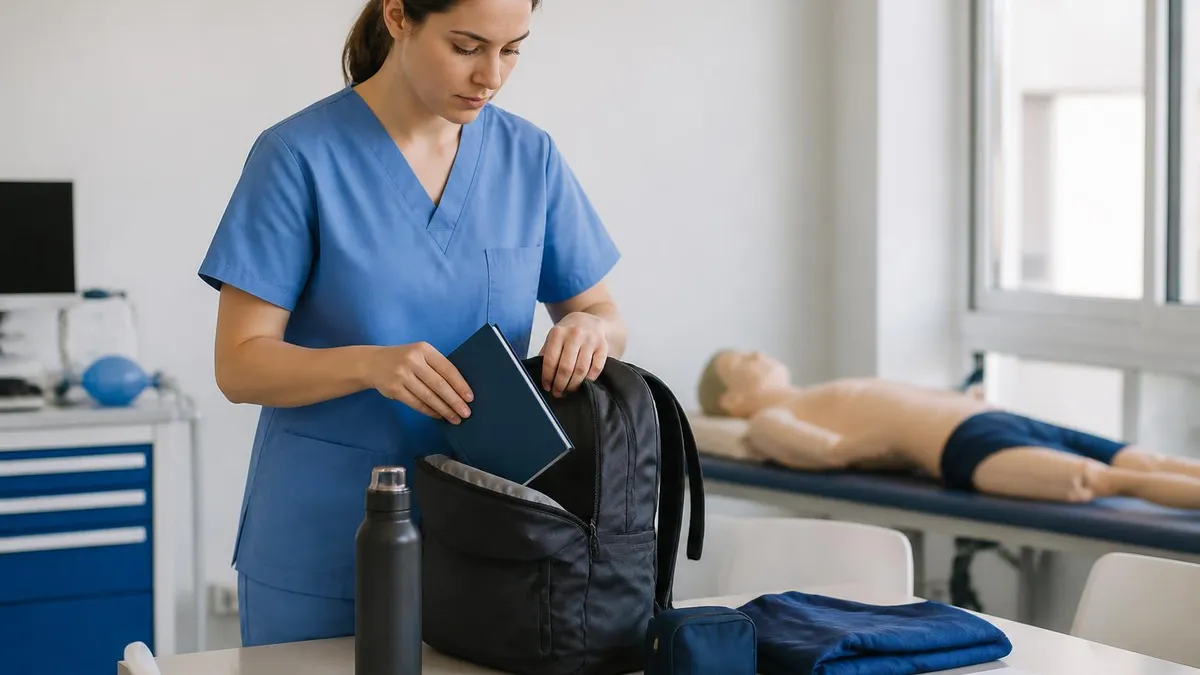
What to Bring to Your Local ACLS Class
- ✓AHA ACLS Provider Manual (2020 or 2025 edition, depending on cycle)
- ✓Government-issued photo ID matching the name on registration
- ✓Current BLS provider card (required to begin most ACLS courses)
- ✓Printed HeartCode completion certificate if doing blended format
- ✓Stethoscope and trauma shears if you have them, though not required
- ✓Comfortable clothes and closed-toe shoes for hands-on manikin work
- ✓Notebook and pen for instructor-provided case scenario notes
- ✓Water bottle and snacks for the long classroom day ahead
- ✓Reading glasses if needed for rhythm strip interpretation
- ✓Employer reimbursement form to have signed before leaving
Memorize Epinephrine and Amiodarone Doses Cold
If you walk in knowing exactly that epinephrine is 1 mg IV every 3 to 5 minutes in cardiac arrest and amiodarone is 300 mg IV bolus then 150 mg, you'll handle 80 percent of megacode pressure. Instructors note these two drugs alone trip up roughly one in four students. Drill them until they're automatic.
Walking into your local ACLS class for the first time can feel intimidating, especially if you've been out of code situations for a while. Knowing exactly what happens on the day removes most of the anxiety. Doors typically open 15 to 30 minutes before the scheduled start so you can sign in, present ID and your BLS card, receive any handouts, and find a seat near the manikin station you'll be using. Late arrivals — even by 10 minutes — are often turned away with no refund, so plan your commute accordingly.
The day usually begins with brief introductions and an overview of the schedule, followed by a BLS competency check. This is non-negotiable: if you can't demonstrate effective high-quality compressions, bag-mask ventilation, and AED use, the instructor will pull you aside and may not let you continue. Practice on your unit's training manikin in the week before class if it's been a while. Compression depth must hit 2 to 2.4 inches and rate must stay at 100 to 120 per minute, both verified by feedback device.
Cognitive content fills the middle hours, with the instructor walking through systematic approach, ACLS algorithms for cardiac arrest, bradycardia, tachycardia, and acute coronary syndrome, plus stroke recognition basics. Expect heavy emphasis on team dynamics: closed-loop communication, clear role assignment, and the importance of speaking up when something looks wrong. Many candidates underestimate this section, but team dynamics questions show up repeatedly on both the written exam and megacode scoring rubrics.
Lunch is rarely catered. Bring your own meal or know the nearby options, because the typical 30 to 45 minute break does not allow time for a sit-down restaurant. After lunch, you'll rotate through skills stations with small groups of 3 to 6 candidates. Each station targets a specific competency: rhythm recognition with strips, defibrillation and synchronized cardioversion on training models, IV and IO access review, and airway management including ETCO2 interpretation.
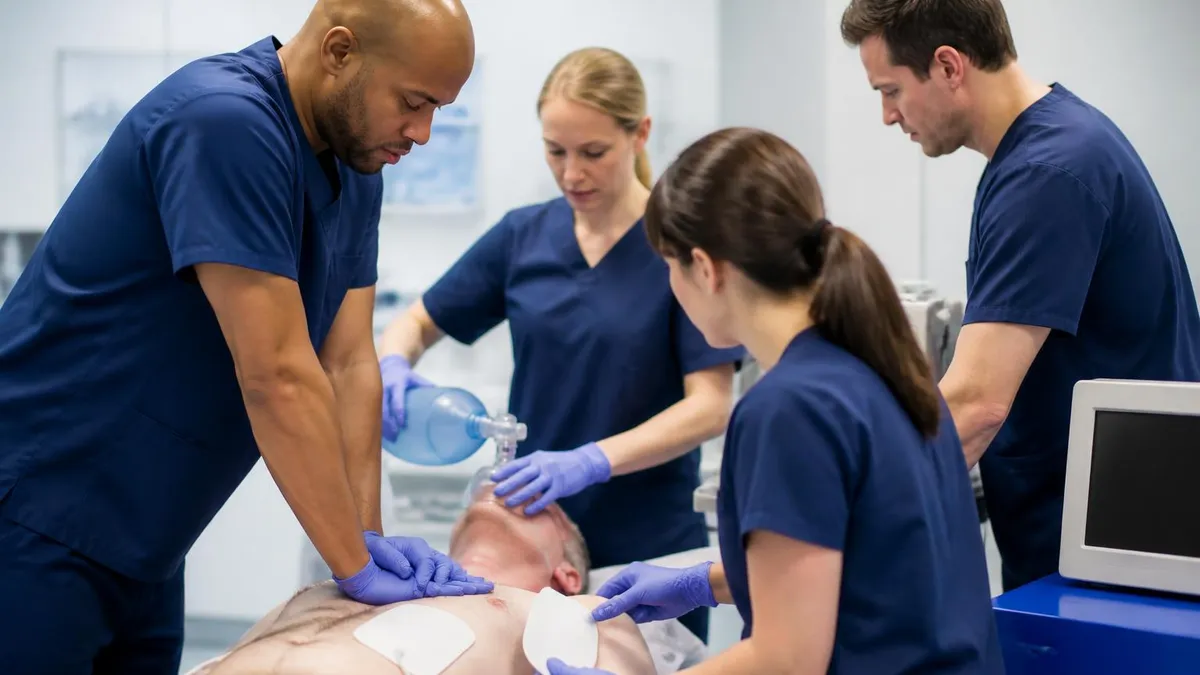
The megacode is the moment most candidates fear. You'll be assigned as team leader and walked through an evolving scenario lasting 8 to 12 minutes. The patient's rhythm will change — perhaps starting as VT with a pulse, progressing to pulseless VT, then VF, then maybe PEA — and your job is to call out the correct algorithm steps, order appropriate drugs in correct doses, manage your team, and reassess after each intervention. Instructors look for systematic thinking, not perfection. If you make a small error but correct it, you'll generally pass.
The written exam consists of 50 multiple-choice questions covering rhythms, drugs, algorithms, and post-arrest care. You need 84 percent — that's 42 correct out of 50. The test is open for 60 to 90 minutes, but most candidates finish in 30 to 40. If you've completed the pretest seriously and worked through practice questions, the exam itself is rarely the failure point. Megacode performance under pressure is where most retests originate.
Cards are typically issued electronically within 24 to 48 hours through the AHA eCard system. You'll receive an email with a verification link your employer can check directly against the AHA database. Print or save a digital copy — and never let the email get buried, because reissuing a lost eCard sometimes requires re-contacting the training center weeks later. Your two-year clock starts on the date of skills completion, not the eCard issue date.
Some online vendors sell "ACLS certification" cards for $59 to $129 that look professional but are not issued under American Heart Association authorization. These are routinely rejected by hospital credentialing offices, state boards, and Joint Commission surveyors. Always verify your provider is listed on the official AHA Training Center directory at heart.org before paying anything.
The difference between initial certification and renewal matters more than most candidates realize when searching for ACLS certification near me. Initial courses are designed for first-time providers and assume zero baseline knowledge of advanced algorithms beyond BLS. Renewal courses assume you've actively worked in environments where ACLS skills are used and compress the cognitive content significantly. Picking the wrong format wastes time or sets you up to fail, so understand which one fits your situation before you book.
Initial ACLS is required for anyone who has never held a provider card or whose card expired more than 30 days ago. Even if you previously held ACLS years ago, most training centers and AHA guidance treat a lapsed card beyond grace as starting fresh. The course runs 12 to 16 hours and includes all foundational content. Don't try to convince a training center to put you in a renewal class to save time and money — they will almost always refuse, and rightly so, since the cognitive gap is significant.
Renewal courses are open to anyone with a current provider card or one that lapsed within the last 30 days. These compress to 5 to 8 hours and skip most of the foundational lecture content, jumping straight to algorithm review, drug calculations, and megacode practice. The assumption is you've been responding to codes or supervising them in your daily work. If that's not the case — perhaps you transferred from ICU to clinic three years ago — consider doing the full initial course again even if your card is technically current.
The AHA eCard is valid for exactly two years from the skills check date. Set a calendar reminder six months before expiration and another at three months. Procrastinating until the month of expiration leaves you scrambling for available slots, especially in October through December when demand spikes. Many candidates discover the hard way that the nearest renewal class is booked solid for six weeks and end up paying premium prices for last-minute alternatives or letting their card lapse entirely.
If your employer requires uninterrupted certification — and most do for ICU, ED, cath lab, and code team roles — a lapsed card can mean immediate removal from the schedule or even job loss in some hospital systems. The grace period some providers offer is courtesy, not policy, and your employer's HR or credentialing office is the final authority. When in doubt, treat your expiration date as a hard deadline and complete your renewal at least four weeks early.
Travel nurses, locum physicians, and per diem clinicians face additional complexity. Your card needs to be valid throughout your contract, and some agencies require it to remain current for the entire scheduled assignment plus a buffer period. Verify renewal timing with your agency's credentialing team before booking. Some agencies will pay for renewal as part of contract onboarding; others expect you to arrive already certified for the full contract duration.
For the official AHA guidance and what to expect from the modern provider course, our breakdown of AHA ACLS standards covers what's tested, what's optional, and how the 2020 guidelines updated drug recommendations and team dynamics scoring. Reading through it before booking helps you decide between initial and renewal with confidence.
Final prep advice from instructors who watch hundreds of candidates pass and fail each year focuses almost entirely on three things: rhythm recognition under time pressure, drug dose recall without hesitation, and calm team leadership during the megacode. Master these three and the written exam takes care of itself. Stumble on any of them and you risk a retest, an awkward conversation with your manager, and another $75 to $150 in fees.
For rhythm recognition, spend at least three to four hours in the week before class working with rhythm strip flashcards or practice apps. The eight rhythms you must know cold are sinus rhythm with variations, sinus bradycardia, sinus tachycardia, atrial fibrillation, atrial flutter, supraventricular tachycardia, ventricular tachycardia (mono and poly), ventricular fibrillation, asystole, PEA, and the three degrees of AV block. If you can't identify each in under five seconds, you need more practice before walking into your local class.
Drug doses are the second pillar. Build a one-page cheat sheet — for personal study only, since you can't bring it into the exam — listing every ACLS medication, its indication, dose, route, and any timing notes. Epinephrine 1 mg every 3 to 5 minutes in arrest. Amiodarone 300 mg then 150 mg in refractory VF/pulseless VT. Atropine 1 mg every 3 to 5 minutes up to 3 mg in symptomatic bradycardia. Adenosine 6 mg rapid push then 12 mg if needed. Drill these until they're muscle memory.
Team leadership during megacode is often the deciding factor between passing and failing. Speak loudly and clearly. Use closed-loop communication: "Maria, please give 1 mg of epinephrine IV push" — then wait for Maria to confirm "Giving 1 mg epinephrine IV push now" — then "Thank you, Maria." This sounds robotic in practice, but it's exactly what instructors are scoring you on. Awkward-feeling communication beats fast and chaotic every single time on the rubric.
The night before class, sleep matters more than cramming. A tired brain misses rhythm strips and forgets drug doses. Eat a real breakfast with protein, arrive 30 minutes early, and avoid heavy caffeine if it makes you jittery — manageable adrenaline is fine, but trembling hands during compressions are scored unfavorably. Bring water and small snacks; the day is long and energy crashes hit hardest right when the megacode happens.
If you fail any portion, don't panic. Most providers allow one free retest within 30 days, often the same week. Use the days between to drill exactly what you missed. Failing megacode usually means inadequate team leadership or a missed algorithm step; failing the written usually means weak drug doses or rhythm recognition. Identify your specific gap honestly and target your retest prep there rather than re-reading the whole manual.
Finally, after you pass, save your eCard verification link in three places: your phone, your email, and a personal cloud folder. Hospital credentialing offices ask for it at the most inconvenient times — typically right before a shift starts. Having it instantly accessible saves stress and demonstrates the kind of preparedness your colleagues and patients deserve. Treat your two-year clock as a calendar appointment, not an afterthought.
ACLS Questions and Answers
About the Author

Registered Nurse & Healthcare Educator
Johns Hopkins University School of NursingDr. Sarah Mitchell is a board-certified registered nurse with over 15 years of clinical and academic experience. She completed her PhD in Nursing Science at Johns Hopkins University and has taught NCLEX preparation and clinical skills courses for nursing students across the United States. Her research focuses on evidence-based exam preparation strategies for healthcare certification candidates.