
WHMIS Training Requirements: Does WHMIS Training Expire? Complete 2026 Guide
Does WHMIS training expire? 🎓 Learn WHMIS 2015 requirements, certificate renewal, AIX safety answers, and how to pass your WHMIS exam in 2026.

If you have been searching for WHMIS 2015 AIX Safety V3 quiz answers or wondering whether your WHMIS certificate is still valid, you are not alone. Every year, thousands of Canadian and US-based workers ask the same critical question: does WHMIS training expire? The short answer is yes — WHMIS training does not last forever, and failing to renew it on time can expose both workers and employers to serious legal and safety risks. Understanding what does whmis stand for is the first step toward building a complete picture of workplace hazardous materials safety.
WHMIS stands for Workplace Hazardous Materials Information System, a comprehensive Canadian regulatory framework that governs how hazardous products are identified, labeled, and communicated in the workplace. The 2015 update — commonly called WHMIS 2015 — aligned the Canadian system with the Globally Harmonized System of Classification and Labelling of Chemicals (GHS), which is also widely used in the United States under OSHA's HazCom 2012 standard. This alignment means that workers trained in WHMIS 2015 will find much of the content familiar if they have also studied American hazard communication rules.
Training expiry timelines are not universally fixed by a single national law. Instead, Canadian federal regulations under the Hazardous Products Act and the Canada Occupational Health and Safety Regulations set broad requirements, while individual provinces add their own rules on top. Most jurisdictions recommend that WHMIS training be renewed annually, and many employers enforce a strict 12-month renewal cycle. Some industries — particularly those involving highly hazardous chemicals or frequent product changes — require even more frequent retraining to keep workers current.
The AIX Safety WHMIS 2015 V3 course is one of the most widely recognized online WHMIS training programs in Canada. Workers at companies across Alberta, British Columbia, Ontario, and beyond use it to satisfy their employer's training requirements. Because the course ends with a graded quiz, many learners search specifically for AIX Safety WHMIS 2015 quiz answers or AIX Safety WHMIS answers to prepare for the assessment. This guide will not hand you a cheat sheet, but it will give you the conceptual understanding you need to answer every question confidently on your own.
Employers bear the primary legal obligation under WHMIS legislation to ensure that workers receive adequate training before they work with or near hazardous products. This means providing both generic WHMIS education — covering hazard classes, pictograms, labels, and Safety Data Sheets (SDS) — and site-specific training tailored to the actual products used in a given workplace. Generic online courses like the AIX Safety WHMIS 2015 program satisfy the first requirement, but employers must supplement them with workplace-specific instruction before a worker is considered fully compliant.
One of the most common misconceptions about WHMIS certification is that a certificate earned through an online course is universally accepted and never needs updating. In reality, WHMIS certificates issued by third-party providers are proof of education, not a government-issued license. The certificate demonstrates that a worker has completed a structured training program, but it does not replace employer-led site-specific training, and it does not automatically remain valid indefinitely. Most reputable providers, including AIX Safety, recommend renewing the course annually or whenever significant changes occur in the workplace's chemical inventory.
Whether you are studying for the AIX Safety WHMIS 2015 V3 quiz, preparing for a workplace audit, or simply trying to understand what your WHMIS certificate actually covers, this guide walks through every key requirement. You will learn about the nine hazard classes, the role of pictograms and labels, how Safety Data Sheets are structured, and exactly what happens when training lapses. By the end, you will have the knowledge base needed to answer any WHMIS training requirements question thrown at you — on a quiz or on the job.
WHMIS Training by the Numbers

Core WHMIS 2015 Training Requirements
Workers must complete a foundational course covering hazard classes, pictograms, labels, and SDS structure. Online programs like AIX Safety WHMIS 2015 satisfy this requirement and result in a certificate upon successful quiz completion.
Employers must supplement generic training with instruction on the actual hazardous products used in the specific workplace. This includes hands-on SDS review, emergency procedures, and safe handling practices relevant to each job role.
Most Canadian jurisdictions and best-practice guidelines recommend renewing WHMIS training every 12 months. Retraining is also required whenever new hazardous products are introduced or when a worker changes roles or worksites.
Employers must keep records of all WHMIS training completed by workers, including dates, course content, and assessment results. Inspectors may request these records during a workplace audit or following a chemical incident.
Workers have the legal right to refuse unsafe work and to access SDS documents for any hazardous product they encounter. They also share responsibility for attending training sessions and applying safe handling procedures consistently.
The question of whether WHMIS training expires is arguably the most important one any worker or employer can ask about workplace chemical safety. The honest and direct answer is: yes, WHMIS training does expire — but the exact timeline depends on your province, your employer's internal policies, and the nature of the hazardous products you work with. Federal guidelines under the Canada Occupational Health and Safety Regulations call for training to be provided whenever a new hazard is introduced and at intervals determined by the employer. In practice, nearly all employers set that interval at 12 months.
Provincial regulations build on federal minimums in different ways. Ontario's Occupational Health and Safety Act requires employers to provide information and instruction on hazardous materials, and the Ministry of Labour strongly recommends annual retraining. Alberta's Occupational Health and Safety Code requires workers to be competent in WHMIS, and competency must be maintained — meaning training that is several years old without refreshers may not satisfy an inspector's standard. British Columbia similarly requires ongoing training that keeps pace with changes in the workplace chemical inventory, making a static one-time certificate insufficient for most environments.
Even where no provincial law explicitly mandates an annual renewal date, the definition of whmis regulatory intent is clear: workers must be knowledgeable about the hazards they face right now, not simply knowledgeable about what they learned three years ago. If a workplace introduces a new solvent, a new cleaning agent, or a new industrial chemical, affected workers must receive updated training on that product before using it. This ongoing obligation means that even a worker with a recently renewed generic WHMIS certificate may need additional site-specific retraining when products change.
AIX Safety WHMIS 2015 certificates, like those issued by other reputable online providers, typically carry a recommended expiry of one year from the date of issue. When you log into the AIX Safety platform and complete the WHMIS 2015 V3 course, your certificate will display the completion date. Most employers treat that date as the start of a 12-month validity clock. Once the year is up, you will need to retake the course — or an equivalent approved program — to receive a new certificate. Some employers use an automated reminder system to flag workers whose certificates are approaching expiry.
It is worth noting that there is no single government-issued WHMIS certificate that is universally recognized across all Canadian provinces and industries. Organizations like AIX Safety, Workplace Safety and Prevention Services (WSPS), and the Canadian Centre for Occupational Health and Safety (CCOHS) all offer WHMIS training programs that are recognized by employers, but none of these certificates are mandatory government documents. The legal obligation rests with the employer to ensure training is adequate, not with the certificate-issuing body. This distinction matters: a certificate proves you completed a training program; employer verification of site-specific competency is what truly satisfies the law.
Workers who let their WHMIS training lapse face real consequences. If a workplace incident occurs and an investigation reveals that an injured worker's training had expired, both the worker and the employer may face regulatory penalties. Workers could be assigned personal liability if they failed to alert their employer about an expired certificate when they knew it was overdue. Employers face fines, stop-work orders, and reputational damage if audits reveal systemic lapses in training records. Staying current is not just a bureaucratic formality — it is a meaningful safeguard against chemical injuries and legal exposure.
For workers preparing to renew their WHMIS training through the AIX Safety WHMIS 2015 platform or a similar program, the core content areas to review include hazard classification under the GHS framework, the nine physical and health hazard classes, the meaning of each WHMIS pictogram, how to read a supplier label, and the 16-section structure of a Safety Data Sheet. The quiz at the end of these programs tests precisely these areas, and a thorough understanding of each concept is the most reliable way to achieve a passing score on your first attempt.
AIX Safety WHMIS 2015 Quiz Answers: Key Topic Areas
WHMIS 2015 organizes hazardous products into physical hazards (such as flammable gases, explosives, and oxidizing liquids) and health hazards (such as acute toxicity, carcinogens, and respiratory sensitizers). Each class is represented by a standardized GHS pictogram — a black symbol on a white background inside a red diamond border. The AIX Safety WHMIS 2015 V3 quiz commonly tests whether learners can match a pictogram to its hazard class and describe the risks associated with each category. Memorizing all nine major pictograms and their meanings is the single most effective preparation strategy.
Common AIX Safety WHMIS answers on pictogram questions include: the skull and crossbones indicates acute toxicity; the flame symbol covers flammable solids, liquids, gases, and self-reactive substances; the exclamation mark appears on products with less severe health effects like skin irritation; and the health hazard symbol (a human silhouette with a starburst on the chest) covers carcinogens, reproductive toxins, and respiratory sensitizers. Knowing which symbol goes with which hazard — and which hazards share symbols — is essential for a passing score on any WHMIS 2015 assessment including the AIX Safety platform.

Online WHMIS Training vs. In-Person WHMIS Training
- +Complete the course at any time and from any location with internet access
- +Self-paced format lets workers revisit difficult sections before attempting the quiz
- +Lower cost than instructor-led classroom sessions for large workforces
- +Instant certificate delivery upon passing the assessment
- +AIX Safety WHMIS 2015 V3 and similar programs are widely accepted by Canadian employers
- +Easy to track and record completion dates for employer compliance purposes
- −Online courses satisfy generic education requirements only — site-specific training must still be done in person
- −Workers cannot ask real-time questions or get hands-on demonstrations of SDS use
- −Some industries and employers require in-person or blended training regardless of online certificate
- −Screen-based learning may reduce retention compared to interactive, scenario-based instruction
- −Technical issues (poor internet, device incompatibility) can interrupt course progress
- −Without employer follow-through, online training alone creates a false sense of full compliance
WHMIS Training Renewal Checklist
- ✓Check your current WHMIS certificate for the original completion date and calculate your renewal deadline
- ✓Confirm whether your province (Ontario, BC, Alberta, etc.) has specific renewal interval requirements beyond the annual recommendation
- ✓Verify that your employer's internal WHMIS policy aligns with provincial regulations and update records accordingly
- ✓Enroll in a recognized WHMIS 2015 program such as AIX Safety WHMIS 2015 V3 before your certificate expires
- ✓Review all nine WHMIS 2015 hazard classes and their associated GHS pictograms before attempting the quiz
- ✓Study the 16-section SDS format and know which sections apply during emergencies (Sections 4, 5, and 6)
- ✓Complete site-specific training with your employer after finishing the generic online course
- ✓Request a copy of your updated WHMIS certificate and submit it to your employer's HR or safety team
- ✓Confirm that your employer has updated your training record with the new certificate date
- ✓Schedule a calendar reminder 30 days before your next annual renewal date to avoid a lapse in certification
Generic Training + Site-Specific Training = Full Compliance
Completing an online WHMIS course like AIX Safety WHMIS 2015 satisfies only the generic education requirement. Employers must still conduct site-specific training covering the actual products used in the workplace. Both components together — and only together — fulfill the full legal WHMIS training obligation under Canadian health and safety law.
Understanding WHMIS symbols is one of the most tested areas in any WHMIS 2015 assessment, including the AIX Safety V3 quiz. WHMIS 2015 adopted the GHS pictogram system, replacing the older hatched-border symbols used under WHMIS 1988 with internationally standardized icons displayed inside a red diamond border. There are nine core pictograms used under WHMIS 2015, and each one represents a specific category of physical or health hazard. Workers who can identify every pictogram on sight are far better positioned to respond quickly and correctly when they encounter a hazardous product in the workplace.
The flame pictogram — a stylized orange flame — covers flammable gases, flammable aerosols, flammable liquids, flammable solids, and self-reactive substances. When you see this symbol on a product label, you know immediate ignition risk is present and you must keep the product away from heat sources, sparks, and open flames. The flame-over-circle pictogram specifically indicates oxidizing hazards — substances that can intensify fires even without being flammable themselves. Confusing these two related symbols is a common error on WHMIS quizzes, so pay close attention to the circle detail beneath the flame when reviewing product labels.
The skull and crossbones pictogram signals acute toxicity at any route of exposure — whether inhaled, ingested, or absorbed through the skin. Products bearing this symbol can cause serious harm or death after a single short-term exposure at relatively low doses. By contrast, the exclamation mark pictogram represents a lower but still significant level of hazard, appearing on products that cause skin or eye irritation, mild respiratory irritation, or other less severe effects. Understanding the hierarchy of severity between these two symbols helps workers prioritize personal protective equipment choices and emergency response actions correctly.
The health hazard pictogram — depicting a human silhouette with a starburst effect on the chest — is one of the most important symbols to recognize because it covers serious long-term health consequences. Products with this pictogram may be carcinogenic, mutagenic, toxic to reproduction, or capable of causing specific target organ toxicity after repeated exposure. Workers in industries that use solvents, adhesives, or industrial cleaning chemicals frequently encounter this symbol, and understanding its meaning is critical for making informed decisions about respiratory protection and exposure limits during regular work activities.
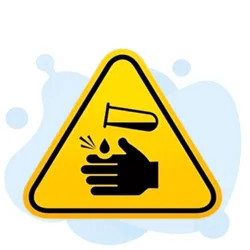
The corrosion pictogram, showing a liquid dripping onto a hand and a surface, indicates products that cause severe skin burns, eye damage, or corrosion to metals. Acids and strong bases commonly carry this symbol. The gas cylinder pictogram appears on compressed gases, including non-flammable and non-toxic gases like compressed nitrogen or carbon dioxide, flagging the physical hazard of pressurized container rupture.
The exploding bomb symbol covers explosives, self-reactive substances that may detonate, and organic peroxides with explosive properties. The environmental hazard pictogram — a dead tree and fish — appears on products toxic to aquatic life and serves as a reminder about proper disposal and spill containment procedures near waterways.
To define whmis pictograms precisely: each image is not merely decorative — it is a legally required communication tool. Suppliers must include every applicable pictogram on their product labels, and the absence of a pictogram is not a sign that a product is safe; it means the product does not meet the classification threshold for that specific hazard. Workers should always consult the SDS for a complete picture of a product's hazard profile, since the SDS may describe hazards that are present but not severe enough to trigger a mandatory pictogram under the GHS classification system.
For workers studying AIX Safety WHMIS 2015 answers related to pictograms, the most reliable approach is to study all nine symbols side by side, noting the specific visual details that distinguish similar-looking icons. Flashcard-style practice — covering the label and trying to name the hazard from the symbol alone — is far more effective than simply reading a list. This visual fluency is exactly what the quiz assesses, and it is also precisely what makes a real difference in workplace safety when a worker encounters an unfamiliar product and needs to quickly assess the risks before handling it.

If your WHMIS certificate has lapsed and a workplace injury occurs, both you and your employer may face regulatory penalties. Inspectors routinely request training records during audits, and missing or outdated certificates can trigger stop-work orders and fines. Renew your training before the expiry date — do not wait until an incident prompts the review.
Earning your WHMIS certificate through a program like AIX Safety WHMIS 2015 is an important milestone, but it is worth understanding exactly what that certificate does and does not certify. The certificate documents that you successfully completed a structured educational program covering the WHMIS 2015 regulatory framework, hazard classification, labeling requirements, and SDS interpretation. It is recognized by employers across Canada as evidence of generic WHMIS knowledge. However, it is not a government-issued license, it does not replace site-specific training, and it carries an effective shelf life that most employers treat as one year.
The AIX Safety WHMIS 2015 V3 quiz that concludes the course typically consists of multiple-choice questions drawn from all major content areas. Questions test hazard class recognition, pictogram identification, label component knowledge, SDS section purposes, and understanding of employer and worker obligations under WHMIS legislation.
A passing score is generally set at 70 percent or higher, and most platforms allow multiple attempts if you do not pass on the first try. Workers who review the course materials thoroughly — rather than skimming for quick AIX Safety WHMIS answers — consistently perform better on repeat attempts because they have built genuine understanding rather than surface-level memorization.
One of the most valuable things you can do before attempting the AIX Safety WHMIS 2015 quiz is to practice with realistic WHMIS training questions. Practice quizzes that mirror the format of the actual assessment help you identify knowledge gaps, build confidence with multiple-choice question phrasing, and develop the time management habits needed to complete a timed assessment without rushing. The free practice tests available on PracticeTestGeeks.com are designed specifically to reinforce WHMIS 2015 concepts in the same format you will encounter in real employer-required assessments including the AIX Safety platform.
Employers who administer WHMIS training programs — whether they use AIX Safety, CCOHS, WSPS, or an internally developed curriculum — are responsible for verifying that the content they deliver is accurate, current, and aligned with the most recent version of the Hazardous Products Regulations.
When regulatory changes occur (as happened during the WHMIS 1988 to WHMIS 2015 transition), employers must update their training materials accordingly and retrain all affected workers. Workers who completed WHMIS training under the old 1988 system and have not retrained under WHMIS 2015 are not considered current, even if their 1988-era certificate has not technically expired under older organizational policies.
For the whmis what does it stand for question that appears in nearly every WHMIS quiz: WHMIS stands for Workplace Hazardous Materials Information System. This full name encodes the core purpose of the regulation — it is a system for communicating information about hazardous materials in the workplace. Each word in the acronym carries meaning: Workplace (it applies specifically to occupational settings), Hazardous Materials (it covers products that pose a risk to health or safety), Information (it is fundamentally a communication framework), and System (it integrates multiple components including labels, SDS, and training rather than relying on any single tool).
WHMIS meaning extends beyond the acronym itself to the underlying philosophy that workers have a right to know about the hazards they face on the job. This right-to-know principle is the foundation of all hazard communication regulation in both Canada and the United States.
When workers understand the meaning and history of WHMIS — not just the rules but the reasoning behind them — they are more likely to take the training seriously, apply safe handling procedures consistently, and speak up when they observe unsafe practices involving hazardous products. This cultural understanding is what distinguishes workers who treat WHMIS as a checkbox from those who treat it as a genuine safety tool.
Preparing thoroughly for your WHMIS certificate assessment is also a professional investment. Workers who demonstrate strong WHMIS knowledge are better positioned for roles in occupational health and safety, warehouse supervision, laboratory management, and industrial operations. Employers in sectors ranging from construction and manufacturing to healthcare and agriculture value workers who can read SDS documents independently, identify hazards quickly, and apply the correct precautionary measures without waiting for supervisor guidance. Your WHMIS certificate, earned through genuine understanding rather than shortcut memorization, is a credential that supports your career development alongside its primary function as a safety requirement.
When preparing for the AIX Safety WHMIS 2015 V3 quiz or any other WHMIS 2015 assessment, a structured study approach dramatically increases your chance of passing on the first attempt. Begin by reading through the entire course material once without stopping to take notes — this first pass gives you a high-level map of the content.
On your second pass, focus on active recall: close the material and try to list all nine pictograms from memory, all 16 SDS sections in order, and the key distinctions between supplier labels and workplace labels. This active retrieval practice strengthens memory far more effectively than passive re-reading.
Pay particular attention to the areas where WHMIS 2015 differs from WHMIS 1988, because quiz questions frequently test these distinctions. Under WHMIS 1988, hazard symbols appeared inside a circular hatched border and were specific to Canadian law. Under WHMIS 2015, symbols appear inside a red diamond border and are internationally standardized under the GHS framework.
The old WHMIS 1988 classes (Class A through F) have been replaced by the GHS-aligned physical and health hazard categories. Material Safety Data Sheets (MSDS) under the old system have been replaced by Safety Data Sheets (SDS) with a mandatory 16-section format. Knowing these specific changes helps you navigate questions about what WHMIS 2015 updated and why.
Another high-yield study strategy is to work through practice questions under timed conditions. The AIX Safety WHMIS 2015 V3 quiz is typically completed in under an hour, but nerves and unfamiliar phrasing can slow you down if you are not practiced at reading multiple-choice questions efficiently. When practicing, note which question types trip you up most frequently.
If pictogram questions are your weak point, spend more time on visual symbol review. If SDS section questions are challenging, create a quick-reference table mapping each section number to its content. Targeted remediation of specific weak areas is more efficient than general review of material you already know well.
On the day of your AIX Safety WHMIS 2015 quiz, read each question completely before looking at the answer choices. Many WHMIS quiz questions use qualifiers like always, never, only, and must that significantly affect the correct answer. A statement that is true in most cases may be wrong as an absolute rule. Eliminate obviously incorrect answers first to improve your odds when the correct answer is not immediately clear.
If two answers seem plausible, return to the specific regulatory language you studied — WHMIS 2015 regulations are precise, and the quiz reflects that precision. Trust the content you studied rather than trying to reason from general common sense, which can lead you astray on technical regulatory questions.
After passing your WHMIS quiz and receiving your AIX Safety WHMIS 2015 certificate, your next step is to complete the site-specific component with your employer. Ask your supervisor or safety officer to walk you through the SDS documents for every hazardous product you will encounter in your role. Practice locating emergency information (Section 4 for first aid, Section 5 for firefighting) quickly and without assistance.
Identify where the SDS binders or digital SDS management systems are located in your workplace — in an emergency, you need to be able to find that information in seconds, not minutes. This hands-on application of your generic WHMIS knowledge is what makes training meaningful rather than merely compliant.
Workers in industries with high chemical turnover — food manufacturing, automotive repair, construction, janitorial services — should proactively review their workplace's SDS inventory whenever new products are introduced. Do not wait for your employer to formally announce new training; ask questions about unfamiliar products before handling them. This proactive attitude reflects the spirit of the right-to-know principle embedded in WHMIS legislation and significantly reduces the risk of chemical exposure incidents. It also demonstrates to supervisors and safety officers that you take workplace safety seriously, which can contribute positively to your professional reputation and career advancement.
Finally, keep digital or printed copies of your WHMIS certificates in a personal record that follows you from job to job. When starting a new position, you may be asked to produce your most recent WHMIS certificate before your employer conducts site-specific training.
Having an organized record of your training history — including dates, course names, and issuing organizations — simplifies onboarding and demonstrates your commitment to maintaining current workplace safety knowledge. Treat your WHMIS training portfolio the same way you would treat any professional credential: keep it current, keep it accessible, and know exactly when each element needs to be renewed.
WHMIS Questions and Answers

WHMIS Label Requirements: Complete Guide to WHMIS 2015 Workplace Labels and Safety Data Sheets
WHMIS Practice Test PDF (Free Printable 2026)

WHMIS Symbols and Meanings: Complete Guide to WHMIS 2015 Pictograms
WHMIS Symbols: Complete Training Guide for WHMIS 2015

WHMIS Law Explained: Is WHMIS Legally Required in Canada and the US?
About the Author

Educational Psychologist & Academic Test Preparation Expert
Columbia University Teachers CollegeDr. Lisa Patel holds a Doctorate in Education from Columbia University Teachers College and has spent 17 years researching standardized test design and academic assessment. She has developed preparation programs for SAT, ACT, GRE, LSAT, UCAT, and numerous professional licensing exams, helping students of all backgrounds achieve their target scores.