
Free White Card Practice Test 2026 July - CPCWHS1001 Questions
🆕 Free White Card practice test for the CPCWHS1001 construction induction. 48 questions on Australian WHS, hazards, PPE, heights and emergencies with answer explanations.
What is the White Card and why do you need one?
If you want to work in construction anywhere in Australia, the White Card is your ticket onto the site. It proves you have completed the general construction induction training described in the unit of competency CPCWHS1001 — Prepare to work safely in the construction industry. Builders, principal contractors and site supervisors are legally required to check that everyone entering a construction zone holds a valid card, so without one you simply will not be allowed to start.
The card exists because construction is one of the most dangerous industries in the country. Workers deal with heights, heavy plant, electricity, hazardous chemicals and constantly changing conditions. The induction training makes sure that before you ever pick up a tool, you understand the basics of work health and safety (WHS): how to spot a hazard, how the hierarchy of control works, what your duties are, and what to do in an emergency. It is deliberately broad rather than deep — think of it as a safety licence to learn, not a trade qualification.
The good news is that the White Card is not designed to trip you up. The assessment checks that you have genuinely absorbed the safety basics, and almost everyone who studies passes. This page is built to get you there faster.
White Card at a glance

How the White Card assessment works
White Card training is delivered by a Registered Training Organisation (RTO), either face to face or, in some states, online. Whichever way you study, the training covers the same core content set out in CPCWHS1001. At the end you complete an assessment that usually mixes multiple-choice questions, short written answers and a few practical demonstrations, such as correctly identifying safety signs or describing how you would respond to a hazard.
There is no harsh time limit and no trick maths. The assessor wants to see that you can apply the basics: that you understand who is responsible for safety, that you can read a sign, that you know the right order of the hierarchy of control, and that you would stop and report rather than push on through something unsafe. Because the content is consistent nationally, the questions you will see in our six quizzes mirror the real subject areas closely.
Once you pass, the RTO issues your card (and an interim statement so you can start work straight away in most states). You should always carry it — or be able to produce it — whenever you are on a construction site.
The legal foundation: the model WHS Act, the role of the PCBU (Person Conducting a Business or Undertaking), worker duties, the right to a safe workplace, consultation, and the Safe Work Method Statement (SWMS) for high risk work. You will also meet your state regulator — SafeWork NSW, WorkSafe Victoria, Workplace Health and Safety Queensland and the rest.
The six topics in your free practice test
We have split the White Card syllabus into the same six areas your RTO will test. Each quiz has eight questions with a full explanation after every answer, so you are not just memorising — you are learning why each answer is right. Work through them in order the first time, then come back and re-take any topic where you slipped. Most people find that two or three passes through all six quizzes is more than enough to feel ready.
Why bother with practice questions when the real assessment is so achievable? Because the worst time to discover a gap in your knowledge is in the assessment room itself. A practice run shows you instantly which ideas have stuck and which need another look, and the explanations turn a wrong answer into a lesson you actually remember. It also takes the nerves out of the day. By the time you sit the real thing, the format feels familiar and the questions feel like old ground rather than a surprise. That calm, prepared mindset is exactly what an assessor wants to see, and it is what keeps you safe once you are on the tools.
WHS Legislation & Duties
The WHS Act, the PCBU's duty of care, your worker duties, SWMS and the role of state safety regulators.
Hazard Identification & Risk
Hazards vs risk, running a risk assessment, near misses and the all-important hierarchy of control.
PPE & Safety Signs
Hard hats and hi-vis, inspecting PPE, and reading Australian safety signs by colour and shape.
Working at Heights & Electrical
Fall prevention, ladders, RCDs, damaged leads and overhead powerline safety on site.
The hierarchy of control — the idea you must know
If you remember only one thing from your White Card training, make it the hierarchy of control. It is the framework Australia uses to decide how to deal with any hazard, and it appears all over the assessment. The order runs from most effective to least effective: elimination (remove the hazard completely), substitution (swap it for something safer), isolation (separate people from it with barriers or exclusion zones), engineering controls (guardrails, machine guards, extraction), administrative controls (training, signage, procedures), and finally personal protective equipment (PPE).
PPE sits at the bottom for a reason. A hard hat or a pair of gloves only protects the one person wearing it, and only if they wear it correctly — it does nothing to remove the danger itself. That is why a good site always tries to design the hazard out first and treats PPE as the last line of defence, not the first. Get comfortable with this ladder and a big chunk of the exam falls into place.
How to pass first go
- ✓Read through all six topic areas once so you know the full scope of what is covered.
- ✓Take each of the six quizzes in order and read every answer explanation, even the ones you got right.
- ✓Note the hierarchy of control word for word — eliminate, substitute, isolate, engineer, administer, PPE.
- ✓Learn the safety sign colours: blue mandatory, yellow warning, red prohibition, green emergency.
- ✓Memorise that 000 is the emergency number and that a serious injury or dangerous incident is notifiable.
- ✓Re-take any quiz you scored below 7 out of 8 until you can pass it comfortably.
- ✓Book your assessment with a Registered Training Organisation once you can pass all six topics.
Reading Australian safety signs
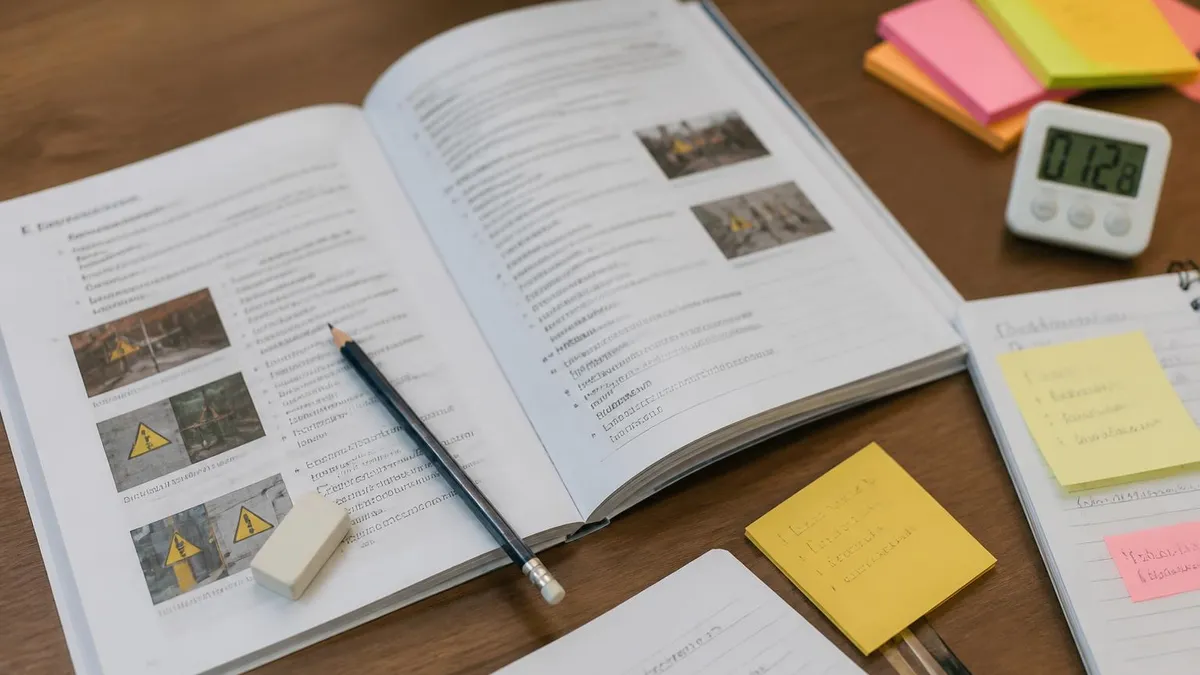
Safety signs are a guaranteed part of the assessment, and the trick is to read the colour and shape rather than the words. A blue circle is a mandatory sign — it tells you something you must do, like 'Hard hat must be worn'. A yellow triangle is a warning — it alerts you to a hazard such as a slippery surface or overhead load. A red circle with a diagonal line is a prohibition sign — the action shown is forbidden, like 'No smoking' or 'No entry'. And green signs carry emergency and safe-condition information, pointing you to first aid, exits and assembly points. Learn those four and you can answer almost any sign question without even reading the caption.
You will also come across a few extra colours on a busy site. Orange or red-and-white tags are commonly used to mark equipment that has been tagged out of service, while a danger sign uses red, black and white to flag something that could cause serious injury or death if ignored. Fire equipment and its signage are red. None of this is meant to be memorised like a vocabulary list — the point of the colour system is that you can react correctly in a split second, even from a distance, before you have had time to read a word. That is why your induction keeps coming back to it.

What each quiz covers
- Questions: 8
- Focus: WHS Act, PCBU, SWMS
- Questions: 8
- Focus: Hierarchy of control
- Questions: 8
- Focus: Sign colours, PPE
- Questions: 8
- Focus: Falls, RCDs, powerlines
- Questions: 8
- Focus: SDS, asbestos, manual handling
- Questions: 8
- Focus: Evacuation, 000, reporting
Working at heights and electrical safety
Falls from heights are consistently among the leading causes of death and serious injury on Australian construction sites, so the induction takes them seriously. The safest option is always to avoid working at height at all; where that is not possible, solid edge protection such as guardrails comes before relying on a harness. A fall-arrest harness is a control measure for when the higher-order options are not reasonably practicable, and it only works if it is fitted, anchored and inspected properly. Even ladders deserve respect: check for damage, set them on firm level ground at about a 4:1 angle, and never stand on the top rungs.
Electricity is the other silent danger. The rule drummed into every White Card holder is simple — treat every wire and piece of equipment as live until a competent person has confirmed otherwise. A residual current device (RCD), or safety switch, cuts power within milliseconds if it senses current leaking to earth, which is why portable tools on site should always run through one. Damaged or frayed leads must be tagged out of service and reported, never taped up and reused, and tall plant like cranes must keep a safe distance from overhead powerlines.
Water and electricity are a deadly mix, so leads should be kept off wet ground and out of puddles, and any work near electrical sources in damp conditions needs extra care. If you ever see a colleague in contact with a live source, never grab them directly — switch off the power first or use a non-conductive object to break the contact, then call 000. These few habits prevent the majority of electrical incidents on Australian sites, and they are exactly the kind of practical judgement the White Card assessment is checking you have.
Studying with practice tests
- +Free, instant feedback on every question with a full explanation
- +Covers all six real White Card topic areas
- +Re-take as many times as you like until you pass comfortably
- +Builds genuine safety knowledge, not just exam answers
- −Does not replace the official RTO training and assessment
- −You still need to attend an RTO to be issued the actual card
- −Some practical tasks can only be assessed in person
After you pass: getting and keeping your card
Once you have completed the training and passed the assessment, your RTO issues your White Card, usually with an interim statement so you can begin work immediately while the physical card is produced. In most states and territories the card does not expire, but there is an important catch: if you do not carry out construction work for two years or more, the card can lapse and you may need to complete the training again. Rules vary slightly by jurisdiction, so always check with your state regulator. Keep your card somewhere safe, carry it on site, and you are set to build your career in Australian construction.
It is worth understanding that the White Card is the starting point, not the finish line. It covers general induction only. Many specific tasks need their own high risk work licences or additional tickets — operating a forklift, erecting scaffold, working on a boom-type elevating work platform, or doing dogging and rigging all require separate qualifications on top of your card. Each site you join will also run its own site-specific induction covering the particular hazards, layout and emergency arrangements of that job. Think of the White Card as the key that gets you through the gate; the site induction and any high risk work tickets are what let you actually do the more specialised work safely once you are inside.
Pick any of the six quizzes above and begin right now — no account, no payment, no catch. Work through all 48 questions, read every explanation, and re-take the topics you find tricky. When you can pass all six comfortably, book your assessment with a Registered Training Organisation and walk in with confidence.
White Card Questions and Answers
About the Author

Australian licensing, citizenship & exam-prep specialist
University of SydneyLiam Bennett is an Australian education specialist with over a decade preparing candidates for the Driver Knowledge Test, citizenship test, NAPLAN and vocational white-card and RSA certifications across NSW, VIC and QLD. He builds study materials and mock tests aligned to the official Australian formats.