
Test Centers and State Requirements for the USMLE 2026 October
USMLE test centers worldwide via Prometric, Step 1/Step 2 CK scheduling, 🧠 2026 October-2026 October exam dates, and state-by-state licensure rules including Florida.
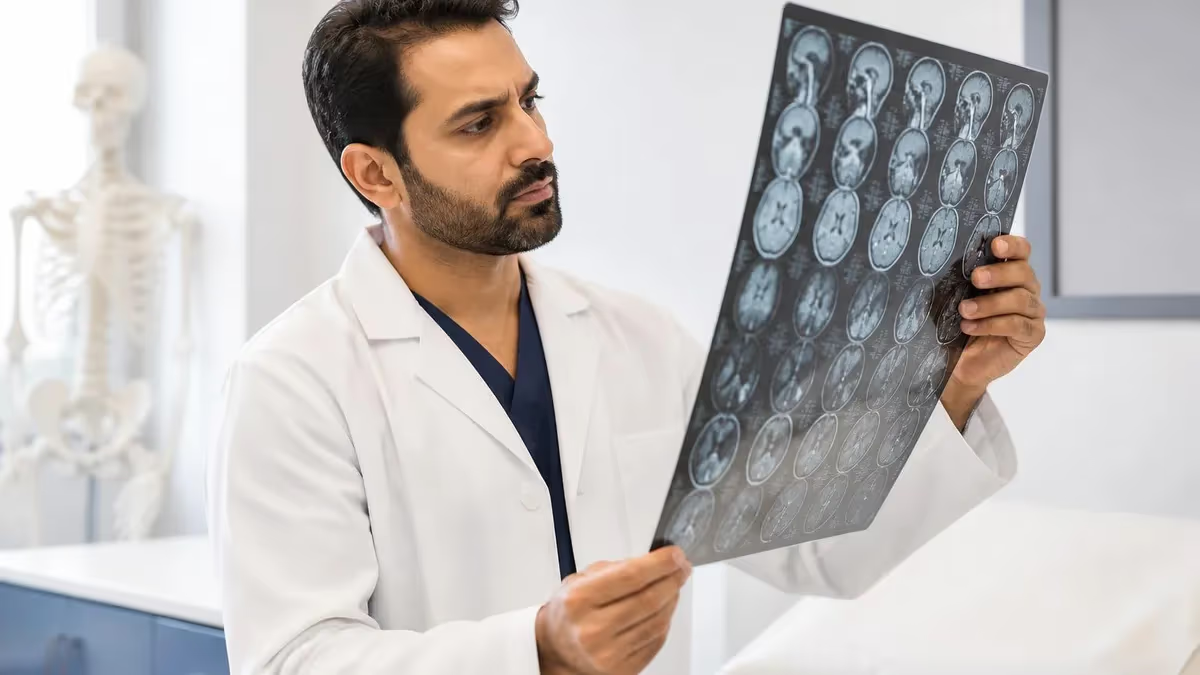
Most candidates approach the USMLE thinking it's mostly about the studying. Then they hit the booking screen at Prometric, see four centers within driving distance, two of which have nothing open until next quarter, and start to realize the logistics matter almost as much as the content prep. Test center selection isn't a trivial decision — your seat, your city, even the building's air conditioning quality can shape how a nine-hour Step 2 CK day actually feels.
And there's a second layer most students never look into until residency application season: state licensure rules. The USMLE is the dominant US licensing exam, but it's not the only path to practicing medicine in this country. A handful of states allow physicians trained abroad to work in specific narrow roles without passing all three Steps. Florida, for example, runs a house physician program that lets graduates of foreign medical schools work in supervised clinical roles under tight conditions. It isn't a USMLE shortcut, but it's a legitimate alternative pathway worth knowing about.
This guide pulls both threads together. We'll walk through the Prometric global network — where USMLE test centers actually exist, how scheduling permits work, what 2025 and 2026 test dates look like, and how rescheduling fees punish indecision.
Then we'll pivot to state-level reality: which states have alternative pathways, what the doctor-without-USMLE picture really looks like (spoiler — limited research and teaching roles, no clinical licensure), and which US states are friendlier to IMGs. By the time you finish, you'll know how to pick a center, when to book it, and exactly what your career options look like state by state. Let's start with the Prometric network itself.
USMLE Test Center Network at a Glance
Prometric runs every USMLE Step 1 and Step 2 CK administration on the planet. The network covers more than 70 countries — concentrated heavily in the US and Canada, with substantial international coverage across India, the UAE, Saudi Arabia, Germany, the UK, Australia, and most of Europe. Step 3 testing, on the other hand, is US-only. International medical graduates planning Step 3 need to fly to a US Prometric center for that one, which is one of the larger budget items on the IMG path to practice.
Inside the US, the network density skews heavily toward major metros. Chicago, New York City, Houston, Los Angeles, Philadelphia, Atlanta, and Dallas all have multiple high-capacity centers running USMLE almost daily. Smaller cities — Cleveland, Indianapolis, Tampa, Salt Lake City — typically run Step 1 and Step 2 CK two or three days a week.
Rural areas often have no USMLE-approved Prometric center at all, which means candidates from places like Wyoming, Montana, or rural Mississippi routinely drive three hours each way to a viable site. That drive factors into your test day prep more than people realize. Showing up to a nine-hour exam exhausted from a 4 AM start is a real disadvantage.
International centers cluster around medical schools and major business hubs. India has roughly 25 USMLE-approved Prometric centers across Bangalore, Mumbai, Hyderabad, Delhi, and Chennai — the four metros most US-bound Indian graduates target. UAE has centers in Dubai and Abu Dhabi. Germany operates sites in Berlin, Frankfurt, and Munich. The UK has Edinburgh, Manchester, and London. Australia covers Sydney, Melbourne, and Brisbane. If you're in Africa or Latin America, options narrow considerably — Egypt and South Africa both host centers, but candidates in Nigeria, Kenya, or Argentina sometimes travel to Europe or the Middle East to test.
International Surcharge Math
IMGs testing outside North America pay an international test delivery surcharge of $235 to $295 per Step. That's on top of the $1,140 base ECFMG fee. Test in Bangalore for Step 1 and Step 2 CK, then fly to a US center for Step 3, and your raw exam costs alone clear $5,000 before flights, lodging, or document verification. Budget the full picture from day one.
Booking a USMLE seat isn't like booking an SAT date. You don't pick from a fixed national calendar and hope your local center has space. The actual process runs in two stages: NBME or ECFMG approves your application and issues a scheduling permit, then you log into Prometric and pick your seat from whatever's available. Those two stages are managed by two different organizations using two different websites, which trips up most first-time candidates.
The permit is the gatekeeper — without it, the Prometric search bar simply returns nothing. With it, you suddenly see every available slot in your chosen three-month eligibility window. The permit-to-booking gap is where most candidates lose time, because they assume the permit will arrive next week and find out three weeks in that their school never finished its registrar certification.
Below are the four moving parts of test center scheduling, laid out in the order most candidates encounter them. Read all four even if you're focused on Step 1 — understanding eligibility periods and reschedule rules now saves you a $290 fee later when life throws a curveball at week ten of your prep. The structure_cards below cover the global network shape, the booking mechanics, the reschedule fee ladder, and the eligibility window rules. Each is a small detail on its own; together they shape whether your test day is calm or chaotic.
How USMLE Test Center Booking Actually Works
Prometric runs Step 1 and Step 2 CK worldwide, with the deepest seat coverage in US major metros. International centers cluster around medical schools and global business hubs — India, UAE, Germany, UK, Australia. Step 3 is US-only, no exceptions, no remote options.
- ▸300+ US centers, 70+ countries total
- ▸Step 3 testing: United States only
- ▸Bangalore, Dubai, Berlin lead intl coverage
- ▸Rural US candidates often drive 2-3 hours
Once your scheduling permit arrives (1-2 weeks for US grads, 4-8 weeks for IMGs), log into prometric.com/usmle and search by zip code or city. Prometric opens scheduling about 6 months ahead — book the same day your permit lands to lock in your preferred center and time slot.
- ▸Permit issued before any booking is possible
- ▸Prometric portal opens ~6 months ahead
- ▸Morning 8 AM slots fill first
- ▸Screenshot your booking confirmation
More than 31 days from your appointment, rescheduling is free. Between 30 and 6 days you pay roughly $50. Within 5 days the fee jumps to about $290. Skip without rescheduling and you forfeit the full exam fee — no refunds, no medical exceptions without documented emergency paperwork.
- ▸31+ days out: free reschedule
- ▸30-6 days out: ~$50
- ▸5 days or less: ~$290
- ▸No-show: full fee forfeit
When you apply, you pick a three-month window — Jan-Mar, Apr-Jun, Jul-Sep, or Oct-Dec. The permit only lets you book inside that window. Miss it without rescheduling and you lose the exam fee. You can extend once for $90 if you ask before the window closes.
- ▸Four fixed quarter windows
- ▸$90 extension available once
- ▸No bookings outside window dates
- ▸Window forfeit costs full fee
Now for the timing side. Candidates ask two questions over and over: when are USMLE exam dates 2025 and 2026, and how do I lock in a Step 2 CK Prometric slot before the residency-application crunch? The honest answer is that the USMLE doesn't publish test dates the way SAT or MCAT does. Prometric administers Step 1 and Step 2 CK on rolling daily availability, set by individual center capacity and proctor scheduling. Some centers offer USMLE only on Tuesdays and Thursdays. Others run six days a week.
There's no consistent national calendar — which is why local reconnaissance beats general advice every time. The tabs below break down what the 2025 and 2026 testing rhythms actually look like across the major center categories, plus how Step 2 CK scheduling overlaps with the ERAS application timeline. Read them in order even if you think you only need one — the way Step 1 dates open in late winter, for instance, has direct implications for when your Step 2 CK window will fill up nine months later.
Test Dates, Scheduling, and Regional Patterns
Step 1 administration runs year-round at most US Prometric centers. Test dates for usmle step 1 in 2025 and 2026 are not pre-announced — they appear on Prometric's calendar roughly 6 months in advance. Peak demand hits late winter (February-April) and late spring (May-July) when US second-year medical students are clearing dedicated study blocks. If you're targeting one of those peaks, book within 48 hours of your permit being issued or expect to drive farther. Smaller centers like those in Toledo or Tucson typically run Step 1 only two or three days per week — confirm your specific date and center before locking in.
Now let's pivot to the second half of this guide — the state-by-state reality that most USMLE candidates only discover during residency interview season. The USMLE is required for full medical licensure in all 50 US states and DC, but the path to clinical practice isn't identical across state lines. Some states have alternative pathways for IMGs that allow narrow forms of clinical work without completing all three Steps. Others have unusual residency requirements, J-1 visa rules, or restricted licensure categories that change the calculus for IMGs weighing a US career.
This question — can i work as a doctor in usa without usmle — gets asked constantly, and the honest answer is mostly no, with a few highly specific exceptions worth knowing. You can't get a full unrestricted medical license without passing Steps 1, 2 CK, and 3. You also can't practice independently in any state without that license.
But there are research-track positions at academic medical centers, teaching roles, and a small number of state-specific programs (notably Florida's house physician pathway) that allow foreign-trained physicians to work in supervised or non-clinical roles. None of these substitute for the USMLE if your goal is independent clinical practice — but for some career paths, they're legitimate alternatives. Let's unpack which states have which rules.
Florida specifically deserves attention because it's the most-Googled state-without-USMLE topic. Florida operates a house physician program that allows graduates of foreign medical schools to work in defined supervised clinical roles at certain hospitals — primarily teaching hospitals and large urban centers — without holding a full Florida medical license. The role is closer to a senior resident than an attending. You're under a fully licensed physician's supervision at all times, you can't write certain controlled-substance prescriptions, and the career ceiling is hard.
Most house physicians eventually pursue full USMLE certification and residency anyway. But for IMGs who need work authorization quickly while preparing for USMLE — or who have visa constraints that make a traditional residency path slow — the Florida house physician program is a genuine option. Texas, New York, and California have narrower equivalent programs but with stricter eligibility, typically requiring an existing foreign medical license plus additional credentialing.
States that do not require usmle for full licensure don't really exist in any meaningful sense — every state board ultimately accepts USMLE as the licensing pathway for MDs trained at LCME-accredited schools and for foreign-trained physicians via ECFMG Certification. What varies is how each state handles secondary credentials: post-graduate training year requirements, English proficiency documentation, jurisprudence exams, and the speed of board processing.
California, for example, requires three years of accredited residency for IMGs (versus two years in most states). New York is generally IMG-friendly with fast processing but rigid on documentation. Texas requires the Texas Jurisprudence Exam in addition to USMLE. These aren't ways around the USMLE — they're additional steps on top of it.
The Florida house physician program is sometimes marketed online as a way to practice medicine in the US without USMLE. That framing is misleading. The role is supervised, restricted in scope, and capped in seniority. You cannot become an attending or open a private practice as a Florida house physician. Most physicians using this pathway are simultaneously preparing for full USMLE certification. Treat it as a bridge, not a destination — and verify current rules directly with the Florida Department of Health before relying on it for career planning.
Let's pull the test-center and scheduling logistics into a single action sequence. Most of the candidates who run into delays on this side of the USMLE process aren't unprepared on content — they just missed a booking window, lost a permit, or didn't realize their center didn't run Step 2 CK on the day they wanted. Run this checklist before you finalize anything. Each item below has cost real candidates real time and real money — none of this is theoretical.
Build the habit now and it carries through all three Steps. Some candidates also forget that their permit is a physical document — well, a PDF, technically — that needs to be presented or readily available on test day. Save it in multiple places. Email it to yourself. Print a copy and keep it with the photo ID you'll bring. The administrative side of the USMLE doesn't reward casual organization. It rewards over-preparation, the same way the content side does.

USMLE Test Center & Scheduling Checklist
- ✓Confirm your permit's exact eligibility window dates before opening the Prometric portal. The system will reject any date outside the window.
- ✓Search Prometric by zip code, then expand the radius to 50 miles if your local center shows nothing. Save your top three center options before booking.
- ✓Book within 48 hours of your permit landing. Peak windows (Feb-May, July-Aug) fill within days for major-metro centers.
- ✓For IMGs, plan a US Prometric trip 6+ months ahead for Step 3 — book flights and lodging only after the seat is confirmed.
- ✓Screenshot and email yourself the booking confirmation. Print one paper copy. Lost confirmations cost 5-10 business days to reissue.
- ✓Confirm your test center 7 days before exam day — verify the building address, parking situation, and arrival time. Drive the route once if possible.
- ✓Check ID requirements 24 hours before — passport for IMGs, government photo ID for US grads. Name on ID must exactly match the name on your permit, middle initial included.
One of the more consequential choices in scheduling is whether to test in a major US metro or a smaller regional center. Each has trade-offs that go beyond convenience — center size, proctor experience, building quality, and even the noise level of adjacent test takers can affect your day. Below is the honest breakdown of testing in a major-metro center versus a smaller regional one.
Neither is objectively better; the right answer depends on what kind of test taker you are, where you live, and how much travel hassle you can stomach the night before a nine-hour exam. Some candidates thrive in large impersonal centers because the routine feels rehearsed. Others prefer the quieter pace of a smaller center where they're one of three USMLE takers that day. Know yourself before you book.
Major Metro Centers vs Regional Centers
- +Major metros run USMLE almost daily — if your first-choice date isn't available, you'll find another within the same week at the same center.
- +Higher proctor experience. Chicago, NYC, and LA centers process dozens of USMLE candidates weekly — staff know the protocols cold and tech glitches resolve faster.
- +Better backup facilities. Most major-metro Prometric centers have 30+ workstations, so if one machine fails mid-exam you're swapped to another quickly.
- +Easier travel logistics. Major metros have airports, hotels, and rideshare coverage near the test center, which matters if you're flying in for Step 3.
- −Seats vanish faster. Popular dates in NYC or Chicago can be gone within 48 hours of permit issuance — you have to act immediately.
- −Traffic and parking stress. A delayed train or backed-up parking deck on test morning can derail your entire day. Build in 90-minute arrival buffers.
- −Higher candidate density means noisier waiting rooms and busier check-in counters. Some candidates find the buzz draining before a nine-hour exam.
- −Travel cost. Flying to a major metro from a rural state can add $400-$800 in flights and lodging — sometimes a closer regional center is the better economic call.
Let's close the state-requirements thread with practical detail. Beyond Florida's house physician program, a handful of other states have IMG-relevant nuances worth knowing if you're planning a US career path. California, despite being a top destination for foreign-trained physicians, requires three years of ACGME-accredited residency for IMG licensure — one full year more than most states.
Texas requires the Texas Jurisprudence Examination in addition to USMLE, plus background checks that can stretch processing by 6 to 12 weeks. New York is generally fast and IMG-friendly but rigid about document originals — copies and digital scans aren't accepted for many credential submissions. Massachusetts is highly competitive for residency placement but has a streamlined licensure process once you've matched.
Then there's the underused option of academic research positions. Major US academic medical centers — Harvard, Johns Hopkins, Stanford, Mayo Clinic — routinely hire foreign-trained physicians as research fellows or research scientists without requiring USMLE completion. These positions are non-clinical: you can't see patients, can't write prescriptions, and don't carry a state medical license.
But they pay reasonable salaries, often sponsor H-1B or O-1 visas, and offer a foothold in US academic medicine. Many IMGs use a 2-3 year research fellowship as a base from which to complete USMLE Step 1, 2 CK, and 3 and then transition into a clinical residency. It's a slower path than coming straight in via the match, but it's a legitimate one — and it lets you save earned dollars toward the considerable cost of USMLE preparation and residency application travel.
One more piece often overlooked. Teaching roles at US medical schools — adjunct instructor positions, problem-based learning facilitators, anatomy teaching assistants — are sometimes open to foreign-trained physicians without USMLE. These tend to be part-time, supplementary roles. They won't replace clinical practice income, and they don't open a path to independent practice.
But for IMGs who are mid-USMLE-prep and need US-based work history for visa purposes, teaching adjuncts can be a useful supplement. The honest summary: there's no way to practice medicine independently in the US without the USMLE. There are narrow, supervised, or non-clinical roles where you can work while preparing for it. Plan accordingly and don't let online claims of USMLE-free shortcuts derail your timeline.
Test center selection is one of those USMLE decisions that rewards forward thinking. Pick a center close enough to drive to comfortably, big enough to have seat redundancy if your first date doesn't work, and book the same day your permit arrives. Don't wait. Don't second-guess. The candidates who get stuck testing at a center four hours from home aren't the ones who studied less — they're the ones who waited two weeks after permit issuance to look at the booking screen. Lock it in immediately, then go back to your study schedule with one less worry on the calendar.
On the state-requirements side, the practical takeaway is simpler. The USMLE is the path. Every full medical license in every US state runs through it. Alternative pathways like the Florida house physician program exist, but they're bridges, not destinations. If your goal is independent clinical practice in the United States, complete all three Steps, earn your ECFMG certification if you're an IMG, match into an ACGME-accredited residency, and apply for state licensure in whichever state you eventually want to work. Build the timeline back from there. The candidates who succeed aren't the ones looking for shortcuts.
They're the ones who treated registration, scheduling, and state licensure with the same discipline they brought to UWorld and First Aid. Open the Prometric portal the day your permit hits your inbox. Screenshot your booking. Confirm your ID matches the permit name exactly.
And keep your study schedule moving — the match cycle waits for nobody, and the candidates who beat the curve are the ones who treated logistics with the same urgency as content prep. Set a calendar reminder for permit follow-up, draft an email to your registrar today, and pull up the Prometric site to scout your nearest centers before you close this tab.
USMLE Questions and Answers
About the Author
Board-Certified Physician & Medical Licensing Exam Expert
Harvard Medical SchoolDr. Michael Reynolds is a board-certified internist and Fellow of the American College of Physicians with an MD from Harvard Medical School and a Master of Science in Medical Education. With 18 years of clinical and academic medicine experience, he specializes in USMLE Step 1, Step 2, and Step 3 preparation, internal medicine board certification, and medical specialty licensing examinations.