
World History Unit Practice Test: Complete Study Guide for US History Students
Master your world history unit practice test 🎯 covering AP US history, regents prep, timelines & key figures. Free practice tests included.
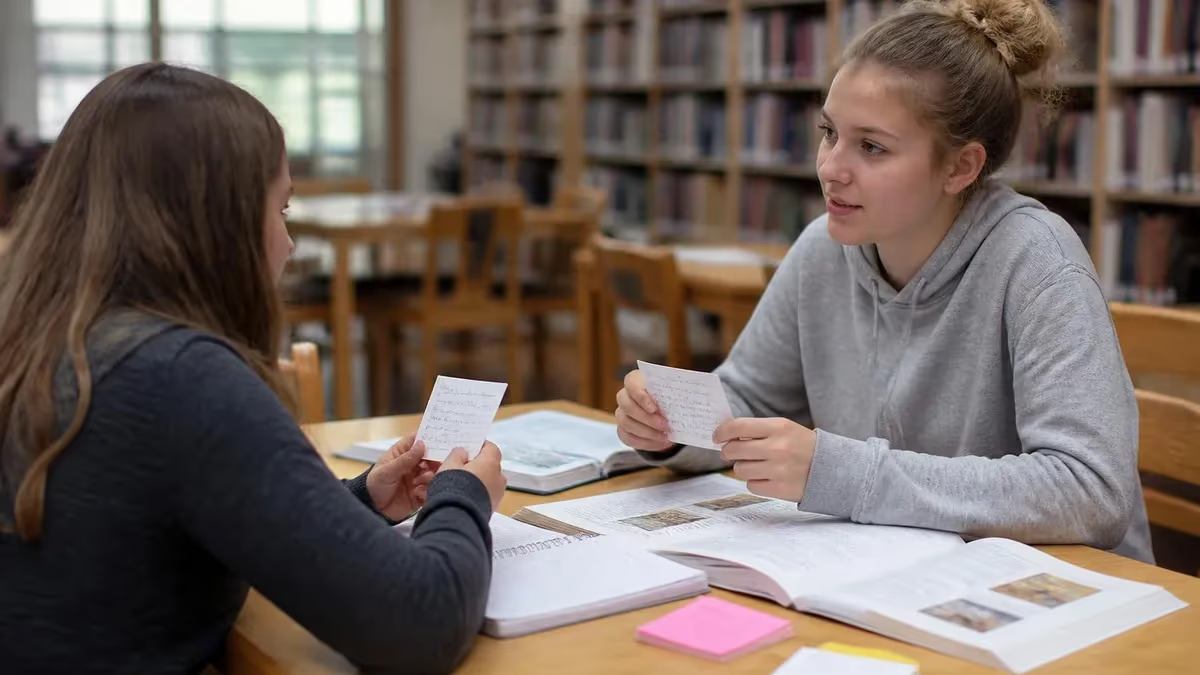
If you are preparing for a world history unit 1 practice test, you are joining millions of students across the United States who rely on structured practice to master the vast sweep of human civilization. Whether your course begins with ancient Mesopotamia, the rise of river valley civilizations, or the philosophical traditions of Greece and China, the first unit typically sets the foundation for every exam that follows.
Understanding how to study this material efficiently — and where to find quality practice questions — can make the difference between a passing grade and a strong one. This guide is designed to help you do exactly that.
Many students are surprised to discover that world history and US history overlap far more than they expect. Discussions about the worst president in us history inevitably require understanding the global context of each presidency — from the Cold War tensions that shaped Truman, Eisenhower, and Nixon to the economic crises that defined Hoover and Buchanan. Knowing world history gives American history meaning, and that is precisely why many state curricula weave the two together from the very first unit.
The world history unit practice test you encounter in class is usually designed to assess your grasp of chronology, causation, and comparison — three of the most important historical thinking skills. You will need to place events on a us history timeline, explain why civilizations rose and fell, and compare political structures across different cultures. These are not skills you develop by memorizing facts alone; they require active practice with real test questions that mirror the format you will face on exam day.
One reason students struggle with world history units is the sheer volume of content. A single unit might cover 10,000 years of human development across six continents. The key is not to memorize everything but to identify the major themes — trade, migration, empire, religion, and technology — and understand how they connect. Practice tests help you identify which themes you have mastered and which still need work, making your study time far more efficient than simply rereading your textbook.
For students enrolled in AP US History or preparing for the us history regents exam in New York, the world history context is especially important. The AP framework explicitly asks students to connect American events to global patterns, and the Regents exam frequently includes questions about European influence on colonial America, Atlantic trade networks, and the global spread of democratic ideals. Practicing with targeted unit tests keeps these connections fresh and helps you answer synthesis questions with confidence.
This guide walks you through the structure of a typical world history unit practice test, the most important content areas to study, effective preparation strategies, and the best free resources available online. By the end, you will have a clear roadmap for tackling not just unit 1, but every subsequent unit in your world history or AP US History course. Let us get started by looking at the numbers behind this subject — because understanding the scope of what you are studying helps you plan your preparation wisely.
World History Unit Practice Test by the Numbers

World History Unit Practice Test Study Schedule
- ▸Read textbook chapters on Mesopotamia, Egypt, India, and China
- ▸Create a timeline of major ancient civilizations from 3500 BCE to 500 BCE
- ▸Complete 20 multiple-choice practice questions on early civilizations
- ▸Review key vocabulary: city-state, ziggurat, dynasty, caste system
- ▸Study the political structures of Athens, Rome, and Han China
- ▸Compare and contrast democracy, republic, and imperial government
- ▸Practice short-answer questions on cultural diffusion and trade routes
- ▸Take a full unit 1 practice test under timed conditions
- ▸Study the rise of Islam, Byzantine Empire, and Tang Dynasty
- ▸Review the Silk Road and Indian Ocean trade networks
- ▸Focus on any weak areas identified from week 2 practice test
- ▸Complete two additional unit practice tests and review all errors
Understanding the key content areas covered on a world history unit practice test is essential for targeted, efficient studying. Most world history unit 1 tests focus on the foundational period of human civilization — roughly 8000 BCE to 600 CE. This era covers the Agricultural Revolution, the rise of river valley civilizations, the development of writing systems, the emergence of major religious traditions, and the expansion of classical empires. Each of these themes is likely to appear in some form on your unit exam, whether as multiple-choice questions, document-based questions, or short-answer prompts.
The Agricultural Revolution is typically the starting point for any world history unit 1 curriculum. Students need to understand not just what happened — humans shifted from nomadic hunting and gathering to settled farming — but why it happened and what consequences it had. The development of surplus food production allowed for population growth, specialization of labor, social stratification, and eventually the complex political structures we associate with early civilizations. Practice test questions often ask students to identify the effects of this shift or to compare how different societies adapted to agricultural life in different geographic settings.
River valley civilizations — Mesopotamia in the Tigris-Euphrates valley, Egypt along the Nile, the Indus Valley civilization in modern-day Pakistan, and the Yellow River civilization in China — are core content for unit 1. Each developed independently but shared common features: organized government, religious institutions, monumental architecture, writing systems, and long-distance trade. A good world history unit practice test will ask you to compare these civilizations, identify their achievements, and explain why geography played such a critical role in their development and eventual decline.
Classical civilizations from roughly 600 BCE to 600 CE form another major content area. Greece, Rome, Persia, India under the Maurya and Gupta dynasties, and Han China all developed sophisticated political, philosophical, and cultural systems during this period. For students also studying us history regents material, the connection between classical Greek democracy and American political thought is especially important. The founding fathers explicitly drew on Athenian democracy and Roman republicanism when designing the United States government, making classical history directly relevant to American history.
Trade networks are another major theme in world history unit tests. The Silk Road connected China to the Mediterranean world, facilitating the exchange of goods, ideas, diseases, and technologies across thousands of miles. The Indian Ocean trade network linked East Africa, the Arabian Peninsula, India, and Southeast Asia. Understanding how these networks worked — who controlled them, what was traded, how they spread religion and culture — is essential for answering comparative and causation questions on your unit exam. Practice tests frequently include maps of these trade routes that you must be able to interpret accurately.
Religion and philosophy round out the major content areas for most world history unit 1 curricula. Hinduism, Buddhism, Confucianism, Daoism, Judaism, and early Christianity all emerged during the classical period and shaped the civilizations that adopted them. World history practice tests often ask students to compare the core beliefs of two religious traditions, explain how a religion spread along trade routes, or analyze a primary source document from a religious text. Building a solid understanding of each major tradition — including its origins, core teachings, and geographic spread — will serve you well on unit tests and cumulative exams alike.
Finally, the decline of classical empires is a topic that appears consistently on world history unit tests. The fall of the Western Roman Empire, the collapse of the Han Dynasty, and the decline of the Gupta Empire all occurred within a few centuries of each other, suggesting common causes: overextension, internal political conflict, economic strain, and external pressure from nomadic peoples. Practice questions in this area often ask you to evaluate competing explanations for imperial collapse and to draw comparisons across different civilizations — exactly the kind of higher-order thinking that AP US History and Regents exams reward.
AP US History & US History Regents Exam Preparation Strategies
The AP US History exam is one of the most challenging AP tests offered, with a pass rate hovering around 55 percent nationally. Success begins with understanding the nine chronological periods that organize the course, from Period 1 (1491–1607) through Period 9 (1980–present). Each period carries a different exam weight, so focus your study time proportionally. Periods 3 through 6, covering 1754 to 1898, carry the heaviest combined weight on the exam and appear most frequently in document-based and long-essay questions.
When practicing for the ap us history exam, prioritize the historical thinking skills the College Board explicitly tests: causation, comparison, continuity and change over time, and contextualization. Every free-response question rewards students who can move beyond simple recall and demonstrate these skills with specific evidence. Use timed practice tests to build the stamina required for the 3-hour-15-minute exam, and review every wrong answer by tracing your error back to a specific content gap or reasoning mistake.
World History Unit Practice Tests: Are They Worth Your Time?
- +Identify specific content gaps before the real exam, not after
- +Build familiarity with question formats used on AP and Regents exams
- +Develop time management skills under realistic test conditions
- +Reinforce retention through active recall, more effective than rereading
- +Track progress over multiple practice sessions to measure improvement
- +Reduce test anxiety by making the exam format feel familiar and predictable
- −Low-quality practice tests may include factual errors or misleading questions
- −Over-reliance on multiple choice may leave essay and DBQ skills underdeveloped
- −Without answer explanations, wrong answers teach nothing and reinforce errors
- −Practice tests take significant time that could be spent on content review
- −Some free online tests cover outdated curriculum frameworks no longer tested
- −Students may develop false confidence after high practice scores on easy tests
Pros and Cons at a Glance
| Pros | Cons |
|---|---|
| Identify specific content gaps before the real exam, not after | Low-quality practice tests may include factual errors or misleading questions |
| Build familiarity with question formats used on AP and Regents exams | Over-reliance on multiple choice may leave essay and DBQ skills underdeveloped |
| Develop time management skills under realistic test conditions | Without answer explanations, wrong answers teach nothing and reinforce errors |
| Reinforce retention through active recall, more effective than rereading | Practice tests take significant time that could be spent on content review |
| Track progress over multiple practice sessions to measure improvement | Some free online tests cover outdated curriculum frameworks no longer tested |
| Reduce test anxiety by making the exam format feel familiar and predictable | Students may develop false confidence after high practice scores on easy tests |
World History Unit Practice Test Study Checklist
- ✓Create a master timeline covering major civilizations from 3500 BCE to 600 CE
- ✓Review the key features of each major river valley civilization and what made each unique
- ✓Memorize the core beliefs and geographic spread of the six major world religions
- ✓Study the Silk Road and Indian Ocean trade routes, including key goods and cultural exchanges
- ✓Practice comparing political systems across at least three classical civilizations
- ✓Complete one full timed world history unit practice test under real exam conditions
- ✓Review every wrong answer and trace it back to a specific content gap in your notes
- ✓Write one short comparison essay contrasting two civilizations from the unit
- ✓Study vocabulary terms for each civilization, including government, economy, and religion
- ✓Review the causes and consequences of the decline of at least two classical empires

Active Recall Beats Rereading by a Wide Margin
Research in cognitive psychology consistently shows that testing yourself on material — even when you get answers wrong — leads to significantly better long-term retention than rereading your notes or textbook. Taking a world history unit practice test before you feel fully ready is not a waste of time; it is one of the most powerful study strategies available. Embrace the errors as learning opportunities rather than evidence of unpreparedness.
The question of who was the who is the worst president in us history is one that historians, political scientists, and students debate with remarkable consistency. Rankings of presidential performance have been conducted by scholars since Arthur Schlesinger Sr. first published a survey in 1948, and while the top and bottom of these lists shift somewhat across surveys, certain names appear with stubborn regularity near the bottom.
James Buchanan, widely considered the worst or near-worst president by most scholarly surveys, presided over the nation as it lurched toward Civil War, refusing to act decisively on slavery or secession. Warren G. Harding is another frequent entry near the bottom, largely because of the Teapot Dome scandal and the corruption that pervaded his administration.
For students studying AP US History or preparing for a us history timeline exercise, presidential rankings offer a useful framework for understanding how historical context shapes political legacies. A president viewed negatively in one era may be partially rehabilitated by later historians who have access to more documents, better historical perspective, or different evaluative criteria. Dwight Eisenhower, for example, was ranked relatively low in early surveys but has risen significantly as historians have come to appreciate his management of the Cold War, his infrastructure investments, and his warnings about the military-industrial complex.
The youngest president in us history was Theodore Roosevelt, who took office at age 42 following the assassination of William McKinley in 1901. John F. Kennedy was the youngest person elected to the presidency at age 43, a distinction that Roosevelt does not hold since he assumed the office through succession rather than election.
Roosevelt's youth and vigor became defining features of his presidency and his public image, and he used the office as a bully pulpit to push for progressive reforms, trust-busting, and conservation of natural resources — a record that has earned him consistently high marks in presidential rankings.
The worst tornado in us history is generally considered the Tri-State Tornado of March 18, 1925, which traveled 219 miles across Missouri, Illinois, and Indiana, killing 695 people and injuring more than 2,000 others. It remains the deadliest and longest-track tornado in recorded American history.
Natural disasters like this one appear in US history curricula because they illuminate the relationship between humans and their environment, the limitations of early warning technology, and the policy responses that shaped how governments at every level manage disaster relief. For students studying the worst tornado in us history, the Tri-State Tornado is the essential starting point.
The us dollar to philippine peso history is a topic that connects American imperialism, Pacific history, and global economics in ways that are highly relevant to both world history and AP US History curricula. The Philippines became a US territory following the Spanish-American War of 1898, and the economic relationship between the two countries has evolved significantly over more than a century.
Today's exchange rate reflects not just current monetary policy but the long legacy of colonial economic structures, postwar reconstruction, and the remittance economy that has developed as millions of Filipino workers have found employment abroad, many in the United States.
The history of us show, a popular educational documentary series narrated by Linda Ellerbee and later distributed widely in schools, has introduced generations of American students to the sweep of US history through an accessible, narrative-driven format. While documentary series cannot replace rigorous study or replace taking practice tests, they can build foundational knowledge and make abstract historical events feel concrete and human. Students who complement their practice test preparation with documentary viewing often find that they can recall details more vividly during exams because they have attached emotional and narrative hooks to the factual content.
Understanding the full us history timeline — from pre-Columbian civilizations through the present — is essential for any student taking a comprehensive US history exam. The timeline is not just a list of dates; it is a framework for understanding causation and consequence.
When you know that the Civil War ended in 1865, that Reconstruction lasted until 1877, and that the Supreme Court's Plessy v. Ferguson decision came in 1896, you can construct a coherent narrative about why Jim Crow laws persisted for nearly a century after emancipation. That narrative thinking is precisely what AP graders and Regents scorers reward in high-scoring responses.
Many students preparing for a world history unit practice test accidentally spend most of their time on US-specific content, then find themselves underprepared for questions about ancient civilizations, classical empires, and cross-cultural trade networks. Make sure your study plan dedicates at least 60 percent of its time to genuinely global content — Mesopotamia, classical China, the Roman Empire, and the Indian Ocean trade world — before pivoting to the American connections your teacher expects you to draw.
Effective preparation for a world history unit practice test requires more than just reviewing content — it demands strategic thinking about how to use your available study time. One of the most important strategies is to begin with a diagnostic practice test, even before you have reviewed all the material.
This baseline assessment shows you exactly where your knowledge is strongest and where the most significant gaps exist, allowing you to prioritize your study time rather than reviewing content you already know well. Many students waste hours reviewing topics they have already mastered while neglecting the areas where targeted practice would yield the greatest score gains.
Spaced repetition is another evidence-based study strategy that is particularly effective for world history, where the volume of factual content can feel overwhelming. Rather than trying to review everything the night before your unit test, spread your review sessions across multiple days, revisiting each topic at increasing intervals. This approach takes advantage of how human memory consolidates information during sleep, and research consistently shows that students who use spaced repetition retain information significantly longer than those who rely on massed practice or cramming sessions the night before an exam.
Primary source analysis is a skill that distinguishes high-scoring students from average ones on both AP US History and world history exams. Rather than skipping primary sources in your textbook or online practice materials, treat each one as an opportunity to practice a core exam skill. When you encounter a primary source, ask yourself: Who wrote this? When? For what audience? What is the author's purpose and perspective? What does this document tell us about the historical context in which it was produced? These questions mirror exactly what AP graders and Regents scorers are looking for in document-based question responses.
Group study can be highly effective for world history unit preparation, particularly when group members divide content areas among themselves and then teach each other what they have learned. The act of explaining a concept to another person — describing the causes of the fall of Rome or the significance of the Silk Road to a classmate — forces you to organize your knowledge in a way that deepens your own understanding.
If you cannot explain a concept clearly, you probably do not understand it as well as you think. Teaching is one of the most powerful learning strategies available, and it costs nothing except time and a willing study partner.
Flashcards remain a staple of history study for good reason: they are an efficient tool for building the vocabulary and factual recall that multiple-choice questions test directly. For world history unit 1, focus your flashcards on key terms (ziggurat, cuneiform, Mandate of Heaven, Dharma, Hellenism), important figures (Hammurabi, Ashoka, Qin Shi Huang, Alexander the Great), and major events with their approximate dates. Digital flashcard apps like Anki use spaced repetition algorithms automatically, making them an especially efficient choice for students managing multiple demanding courses simultaneously.
Timed practice is non-negotiable for students preparing for AP US History or the Regents exam. Both exams have strict time limits, and students who have not practiced working under time pressure frequently run out of time on the actual exam, leaving questions unanswered or rushing through essay responses in ways that undermine the quality of their arguments. Set a timer when you take practice tests and resist the temptation to pause it when you get stuck. Learning to make quick, reasonable guesses on difficult questions and move on is a skill that only develops through consistent timed practice.
Finally, do not neglect the review phase of your practice test sessions. Taking a practice test and then simply checking your score teaches you very little. The real learning happens when you go back through every question you missed — and even some that you got right — and understand precisely why the correct answer is correct and why the wrong answers are wrong.
This analytical review process is time-consuming, but it is the mechanism by which practice tests actually improve your knowledge and reasoning skills. Students who complete this review consistently outperform those who simply rack up practice test attempts without careful analysis of their results.
In the final weeks before your world history unit test, your study strategy should shift from broad content review to focused, targeted practice on your weakest areas. Pull out your diagnostic practice test from the beginning of your preparation and compare it to a more recent practice test. Measure your improvement, identify any areas where you are still consistently missing questions, and dedicate your remaining study time to those specific topics. This targeted approach is far more efficient than broad review in the final days before an exam, when time is scarce and anxiety is rising.
Essay preparation deserves special attention in the final stretch of your world history unit prep. If your unit test includes an essay or extended response component — as most AP and Regents exams do — practice writing complete thesis statements for a variety of possible prompts. A strong thesis makes a historically defensible claim, establishes a line of reasoning, and previews the evidence you will use to support your argument. AP graders use a specific rubric for thesis evaluation, and practicing thesis writing is one of the highest-return activities you can engage in during the week before your exam.
Map skills are tested on nearly every world history unit exam, yet many students neglect them in favor of content-heavy studying. Make sure you can identify the geographic locations of major ancient civilizations, the routes of major trade networks, and the extent of major classical empires on an unlabeled map. These questions are relatively quick to answer correctly if you have practiced them, and they can make a significant difference in your final score. Use online map quizzes or create your own by printing blank maps and labeling them from memory multiple times until the locations become automatic.
The night before your world history unit practice test is not the time for intensive new learning. Instead, do a light review of your most important notes — your master timeline, your key vocabulary terms, and your comparison charts for major civilizations. Get a full night of sleep, which research consistently shows improves memory consolidation and test performance far more effectively than late-night cramming. Eat a nutritious breakfast on test day, arrive early to your exam room, and bring all required materials. These logistical details matter more than most students realize, and overlooking them can undermine weeks of careful preparation.
During the actual world history unit practice test, manage your time carefully across all sections. On multiple-choice sections, do not spend more than 60 to 90 seconds on any single question. If you are stuck, make your best educated guess, mark the question if your format allows for review, and move on. Return to marked questions only if you finish the section early. On short-answer and essay sections, budget your time before you begin writing — decide how many minutes you will spend on each question and stick to your plan, even if one question is taking longer than expected.
After your world history unit test, take a few minutes to jot down the topics and question types that surprised you or that you found most difficult. This post-exam reflection is genuinely valuable information for preparing for future units and cumulative exams. History courses build on themselves, and the content you struggled with in unit 1 will likely reappear in later units as teachers ask you to make connections across time periods. A brief written reflection after each unit test creates a personalized study guide that grows more useful with every exam you take throughout the year.
The most successful history students are not necessarily those who find the subject naturally easy or who have an exceptional memory for dates and names. They are the students who approach their preparation systematically, use evidence-based study strategies, take timed practice tests consistently, and learn from their mistakes with genuine analytical rigor. If you follow the strategies outlined in this guide — from the structured three-week study schedule to the post-test reflection practice — you will enter your world history unit practice test and your real exam with the preparation, skills, and confidence to perform at your best.
Sample US History Test Practice Questions
Try these questions from our free US History Test practice tests. The correct answer and an explanation follow each question.
What was the primary reason the United States initially avoided entering World War I?
- A. Lack of military resources
- B. A policy of isolationism and neutrality
- C. Congressional opposition to all wars
- D. Ongoing conflicts with Mexico
Answer: B. A policy of isolationism and neutrality
Under President Woodrow Wilson, the U.S. maintained a policy of neutrality for nearly three years, reflecting widespread isolationist sentiment.
What was the significance of the Battle of Midway in World War II?
- A. It was the first major U.S. victory in Europe
- B. It turned the tide of the Pacific War in favor of the United States
- C. It led directly to Japan's surrender
- D. It was the largest land battle in the Pacific theater
Answer: B. It turned the tide of the Pacific War in favor of the United States
The Battle of Midway (June 1942) destroyed four Japanese aircraft carriers and halted Japan's expansion, marking the turning point in the Pacific War.
What event directly triggered the United States' entry into World War II?
- A. The invasion of Poland
- B. The fall of France
- C. The attack on Pearl Harbor
- D. The sinking of the Lusitania
Answer: C. The attack on Pearl Harbor
Japan's surprise attack on the U.S. naval base at Pearl Harbor, Hawaii, on December 7, 1941, led Congress to declare war the next day.
What treaty formally ended World War I, and in which year was it signed?
- A. The Treaty of Paris, 1917
- B. The Treaty of Versailles, 1919
- C. The Treaty of Berlin, 1920
- D. The Armistice of Compiègne, 1918
Answer: B. The Treaty of Versailles, 1919
The Treaty of Versailles, signed in June 1919, formally ended WWI and imposed harsh reparations and territorial losses on Germany.
US Questions and Answers
US History Test Video Answers

US History Unit 1 Test PDF: Complete Study Guide & Practice

US History Unit 6 Test Answers: Complete Study Guide & Exam Prep

World History Unit Test Answers: Complete Study Guide for US History Students

History STAAR Test: Complete Study Guide, Exam Format & Practice Strategies
About the Author

Educational Psychologist & Academic Test Preparation Expert
Columbia University Teachers CollegeDr. Lisa Patel holds a Doctorate in Education from Columbia University Teachers College and has spent 17 years researching standardized test design and academic assessment. She has developed preparation programs for SAT, ACT, GRE, LSAT, UCAT, and numerous professional licensing exams, helping students of all backgrounds achieve their target scores.