
AP Art History Practice Test — Free Exam Prep, US History Study Guide
Free AP art history practice test with US history trivia, regents prep, and study guides. Ace your exam with real questions and answers. ✍🏼
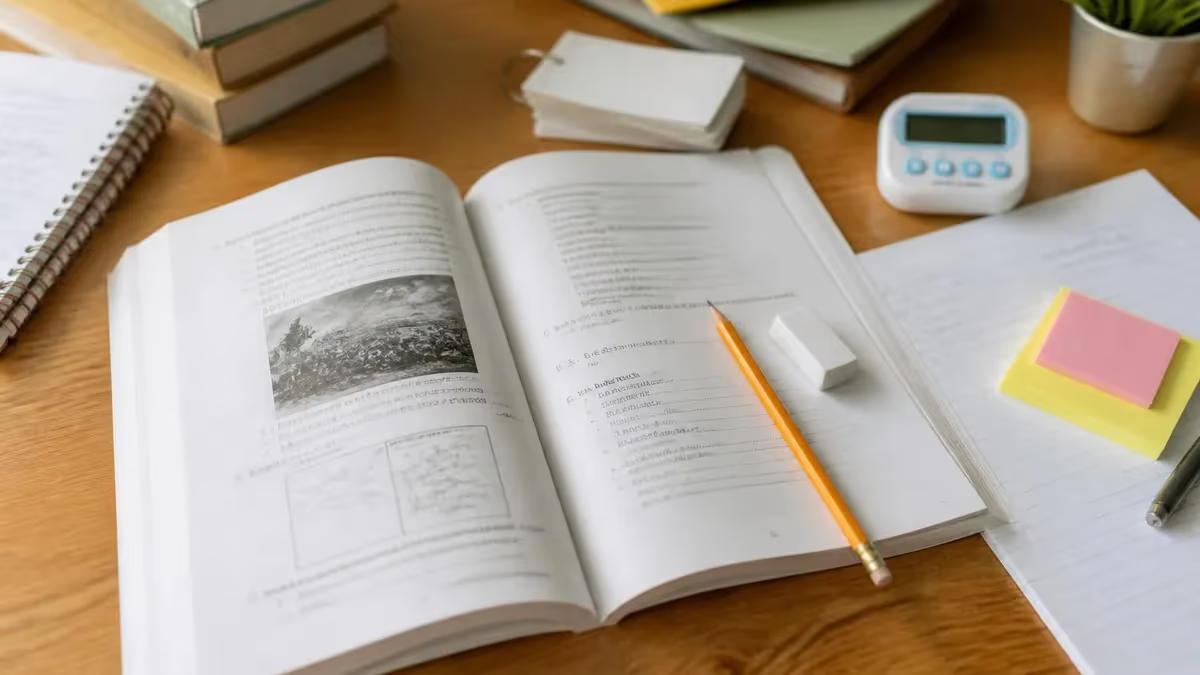
If you are preparing for the AP Art History exam or brushing up on broader US history knowledge, a focused ap art history practice test is your single most effective study tool. The College Board's AP Art History course spans 250 works across 10 global content areas, but students who understand how American history intersects with global artistic movements consistently outperform those who study art in isolation. Connecting visual culture to the political and social forces shaping the United States — from colonial portraiture to twentieth-century muralism — transforms rote memorization into genuine comprehension that sticks on exam day.
Many students begin their review by exploring worst president in us history rankings and debates, only to discover that presidential eras map neatly onto artistic movements. The Gilded Age of the 1870s through 1890s, widely associated with some of the most criticized administrations in American political history, also gave birth to the American Renaissance movement in painting and architecture. Understanding these overlaps helps students contextualize artworks within their historical moment, a skill the AP exam explicitly rewards in its free-response and long-essay sections.
The AP Art History exam is scored on a five-point scale, with scores of three, four, or five generally considered passing for college credit purposes. In recent years, roughly 63 percent of test-takers have earned a three or higher, making it one of the more accessible AP exams — but only for students who prepare strategically. A well-designed practice test reveals which content areas need the most attention before the official exam date, allowing you to allocate precious study hours efficiently rather than reviewing material you already know.
Beyond the formal exam, US history trivia about art and culture is surprisingly rich. Did you know that the youngest president in US history, Theodore Roosevelt, was also a passionate conservationist whose policies directly inspired the rise of the American landscape painting tradition in the early twentieth century?
Or that the worst tornado in US history — the Tri-State Tornado of 1925 — struck during the same decade that regionalist painters like Grant Wood and Thomas Hart Benton were celebrating the American Midwest on canvas? These connections make history memorable and give AP essays the specific detail that earns top scores.
This guide walks you through the AP Art History exam format, proven study strategies, the historical context you need to interpret artworks accurately, and a curated set of free practice resources available right here on PracticeTestGeeks.com. Whether you are a high school junior tackling the course for the first time or a senior looking to boost a borderline score, the information below will help you build a targeted, efficient preparation plan that respects your time and maximizes your results.
We have also included guidance on complementary resources such as the US History Regents exam for New York students and the AP US History course, since many art history students are simultaneously enrolled in those programs. Cross-referencing timelines and themes across courses is not just efficient — it actually deepens your understanding of both subjects in ways that isolated study never can. The best prepared AP Art History students are almost always the ones who treat history as one interconnected story, not a series of separate silos.
Finally, keep in mind that the history of US show — a beloved educational television series that brought American history to life for millions of students — demonstrated decades ago that narrative context makes facts stick. The same principle applies to AP Art History. When you understand why a work was created, who commissioned it, and what social forces shaped the artist's vision, you are no longer memorizing isolated images. You are reading visual arguments made by real people living through real historical moments, and that understanding is precisely what the AP exam is designed to test.
AP Art History by the Numbers

AP Art History Exam Format
| Section | Questions | Time | Weight | Notes |
|---|---|---|---|---|
| Section I — Multiple Choice | 80 | 60 min | 50% | Image-based and text-based stimulus sets |
| Section II — Short Answer | 2 | 30 min | 12% | Contextual and visual analysis prompts |
| Section II — Long Essay | 1 | 35 min | 14% | Comparative or thematic argument |
| Section II — Document-Based Question | 1 | 55 min | 24% | Synthesis across primary and visual sources |
| Total | 86 | 3 hours | 100% |
Understanding the deep relationship between American political history and visual culture is essential for scoring well on the AP Art History exam. Students who treat art history as a purely aesthetic discipline — focusing only on formal analysis — routinely struggle with the contextual questions that make up a significant portion of the exam's score. The College Board explicitly rewards students who can connect artworks to their historical, social, and political contexts, which means knowing your US history is not optional; it is a direct scoring advantage.
One of the most productive study strategies is to align major artistic movements with American presidential eras. Students preparing for exams often find it illuminating to research debates about the who is the worst president in us history question, because those debates surface the political crises — economic panics, wars, social upheavals — that forced artists to respond visually. The Great Depression, for example, is inseparable from the Federal Art Project, which employed thousands of artists under the New Deal and produced an enormous body of public murals, prints, and sculptures that the AP exam frequently tests.
The colonial and early national period is particularly rich with testable material. American portrait painting of the seventeenth and eighteenth centuries served explicit political functions — asserting social status, legitimizing new elites, and constructing a visual identity for a nation that had not yet developed its own distinct artistic tradition. Gilbert Stuart's portraits of George Washington were not simply records of a man's appearance; they were deliberate acts of nation-building that established visual conventions for representing presidential authority that lasted well into the nineteenth century.
The Civil War era brought radical changes to American visual culture that the AP exam tests extensively. Mathew Brady's photographs transformed how Americans understood war, death, and national trauma. Winslow Homer's paintings shifted from cheerful genre scenes to haunting meditations on the psychological costs of conflict. Thomas Nast's political cartoons in Harper's Weekly shaped public opinion more powerfully than most newspaper editorials. Students who understand the social history of this period — the debates over slavery, Reconstruction, and national reunification — will interpret these works far more accurately than students who approach them purely as aesthetic objects.
For students in New York State, the connection between AP Art History and worst presidents in us history content in the Regents curriculum is particularly strong. The Regents exam covers many of the same historical periods that the AP Art History course addresses, meaning that students preparing for both exams can study efficiently by drawing connections across their curricula. The Gilded Age, the Progressive Era, the New Deal, and the Cold War all appear in both exam frameworks, and each period produced distinctive visual responses that the AP Art History exam tests directly.
The twentieth century presents students with an especially complex landscape. The Harlem Renaissance produced a flowering of African American visual art — Aaron Douglas, Augusta Savage, and Jacob Lawrence — that was inseparable from the Great Migration, the NAACP's anti-lynching campaigns, and the broader struggle for civil rights.
Abstract Expressionism emerged from the traumas of World War II and the anxieties of the early Cold War. Pop Art responded to consumer culture and the mass media of the Eisenhower and Kennedy years. Each movement makes more sense — and is easier to remember — when students understand the historical forces that produced it.
The final decades of the twentieth century brought the Culture Wars, identity politics, and globalization into the gallery and museum space. Artists like Barbara Kruger, Kara Walker, and Kehinde Wiley used visual language to engage directly with American political debates, making their work almost impossible to analyze without historical context. The AP exam has increasingly moved toward testing contemporary and non-Western art, which means students who build strong historical-contextual analysis skills early in their preparation will have a significant advantage on the most challenging questions the exam presents.
AP US History and Art History Study Strategies
The AP Art History curriculum divides its 250 required works across 10 content areas, ranging from Global Prehistory to Global Contemporary. Students should identify their weakest content areas in the first week of serious preparation and allocate study time accordingly. Most US-focused students are strongest in the Indigenous Americas, Later Europe and Americas, and Global Contemporary sections, while struggling with South, East, and Southeast Asia or West and Central Asia content.
Flashcard systems work well for memorizing formal attributes — artist, date, medium, location — but the most effective study approach pairs each work with a brief contextual note explaining why it was made and what historical forces it reflects. Apps like Anki allow students to embed images directly into flashcard decks, which is essential for a visual exam. Aim to review at least 10 to 15 works per study session, focusing on the contextual story rather than isolated facts.

AP Art History: Is It Worth Taking?
- +Earns college credit at most universities with a score of 3 or higher, saving tuition costs
- +Develops strong visual analysis skills transferable to law, medicine, design, and business
- +Exposure to global art history provides competitive advantage in college applications
- +Pass rate of approximately 63 percent makes it more accessible than many other AP exams
- +Overlaps significantly with AP US History content, enabling efficient cross-course study
- +Genuine appreciation for art and culture that enriches lifelong learning beyond academics
- −Requires memorizing 250 specific artworks with precise dates, media, and locations
- −Free-response section demands strong writing skills alongside visual analysis ability
- −Non-Western content areas can be unfamiliar for students without prior exposure
- −Limited availability at some schools means not all students can take the course formally
- −Heavy reading load — college-level art history texts are dense and time-consuming
- −Score of 3 may not earn credit at highly selective universities that require a 4 or 5
AP Art History Exam-Day Preparation Checklist
- ✓Review all 250 required artworks using image-based flashcards in the final two weeks before the exam
- ✓Complete at least three full-length timed practice exams, including both multiple-choice and free-response sections
- ✓Write at least five timed long-essay responses using official College Board prompts from past years
- ✓Master the formal analysis vocabulary — composition, line, color, texture, scale, medium, and iconography
- ✓Memorize the 10 content area time periods and geographic regions so you can quickly categorize unfamiliar works
- ✓Practice writing comparative essays that identify both similarities and meaningful differences between two works
- ✓Review primary source documents related to major artworks — artist statements, patron contracts, critical reviews
- ✓Study the AP Art History rubric carefully so you understand exactly what earns points on free-response questions
- ✓Build a personal timeline connecting major US historical events to corresponding artistic movements and works
- ✓Get adequate sleep the night before the exam — recall of visual details is strongly affected by sleep quality
Context Beats Memorization Every Time
Students who can explain WHY an artwork was created — its patron, its historical moment, its social function — consistently outscore students who simply memorize visual details. The AP Art History free-response rubric allocates the majority of its points to contextualization and argumentation, not description. Build your study practice around the question 'Why does this work exist?' and your scores will reflect it.
Scoring on the AP Art History exam follows the standard College Board five-point scale, where a five represents extremely well qualified, four is well qualified, three is qualified, two is possibly qualified, and one is no recommendation. Most four-year colleges and universities award credit or advanced placement for scores of three or higher, though policies vary significantly by institution. Students aiming for highly selective schools should target a four or five, as some schools accept only those scores for credit purposes.
The overall pass rate for AP Art History has hovered around 60 to 65 percent in recent years, which places it in the middle tier of AP exam difficulty. For comparison, AP Physics C: Mechanics has a pass rate below 70 percent among a highly self-selected population, while AP Environmental Science typically sees pass rates above 65 percent. AP Art History's pass rate is meaningful because the exam is taken by a relatively broad population — including students with no prior formal art training — which makes the figure representative of what a typical prepared student can achieve.
The free-response section, which accounts for half the total score, is where the most significant score variations occur. Students who enter the exam with strong essay writing habits — clear thesis statements, specific evidence, organized argumentation — tend to perform significantly better than students whose multiple-choice performance would predict. This means that investing study time in free-response practice is one of the highest-return activities you can undertake in the weeks before the exam.
The multiple-choice section presents 80 questions in 60 minutes, which works out to 45 seconds per question on average. Many questions are stimulus-based, meaning they present an image or a short primary source text and ask a series of questions drawing on that stimulus. This format rewards students who can read visual information quickly and confidently, which is a skill that develops with practice rather than talent. Regular exposure to images from all 10 content areas — not just the ones you find personally interesting — is essential for building this speed and confidence.
Score reporting typically occurs in mid-July for exams taken in May, which means students applying for early decision or early action in the fall will have their scores available well before application deadlines. AP scores are sent directly to the college or university the student designates during registration, and students can also view their scores through the College Board's website. Some students choose to withhold scores from colleges if they perform below expectations, though this decision should be made carefully and ideally in consultation with a college counselor.
Research on AP exam performance consistently shows that students who take the full course — rather than self-studying — outperform self-studiers by a meaningful margin, primarily because classroom instruction provides structured exposure to content areas students would otherwise skip. However, students who cannot access the course but engage in disciplined self-study using official College Board materials, quality practice tests, and systematic image review can absolutely achieve competitive scores. The resources available today — including free practice materials on sites like PracticeTestGeeks.com — have dramatically leveled the playing field for self-studiers.
Finally, it is worth noting that AP Art History scores are only one data point in what is typically a holistic college admissions process. A score of three on a challenging AP exam, particularly one taken by a student who lacked formal instruction, often reads as more impressive to admissions officers than a five earned in an intensive coached environment. Context matters in admissions as much as it does in art history itself, and students should present their AP scores alongside the full story of their academic preparation and personal circumstances.
AP Art History exam registration typically closes in early November for the following May exam date. Students who miss the regular registration window may face late fees or lose the opportunity to test at their school entirely. Contact your AP coordinator or school counselor in September to confirm registration procedures — do not assume you are automatically enrolled simply because you are taking the AP Art History course.
Free practice resources for AP Art History have never been more abundant, but quality varies enormously across the internet. The most reliable free resource remains the College Board's own AP Art History page, which publishes past free-response questions, sample student responses with scoring commentary, and the official course and exam description. Students should treat the official course and exam description as their primary study document — it lists all 250 required works with identifying information and specifies exactly what skills the exam tests.
Students preparing for related exams should also explore the us history regents resources available on PracticeTestGeeks.com, which provide valuable historical context that supports AP Art History preparation. The Regents curriculum's emphasis on primary sources, causation, and continuity and change over time aligns closely with the historical thinking skills the AP Art History exam rewards. New York students in particular will find that strong Regents preparation translates directly into higher AP Art History scores.
YouTube has emerged as a surprisingly strong resource for AP Art History preparation. Channels dedicated to AP Art History walk through all 250 required works with image-based explanations, contextual background, and formal analysis practice. Watching these videos in the months before the exam — even passively during commutes or exercise — builds the kind of effortless image recognition that makes the multiple-choice section feel manageable rather than overwhelming. Video learning also tends to be more engaging than reading for visual learners, which many art history students are by nature.
Structured study groups are another underutilized resource for AP Art History preparation. Because the exam requires knowledge of 250 specific works, dividing the list among group members and teaching one another is both efficient and pedagogically effective. The act of explaining a work to a peer — its context, its formal qualities, its historical significance — cements learning far more deeply than passive review. Groups can also conduct practice discussions that simulate the comparative analysis required by the free-response section, building the verbal habits that translate into strong written arguments on exam day.
Commercial prep books from publishers like Barron's and Princeton Review offer comprehensive AP Art History coverage, including practice multiple-choice questions, free-response prompts, and content reviews organized by curriculum period. While these books require purchase, many public libraries carry them, making them effectively free for students with library cards. The quality of practice questions in commercial books is generally high, though students should always cross-reference with official College Board materials to ensure they are studying accurate information about the required works.
PracticeTestGeeks.com offers free quiz tools covering US History content areas that are directly relevant to AP Art History preparation. The American Revolution, Civil War Era, and Cold War and Modern America quizzes all cover historical periods that produced significant testable artworks. Using these resources strategically — taking a US history quiz on a period you are about to study in art history, then reviewing the artworks from that era — creates the kind of integrated knowledge that the AP exam specifically rewards.
Finally, students should not underestimate the value of visiting actual museums and galleries during their preparation period. Looking at original artworks — including their scale, texture, and physical presence — builds a visceral familiarity with art that no photograph can fully replicate. Many museum education departments offer resources specifically designed for AP Art History students, including gallery tours, teacher guides, and online collections. The Metropolitan Museum of Art, the Art Institute of Chicago, and the National Gallery of Art all have extensive free online resources tied directly to the AP Art History curriculum.
The final weeks of AP Art History preparation should follow a clear rhythm that balances content review, practice testing, and rest. In the four weeks before the exam, spend the first two weeks doing comprehensive content review — going through all 250 works systematically, ensuring you can identify each one from an image and provide accurate contextual information. Use the official course and exam description as your checklist, marking off works as you master them and prioritizing the ones that appear most frequently in past exam questions.
In the third week before the exam, shift your focus to practice testing. Take at least two full-length practice exams under timed conditions — sitting down for the full three hours without interruption, just as you will on exam day. Review your answers critically, paying special attention to the types of questions you miss. Do you consistently miss contextual questions? Multiple-choice questions about non-Western content? Free-response prompts that require comparative analysis? Identifying these patterns allows you to target your final review week with precision rather than reviewing everything indiscriminately.
The final week before the exam should emphasize consolidation rather than new learning. Avoid introducing new study materials or attempting to cram unfamiliar works — this typically increases anxiety without improving scores. Instead, review your personal list of works you found most challenging, re-read the AP Art History scoring rubrics for the free-response section, and practice writing one or two timed essays to keep your writing muscles active. Give yourself permission to take breaks and do activities you enjoy, because cognitive performance on a high-stakes exam is strongly correlated with mental freshness.
On the day of the exam, arrive early enough to get settled without rushing. Bring everything you need — multiple pencils, pens, an eraser, your school ID, and your AP registration ticket if required by your school. During the multiple-choice section, do not spend excessive time on any single question — make your best choice, flag questions you are unsure about, and return to them if time permits. During the free-response section, use the reading period strategically to plan your essays before you begin writing.
For the free-response questions, follow the structure the rubric rewards: begin with a clear, arguable thesis that addresses the prompt directly; support it with specific visual and contextual evidence from the works you are analyzing; and explain how your evidence proves your thesis rather than simply describing what you see. Graders read dozens of essays per day and are trained to identify the specific elements the rubric requires — giving them those elements clearly and efficiently will earn you more points than eloquent but unfocused writing.
After the exam, take a genuine break before you begin worrying about your score. The July score release date is weeks away, and there is nothing productive you can do in the interim about the exam you just completed.
Celebrate the work you put into preparation, regardless of how you feel the exam went — the skills you built through systematic study will serve you well in college coursework, in your career, and in your life as a curious, culturally literate person. AP Art History is ultimately about learning to see the world more richly, and that skill has value far beyond any five-point scale.
Remember that whether you are studying for AP Art History, the US History Regents, or simply satisfying a curiosity about American culture and politics — including perennial debates about the youngest president in US history, the worst tornado in US history, or the worst presidents in US history — history is a living conversation that connects the past to the present.
The artworks you study in AP Art History are not relics from a sealed-off past; they are documents of human experience that speak directly to the political and social questions Americans are still wrestling with today. That is what makes both history and art endlessly worth studying.
US Questions and Answers

About the Author

Educational Psychologist & Academic Test Preparation Expert
Columbia University Teachers CollegeDr. Lisa Patel holds a Doctorate in Education from Columbia University Teachers College and has spent 17 years researching standardized test design and academic assessment. She has developed preparation programs for SAT, ACT, GRE, LSAT, UCAT, and numerous professional licensing exams, helping students of all backgrounds achieve their target scores.