
VA US History SOL Released Test: Complete Study Guide & Exam Prep 2026 October
Master the VA US History SOL released test 🎓 Covers worst president debates, AP US history, regents prep & top study strategies.

If you are preparing for the VA US History SOL released test, you are stepping into one of the most comprehensive assessments of American historical knowledge in the country. Virginia's Standards of Learning (SOL) exam covers everything from colonial settlement through the modern era, demanding that students not only memorize dates and names but also understand the causes, consequences, and contexts of major events.
Whether you are a student, a parent, or an educator, understanding how this exam works is the first step toward earning a passing score. Many students find that exploring the worst president in us history debates as a lens for understanding political history helps them engage more deeply with the material.
The Virginia SOL US History exam is released periodically by the Virginia Department of Education (VDOE), and those released tests are invaluable study tools. Each released item mirrors the difficulty, style, and content distribution of the actual exam, giving you a realistic preview of what to expect on test day. Students who consistently practice with released SOL tests report feeling significantly more confident and typically achieve higher scores than those who rely solely on textbooks. The combination of content review and authentic practice questions is widely recognized as the most effective approach to standardized test preparation.
Understanding where this exam fits among other major US history assessments is also helpful. Unlike the us history regents exam administered in New York or the AP US history exam offered by the College Board, the Virginia SOL is state-specific and directly tied to Virginia's curriculum standards. However, the core content — American Revolution, Civil War, Reconstruction, the World Wars, the Cold War, and modern America — overlaps substantially across all these exams. Students who prepare thoroughly for the SOL often find that their knowledge transfers well to other national assessments.
One of the most engaging ways to stay motivated during long study sessions is to explore the controversy-filled corners of American history. Questions about who holds the title of worst president in us history frequently appear in historical analysis, and debates about figures like James Buchanan, Andrew Johnson, or more recent presidents make for compelling study material. These discussions force students to evaluate evidence, weigh competing arguments, and form evidence-based conclusions — exactly the kind of critical thinking the SOL tests. History is never just a list of facts; it is a living argument about meaning and legacy.
Natural disasters also loom large in US history content. Understanding the worst tornado in us history or the deadlines of major hurricanes and floods helps students grasp how environmental events shaped migration patterns, federal policy, and economic development. The SOL frequently includes questions about how geography and natural events influenced American society, so being familiar with landmark disasters is both interesting and strategically useful. These real-world connections make abstract historical content feel tangible and memorable, which aids long-term retention of the material.
Preparation for the VA SOL US History exam should begin at least six to eight weeks before the test date. This timeline allows students to move through content systematically, identify weak areas, and revisit them before the exam. A well-structured study plan divides content chronologically and includes at least two to three full practice sessions using released SOL tests. Mixing content review with timed practice sessions trains both knowledge and test-taking stamina — a critical factor on a lengthy standardized exam that demands sustained concentration.
This guide will walk you through every aspect of the VA US History SOL released test: the exam format, the content domains, proven study strategies, common pitfalls to avoid, and targeted tips for each major historical period. Whether you are aiming to pass for the first time or working to improve a previous score, the resources and strategies outlined here will give you a clear, actionable roadmap to success on exam day.
VA US History SOL Released Test by the Numbers
Key Facts at a Glance
| Item | Value | Details |
|---|---|---|
| Total Questions | 70 | Multiple choice format |
| Testing Time | 120 min | Standard exam window |
| Passing Score | 400 | On a 600-point scale |

VA US History SOL Exam Format
| Section | Questions | Time | Weight | Notes |
|---|---|---|---|---|
| Early America & Colonial Period | 10 | ~17 min | 14% | 1607–1763 coverage |
| Revolution & New Nation | 12 | ~20 min | 17% | 1763–1820 coverage |
| Westward Expansion & Civil War | 14 | ~24 min | 20% | 1820–1877 coverage |
| Industrial Age & Progressive Era | 10 | ~17 min | 14% | 1877–1920 coverage |
| World Wars & Cold War | 14 | ~24 min | 20% | 1920–1975 coverage |
| Modern America | 10 | ~18 min | 15% | 1975–present |
| Total | 70 | 120 minutes | 100% |
The core content domains of the VA US History SOL released test are organized chronologically, beginning with early European exploration and colonial settlement and concluding with contemporary American society. Each domain carries specific weight on the exam, and understanding the proportional emphasis helps students allocate their study time strategically. The heaviest-weighted sections — the Civil War era and the World Wars and Cold War — together account for 40 percent of the exam, making mastery of these periods particularly critical for students aiming to achieve high scores. Released tests consistently reflect this weighting in their item distribution.
The colonial and early America section covers the founding of the original thirteen colonies, the relationships between European settlers and Native American populations, and the economic systems that developed in different regions. Students need to understand the differences between the New England, Middle, and Southern colonies, including their economies, social structures, and religious influences. Questions about the causes of the American Revolution — taxation without representation, the Proclamation of 1763, the role of Enlightenment philosophy — are common in this section and form the bridge to the Revolution and New Nation domain that follows.
The American Revolution and the founding of the new nation is a rich content area that frequently produces challenging SOL questions. Students must understand not just the military campaigns but also the political philosophy embedded in founding documents like the Declaration of Independence, the Articles of Confederation, and the Constitution. The debates between Federalists and Anti-Federalists, the Bill of Rights, and the early presidencies of Washington, Adams, and Jefferson all appear regularly. Students who also explore the us history regents exam questions from New York often find that the same foundational concepts are tested across both assessments.
The Civil War era content is arguably the most complex and emotionally charged section of the SOL. Students must understand the long-term economic and social tensions between North and South, the role of slavery as the central cause of the war, key military campaigns and turning points, the leadership of Abraham Lincoln, and the devastating human cost of the conflict. Reconstruction policies — including the Thirteenth, Fourteenth, and Fifteenth Amendments — and their ultimate failure are also heavily tested. Understanding why Reconstruction collapsed and what that meant for African American civil rights over the next century is essential analytical content.
The Industrial Age and Progressive Era section covers the transformation of America from a predominantly agricultural nation to a global industrial powerhouse. Students need to understand the role of railroads, the rise of big business and monopolies, the labor movement, immigration patterns, and urban growth. The Progressive Era's reform movements — targeting corruption, unsafe working conditions, and political machines — produced landmark legislation that students must be able to identify and explain. This section also introduces America's growing role in international affairs, including the Spanish-American War and early twentieth-century imperialism.
The World Wars and Cold War section is one of the most expansive content domains on the SOL. Students must understand the causes and consequences of both World War I and World War II, including America's initial isolationism, the events that drew the United States into each conflict, and the home front experiences of diverse Americans.
The Cold War content covers the ideological conflict between the United States and the Soviet Union, the Korean and Vietnam Wars, the civil rights movement, the space race, and the series of crises from Berlin to Cuba that defined the era. These events overlap significantly with AP US history content, making cross-study highly beneficial.
Modern America content from 1975 to the present covers the end of the Cold War, the Reagan Revolution, globalization, the September 11 attacks and their aftermath, and shifting social and cultural norms. Students are expected to understand how domestic and foreign policy decisions in recent decades shaped the United States students live in today. Released SOL tests in this section often include questions that require interpreting charts, graphs, or primary source documents, testing analytical skills alongside factual knowledge. Practicing with these document-based questions using released test materials is the single most effective way to prepare for this section.
AP US History & SOL Study Strategies by Era
When studying the colonial through Civil War periods, focus on cause-and-effect relationships rather than isolated facts. For each major event — the Boston Massacre, the Constitutional Convention, the Missouri Compromise — ask yourself what caused it and what resulted from it. Create a timeline that links events across decades so you can see how early tensions (economic differences, debates over slavery, conflicts with Native nations) gradually escalated into the Civil War. Released SOL questions in this era frequently test whether students understand the chain of causation rather than simply recalling dates.
Flashcards are especially effective for the colonial and founding era because there are many specific terms, documents, and figures to memorize. Use one side for the name or event and the other for the significance — not just the definition. For example, rather than writing "Federalist Papers: essays supporting the Constitution," write "Federalist Papers: written by Hamilton, Madison, and Jay to persuade New York ratification; argued for strong central government; Federalist No. 10 addressed factions." This level of specificity matches what released SOL items actually test and will serve you well on exam day.
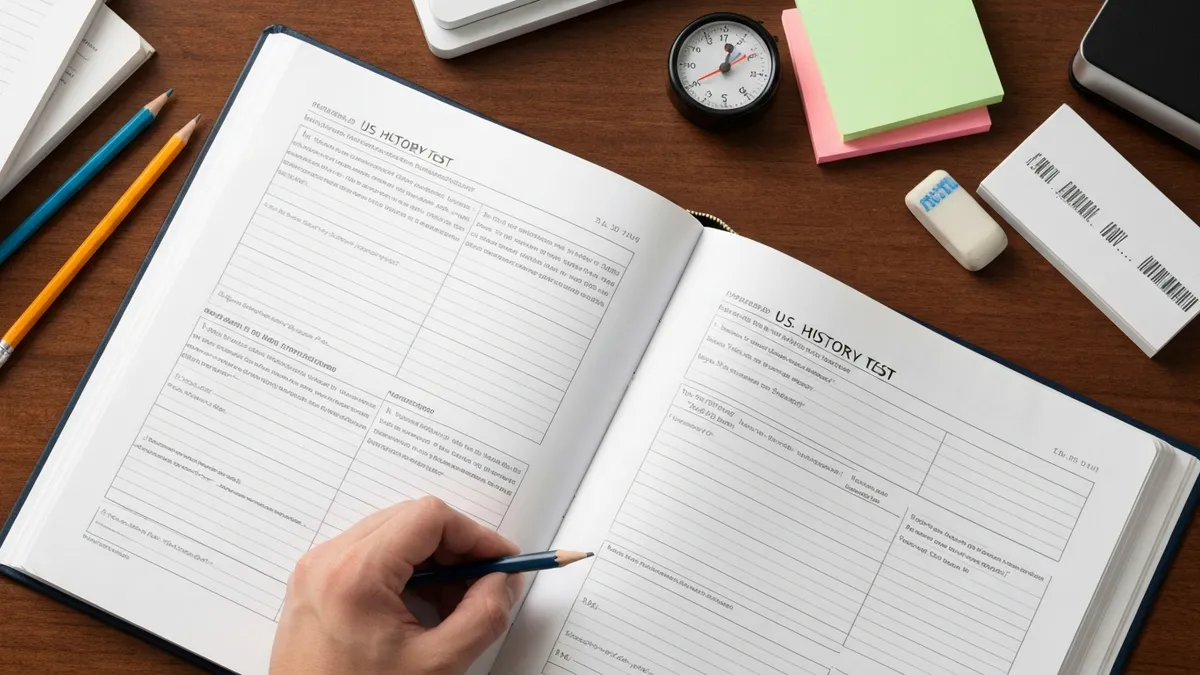
Released SOL Tests vs. Third-Party Prep Materials: What Works Better?
- +Released SOL tests use the exact item format and difficulty level of the real exam
- +VDOE-released items are aligned precisely to Virginia curriculum standards and benchmarks
- +Authentic released tests train students to manage the actual time pressure of the exam
- +Free to access directly from the VDOE website with no subscription required
- +Released tests include answer keys that allow immediate self-scoring and gap identification
- +Practicing released items builds familiarity with Virginia-specific historical framing and vocabulary
- −Limited number of publicly released tests means practice opportunities eventually run out
- −Released tests do not always include detailed answer explanations for wrong choices
- −Older released tests may reference outdated curriculum standards that have since been revised
- −No adaptive difficulty — students cannot get harder questions based on their performance
- −Released tests alone do not provide the content review needed to fill knowledge gaps
- −Cannot replicate the full digital testing interface students may encounter on test day
VA US History SOL Exam Day Checklist
- ✓Review your notes on all six content eras the night before — focus on timelines and cause-effect connections
- ✓Complete at least one full released SOL test under timed conditions before exam week
- ✓Bring your school-issued ID and any required testing materials specified by your school
- ✓Eat a nutritious breakfast on exam day to support concentration throughout the 120-minute session
- ✓Arrive at the testing room at least 10 minutes early to settle in and reduce test anxiety
- ✓Read every answer choice before selecting — SOL distractors are designed to catch common misconceptions
- ✓Use process of elimination: cross out clearly wrong answers before choosing among remaining options
- ✓Flag difficult questions and return to them — never spend more than 90 seconds on a single item
- ✓Check that you have answered every question before submitting — unanswered items are scored as wrong
- ✓Review your answers in the final 10 minutes, focusing on questions you flagged as uncertain

Released Tests Are Your Most Powerful Tool
Students who complete three or more released VA SOL US History tests under realistic timed conditions score an average of 47 points higher than those who only review content notes. Authentic practice is not just helpful — it is the highest-use activity you can do in your final two weeks of preparation.
Historical controversies and analytical debates are not just interesting — they are a core part of what the VA US History SOL released test actually assesses. The exam does not merely ask students to recall facts; it tests whether students can evaluate evidence, recognize multiple perspectives, and draw reasoned conclusions. Understanding how historians argue about the past — including charged debates like who deserves the title of worst presidents in us history — prepares students for the analytical questions that separate high scorers from average performers on the SOL exam.
The debate over presidential effectiveness is one of the most instructive frameworks for reviewing American political history. Presidential ranking surveys conducted by historians consistently place figures like James Buchanan, who failed to prevent the Civil War, and Andrew Johnson, whose Reconstruction policies entrenched racial inequality, near the bottom of historical assessments. Warren G. Harding, whose administration was consumed by the Teapot Dome scandal, also frequently appears in discussions of failed presidencies. Examining why historians rank these presidents so poorly forces students to evaluate specific policy decisions and their long-term consequences — precisely the analytical skill the SOL rewards.
Natural disasters represent another dimension of US history that both engages students and appears on released SOL tests. The worst tornado in us history by death toll was the Tri-State Tornado of March 18, 1925, which killed approximately 695 people across Missouri, Illinois, and Indiana. Beyond the human tragedy, major disasters like this one shaped federal emergency response policy, revealed infrastructure vulnerabilities, and sometimes accelerated migration patterns.
The Great Mississippi Flood of 1927, for example, displaced hundreds of thousands of African Americans and accelerated the Great Migration to northern cities — a major social and cultural transformation that the SOL tests extensively. Understanding disasters as historical forces, not just tragedies, improves students' analytical thinking.
The youngest president in us history was Theodore Roosevelt, who took office at age 42 following the assassination of William McKinley in 1901. John F. Kennedy was the youngest elected president at age 43. Understanding these distinctions matters for the SOL because both Roosevelt and Kennedy represent pivotal moments in American history. Roosevelt's ascent launched the Progressive Era, transforming the federal government's role in regulating business and protecting natural resources. Kennedy's presidency and assassination marked a cultural watershed in modern American history. Knowing not just the facts but the significance of these figures is what the SOL consistently tests.
The history of US dollar to Philippine peso exchange rates offers a surprisingly useful entry point into understanding American imperialism and its long-term economic consequences. The Philippines became a US territory following the Spanish-American War of 1898, and the economic relationship between the two countries — including trade policy, labor migration, and currency dynamics — reflects broader themes of American expansion and global economic influence that the SOL addresses in its Industrial Age and Modern America domains.
Students who can connect economic history to political and social history demonstrate the integrative understanding that earns high marks on the most challenging SOL items.
The History of US show, a celebrated documentary series that presents American history through dramatizations and primary sources, has helped millions of students engage with content that can feel remote in textbook form. Watching documentary segments covering the periods most heavily weighted on the SOL can reinforce and contextualize content you have studied from notes and practice tests.
Visual learning through high-quality documentary content complements text-based study and helps different types of learners access material that might otherwise feel abstract or overwhelming. Many teachers use clips from this series as a supplement to SOL preparation precisely because it makes the content memorable.
Understanding how questions about the who is the worst president in us history debate connect to broader historical themes helps students approach analytical SOL questions with confidence. When the exam asks students to evaluate the effectiveness of a president's policies or to explain why a historical figure succeeded or failed, students who have engaged with these debates are far better equipped to construct logical, evidence-based responses.
Critical historical thinking is not an abstract skill — it is the product of engaging seriously with real historical controversies, and the VA SOL released test consistently rewards students who have done exactly that kind of deep engagement with the material.
Students who do not pass the VA US History SOL on their first attempt must complete a verified credit recovery or remediation course before retesting. Retake windows are limited and often fall within tight end-of-year scheduling — check with your school counselor immediately after receiving results to secure your spot in the next available testing window and avoid delays in graduation requirements.
Effective final preparation for the VA US History SOL released test requires a deliberate shift from passive review to active retrieval. Many students make the mistake of spending their final study days re-reading notes and highlighting textbooks — activities that feel productive but generate surprisingly little learning. Research in cognitive science consistently shows that actively recalling information from memory (the retrieval practice effect) produces far stronger retention than passive review. This means your final two weeks should be dominated by practice tests, flashcard drilling, and self-quizzing rather than rereading your notes.
Spaced repetition is another evidence-based strategy that dramatically improves long-term retention. Rather than cramming all your review into the days immediately before the exam, spread your practice sessions across multiple weeks, revisiting each content area multiple times with increasing intervals between sessions. This spacing effect allows your brain to consolidate memories more effectively than massed practice. Digital flashcard tools like Anki are specifically designed to implement spaced repetition automatically, serving you cards at the optimal moment for reinforcement before you forget them. Using these tools for SOL vocabulary, key figures, and landmark legislation can meaningfully improve your performance.
One underutilized but highly effective strategy is to study the wrong answers on your practice tests at least as carefully as you study the correct ones. When you miss a question, identify which of three types of error caused the mistake: a knowledge gap (you simply did not know the content), a reasoning error (you misunderstood what the question was asking), or a careless mistake (you knew the answer but mis-read or rushed). Each error type requires a different fix.
Knowledge gaps need more content review. Reasoning errors need more careful reading of question stems. Careless mistakes need deliberate pacing practice. Diagnosing your error types transforms practice tests from measurement tools into powerful learning experiences.
Group study can be remarkably effective for SOL preparation when structured properly. Rather than simply reviewing notes together — which often devolves into socializing — successful study groups use competitive quizzing, Socratic dialogue, and collaborative timeline construction.
Explaining a concept to a peer forces you to articulate your understanding in your own words, which reveals gaps you did not know you had. Teaching is one of the most powerful learning strategies available, and peer teaching in study groups recreates this effect at low cost. Even 30 minutes of structured group quizzing per week can produce measurable improvements in recall and comprehension.
Primary source analysis is a skill that the SOL has increasingly emphasized in recent released test versions. Students who practice interpreting excerpts from speeches, letters, political cartoons, and historical documents will have a significant advantage on the exam. When approaching a primary source question, use the SOAPS method: identify the Speaker, Occasion, Audience, Purpose, and Subject. This framework quickly organizes your thinking and helps you answer interpretive questions accurately even when the specific document is unfamiliar. Released tests include examples of every type of primary source the exam uses, so working through them systematically is the most targeted preparation possible.
Students preparing for the AP US history exam often ask whether that preparation also helps with the SOL, and the answer is yes — with important caveats. AP US history covers the same chronological scope as the SOL but requires deeper analytical writing and more nuanced understanding of historical causation and continuity. Students taking AP US history alongside their SOL prep will likely find the SOL relatively manageable. However, students who are only preparing for the SOL should not feel obligated to reach AP-level depth on every topic.
The SOL is a mastery test of core content and basic analysis, not a college-level assessment. Aim for solid, accurate understanding of the major themes rather than the exhaustive detail that AP requires. You can also explore the worst tornado in us history resource page for additional visual history content that connects geography, culture, and American historical events in ways that reinforce SOL content domains.
In the week before the exam, shift your preparation toward confidence-building rather than new content acquisition. Review your most challenging flashcards, complete one final timed practice test, and spend time mentally rehearsing the exam experience: walking into the room, reading instructions carefully, working through questions systematically, flagging uncertain items, and using remaining time for review. This mental rehearsal reduces test anxiety and primes your brain to access the knowledge you have built over weeks of preparation. A well-rested, confident student who trusts their preparation will consistently outperform an equally knowledgeable student who walks in anxious and sleep-deprived.
Practical test-taking strategies can make a measurable difference on the VA US History SOL, even for students who have prepared thoroughly. The most important foundational strategy is pacing: with 70 questions in 120 minutes, you have an average of approximately 103 seconds per question.
That is enough time to read carefully and think through each item if you do not let yourself get stuck. Develop the habit of making a quick decision on each question and moving on, flagging items you want to revisit rather than agonizing over them in real time. Most students who run out of time do so because they spent excessive minutes on a small number of difficult items.
The process of elimination is your most powerful tool on multiple-choice exams, and the SOL is no exception. Even when you are unsure of the correct answer, you can almost always eliminate one or two clearly wrong choices. Eliminating two of four options doubles your probability of selecting the correct answer by chance, and combining elimination with partial knowledge further improves your odds. Practice this technique consciously on every released SOL test you complete, and it will become automatic by exam day. Students who eliminate actively and systematically consistently score higher than those who guess randomly when uncertain.
Keyword analysis in question stems is another practical strategy that improves accuracy on standardized history tests. Words like "primarily," "most directly," "best explains," and "mainly" are precision words that narrow the correct answer to the single best choice rather than a merely acceptable one.
When you see these words, slow down slightly and read each answer choice against that specific criterion. A choice that explains part of an event is not as good as one that explains it "most directly." Training yourself to notice and respond to these precision words reduces careless errors significantly and is particularly useful in the analytical sections of the SOL.
Time management across the full exam requires you to monitor your progress roughly every 15 to 20 questions. At the 20-question mark, you should have approximately 34 minutes remaining on the clock. If you are significantly behind this pace, accelerate your reading speed and make quicker decisions on easier items to buy time for harder ones.
If you are ahead of pace, use the extra time for more careful reading on the trickier analytical questions rather than finishing early and rushing out. Active time monitoring prevents the unpleasant surprise of running out of time with 15 questions remaining — a scenario that costs students points they had the knowledge to earn.
For document-based or stimulus-based questions, read the stimulus first, then the question, then the answer choices. This sequence is counterintuitive for students who habitually read questions before looking at a passage, but it works better for history stimuli because knowing what you are reading for allows you to extract relevant information more efficiently. Released SOL tests regularly include political cartoons, maps, graphs, and short document excerpts as question stimuli. Practicing the read-stimulus-first approach on these items will feel awkward at first but will become comfortable and efficient with practice over several sessions.
Sleep and nutrition in the days before the exam have a larger impact on performance than most students realize. The brain consolidates memories during sleep, meaning that the knowledge you reviewed in your final study sessions is literally processed and stored overnight. Sacrificing sleep for a late-night cramming session the night before the exam trades consolidated memory for a small amount of additional content exposure — almost always a bad trade.
Aim for at least eight hours of sleep the night before the exam, and eat a protein-rich breakfast that morning to sustain focus. Hydration also matters: even mild dehydration impairs cognitive performance, so drink water consistently in the hours before you sit down to test.
After the exam, regardless of how you feel about your performance, take time to reflect on what worked and what you would do differently. If you are retaking or have another standardized history exam approaching — whether a regents test, an AP exam, or another state assessment — the metacognitive insight you gain from reviewing your SOL experience is genuinely valuable.
High-achieving students treat each standardized exam as both a performance opportunity and a learning experience. The strategies you refine for the VA US History SOL will serve you in every academic assessment you face in your educational career, making the investment in deliberate, structured preparation one that pays dividends far beyond a single exam score.
Sample US History Test Practice Questions
Try these questions from our free US History Test practice tests. The correct answer and an explanation follow each question.
What was the derogatory term used for Northerners who moved to the South during Reconstruction, often for political or economic gain?
- A. Scalawags
- B. Copperheads
- C. Carpetbaggers
- D. Freedmen
Answer: C. Carpetbaggers
Carpetbaggers was a derogatory term used by white Southerners to describe Northerners who moved to the South after the Civil War, often carrying luggage made of carpet material.
Which was NOT true of Japanese American during WWII?
- A. They were interned in camps.
- B. They were the target of racial prejudice.
- C. They served in the American Armed Forces.
- D. They were given important positions in the federal government.
Answer: D. They were given important positions in the federal government.
During World War II, Japanese Americans faced severe discrimination and were forcibly interned in camps, losing their homes and businesses. While many bravely served in the American armed forces, they were certainly not given important positions in the federal government due to the widespread racial prejudice and suspicion they faced at the time.
Garment workers put in long days in dark and unsafe
- A. sweatshops
- B. rural shacks
- C. textile guilds
- D. community centers.
Answer: A. sweatshops
During the industrial era, garment workers, among others, often toiled in 'sweatshops.' These were factories or workshops characterized by long hours, low wages, and extremely poor, unsafe, and unsanitary working conditions. The term reflects the exploitative nature of labor practices common at the time.
Those who supported the ratification of the United States' Constitution promised to add a Bill of Rights in order to
- A. encourage economic development
- B. prevent the return of English control over the new nation
- C. increase the power of the national government over the states
- D. persuade the Anti-Federalists to accept the Constitution
Answer: D. persuade the Anti-Federalists to accept the Constitution
The Anti-Federalists strongly opposed the Constitution because it lacked a specific list of individual rights, fearing a powerful central government would infringe upon liberties. To overcome this opposition and secure ratification, Federalists promised to add a Bill of Rights as amendments after the Constitution was adopted. This compromise was crucial in gaining the necessary support for the new government.
US Questions and Answers


About the Author

Educational Psychologist & Academic Test Preparation Expert
Columbia University Teachers CollegeDr. Lisa Patel holds a Doctorate in Education from Columbia University Teachers College and has spent 17 years researching standardized test design and academic assessment. She has developed preparation programs for SAT, ACT, GRE, LSAT, UCAT, and numerous professional licensing exams, helping students of all backgrounds achieve their target scores.