
TEAS Test at San Jose State: Complete Prep Guide for Nursing Applicants
Preparing for the TEAS test at San Jose State? 🎓 Get scores, requirements, study tips, and free practice questions to pass on your first try.
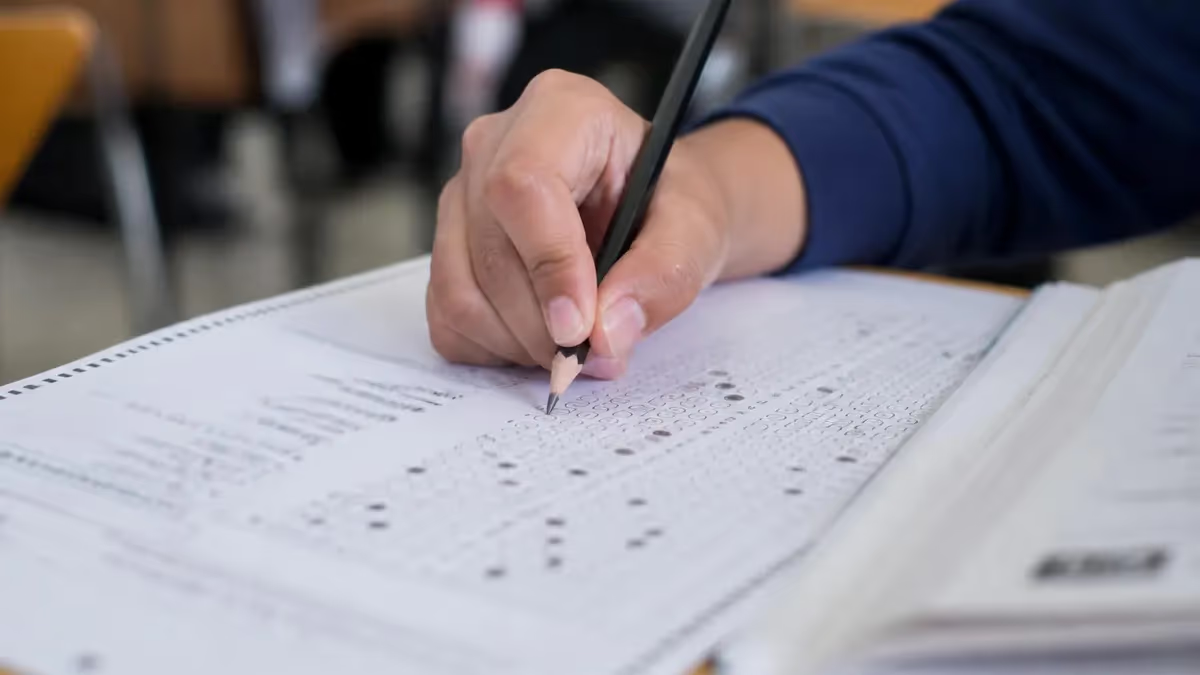
The TEAS test at San Jose State University is one of the most important hurdles you will face on your path to nursing school. San Jose State's nursing program is highly competitive, and understanding exactly what the TEAS requires — from minimum scores to section breakdowns — gives you a genuine edge over other applicants. Whether you are just starting to explore the tea app offered by ATI or you are deep into your final review week, knowing how SJSU evaluates your TEAS results can shape your entire preparation strategy.
Many prospective students treat the TEAS like a general knowledge quiz, underestimating how rigorous it actually is. The ATI TEAS 7 exam tests Reading, Mathematics, Science, and English & Language Usage across 170 questions in roughly three hours. San Jose State's College of Health and Human Sciences uses your composite score alongside your GPA and other application materials to rank candidates for limited spots. A score that looks decent on paper may still fall short of what competitive applicants are submitting this cycle.
Preparation timelines matter enormously when applying to SJSU's nursing program. Most successful applicants spend eight to twelve weeks in focused, daily study before sitting for the exam. That preparation should include timed practice tests, targeted review of weak content areas, and a clear understanding of which TEAS sections carry the most weight in SJSU's admissions formula. Skipping the structured prep phase and relying on general knowledge almost always leads to disappointing scores.
The good news is that resources have never been more accessible. The official tea app from ATI gives you mobile-friendly practice, video lessons, and personalized performance reports. Beyond the app, free online practice banks let you work through hundreds of questions by subject, simulating the pressure of actual test day. Combining these tools with a disciplined weekly schedule is the approach most nursing advisors recommend for SJSU applicants specifically.
This guide is designed to walk you through everything — SJSU's minimum score requirements, the full TEAS exam format, the most effective study strategies, common mistakes to avoid, and free practice quizzes you can start right now. By the time you finish reading, you will have a concrete action plan tailored to the San Jose State nursing application process and the confidence to execute it from your very first study session.
One thing experienced test-takers consistently report is that the Science section catches applicants off guard. Human anatomy, life science, and physical science questions demand genuine conceptual understanding, not just memorization of isolated facts. Meanwhile, the Mathematics section — covering numbers, algebra, measurement, and basic statistics — rewards students who practice problem-solving under time pressure. Allocating your prep hours across all four sections based on your diagnostic performance is essential rather than optional.
Throughout this article, you will find statistics, study schedules, checklist items, and expert tips drawn from ATI's own data and the experiences of SJSU nursing applicants. Use this page as your central reference point, bookmark the practice quiz links, and return here each week to track your progress against the benchmarks that actually matter for admission to one of the Bay Area's most respected nursing programs.
TEAS Test at San Jose State by the Numbers
Key Facts at a Glance
| Item | Value | Details |
|---|---|---|
| Total Testing Time | 209 min | Including all four sections plus breaks |
| Total TEAS Questions | 170 | Scored + unscored pretest items |
| Maximum Retake Attempts | 3× | ATI allows up to 3 attempts per year |
| Recommended Prep Time | 8–12 wks | For SJSU nursing program applicants |

TEAS Exam Format
| Section | Questions | Time | Weight | Notes |
|---|---|---|---|---|
| Reading | 45 | 55 min | ~31% | Key skills, inferences, passage comprehension |
| Mathematics | 38 | 57 min | ~22% | Numbers, algebra, measurement, data |
| Science | 50 | 60 min | ~31% | Human body, life science, physical science |
| English & Language Usage | 37 | 37 min | ~16% | Grammar, sentence structure, vocabulary |
| Total | 170 | 209 minutes | 100% |
San Jose State University's nursing program falls under the College of Health and Human Sciences, and admission is competitive enough that your TEAS score functions less like a pass/fail gate and more like a ranked performance metric. SJSU typically looks for a composite TEAS score in the upper fifties to low sixties at minimum, but applicants who actually receive offers of admission often score higher — frequently in the 65–75 range depending on the applicant pool for that cycle. Understanding this distinction between the stated minimum and the effective competitive threshold is critical before you register for the exam.
The admissions committee at SJSU weighs your TEAS composite alongside your prerequisite GPA, any prior healthcare experience, and your personal statement. This means a slightly lower TEAS score can sometimes be offset by a strong GPA in your science prerequisites, but only up to a point. If your TEAS composite falls below the program's published minimum — which has historically hovered around 58 percent — your application will not advance regardless of your GPA. Always verify the current minimum score requirement directly with SJSU's nursing department, as requirements can change between application cycles.
Each of the four TEAS sections is scored individually, and some nursing programs give additional weight to Science scores because they most directly reflect readiness for nursing coursework. Anatomy, physiology, and biology concepts tested on the TEAS mirror content in first-year nursing classes, so strong Science performance signals academic preparedness in a way that is meaningful to admissions reviewers. If your Science subscore is significantly weaker than your overall composite, consider spending a disproportionate share of your prep time on that section.
San Jose State requires applicants to submit scores directly from ATI, the company that administers the TEAS. You cannot self-report your score by typing a number into an application field — the official score report must be sent electronically. When registering for your exam, make sure you select SJSU as a score recipient at the time of registration rather than trying to add the institution afterward, which can delay processing and potentially miss application deadlines. Nursing programs at SJSU often have strict deadlines, and late score submissions are a common and entirely avoidable reason for application disqualification.
Retake policies matter too. ATI permits test-takers to retake the TEAS up to three times within a twelve-month period, with a mandatory waiting period of at least 30 days between attempts. SJSU's nursing program may have its own retake limitations or may specify which score they accept — typically the most recent score rather than the highest. Before deciding to retake, make sure you have genuinely addressed your weak areas through additional study, because retaking without meaningful preparation rarely produces a significant score improvement and consumes one of your limited attempts.
Timing your TEAS attempt relative to SJSU's application deadline is a strategic decision. Aim to take the exam at least six weeks before the application deadline. This buffer gives you time to review your score report, identify whether a retake is warranted, complete the second prep cycle if necessary, and still submit scores before the deadline. Students who take the TEAS within two weeks of the application deadline leave themselves no room to maneuver if the score comes back lower than expected.
Financial considerations are also part of the planning process. The ATI TEAS exam costs approximately $115 when taken at an ATI-approved testing site, though costs can vary slightly depending on whether you test at a proctored center or at your college's testing facility. Add to that the cost of official ATI study materials, any prep courses, and score report fees, and the total investment can reach $200–$300. Treating this investment seriously — and preparing thoroughly so you pass on your first attempt — is both financially and strategically smart.
Study Strategies, Tools & the Tea App for TEAS Prep
The official tea app from ATI is the single most targeted digital tool available for TEAS preparation. It offers adaptive practice quizzes that adjust question difficulty based on your performance, video lessons for every content area, and detailed performance reports that show exactly which sub-topics are pulling your score down. For SJSU applicants, the app's diagnostic feature is especially valuable — it produces a personalized study plan that prioritizes your weakest areas so you are not wasting prep time on content you already know well.
The app costs extra beyond the base exam registration fee, but most nursing advisors consider it worth the investment, especially for students who commute or have irregular schedules. Because the tea app is mobile-friendly, you can squeeze in 15-minute practice sessions during lunch breaks, bus rides, or between classes. Consistent short sessions across many days beat occasional long marathons, and the app's push reminders help you maintain the daily habit. If you only purchase one paid prep resource for the TEAS, the official ATI app is the one most advisors recommend first.

Is the TEAS the Right Path into SJSU Nursing?
- +A strong TEAS score significantly boosts your competitiveness for SJSU's limited nursing seats
- +The TEAS covers content directly relevant to first-year nursing coursework, so good prep doubles as class preparation
- +Multiple testing windows per year give you flexibility to choose the best exam date for your schedule
- +Abundant free and low-cost study resources make effective preparation accessible on nearly any budget
- +Passing the TEAS on your first attempt demonstrates academic readiness that impresses admissions committees
- +ATI's score report provides a detailed breakdown that helps you understand your academic strengths and target areas for growth
- −The 30-day mandatory wait between retake attempts can delay your application by an entire admissions cycle
- −SJSU's competitive applicant pool means the effective score threshold is higher than the published minimum
- −The Science section demands genuine conceptual mastery that cannot be crammed in a few days
- −Exam registration plus official study materials can cost $200–$300, a real burden for budget-constrained students
- −Score reports must be submitted electronically through ATI, and late submissions can disqualify your application
- −Test anxiety on a high-stakes exam can cause scores to underrepresent a student's actual academic ability
TEAS Prep Checklist for San Jose State Applicants
- ✓Confirm SJSU's current minimum TEAS composite score requirement before registering for the exam
- ✓Take a full-length diagnostic TEAS practice test to establish your baseline score by content area
- ✓Download the official ATI tea app and complete the personalized study plan it generates
- ✓Schedule your TEAS exam at least six weeks before SJSU's nursing application deadline
- ✓Select San Jose State as a score recipient when registering through the ATI website
- ✓Allocate at least 40 percent of your weekly study hours to the Science section
- ✓Complete at least two full-length timed practice tests under real exam conditions
- ✓Keep a written error log that categorizes every missed practice question by topic and subtopic
- ✓Review your Math skills in ratios, proportions, and basic algebra — common TEAS weak spots
- ✓Confirm SJSU's retake policy and understand whether they use your most recent or highest score

Competitive Score vs. Minimum Score — Know the Difference
SJSU may publish a minimum TEAS score around 58 percent, but successful admits in recent cycles frequently reported composite scores of 65–75 percent. Aiming for the minimum is aiming to be ranked last — target at least 10 points above the stated minimum to put yourself in a genuinely competitive position within SJSU's nursing applicant pool.
Understanding how each TEAS section works at a granular level allows you to allocate your preparation time with precision rather than guesswork. The Reading section, which contains 45 questions across 55 minutes, tests your ability to comprehend, analyze, and draw inferences from informational and narrative passages. You will encounter questions about the author's purpose, the meaning of words in context, and the logical structure of arguments. Strong readers who are accustomed to reading academic or scientific texts often perform well here with relatively little additional preparation beyond practicing the specific question formats the TEAS uses.
The Mathematics section presents 38 questions in 57 minutes, covering four main content areas: numbers and algebra, measurement and data, and mathematical reasoning. Many test-takers find the time pressure on this section more challenging than the content itself. You have roughly 90 seconds per question, which is enough time if you are fluent with the math but punishingly short if you are reconstructing formulas from scratch during the exam. Regular timed practice is the single most effective intervention for improving math performance, because it builds the automatic recall speed the section demands.
The Science section is the longest and most content-heavy, with 50 questions in 60 minutes. Content is drawn from human anatomy and physiology, biology, chemistry, and scientific reasoning. ATI's own research shows that the Science section has the widest score variance among test-takers — meaning it is both the section where students most commonly underperform and the section where deliberate preparation produces the largest score gains. For SJSU applicants who have been out of a science classroom for a year or more, a dedicated anatomy review using diagrams and labeled illustrations is one of the most time-efficient prep strategies available.
The English and Language Usage section covers 37 questions in 37 minutes — exactly one minute per question on average. This section tests grammar conventions, sentence structure, punctuation, and vocabulary in context. Many test-takers underestimate this section because it seems familiar, but the TEAS asks about specific grammatical rules such as subject-verb agreement in complex sentences, proper use of semicolons and colons, and the distinction between commonly confused words. Reviewing a concise grammar reference guide and working through targeted practice questions is more effective than relying on your intuitive sense of what sounds right.
One often-overlooked aspect of TEAS preparation is developing a consistent pacing strategy for each section. Many test-takers spend too long on difficult questions early in a section and run out of time before reaching questions they could answer easily. The recommended approach is to answer every question in order, making your best educated guess on anything that stumps you rather than leaving it blank, and then flagging it for review if time permits. Since the TEAS does not penalize wrong answers, a blank answer is strictly worse than your best guess on every question you encounter.
Practice under realistic conditions is non-negotiable for meaningful preparation. This means sitting at a desk with no phone, no music, and no interruptions — simulating the actual testing environment as closely as possible. Students who only practice in comfortable, low-pressure settings consistently report that the actual exam feels harder than their practice scores suggested, not because the content is different but because the environmental pressure affects their performance. Training your focus and stamina under realistic conditions is a skill that must be developed deliberately and cannot be substituted with additional content review alone.
Finally, consider the role of sleep and nutrition in your TEAS performance. Cognitive research consistently shows that sleep deprivation impairs memory retrieval, problem-solving speed, and reading comprehension — all skills directly tested on the TEAS. The week before your exam, prioritize seven to nine hours of sleep per night and avoid the temptation to cram late into the night before test day. A well-rested brain outperforms an exhausted one regardless of how many study hours you logged. On exam morning, eat a balanced meal with protein and complex carbohydrates to maintain steady energy and focus throughout the 209-minute testing session.
SJSU nursing application cycles have strict score submission deadlines, and ATI score reports must be sent electronically — not self-reported. Register for your TEAS exam at least six to eight weeks before the application deadline and designate San Jose State as a score recipient at the time of registration to avoid delays that could disqualify your application entirely.
Test day preparation extends well beyond studying the content. What you do in the 48 hours before your TEAS exam can meaningfully affect your performance, and most students either underestimate or entirely ignore this phase of preparation. Two days before your exam, complete a light review of your notes and error log — not new content, just familiar material that reinforces what you already know. Avoid introducing new topics this close to the exam, because encountering confusing new information right before test day increases anxiety without meaningfully improving your score.
The night before your TEAS, lay out everything you need: your government-issued photo ID, your ATI admission ticket, any permitted calculators or scratch paper (policies vary by testing site), and your transportation plan. Know exactly how to get to the testing center, how long the drive or commute takes, and where to park. Arriving flustered or late because of a logistics problem that could have been resolved the day before is an entirely avoidable source of test-day stress that can derail even the best-prepared candidate.
During the exam itself, use the scratch paper provided for Math calculations rather than trying to work problems in your head. Many test-takers make careless arithmetic errors on problems they fully understand simply because they are trying to minimize scratch work. Writing out each step, even for calculations that feel simple, reduces error rates and helps you catch mistakes before submitting your answer. For Reading and Science passages, briefly noting the main idea of each paragraph as you read helps you locate supporting details quickly when answering questions, saving valuable time on passage-based items.
Managing anxiety during the exam is a skill worth practicing explicitly. If you feel a surge of anxiety during a difficult question, take three slow, deep breaths before continuing. This is not a technique that requires much time — three deep breaths take about 15 seconds — but the physiological effect on your stress response is measurable and can help you regain composure and clear thinking. Some test-takers find it helpful to briefly close their eyes and visualize a calming image between sections, using the transition time productively rather than letting anxiety build during breaks.
After your TEAS exam is complete, your score report will typically be available through the ATI portal within 48 hours. Review each section's subscore carefully, not just the composite. Your score report identifies specific content areas where your performance was weakest, and this information is invaluable whether you passed with the score you needed or are evaluating whether to retake the exam. Even students who achieve their target score benefit from reviewing the report, since the content areas you struggled with on the TEAS often predict which nursing school subjects will be most challenging for you in your first year.
If your score falls below SJSU's competitive threshold, resist the impulse to register for a retake immediately. Give yourself at least one week to process the result, review your score report carefully, and create a revised study plan that specifically addresses your weakest subsections. Then — and only then — register for your retake. Students who retake within 30 days of their first attempt without meaningfully changing their preparation approach rarely see significant score improvements. The 30-day mandatory wait period exists precisely to encourage this kind of reflective revision rather than reactive retaking.
Building community with fellow SJSU nursing applicants can also accelerate your preparation. Online study groups, Reddit threads dedicated to TEAS prep, and Discord servers for pre-nursing students provide peer support, shared resources, and accountability partners who help keep you on schedule. When you explain a confusing concept to a study partner, your own understanding deepens — a well-documented phenomenon called the protege effect. Even brief weekly check-ins with one or two study partners can dramatically improve your consistency and motivation through the weeks of preparation that a competitive TEAS score requires.
The final two weeks before your TEAS exam should follow a different rhythm than your earlier preparation. Instead of introducing new material, this phase is about consolidation — reinforcing what you have learned, identifying any remaining gaps, and building confidence through repeated successful practice. Complete one full-length timed practice test in week two, score it carefully, and spend the remaining days on targeted review of the specific subtopics where you made errors. By this point, your preparation foundation is already built; your job now is to sharpen it.
Pay particular attention to your Math fluency in the final stretch. Many test-takers who have otherwise strong TEAS scores lose points on the Mathematics section because they slow down on multi-step problems and run out of time. Drilling calculation speed — not just accuracy — in your final prep week is one of the highest-return uses of your remaining study hours. Set a timer and work through 10 math problems in 15 minutes, then review every missed item. Repeating this drill daily for the final week builds the automaticity that translates directly into better Math scores on test day.
For the Science section in your final week, focus on the highest-yield content areas: the cardiovascular system, the respiratory system, DNA and cell biology, and the basic principles of chemistry including atomic structure and chemical reactions. These topics consistently appear across multiple TEAS questions and represent disproportionate opportunities for point gains. A well-labeled diagram of the heart's chambers and blood flow pathway, memorized thoroughly, can be worth several questions on your actual exam depending on how Science questions are distributed in your specific test version.
English and Language Usage prep in the final week should emphasize active recognition of rule violations rather than passive reading of grammar explanations. Work through practice sentences and identify specifically what is wrong — not just that something sounds off. Is it a comma splice? A dangling modifier? Subject-verb disagreement?
Being able to name the error type precisely is the level of mastery the TEAS English section rewards, and it is a skill that emerges from practice rather than from reading grammar rules in isolation. Short daily grammar drills of 15 to 20 questions are more effective than longer, less frequent sessions at this stage.
Reading section prep in your final two weeks should include at least one practice session devoted entirely to scientific and technical passages, since these tend to be the most challenging for students who primarily read narrative or conversational texts.
The TEAS uses dense informational passages drawn from health science topics, and the question types — inference, main idea, author's purpose, vocabulary in context — require active reading skills that degrade quickly without practice. Reading a scientific article or a nursing textbook passage and generating your own comprehension questions is a surprisingly effective final-week strategy that costs nothing except about 20 minutes per session.
On the evening before your exam, your most important task is to stop studying. A light review of your summary notes for no more than 30 minutes is acceptable, but extended studying the night before consistently fails to improve scores and reliably increases anxiety and fatigue. Instead, do something genuinely relaxing — a walk, a favorite meal, a conversation with a supportive friend or family member. Your brain consolidates learning during sleep, so the hours you spend resting the night before your TEAS are not wasted preparation time — they are an essential part of the preparation process.
Approach your TEAS exam at San Jose State with the understanding that this is a learnable, passable test. The students who perform best are not necessarily the most naturally talented — they are the ones who prepared methodically, practiced under realistic conditions, and treated test day as one performance they had specifically trained for. With the right preparation approach, a realistic timeline, and the free practice resources available right here on this site, a competitive TEAS score for SJSU's nursing program is an achievable goal that is well within your reach if you commit to the process from day one.
Sample TEAS Practice Questions
Try these questions from our free TEAS practice tests. The correct answer and an explanation follow each question.
A nursing journal article states: 'Despite widespread adoption of fall prevention protocols, hospital fall rates have plateaued at approximately 3.5 per 1,000 patient-days. New research suggests that individualized risk assessments, rather than standardized checklists, may be more effective at reducing falls among high-risk populations.' What is the author's main argument?
- A. Fall prevention protocols should be eliminated entirely
- B. Standardized approaches have reached their limit and individualized methods may work better
- C. Hospital fall rates are acceptable at current levels
- D. High-risk populations should not be admitted to hospitals
Answer: B. Standardized approaches have reached their limit and individualized methods may work better
The author presents the plateau in fall rates despite current protocols and suggests individualized approaches as a potentially superior alternative.
A nursing textbook states: 'Hypertension affects approximately 47% of adults in the United States, making it one of the most prevalent chronic conditions. Left untreated, it significantly increases the risk of stroke, heart attack, and kidney disease.' Based on this passage, what is the author's primary purpose?
- A. To persuade readers to take blood pressure medication
- B. To inform readers about the prevalence and dangers of hypertension
- C. To compare hypertension rates across different countries
- D. To describe the symptoms of hypertension
Answer: B. To inform readers about the prevalence and dangers of hypertension
The passage provides factual information about how common hypertension is and what can happen if left untreated, making its primary purpose informational.
An author writes: 'All applicants to accredited nursing programs must achieve a minimum TEAS score of 60% for admission.' What is the author's PRIMARY purpose?
- A. To entertain readers with an anecdote about nursing school applications
- B. To inform readers of an established admission requirement
- C. To persuade readers to pursue a nursing career
- D. To describe the historical development of nursing education standards
Answer: B. To inform readers of an established admission requirement
The sentence is factual and directive, delivering a requirement without narrative, emotional appeal, or historical context. Its primary function is to inform.
Which sentence states an opinion rather than a fact?
- A. The bridge spans 1,200 meters
- B. The bridge was completed in 1998
- C. The bridge is the most beautiful structure in the country
- D. The bridge carries four lanes of traffic
Answer: C. The bridge is the most beautiful structure in the country
Calling the bridge the most beautiful is a subjective judgment, making it an opinion.
TEAS Questions and Answers




About the Author

Registered Nurse & Healthcare Educator
Johns Hopkins University School of NursingDr. Sarah Mitchell is a board-certified registered nurse with over 15 years of clinical and academic experience. She completed her PhD in Nursing Science at Johns Hopkins University and has taught NCLEX preparation and clinical skills courses for nursing students across the United States. Her research focuses on evidence-based exam preparation strategies for healthcare certification candidates.