
TEAS Study Guide: Best Materials, Free Resources, and Proven Strategies
Pass the TEAS Study Guide: Best Materials, Free exam with confidence. Practice questions with detailed explanations and instant feedback on every answer. 🆕

Choosing the right study materials can make or break your TEAS score. Whether you're working through a teas study guide for the first time or revisiting one after a disappointing attempt, the resources you pick matter just as much as the hours you put in. Not all study materials are created equal — some are outdated, some don't match the current ATI TEAS 7 format, and some are just really plain bad.
An ati teas study guide from ATI themselves is considered the gold standard by most nursing school applicants. It covers all four sections — Reading, Math, Science, and English Language Arts — in the exact format you'll see on test day. But it's not your only option, and depending on your learning style, you might benefit from supplementing it with other materials or going a completely different route.
This page walks you through every type of TEAS study material available right now. We'll cover free options, paid courses, textbooks, apps, and practice tests. You'll learn what works, what doesn't, and how to build a study plan that fits your timeline and budget. If you're serious about getting into nursing school, your prep starts here — and it starts with picking the right tools for the job. We've helped thousands of nursing school candidates prepare, and the advice here reflects what actually moves scores — not just what sounds impressive on a study plan.

The official ati teas study guide is the single most popular resource among nursing school applicants, and for good reason. ATI — the company that makes the TEAS exam — publishes this guide specifically to match the test format. It includes content review for all four sections, practice questions with detailed explanations, and two full-length online practice assessments. If you're only going to buy one thing, this is it.
A solid teas test study guide should cover more than just content. It needs to teach you test-taking strategies specific to the TEAS format — things like how to handle the science section's emphasis on anatomy and physiology, or how to manage your time across sections with different question counts. The best guides include diagnostic tests that help you identify weak areas before you waste time studying what you already know.
Third-party guides from publishers like Mometrix, Kaplan, and McGraw-Hill offer alternative perspectives that can strengthen your prep. These guides sometimes explain concepts differently than ATI's official material, which can be helpful if you're struggling with a particular topic. Many successful test-takers use the official ATI guide as their primary resource and supplement it with one third-party guide for additional practice questions and different explanations. The variety helps you see concepts from multiple angles, which strengthens your overall understanding.
When you're shopping for teas test study guide options, pay attention to which TEAS version they cover. The current exam is the ATI TEAS 7, released in June 2022. Guides written for TEAS V or TEAS 6 are outdated and won't fully align with the current test format. The science section, in particular, has changed significantly — older guides may not cover the updated emphasis areas.
The best ati teas study materials combine content review with active practice. Reading a textbook cover to cover isn't effective for most people. Instead, you'll retain more by alternating between content review and practice questions. After studying a chapter on anatomy, immediately test yourself with related questions. This active recall method has been shown to improve retention by 50% or more compared to passive reading alone.
Your teas exam study guide strategy should also include a realistic study schedule. Most experts recommend 4-8 weeks of dedicated preparation, studying 1-2 hours daily. Shorter timelines work if you have a strong science and math background. Longer timelines — 10-12 weeks — suit students who've been away from school for a while or need to rebuild foundational knowledge in chemistry or biology before tackling TEAS-specific content.
TEAS Study Approaches by Section
The Reading section has 45 questions in 55 minutes. Focus on passage comprehension, key ideas, and craft/structure questions. Practice with timed reading passages daily — news articles, scientific papers, anything dense. Speed matters here, so train yourself to identify the main idea within the first read. Don't re-read entire passages; scan for answers using line references.
Figuring out how to study for the teas test starts with an honest assessment of where you stand right now. Take a full-length diagnostic practice test before you open a single study guide. Your results will show exactly which sections need the most work — and that's where you should spend the majority of your study time. Don't fall into the trap of studying what you already know because it feels productive.
A good study guide teas strategy splits your prep into phases. Phase one is diagnostic and content review — typically weeks 1-3. Phase two is active practice and drilling — weeks 3-5. Phase three is full-length practice tests and review — weeks 5-8. Each phase builds on the last, moving you from learning concepts to applying them under test conditions. This phased approach prevents burnout and keeps your progress measurable.
Study environment matters more than people realize. Find a quiet, consistent spot — a library, a coffee shop, a dedicated desk at home. Use the same location each time so your brain associates that space with focused work. Turn off your phone notifications. Use a timer for study blocks (try 45 minutes on, 10 minutes off). These small habits compound over weeks and make a real difference in how much you retain. Treat your study environment like a workspace — organized, distraction-free, and ready to go when you sit down.
If you're looking for a teas v test study guide, keep in mind that the TEAS V was retired years ago, replaced by TEAS 6 and then TEAS 7. The core subjects remain similar, but the question styles and emphasis areas have shifted. Any material marketed as a TEAS V study guide is outdated. You need resources designed specifically for the ATI TEAS 7 format to get the most accurate preparation possible.
Good news if budget is a concern: you can study for teas test free using several legitimate resources. Khan Academy covers math and science topics that overlap heavily with TEAS content. YouTube has thousands of free TEAS review videos. Your local library likely carries TEAS prep books you can borrow. And ati teas study materials on this site include free practice questions you can use right now without creating an account or paying anything.
Free resources do have limitations — they typically lack full-length timed practice tests and adaptive study plans. But if you're strategic about combining multiple free sources, you can build a prep experience that rivals many paid programs. Start with free options, identify gaps, and then spend money only where you truly need targeted help. Many students find that free resources handle 80% of their prep — the last 20% is where a paid guide or tutor earns its value.
Pros and Cons of Popular TEAS Study Materials
- +ATI official guide matches the actual test format exactly
- +Free online resources like Khan Academy cover most TEAS math and science topics
- +Practice tests with explanations help you learn from mistakes
- +Multiple study guide options let you find one that fits your learning style
- +Digital flashcard tools offer spaced repetition for better retention
- +Video courses make complex science concepts more accessible
- −ATI official materials can be expensive at $50-$80 per product
- −Third-party guides sometimes contain errors or outdated content
- −Free resources lack the structure of paid prep programs
- −Too many options can cause analysis paralysis and delay your start
- −Some guides overemphasize content review at the expense of practice
- −Digital-only materials may not suit students who prefer physical books
A free teas study guide doesn't have to mean low quality. Several nursing education websites publish excellent free content reviews and practice questions. The key is verifying that the material aligns with the current ATI TEAS 7 format. Check publication dates, read reviews from recent test-takers, and cross-reference content with ATI's official test blueprint to make sure nothing critical is missing from your free materials.
Students who've used a study for the teas v test approach in the past need to update their strategies for TEAS 7. The biggest changes include a heavier emphasis on anatomy and physiology in the science section, updated reading passage types, and revised math content that puts more weight on data interpretation. Your old TEAS V notes might still be useful for foundational concepts, but you'll need current materials for test-specific preparation.
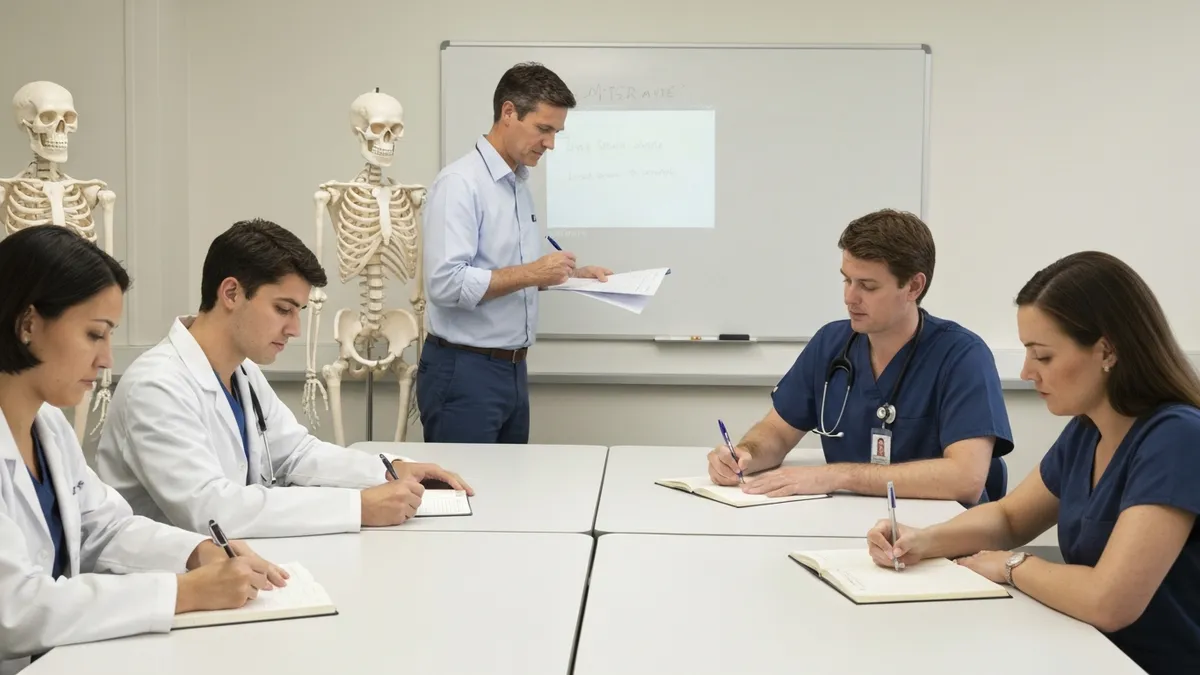
Study groups can amplify the value of any material. Find 2-3 other TEAS candidates and meet weekly to quiz each other, discuss tricky concepts, and share resources. One person's strength is another person's weakness — your study partner who crushes anatomy can help you with body systems while you help them with algebra. This collaborative approach works especially well during the final weeks of preparation. Teaching a concept to someone else is also one of the most effective ways to cement your own understanding of it.
Your TEAS Study Materials Checklist
- ✓Purchase or borrow the ATI TEAS Official Study Manual (latest edition)
- ✓Take a full-length diagnostic practice test to identify your weak areas
- ✓Create a 4-8 week study schedule with daily 1-2 hour study blocks
- ✓Set up free Khan Academy courses for math and science review
- ✓Download or create flashcards for anatomy terms and math formulas
- ✓Complete at least one practice test per week during your final 3 weeks
- ✓Review every wrong answer thoroughly — understand why you missed it
- ✓Watch video explanations for any science concepts that aren't clicking
- ✓Take a final full-length practice test 3-5 days before your real exam
- ✓Organize your test day materials: valid ID, confirmation email, snacks
Your teas study routine should feel challenging but sustainable. If you're burning out after two weeks, you've set the intensity too high. Scale back to shorter sessions and build up gradually. Consistency trumps marathon study sessions every time — 45 minutes of focused daily study beats a 6-hour weekend cram session. Your brain needs time to consolidate what you've learned, and sleep is when most of that consolidation happens.
When exploring tea programs of study at nursing schools, you'll notice that most require a minimum TEAS score between 62% and 80%. Competitive programs often want scores above 75%. Check your target school's requirements before you start studying — knowing your goal score helps you calibrate your prep intensity. A student aiming for 65% needs a different teas exam study guide strategy than one targeting 85%.
Don't neglect the English and Language Arts section. Many students focus heavily on science and math, then lose easy points on grammar and punctuation questions they could've nailed with minimal review. The ELA section has 37 questions in 34 minutes and covers sentence structure, punctuation, spelling, and contextual vocabulary. A quick brush-up on comma rules and subject-verb agreement can boost your score with minimal effort. Those are points you can't afford to leave on the table when every percentage point counts for your application.
Finding a teas study guide free option that actually covers everything is tricky, but it's doable. Combine free practice tests from sites like this one with Khan Academy's math and science courses, YouTube anatomy reviews, and library books. Create your own study binder by printing out section outlines from ATI's free test blueprint document — it lists every topic the TEAS covers, so you can check off concepts as you master them.
Planning how to study for teas test success means building in review days. Don't just push forward through new material every session. Dedicate at least one day per week to reviewing previous content. Use spaced repetition — revisit topics at increasing intervals (day 1, day 3, day 7, day 14) to move information from short-term to long-term memory. This technique is backed by decades of cognitive science research and works exceptionally well for fact-heavy subjects like anatomy.
Practice tests are your most valuable study tool in the final two weeks. At this point, you should shift from content review to test simulation. Take full-length, timed practice exams under realistic conditions — no phone, no notes, timed sections. After each test, spend twice as long reviewing your wrong answers as you did taking the test. Understanding why you missed a question teaches you more than getting ten right answers.
The ATI TEAS 7 replaced the TEAS 6 in June 2022. Any study guide, practice test, or flashcard set published before that date may contain outdated content or question formats. Always verify you're using TEAS 7-aligned materials. Check the publication date, look for 'TEAS 7' or 'ATI TEAS Version 7' on the cover, and read recent reviews from other test-takers.
While a dedicated teas exam study book gives you structured content review, don't overlook the value of reading your old college textbooks — especially for anatomy, physiology, and chemistry. If you took these courses recently, your existing notes and highlighted textbook passages are study materials you've already partially learned. Revisiting familiar material is faster than learning it fresh from a new source, and it reinforces neural pathways you've already started building.
An ati teas study manual from ATI's online store typically costs around $35-$50 and includes access to two online practice assessments. These practice assessments are arguably more valuable than the book itself — they simulate the real testing interface and provide detailed score reports by section. Many students report that their practice assessment scores closely predicted their actual TEAS scores, making them excellent benchmarking tools.
Consider supplementing your primary study materials with subject-specific resources. If science is your weak point, a standalone anatomy and physiology review book offers deeper coverage than any all-in-one TEAS guide can provide. Similarly, students struggling with math benefit from resources that focus exclusively on the types of calculations the TEAS tests — fractions, percentages, ratios, unit conversions, and basic algebra.
TEAS Practice Test Questions
Prepare for the TEAS - Test of Essential Academic Skills exam with our free practice test modules. Each quiz covers key topics to help you pass on your first try.
TEAS English Practice Test
TEAS Exam Questions covering English Practice Test. Master TEAS Test concepts for certification prep.
TEAS English Practice Test #2
Free TEAS Practice Test featuring English Practice Test #2. Improve your TEAS Exam score with mock test prep.
TEAS English Practice Test #3
TEAS Mock Exam on English Practice Test #3. TEAS Study Guide questions to pass on your first try.
TEAS Math Practice Test
TEAS Test Prep for Math Practice Test. Practice TEAS Quiz questions and boost your score.
TEAS Math Practice Test #2
TEAS Questions and Answers on Math Practice Test #2. Free TEAS practice for exam readiness.
TEAS Math Practice Test #3
TEAS Mock Test covering Math Practice Test #3. Online TEAS Test practice with instant feedback.
TEAS Reading Practice Test
Free TEAS Quiz on Reading Practice Test. TEAS Exam prep questions with detailed explanations.
TEAS Reading Practice Test #1
TEAS Practice Questions for Reading Practice Test #1. Build confidence for your TEAS certification exam.
TEAS Reading Practice Test #2
TEAS Test Online for Reading Practice Test #2. Free practice with instant results and feedback.
TEAS Reading Practice Test #3
TEAS Study Material on Reading Practice Test #3. Prepare effectively with real exam-style questions.
TEAS Reading Practice Test #4
Free TEAS Test covering Reading Practice Test #4. Practice and track your TEAS exam readiness.
TEAS Reading Practice Test #5
TEAS Exam Questions covering Reading Practice Test #5. Master TEAS Test concepts for certification prep.
TEAS® Science Practice Test
Free TEAS Practice Test featuring TEAS® Science Practice Test. Improve your TEAS Exam score with mock test prep.
TEAS Science Practice Test
TEAS Mock Exam on Science Practice Test. TEAS Study Guide questions to pass on your first try.
TEAS Science Practice Test #2
TEAS Test Prep for Science Practice Test #2. Practice TEAS Quiz questions and boost your score.
TEAS Science Practice Test #3
TEAS Questions and Answers on Science Practice Test #3. Free TEAS practice for exam readiness.
Searching for a teas test study guide free option? Start with the resources on this site — you've got access to multiple free TEAS practice tests organized by section. Pair those with the free ATI TEAS Smartprep trial (if available) and Khan Academy courses for a zero-cost study plan that covers all four sections. Many students have scored above program minimums using only free materials combined with disciplined study habits.
The best ati teas test study guide approach combines multiple resource types. Use a textbook for content review, flashcards for memorization, practice tests for application, and video courses for concepts you can't grasp through reading alone. This multi-modal approach engages different parts of your brain and leads to stronger, more durable learning. Don't rely on any single resource — variety in your study materials creates variety in your understanding.
Your final week before the TEAS should be low-intensity. Review your notes lightly, retake one practice test at most, and focus on rest and nutrition. Cramming in the last 48 hours has been shown to increase anxiety without improving performance. Trust the preparation you've already done. If you've followed a consistent study plan with quality materials over 4-8 weeks, you're ready. Walk into that testing center knowing you've put in the work, and let your preparation carry you through. The confidence that comes from thorough preparation is itself a performance booster on test day.
TEAS Questions and Answers




About the Author

Registered Nurse & Healthcare Educator
Johns Hopkins University School of NursingDr. Sarah Mitchell is a board-certified registered nurse with over 15 years of clinical and academic experience. She completed her PhD in Nursing Science at Johns Hopkins University and has taught NCLEX preparation and clinical skills courses for nursing students across the United States. Her research focuses on evidence-based exam preparation strategies for healthcare certification candidates.