
TCOLE Guide: Texas Peace Officer Licensing, Tests, and Career Path 2026 October
🆕 TCOLE guide for Texas officers. Licensing levels, exam format, hour requirements, jailer and telecommunicator paths, and study tips that work.
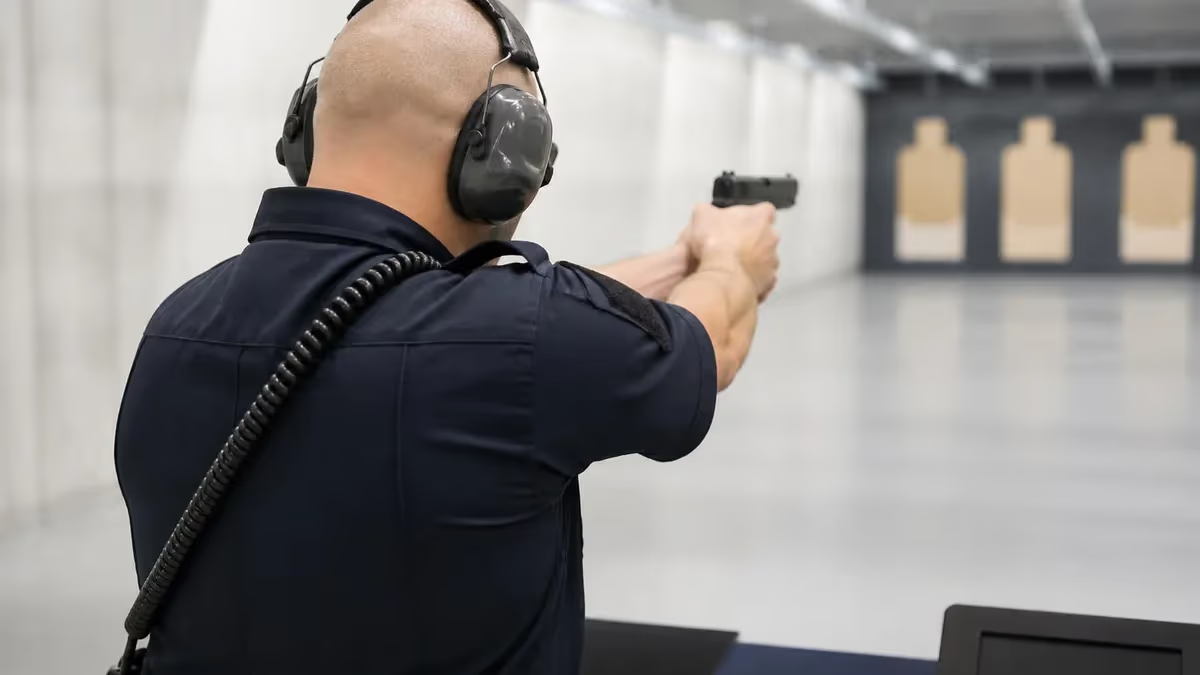
TCOLE is the Texas Commission on Law Enforcement. It is the state agency that licenses every peace officer, jailer, telecommunicator, school marshal, and many corrections personnel working in Texas. If you want a badge in this state, your career runs through TCOLE from day one.
That is a lot to handle when you are just trying to figure out where to start. New cadets often ask the same questions. What does TCOLE actually do? How long does the academy take? Which test do I sit for? What happens if I move from another state? The answers are not buried; they are just spread across dozens of pages of administrative rules and curriculum manuals. This guide pulls it all together in plain language.
You will see how the licensing pipeline works, what each license type covers, how the state exam is structured, and what continuing education looks like once you wear the badge. We will also touch on practical things people rarely mention. Background investigations. Psychological screening. Reciprocity from out-of-state. The small details that decide whether your first year on the job feels smooth or rough.
TCOLE by the Numbers

What TCOLE Actually Does
TCOLE is not a police department. It is a regulatory body. It writes the rules that license you, the curriculum your academy must teach, and the standards every agency must follow when hiring. Think of it less as a boss and more as the umpire that calls strikes for the whole state.
The commission sits in Austin. Its nine commissioners are appointed by the governor and represent a mix of sheriffs, chiefs, prosecutors, and citizens. Day-to-day, a paid staff handles license applications, audits academy records, runs investigations into officer misconduct, and approves continuing education courses. If you ever get a complaint filed against your license, this is the office that reviews it.
The relationship between TCOLE and individual agencies confuses new candidates. Agencies handle hiring, payroll, supervision, and discipline at the employer level. TCOLE handles the underlying license that lets you legally do the job in the first place. You can lose a job without losing your license, and you can lose your license without breaking a single agency policy. Both outcomes happen every year. Understanding which body controls which decision saves a lot of frustration when something goes wrong.
TCOLE also runs the public-facing Texas Law Enforcement Telecommunications System integration and maintains records that follow officers from agency to agency. That portable database is one reason Texas takes its initial license standards so seriously. Once you are in the system, your training history, discipline file, and continuing education record stay with you for the rest of your career, regardless of how many agencies you work for.
Holding a TCOLE license does not mean you have a job. The license proves you completed the requirements; agencies still hire on their own terms. Most cadets are sponsored by an agency before they ever step into class, which means the job offer comes first and academy is part of onboarding. Walking in cold without a sponsor is harder, slower, and usually means paying tuition yourself.
The Core TCOLE License Types
City police, sheriff's deputies, constables, troopers, and agency investigators. 643 academy hours minimum, plus the state exam covering law, patrol, and procedure.
Detention staff in county jails. 96-hour basic jailer course followed by a separate state exam. Many candidates earn this license first while waiting for academy seats to open.
911 dispatchers and call-takers. 40-hour basic course plus state exam. Required within 12 months of hire under TCOLE rule 217.
Trained school employees who carry concealed firearms on K-12 campuses. 80-hour specialized course with extensive psychological screening and yearly recertification.
The Path to Becoming a Texas Peace Officer
This is the route most people are thinking about when they search for TCOLE information. It has more steps than most candidates expect, so plan a real timeline. Six to twelve months is realistic from the day you apply to the day you swear in.
First comes the background packet. Personal history statement, fingerprint card, driving record, credit check, employment verification, references. Agencies want a complete picture, not just whether you have a clean record. They are looking for honesty too; lying about a minor traffic ticket can wash you out faster than the ticket itself ever would.
Then comes academy. A few large agencies run their own; everyone else attends a regional academy at a community college or police training center. The basic peace officer course runs 643 hours. That is the floor set by TCOLE. Many academies push well past it, especially ones tied to large urban departments. Expect classroom instruction on criminal law, traffic law, search and seizure, report writing, ethics, and crisis intervention. Then practical blocks on firearms, defensive tactics, driving, arrest tactics, and emergency vehicle operations.
Academy schedules vary. Many full-time programs run Monday through Friday, eight or nine hours a day, with occasional weekends for tactical exercises. Part-time evening academies exist for working candidates but stretch the timeline to twelve or fifteen months. Most agencies that sponsor cadets prefer full-time programs because the immersion produces better outcomes on the state exam and in field training. If you have any choice, take the full-time option.
Once you finish the curriculum, you sit for the state licensing exam. Pass it, and TCOLE issues your license. You are not done. Most agencies put new officers through a field training officer program for another four to six months before you ride solo. During that period, you wear the badge and carry the gun, but a senior officer is documenting your performance day by day. Field training failure rates are not trivial; about ten percent of cadets who pass the state exam still wash out during FTO because they cannot apply classroom rules in the field.
TCOLE Exam and Training Reference
Basic peace officer course is 643 hours minimum across roughly six months of full-time training. Basic jailer course is 96 hours, often completed in two to three weeks. Basic telecommunicator course is 40 hours. School marshal training runs 80 hours plus annual recertification. Continuing education is 40 hours every 24 months for active peace officers, with specific topic mandates.

The State Licensing Exam in Detail
The peace officer state exam runs 250 multiple choice questions. You get four hours. The minimum passing score is 70 percent. You can retake it twice if you fail; after a third failure, you must repeat training before another attempt.
Content mirrors the basic peace officer curriculum. Roughly a quarter of the test covers laws and procedures. Another quarter touches on traffic and patrol issues. The rest is split across investigations, communication and culture, professionalism, and special topics like family violence and crisis intervention.
Most candidates who fail the first time underestimated the law portion. They drilled the practical skills hard, then ran out of energy for chapters on statutory authority, civil rights, and use of force standards. Spend extra weeks there. The hands-on instructors at academy already drilled the muscle memory; the exam is mostly checking whether you understand the legal framework around those skills.
Before You Apply for a TCOLE Path
- ✓Pull your driving record from the last seven years
- ✓Gather military discharge papers if you served
- ✓Collect college transcripts and high school diploma
- ✓List every job and gap longer than 30 days since age 17
- ✓Make a written record of any legal issue, even dismissed cases
- ✓Be ready to discuss every relationship, financial issue, and prior drug use honestly
- ✓Identify three to five strong personal references who can speak to your character
- ✓Get a basic physical exam to confirm you can meet academy fitness standards
Continuing Education and License Renewal
TCOLE licenses do not expire in the usual sense. They stay active as long as you meet continuing education requirements. Peace officers must complete 40 hours every two years, including specific blocks on cultural diversity, crisis intervention, and de-escalation. Supervisors get extra requirements. Specialty assignments like SWAT or narcotics often add their own.
Skip continuing education and your license goes inactive. Inactive officers cannot work in a peace officer role until they catch up. Most agencies track hours internally and remind staff before deadlines, but the responsibility ultimately sits with the licensee. Keep your own records.
If you work 911 in Texas, you must hold a TCOLE telecommunicator license within 12 months of hire. The 40-hour course covers call processing, radio procedures, criminal law basics, and crisis communication. Agencies usually pay for training, but the license belongs to you and travels between employers when you change agencies.
Common Disqualifiers
Texas has strict standards on who can hold a peace officer license. Knowing what disqualifies you saves time and disappointment. A felony conviction is automatic disqualification. A Class A misdemeanor conviction in the last ten years also disqualifies. So does a Class B drug-related misdemeanor within five years. Family violence convictions, regardless of class, are a permanent bar under federal law.
Beyond convictions, agencies look at the overall picture. Excessive traffic violations, dishonorable military discharge, financial trouble that looks like instability, recent illegal drug use, and gang affiliation can all stop an application. Some of these are formal rules; many are agency discretion. Be honest on every form. Almost every disqualification story involves a candidate who tried to hide something they could have explained.

TCOLE Career Path Pros and Cons
- +Strong demand statewide, hiring rarely slows for long
- +Multiple entry points (peace officer, jailer, telecommunicator)
- +Clear written rules from TCOLE; less guessing than other states
- +Steady advancement and specialty options across 2,500+ agencies
- +Continuing education keeps skills current
- +License transfers between Texas agencies without retraining
- −Background process is long and intrusive
- −Academy is full-time and demanding
- −Pay starts modestly in rural counties
- −Continuing education and licensing fees never stop
- −Discipline cases can affect the license itself, not just a job
- −Shift work strains family and personal life
Pros and Cons at a Glance
| Pros | Cons |
|---|---|
| Strong demand statewide, hiring rarely slows for long | Background process is long and intrusive |
| Multiple entry points (peace officer, jailer, telecommunicator) | Academy is full-time and demanding |
| Clear written rules from TCOLE; less guessing than other states | Pay starts modestly in rural counties |
| Continuing education keeps skills current | Continuing education and licensing fees never stop |
| License transfers between Texas agencies without retraining | Discipline cases can affect the license itself, not just a job |
The Jailer Track
If you want law enforcement work but cannot wait for an academy seat, becoming a county jailer first is a smart move. The basic jailer course is 96 hours. You can usually complete it in two to three weeks of full-time training. Counties often hire jailers without prior experience, train them on the job, and use the role as a feeder for their patrol academy classes.
Jailer duties are not glamorous. Booking, supervising inmates, transporting prisoners to court, responding to fights and medical events inside a facility. The work is structured, indoors, and gives you exposure to the criminal justice system from a different angle than patrol. Many of the best deputies started there because they learned how to read people in a setting where backup is far away.
Out-of-state officers apply through TCOLE's recognition process. Expect a bridge course on Texas law plus the full state exam. Federal officers, military police, and tribal officers follow similar paths. If you have been out of policing for more than two years, the bridge gets longer. More than five years away, and you may need to repeat significant portions of academy.
Background Investigation in Detail
Texas agencies run a deeper background check than candidates expect. You will fill out a personal history statement that asks about every job, every address, every relationship, every legal issue going back to age 17 or earlier. References get interviewed in person or by phone. Investigators visit former employers, neighbors, sometimes ex-spouses.
Polygraph examinations are standard at most agencies. They are not infallible, but they are useful for catching inconsistencies between what you wrote and what you say in the interview. Psychological screening is also required by TCOLE rule. A licensed psychologist reviews your responses and conducts an interview before signing off. Failing this stage is more common than candidates think. Stress on the job is real, and the screening is designed to flag people who would struggle.
Starting Pay Across Texas Agencies
Picking an Academy
Not all academies are the same. Some are tied to specific agencies and train only sponsored cadets. Others run open classes at community colleges. A few elite programs have selective entry. The basic curriculum is identical because TCOLE sets the minimum, but instructor quality, additional hours, and facilities vary widely.
If you are sponsored, your agency picks the academy. If you are paying your own way, visit the campus. Talk to current students. Ask about pass rates on the state exam, the experience of firearms instructors, and what extra training the academy adds beyond the 643-hour minimum. A school with a strong firearms program and high state exam pass rates is worth the drive.
What the Job Looks Like After Licensing
Getting your TCOLE license is the start, not the finish. Most departments put new officers through 14 to 26 weeks of field training. You ride with experienced officers, rotate through patrol shifts, and get daily evaluations. Field training officers are looking for decision making under stress, report writing, officer safety habits, and how you handle community contacts.
Pay varies sharply by region and assignment. The career path branches quickly after probation: patrol, investigations, K-9, traffic enforcement, SWAT, training, school resource. Texas has more than 2,500 law enforcement agencies, so options are wide once you have a license and a clean record.
TCOLE can suspend or revoke any license it issues. The most common triggers are felony arrests, sustained findings of dishonesty, and serious uses of force that violate policy. Smaller actions like late continuing education are handled administratively. Take any complaint seriously from minute one — get a lawyer who knows TCOLE law if discipline looks likely. Officers usually lose licenses because of how they handled the investigation, not the original conduct.
Studying for the State Exam
Smart study beats hard study every time. Most academies issue a study guide, but the gold standard is the TCOLE-approved curriculum binder you used in class. Re-read it. Build flashcards on statutory authority. Pay attention to numbers that show up in test items: hours, percentages, distances, fines. Examiners love them because they make objective questions easy to write.
Practice tests help, especially timed ones. The exam is four hours for 250 questions. That is roughly a minute per question, which sounds comfortable until you hit a long fact pattern about an interrupted traffic stop. Get used to the pace. Set a timer at home. Run full-length practice sessions in one sitting. The mental endurance matters as much as the knowledge.
The Future of TCOLE Standards
Standards keep climbing. In recent years, Texas has added required training on de-escalation, mental health response, and use of force review. The legislature regularly proposes new mandates after high-profile incidents. Expect ongoing changes to continuing education topics, hour requirements, and admissions standards. The trend is more training, more scrutiny, and more documentation, not less.
Keep up. Officers who treat training as a checkbox eventually find themselves behind. The ones who treat each new requirement as a chance to sharpen something get promoted faster and survive complicated incidents better. The badge has not gotten easier to earn in Texas, and that is a feature, not a flaw.
Daily Life on a TCOLE License
People imagine peace officer work as constant emergencies. Reality is closer to a long quiet shift broken up by ten minutes of total chaos, then back to traffic stops and report writing. The license you earn through TCOLE is what makes both halves legal: the calm citizen contact and the felony pursuit. You sign your name on every report, every citation, and every probable cause affidavit. Each signature carries your license number, which means the document follows you for the rest of your career.
That permanence shapes how good officers work. They write reports as if a defense attorney is reading every word three years later, because one usually will. They document training, document supervisor approvals, document equipment checks. The discipline is not paranoia. It is professionalism that protects the license that protects the paycheck. None of this is meant to scare you. Plenty of Texas officers retire after long, satisfying careers and look back on academy as one of the best decisions they ever made.
Final Thoughts on the TCOLE Journey
The TCOLE process exists to make sure the people Texas trusts with arrest authority are trained, screened, and accountable. It is deliberately long, deliberately invasive, and deliberately rule-bound. That can feel personal during the application, but it is not. The same standards apply to the cadet next to you and to the chief who hired you both.
Treat every step as a chance to demonstrate the same judgment the badge will eventually demand. Be honest on paperwork. Show up to academy on time. Ask questions in class. Build relationships with classmates who will become your peer network for the rest of your career. Texas is a big state with a tight law enforcement community, and the people you train alongside will show up on incident scenes with you years later. The license is paperwork; the relationships are what carry the career.
If you want more targeted practice, the my tcole page covers the same material with additional questions and explanations.
Sample TCOLE - Texas Commission on Law Enforcement Practice Questions
Try these questions from our free TCOLE - Texas Commission on Law Enforcement practice tests. The correct answer and an explanation follow each question.
A Texas peace officer witnesses a driver commit a misdemeanor traffic offense outside the officer's jurisdiction. The officer may:
- A. Make the arrest only if the offense is a felony
- B. Pursue and arrest the violator anywhere in Texas under fresh pursuit
- C. Only detain the driver until local officers arrive
- D. Issue a written notice but cannot physically arrest
Answer: B. Pursue and arrest the violator anywhere in Texas under fresh pursuit
Texas Code of Criminal Procedure authorizes officers to make arrests outside their jurisdiction under fresh pursuit for any offense committed in their presence.
A city employee asks a peace officer, who is a friend, to look up a license plate for non-law enforcement purposes. The officer complies using the department's computer terminal. Under the Texas Penal Code, what offense has the officer most likely committed?
- A. Official Oppression
- B. Bribery
- C. Abuse of Official Capacity
- D. Tampering with a Governmental Record
Answer: C. Abuse of Official Capacity
Abuse of Official Capacity (Texas Penal Code §39.02) occurs when a public servant, with intent to obtain a benefit or harm another, misuses government property, services, or personnel. By using the official computer system (a government service) for an unauthorized, non-law enforcement purpose, the officer has committed this offense. Official Oppression involves denying a right or unlawful mistreatment, which did not occur here.
A peace officer observes their Field Training Officer using force that is clearly excessive on a subject who is handcuffed and no longer resisting. What is the observing officer's primary ethical and professional duty in this situation?
- A. Immediately intervene, verbally or physically if necessary, to stop the excessive force and report the incident to a supervisor.
- B. Wait until the situation is over and then discuss the matter privately with the FTO to avoid insubordination.
- C. Document the incident thoroughly in their report but take no immediate action.
- D. Ask a nearby officer of equal rank what they should do before taking any action.
Answer: A. Immediately intervene, verbally or physically if necessary, to stop the excessive force and report the incident to a supervisor.
Peace officers have an affirmative duty to intervene when they witness another officer using force that is clearly excessive or unlawful. This duty exists regardless of rank or seniority. The primary responsibility is to protect the subject from harm and uphold the law, which includes reporting the misconduct to a supervisor.
A peace officer attempts to arrest a suspect who has just committed an armed robbery. The suspect flees and the officer gives chase. According to the U.S. Supreme Court ruling in *Tennessee v. Garner*, when would the officer be constitutionally justified in using deadly force to prevent the suspect's escape?
- A. As soon as the suspect begins to flee, because robbery is a felony.
- B. Only after firing a warning shot and giving a verbal command to stop.
- C. If the officer has probable cause to believe the suspect poses a significant threat of death or serious physical injury to the officer or others.
- D. At any point during the foot pursuit, as long as the suspect is still in sight.
Answer: C. If the officer has probable cause to believe the suspect poses a significant threat of death or serious physical injury to the officer or others.
*Tennessee v. Garner* ruled that using deadly force to stop a fleeing felon is a 'seizure' under the Fourth Amendment and is not permissible unless the officer has probable cause to believe the suspect poses a significant threat of death or serious physical injury to the officer or others.
Take the full TCOLE - Texas Commission on Law Enforcement practice test
TCOLE Questions and Answers
About the Author

Educational Psychologist & Academic Test Preparation Expert
Columbia University Teachers CollegeDr. Lisa Patel holds a Doctorate in Education from Columbia University Teachers College and has spent 17 years researching standardized test design and academic assessment. She has developed preparation programs for SAT, ACT, GRE, LSAT, UCAT, and numerous professional licensing exams, helping students of all backgrounds achieve their target scores.
Join the Discussion
Connect with other students preparing for this exam. Share tips, ask questions, and get advice from people who have been there.
View discussion (9 replies)