
TCOLE Jobs: Texas Law Enforcement Careers and Hiring Guide 2026 September
🗨️ Free TCOLE Jobs: Texas Law Enforcement practice test with questions and answer explanations. Prepare for the 2026 September exam with instant scoring.
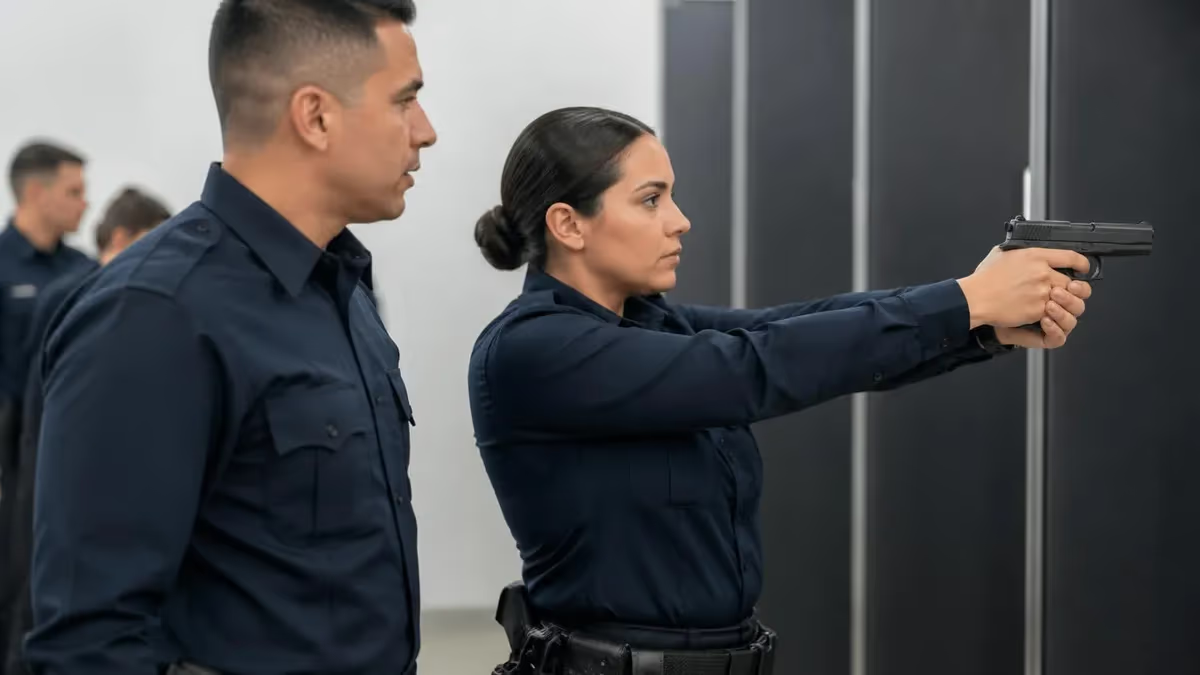
Texas Commission on Law Enforcement certification isn't optional — it's the legal requirement for every sworn peace officer in the state. Whether you're applying to a big-city police department in Houston or a small-town marshal's office in West Texas, you can't work as a peace officer without a valid TCOLE license. That single requirement shapes everything about how Texas law enforcement hiring works, and it's the first thing you need to understand before researching job openings.
The state employs more than 75,000 licensed peace officers across roughly 2,500 agencies. That's patrol officers, investigators, school resource officers, game wardens, constable deputies, and a dozen other job titles that all share one thing: a TCOLE license in the officer's personnel file. The breadth of job types is wider than most people realize when they first start researching this career path.
Texas law enforcement jobs are genuinely in demand right now. Turnover, retirements, and population growth have left many agencies understaffed, and the hiring push is real. Agencies in urban counties compete with signing bonuses and lateral transfer packages; rural departments often offer a faster path to promotion and specialized assignment. There's real opportunity across the board for qualified candidates willing to do the work.
This guide covers the main types of TCOLE jobs available, what they pay at different career stages, and how the certification and hiring process actually works. If you're figuring out where to apply — or just deciding whether law enforcement is the right fit — the information here is practical, not promotional. We'll cut through the vague career-site language and get to what you actually need to know.
It also helps to understand what TCOLE itself does. The commission sets training standards, licenses individual officers, and disciplines officers who violate the law or department policy. Its role in the hiring pipeline is largely invisible to applicants — but agencies track TCOLE licensing status closely, and an expired or revoked license ends careers fast. Understanding that context helps you take the certification process seriously from day one.
The minimum requirements to become a TCOLE-licensed peace officer in Texas are consistent across agencies. You must be at least 21 years old, a U.S. citizen, and hold a high school diploma or GED. You can't have felony convictions or certain misdemeanor convictions involving family violence or moral turpitude. Getting your tcole certification starts with meeting these baseline eligibility criteria before you ever set foot in an academy — background investigators verify all of it.
After clearing eligibility requirements, most candidates enroll in a TCOLE-approved Basic Peace Officer Course. These programs typically run 600 to 800 hours over four to six months. Curriculum covers criminal law, arrest and search procedures, use of force, emergency driving, first aid, and dozens of other required topics. Some agencies sponsor recruits through academy training and pay them during the process; others require applicants to self-fund their own pre-service academy attendance before being hired.
The TCOLE licensing exam comes after you complete BPOC training. The written exam tests knowledge from your academy coursework across multiple domains — criminal law, patrol procedures, and law enforcement operations. Candidates who want to know how to obtain tcole certification should budget three to four months minimum from application to license, assuming no testing delays or background investigation complications along the way.
Background investigations for law enforcement candidates are thorough. Investigators check credit history, driving record, social media activity, past employment, and personal references. Polygraph examinations are standard at most agencies. Many candidates who fail aren't disqualified by criminal history — they're rejected for deception during the background process or for contradictions between their application and what investigators find. Honesty throughout genuinely matters more than having a flawless past.
Continuing education requirements kick in after you're licensed. TCOLE mandates annual training hours that officers must complete to maintain an active license. Many employers handle this through in-service training days, but the responsibility ultimately sits with the individual officer. If training lapses, the license becomes inactive — and an inactive TCOLE license means you can't legally work as a peace officer anywhere in Texas until you complete the required hours.

Texas Law Enforcement Agency Types
City and Town Police Departments
Municipal police departments are the largest employers of TCOLE-licensed officers in Texas. The Houston Police Department alone employs over 5,000 sworn officers; the Dallas, San Antonio, and Austin PDs each employ between 1,800 and 3,000. Together with dozens of medium-sized departments in cities like Lubbock, Amarillo, El Paso, and Corpus Christi, municipal agencies account for the majority of law enforcement jobs statewide.
Independent School District police departments also fall under the municipal umbrella. Texas ISDs are required to maintain their own police departments above certain enrollment thresholds, and ISD officers are full TCOLE-licensed peace officers with jurisdiction on district property. These positions often offer strong benefits, predictable schedules, and a community-focused mission that appeals to officers interested in youth interaction and prevention work.
Municipal positions typically offer the best starting pay in the Texas law enforcement market, particularly in DFW and Houston metro areas. Entry-level officers at major city PDs can start between $55,000 and $70,000, with competitive step increases that reach six figures within a decade for officers who stay in active assignments. The trade-off is higher call volume, larger department bureaucracy, and more intense public scrutiny than smaller agencies.
The main clearinghouses for Texas law enforcement job listings are agency websites, TexasJobSource.com, and the Texas Municipal League job board. Most agencies post openings on their HR pages with specific testing dates for written exams, physical agility tests, and oral boards. State agencies like DPS post on the Texas Workforce Commission portal. Setting up email alerts on all of these saves you from missing application windows, which are often brief and fill quickly at competitive departments.
The application process varies significantly by agency size. Large departments like Houston PD or SAPD run testing cohorts several times a year, which means you're competing with hundreds of candidates per cycle. Smaller agencies hire one or two officers at a time and move much faster — sometimes from application to job offer in six to eight weeks. If speed matters to your situation, smaller agencies are often the better entry point into the field.
Agencies aren't just looking for a clean background and a TCOLE license. They want candidates who can communicate clearly, handle stress without escalating situations, and make sound decisions with incomplete information. If you're researching tcole certification online options and wondering whether online prep alone positions you for success, the short answer is that agencies want demonstrated commitment — reserve officer work, military service, civilian employment in a relevant field, or volunteer experience all signal that you've tested your fit for this career before applying.
Understanding what is tcole certification in relation to the job market helps you position yourself correctly when applying. Agencies distinguish between candidates who hold a basic license and those who already have years of field experience. Entry-level positions exist for new licensees, but competitive agencies in major metros often prefer lateral transfers — officers with two or more years of full-time experience from another Texas department. Your strategy for which agencies to target should account for where you fall on that spectrum.
Networking matters more in law enforcement than in most careers. Ride-alongs, volunteer reserve positions, and civilian roles within an agency give you face time with supervisors and a realistic preview of the day-to-day work. Many officers who got hired quickly into competitive departments had spent months or years volunteering in some capacity before applying. It demonstrates commitment, and it gives hiring managers something concrete to discuss with your references beyond your paperwork.

Steps to Land a TCOLE Law Enforcement Job
- ✓Verify you meet basic TCOLE eligibility: age 21+, U.S. citizen, no disqualifying convictions
- ✓Start physical fitness training for the agility test (1.5-mile run, push-ups, sit-ups)
- ✓Research and apply to a TCOLE-approved Basic Peace Officer Course
- ✓Complete BPOC training and pass the TCOLE licensing examination
- ✓Identify target agencies and review their hiring calendars and pay scales
- ✓Submit a complete and accurate application, including full employment history
- ✓Pass the written exam, physical agility test, polygraph, and oral board interview
- ✓Complete the background investigation process with full honesty
- ✓Receive a conditional offer and pass the medical and psychological evaluation
- ✓Begin the Field Training Officer program and earn full independent status
Law Enforcement Career: Honest Trade-offs
- +Job security with defined pension benefits through TMRS or ERS
- +Clear promotion paths with structured pay increases at each rank
- +Meaningful work with direct community impact daily
- +Variety — no two shifts are identical in active assignments
- +Early retirement eligibility at 20-23 years of service
- −Physical and psychological demands are genuinely significant
- −Rotating shift work disrupts family schedules for most of your career
- −High public and media scrutiny of officer decisions
- −Starting salaries are competitive but modest in major metro cost-of-living areas
- −Hiring process from application to academy graduation takes 12-18 months

Starting salaries for TCOLE-licensed peace officers vary by agency and region, but most entry-level positions in Texas fall between $40,000 and $58,000 annually. Metro departments in DFW, Houston, San Antonio, and Austin typically pay more — some starting officers above $60,000, with additional pay for bilingual skills, military service, or prior law enforcement experience. Rural and smaller-city departments often start lower but offer strong benefit packages that partially offset the base pay difference.
Benefits are a real part of the total compensation picture. Most Texas law enforcement jobs come with health insurance, paid leave, and participation in the Texas Municipal Retirement System or the Employees Retirement System of Texas. Both are defined-benefit pension plans that have largely disappeared from private-sector employment. Pension eligibility typically starts at 20 or 23 years of service, with options for early retirement at reduced benefits. For long-term career planning, that pension is worth significantly more than the base salary comparison suggests.
Pay progression follows a structured step system at most agencies. Officers can expect meaningful raises tied to time-in-service milestones — typically at years 1, 3, 5, 7, and 10. Promotions to detective, corporal, or sergeant accelerate the timeline significantly. An officer who makes rank within five to seven years can often approach double their starting salary before the ten-year mark, especially in larger agencies with active specialty assignment pay for SWAT, K-9, or criminal investigations.
State agency positions — DPS troopers, TPWD game wardens, TABC agents — come with their own pay scales that differ from municipal and county positions. DPS troopers start around $55,000, which is competitive but lower than what some major metro PDs pay. The trade-off is statewide jurisdiction, specialized equipment, and different career track options. It's worth comparing carefully before committing to a particular agency type, because the pay structures and cultures diverge significantly over a full career.
Overtime and supplemental assignments add meaningful income for officers willing to work extra shifts. Most Texas departments pay time-and-a-half for overtime, and court appearances — which officers are often required to attend on off-duty days — typically generate additional pay. Officers in high-activity assignments often accumulate 200 to 400 hours of overtime annually. When you add supplemental income, many officers earn 20 to 30 percent above their base salary, particularly during the first decade of their career.
Most Texas peace officers who plan to stay in law enforcement long-term start thinking about promotion tracks early. The typical ladder runs from officer to corporal, sergeant, lieutenant, captain, and chief — though titles and intermediate ranks vary by agency. Promotion exams are competitive at most departments, and candidates who score high and maintain clean records move up faster. Some agencies use assessment centers that evaluate leadership and decision-making alongside written test performance.
Specialized units open up after officers accumulate two to four years of patrol experience. Homicide, narcotics, auto theft, family violence, and cybercrime are common detective assignments. K-9, SWAT, and traffic enforcement are patrol-level specializations that often come with pay bumps. Tactical units like SWAT typically require voluntary certification programs that officers complete on their own time before applying. The work is specialized — and so is the commitment required to get there.
If you want to practice the material covered in BPOC training and the TCOLE licensing exam, the FREE TCOLE Basic Peace Officer Questions and Answers practice set is worth working through before your test date. Covering the material early and consistently is a smarter strategy than cramming the week before the exam.
Lateral transfers between Texas agencies are common and often accelerate career progression. An officer who spends three years at a smaller department and then transfers to a major metro brings experience that moves them ahead of entry-level recruits. Many officers deliberately use smaller agencies as entry points specifically to gain field experience faster and then lateral to a larger department with better pay and more specialty options. It's a deliberate strategy — not a fallback plan.
For officers who eventually want to move into administration, a college degree becomes increasingly important above the rank of sergeant. Many large departments require a bachelor's degree for promotion to lieutenant or above. Officers who pair street experience with a criminal justice, public administration, or related degree are competitive candidates for senior agency positions. Starting a degree program early in your career — even a few courses per semester — pays compounding dividends over a 25-year career.
TCOLE Practice Test Questions
Prepare for the TCOLE - Texas Commission on Law Enforcement exam with our free practice test modules. Each quiz covers key topics to help you pass on your first try.
TCOLE Arrest, Search, and Seizure
TCOLE Exam Questions covering Arrest, Search, and Seizure. Master TCOLE Test concepts for certification prep.
TCOLE Basic Peace Officer
Free TCOLE Practice Test featuring Basic Peace Officer. Improve your TCOLE Exam score with mock test prep.
TCOLE Code of Criminal Procedure
TCOLE Mock Exam on Code of Criminal Procedure. TCOLE Study Guide questions to pass on your first try.
TCOLE Professionalism and Ethics
TCOLE Test Prep for Professionalism and Ethics. Practice TCOLE Quiz questions and boost your score.
TCOLE Telecommunicator
TCOLE Questions and Answers on Telecommunicator. Free TCOLE practice for exam readiness.
TCOLE Texas Penal Code
TCOLE Mock Test covering Texas Penal Code. Online TCOLE Test practice with instant feedback.
TCOLE Traffic Law and Enforcement
Free TCOLE Quiz on Traffic Law and Enforcement. TCOLE Exam prep questions with detailed explanations.
TCOLE Use of Force Principles
TCOLE Practice Questions for Use of Force Principles. Build confidence for your TCOLE certification exam.
TCOLE Law Enforcement Ethics
TCOLE Test Online for Law Enforcement Ethics. Free practice with instant results and feedback.
TCOLE Texas Penal Code Offenses
TCOLE Study Material on Texas Penal Code Offenses. Prepare effectively with real exam-style questions.
Getting ready for a TCOLE law enforcement job starts well before you apply. Physical fitness is the first bottleneck for most candidates. The standard agility test at most agencies includes a timed 1.5-mile run, push-ups, sit-ups, and either a shuttle run or obstacle course. Start training specifically for these standards six months before you plan to test. Showing up unprepared for the physical portion is the most avoidable reason applicants wash out early in the hiring process.
Written testing prep varies by agency, but most entry-level written exams test reading comprehension, basic math, situational judgment, and sometimes memory and observation skills. Study guides and practice materials are available online. If you're planning to attend a pre-service academy, your BPOC curriculum will cover the licensing exam material in depth. Reviewing the FREE TCOLE Code of Criminal Procedure Questions and Answers is a smart way to get ahead on one of the more challenging exam domains before your formal training begins.
The oral board interview is where candidates who look good on paper lose opportunities. Panels typically include department supervisors who ask scenario-based questions about use of force decisions, ethics, conflict resolution, and community relations. Prepare by practicing out loud — not just mentally running through answers. Know the department's core values, recent initiatives, and community priorities. Generic answers that could apply to any agency don't score well with experienced interviewers.
Background investigation preparation is underrated by most first-time applicants. Before applying, audit your own social media accounts, resolve any outstanding traffic fines or civil judgments, and check with past employers to know what references will say. Prepare a complete and accurate employment history going back ten years. Investigators will verify everything. Agencies don't automatically disqualify candidates for past mistakes if they're honest about them — but they do disqualify candidates who lie or omit information on their applications.
The path from deciding to apply to graduating the academy takes one to two years for most candidates. That timeline is shorter than many professional certifications, and the career stability on the other side — defined pension, strong job security, structured advancement — is hard to replicate in the private sector. If you're serious about a TCOLE career, start the physical conditioning and academy research now. Texas agencies are actively hiring qualified candidates, and the sooner you begin building your file, the better positioned you'll be when openings appear.
TCOLE Questions and Answers
About the Author

Educational Psychologist & Academic Test Preparation Expert
Columbia University Teachers CollegeDr. Lisa Patel holds a Doctorate in Education from Columbia University Teachers College and has spent 17 years researching standardized test design and academic assessment. She has developed preparation programs for SAT, ACT, GRE, LSAT, UCAT, and numerous professional licensing exams, helping students of all backgrounds achieve their target scores.
Join the Discussion
Connect with other students preparing for this exam. Share tips, ask questions, and get advice from people who have been there.
View discussion (9 replies)