
State Trooper Phone Number: Every State Patrol Contact Number, Non-Emergency Lines, and How to Reach a Trooper Fast
State trooper phone number directory for all 50 states. Find non-emergency, dispatch, and HQ lines for Texas, Florida, Illinois, Arizona and Carolina ⏳
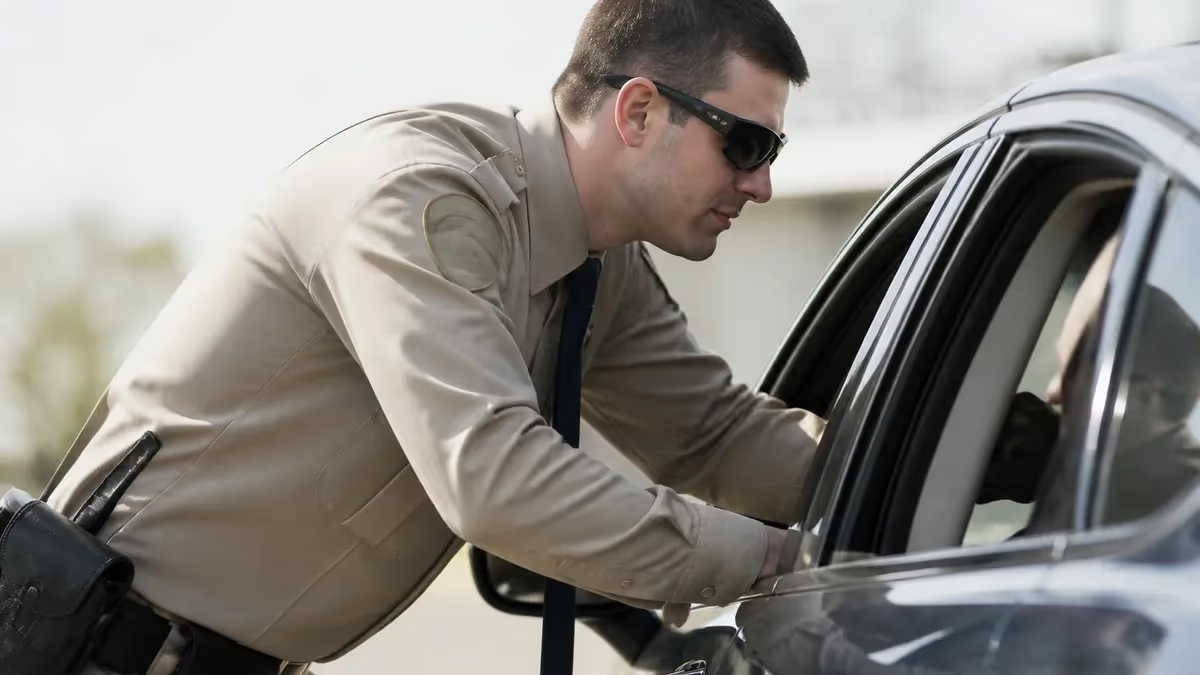
Finding the right state trooper phone number can feel surprisingly difficult when you actually need it. Whether you witnessed reckless driving on the interstate, need to report a stranded motorist, or want to verify a traffic citation, dialing 911 is not always appropriate, and the general state police website often buries the dispatch line three pages deep. This guide consolidates every state highway patrol contact line in the United States, explains which number to call for which situation, and walks through what happens after you connect with a dispatcher.
The phrase state trooper phone number actually covers several different lines depending on your need. There is the emergency 911 line, the statewide non-emergency dispatch number, the regional barracks line, the public information office, the recruiting line, and even specialty desks like commercial vehicle enforcement or missing persons. Calling the wrong one can mean a 45-minute wait while a switchboard operator transfers you, so knowing the right extension up front saves real time, especially during peak hours like Friday evening rush.
Public interest in trooper contact information has spiked sharply since 2023, partly because of the viral state trooper texas a incident at a college football game that pushed Texas DPS into the national spotlight. Searches for Texas Department of Public Safety phone numbers tripled in the weeks after the meme spread, and similar bumps followed high-profile pursuits in Florida, Illinois, and the Carolinas. People want to know who they are calling, what jurisdiction the agency covers, and whether a trooper will actually respond to a non-emergency tip phoned in from a cell phone.
This article is organized by state, but it also explains the difference between a state police force, a state highway patrol, and a state department of public safety, because the names are not interchangeable. Texas, for example, runs its troopers under the Texas DPS umbrella. Florida calls its troopers the Florida Highway Patrol, a division of the Department of Highway Safety and Motor Vehicles. Illinois has its own dedicated Illinois State Police, while South Carolina and North Carolina each operate their own Highway Patrol divisions with distinct contact directories.
You will also find dial-by-cell shortcuts in this guide. Most states maintain a *47, *55, *77, *HP, or *SP three-digit shortcode that routes mobile callers directly to the nearest highway patrol dispatch center. These shortcodes are free, do not count against your minutes on prepaid plans, and connect faster than the ten-digit alternative because they bypass commercial routing. Truckers, rideshare drivers, and long-distance commuters should memorize their state's shortcode the same way they memorize 911.
Finally, this guide covers what you should and should not say when you call. Dispatchers triage hundreds of calls per shift, and giving them the right information in the right order, mile marker, direction of travel, vehicle description, plate, behavior observed, gets a trooper on scene faster than a long narrative. Read on for the full directory, the calling scripts, and a Q&A section answering the questions readers ask most often about reaching a state trooper by phone in 2026.
State Trooper Phone Lines by the Numbers

State Trooper Phone Number Directory by Region
Main line: 512-424-2000 (Austin HQ). Non-emergency highway: *DPS (*377) from a cell phone. Texas Highway Patrol operates 24/7 from regional communications centers in Austin, Houston, El Paso, and Lubbock.
Statewide non-emergency: *FHP (*347) from a cell phone. HQ in Tallahassee: 850-617-2300. FHP dispatch routes to one of eight regional troops covering every county from Pensacola to Key West.
Non-emergency: 217-782-7263 (Springfield HQ). Mobile shortcode: *999 reaches District dispatch. Illinois operates 21 districts statewide, each with its own 24-hour communications line.
Statewide: 602-223-2000. Highway patrol dispatch via cell: *DPS (*377). Arizona Department of Public Safety covers all interstates including I-10, I-17, and I-40 with regional offices in Phoenix, Tucson, and Flagstaff.
North Carolina: *HP (*47) statewide, or 919-733-7952. South Carolina: *HP (*47) or 803-896-9621. Both states route mobile shortcodes to the nearest troop headquarters automatically based on cell tower location.
Knowing when to dial 911 versus a non-emergency trooper line saves dispatch resources and gets your specific situation handled by the right desk. Call 911 when there is an active threat to life or property: a wreck with injuries, a suspected impaired driver swerving across lanes, an active road-rage incident, or a vehicle on fire. Dispatchers will conference state troopers, EMS, and fire automatically. Calling a non-emergency line in a true emergency adds minutes that you cannot get back, even if the line is technically staffed around the clock.
Use the non-emergency state trooper phone number for situations that need a trooper but are not time-critical. Examples include a stalled vehicle on the shoulder, debris in the roadway, a missing road sign, a follow-up question about a citation, a request for an accident report copy, or general traffic complaints about a recurring problem at a specific mile marker. These get logged into the computer-aided dispatch system and assigned to the next available trooper in the patrol area, usually within 30 to 90 minutes.
The texas state trooper system uses a tiered priority code. Priority 1 calls are life-threatening and get immediate dispatch. Priority 2 covers in-progress crimes or hazards without injury. Priority 3 includes traffic complaints, suspicious activity, and minor property issues. Priority 4 is information only, like checking on a relative who has not arrived. When you call, the dispatcher silently codes your report, which determines how fast a unit is sent and whether lights and sirens are authorized. Stating facts clearly helps them code accurately.
Most states also operate a dedicated drunk driving hotline, often branded as Highway Watch, REDDI (Report Every Drunk Driver Immediately), or *DUI. These lines connect straight to highway patrol dispatch with a fast-track script: vehicle description, plate, direction of travel, last observed mile marker. You stay on the line while a trooper is dispatched, and you can frequently follow the suspect until the stop is made. Studies show REDDI-style citizen calls account for roughly 12% of all impaired driving arrests on rural interstates.
The florida state trooper non-emergency network is unusual because Florida lets you text *FHP (*347) for non-urgent reports. Texting works well for hearing-impaired callers and for situations where a phone call would be unsafe, like a passenger reporting their own driver. Several other states, including California, Virginia, and Ohio, have followed Florida's lead and now accept text-to-dispatch for non-emergency reports. Always confirm the text option on your state patrol's official website before relying on it during travel.
For inquiries that are not time-sensitive at all, agency main lines and regional barracks are appropriate. These include questions about job applications, ride-along programs, school presentations, public records requests, and citation contesting procedures. Main lines operate during business hours, generally 8 a.m. to 5 p.m. on weekdays, and route to a switchboard operator who can forward you to the right desk. If you need a specific trooper, having their badge number or the report number ready cuts your wait substantially.
Understanding the difference between dispatch, barracks, and headquarters phone systems is the foundation of getting good service from any state patrol. Dispatch handles active incidents and live radio traffic. Barracks handle administrative business for a region. Headquarters handles statewide policy, public information, and command-level operations. Pick the right desk and you cut your hold time from 20 minutes to 90 seconds, which matters when you have a real problem and a dwindling cell battery on the side of a rural highway.

State Trooper Practice Test Questions
Prepare for the State Trooper exam with our free practice test modules. Each quiz covers key topics to help you pass on your first try.
State Trooper Criminal and Traffic Law
State Trooper Exam Questions covering Criminal and Traffic Law. Master State Trooper Test concepts for certification prep.
State Trooper General
Free State Trooper Practice Test featuring General. Improve your State Trooper Exam score with mock test prep.
State Trooper MCQ
State Trooper Mock Exam on MCQ. State Trooper Study Guide questions to pass on your first try.
State Trooper Patrol and Investigation Pro...
State Trooper Test Prep for Patrol and Investigation Procedures. Practice State Trooper Quiz questions and boost your score.
State Trooper
State Trooper Questions and Answers on State Trooper. Free State Trooper practice for exam readiness.
State Trooper Random
State Trooper Mock Test covering Random. Online State Trooper Test practice with instant feedback.
State Trooper Reading Comprehension and Re...
Free State Trooper Quiz on Reading Comprehension and Reasoning. State Trooper Exam prep questions with detailed explanations.
State Trooper Report Writing and Grammar
State Trooper Practice Questions for Report Writing and Grammar. Build confidence for your State Trooper certification exam.
State Trooper Situational Judgment and Ethics
State Trooper Test Online for Situational Judgment and Ethics. Free practice with instant results and feedback.
State Trooper Trivia
State Trooper Study Material on Trivia. Prepare effectively with real exam-style questions.
State Trooper Use of Force Principles
Free State Trooper Test covering Use of Force Principles. Practice and track your State Trooper exam readiness.
State Trooper Ultimate State Trooper
State Trooper Exam Questions covering Ultimate State Trooper. Master State Trooper Test concepts for certification prep.
State Trooper Community Relations and Comm...
Free State Trooper Practice Test featuring Community Relations and Communication. Improve your State Trooper Exam score with mock test prep.
State Trooper Constitutional Rights and Ci...
State Trooper Mock Exam on Constitutional Rights and Civil Liberties. State Trooper Study Guide questions to pass on your first try.
State Trooper Criminal Law Fundamentals
State Trooper Test Prep for Criminal Law Fundamentals. Practice State Trooper Quiz questions and boost your score.
State Trooper Emergency Response and Crisi...
State Trooper Questions and Answers on Emergency Response and Crisis Management. Free State Trooper practice for exam readiness.
State Trooper Emergency Vehicle Operations
State Trooper Mock Test covering Emergency Vehicle Operations. Online State Trooper Test practice with instant feedback.
State Trooper Ethics and Professional Conduct
Free State Trooper Quiz on Ethics and Professional Conduct. State Trooper Exam prep questions with detailed explanations.
State Trooper Firearms Safety and Use of F...
State Trooper Practice Questions for Firearms Safety and Use of Force. Build confidence for your State Trooper certification exam.
State Trooper Incident Report Writing
State Trooper Test Online for Incident Report Writing. Free practice with instant results and feedback.
State Trooper Investigation Procedures
State Trooper Study Material on Investigation Procedures. Prepare effectively with real exam-style questions.
State Trooper Map Reading and Navigation
Free State Trooper Test covering Map Reading and Navigation. Practice and track your State Trooper exam readiness.
State Trooper Patrol Operations and Proced...
State Trooper Exam Questions covering Patrol Operations and Procedures. Master State Trooper Test concepts for certification prep.
State Trooper Patrol Procedures and Tactics
Free State Trooper Practice Test featuring Patrol Procedures and Tactics. Improve your State Trooper Exam score with mock test prep.
State Trooper Physical Fitness and Wellnes...
State Trooper Mock Exam on Physical Fitness and Wellness Standards. State Trooper Study Guide questions to pass on your first try.
State Trooper Reading Comprehension and Logic
State Trooper Test Prep for Reading Comprehension and Logic. Practice State Trooper Quiz questions and boost your score.
State Trooper Report Writing and Documenta...
State Trooper Questions and Answers on Report Writing and Documentation. Free State Trooper practice for exam readiness.
Texas State Trooper, Florida State Trooper, and Illinois State Trooper Phone Lines
The Texas state trooper main number is 512-424-2000, which routes to the Department of Public Safety headquarters in Austin. For roadside emergencies on Texas highways, dial 911 or use the *DPS shortcode (*377) from a cellular phone. Non-emergency reports of impaired drivers, road hazards, or stranded motorists also use *DPS, which automatically routes to the nearest of six Texas Highway Patrol communications districts based on your cell tower location.
Texas DPS recruiting operates from 512-424-2105, and the Crime Records Division for accident report copies is 512-424-2079. Each of the 16 patrol regions also runs its own administrative line during business hours. Houston dispatches from 713-681-1761, Dallas from 214-861-2000, and the El Paso district from 915-849-4000. Calls to the regional desk reach the on-duty sergeant rather than dispatch, which is appropriate for follow-ups and minor administrative questions.
Calling a State Trooper Non-Emergency Line vs Dialing 911
- +You free up the 911 system for genuine life-threatening emergencies
- +Non-emergency calls still get logged into the same CAD dispatch system
- +You can stay on the line and follow a suspect vehicle without lights or sirens
- +Reports filed on non-emergency lines still count toward enforcement statistics
- +Dispatchers can transfer you laterally to the right desk without re-explaining
- +Text-based reporting is available in many states for safer reporting
- +Hold times are typically shorter than 911 during high-volume periods
- −Response times can stretch to 30-90 minutes for low-priority calls
- −Not every state publishes its non-emergency number prominently
- −Shortcodes like *47 or *77 do not work on landlines
- −Some carriers do not route shortcodes correctly across state lines
- −Hearing-impaired callers may not get TTY support on every regional line
- −Spanish-language dispatchers are not available in every state 24/7
- −Calls outside business hours sometimes route to voicemail at smaller barracks
Pros and Cons at a Glance
| Pros | Cons |
|---|---|
| Non-emergency calls still get logged into the same CAD dispatch system | Not every state publishes its non-emergency number prominently |
| You can stay on the line and follow a suspect vehicle without lights or sirens | Some carriers do not route shortcodes correctly across state lines |
| Reports filed on non-emergency lines still count toward enforcement statistics | Hearing-impaired callers may not get TTY support on every regional line |
| Dispatchers can transfer you laterally to the right desk without re-explaining | Calls outside business hours sometimes route to voicemail at smaller barracks |

Information to Have Ready When You Dial a State Trooper Phone Number
- ✓Your exact location: highway, mile marker, direction of travel, nearest exit
- ✓Vehicle description in order: color, make, model, body style
- ✓Full license plate and state of issuance if visible
- ✓Specific behavior observed: lane drifting, speeding, brake-checking, debris
- ✓Time you first observed the situation and where it started
- ✓Your own vehicle description and plate so the trooper can identify you
- ✓Whether you are still following or have lost visual contact
- ✓Any weapons, injuries, or hazardous materials involved
- ✓Your callback number in case the line drops
- ✓Whether you are willing to be contacted as a witness later
Use *47, *77, or *DPS Before Dialing Ten Digits
Three-digit cellular shortcodes like *47, *77, *HP, and *DPS route to the nearest dispatch center based on cell tower triangulation, often 15 to 30 seconds faster than a ten-digit alternative. Memorize your state's shortcode and program it as a favorite contact for quick highway access.
Dispatch centers, barracks, and headquarters each handle a different slice of state patrol business. Dispatch is the 24/7 nerve center where calls for service are received, prioritized, and assigned to troopers in the field. The communications operator you reach is trained to triage hundreds of calls per shift, run plates and warrants in seconds, and coordinate with neighboring agencies. When you call a dispatch line, expect a short, professional script: agency, your name, your location, the nature of the problem, and any safety details that affect how a trooper approaches.
Barracks operate at the regional level and serve as the home base for a specific group of troopers assigned to a patrol area. A barracks phone line is appropriate for follow-up questions about an open case, scheduling a visit to pick up property, requesting an accident report copy in person, or speaking to a specific trooper or sergeant by name. Barracks lines typically operate during business hours, although many roll over to dispatch after 5 p.m. so callers are not stranded after hours. The state trooper salary conversation often starts at this level too, since regional captains handle recruiting tours.
Headquarters phone systems handle statewide functions: public information officers who speak to media, legal counsel who handles subpoenas, the office of professional standards that investigates complaints against troopers, and the commissioner's office that sets policy. The public information line is also where reporters and researchers call for statistics, crash data, and statements on high-profile incidents. Citizens with general policy questions, like why a certain enforcement campaign is happening, should call the public information line rather than dispatch.
Specialty desks at headquarters include commercial vehicle enforcement, K9 operations, dive teams, aviation, and crime laboratory services. If you have a truck-related complaint, the commercial vehicle desk can dispatch a weight inspector. If you are reporting a missing person under suspicious circumstances, the criminal investigation division desk takes over from dispatch once initial information is gathered. Each desk publishes its own ten-digit number on the agency website, but most can be reached by asking the main switchboard for a transfer.
Some states divide further by interstate corridor. Pennsylvania State Police, for example, runs Troop T specifically for the Pennsylvania Turnpike, with its own dispatch number distinct from county-based troops. New York State Police runs Troop T for the New York State Thruway. Drivers on these toll roads should call the corridor-specific line rather than the general state police line, because the responding trooper jurisdiction is different and a county dispatcher will only transfer you back.
Mutual aid agreements between agencies mean that a state trooper phone number sometimes connects you to a sheriff's deputy or city officer first, depending on which unit is closest. This is most common on county or city lines that border a state highway. Dispatchers are trained to hand off seamlessly, so you should not need to re-explain the situation, but it is worth confirming which agency is responding so you know who to expect when help arrives. Always note the call reference number the dispatcher gives you.
Finally, every state operates a non-public administrative line for inter-agency coordination, plus a dedicated line for federal partners like the FBI, DEA, and Border Patrol. These are not public-facing and you cannot reach them from a personal phone, but they explain why dispatchers can sometimes connect a complex multi-jurisdiction case in under five minutes. If you ever wonder why a trooper from one state shows up to assist on a case that started in a neighboring state, this back-channel network is the reason.
If someone is in immediate danger, a crash has injuries, or a driver is actively impaired and posing a threat to other vehicles, dial 911. Non-emergency lines and shortcodes are not monitored at the same priority level, and using them in true emergencies can delay response by several minutes. When in doubt, always call 911 first.
Recruiting is the other major reason civilians call a state trooper phone number. Every state patrol publishes a dedicated recruiting line, usually staffed by sworn troopers who have rotated into a recruiting assignment for a two- or three-year tour. These recruiters can answer questions about academy length, starting salary, physical fitness standards, residency requirements, and the application timeline. Most agencies prefer initial contact by phone before steering candidates to an online application portal. The carolina state trooper recruiting team is particularly active in college and military recruiting outreach.
Public records requests are another high-volume call type. Citizens, journalists, attorneys, and insurance investigators all need access to crash reports, citations, incident reports, and bodycam video. Each state publishes a specific public records phone number, often within the legal counsel office, where requests can be initiated. Some states accept records requests entirely online through portals like AppRiver or LexisNexis crash report systems, but having a phone contact is useful for following up on delayed responses and for complex requests that require legal review.
Citizen complaints about trooper conduct go through the Office of Professional Standards, sometimes called Internal Affairs or the Office of the Inspector General. Every state patrol maintains a publicly listed complaint line, and federal consent decrees require that it be answered by a human during business hours, with voicemail intake after hours. Complaints can be filed anonymously in most states, although providing contact information helps investigators interview the complainant. Outcomes are tracked and published in annual professional standards reports.
Compliments and recognition for good service also have a dedicated line in most states, although it is the same number as the complaint line. Letters to the commissioner praising specific troopers are read at quarterly meetings and become part of the trooper's permanent personnel file, factoring into promotion and special assignment decisions. Recruiters love when applicants mention specific positive interactions during interviews, so the recognition system has indirect career benefits for officers who consistently deliver good service.
The texas a&m state trooper viral moment in 2023 generated a flood of calls to the Texas DPS public information office, both critical and supportive. Public information officers fielded media interviews, citizen complaints, and even job inquiries from people inspired by the trooper's professional demeanor. This is a good example of how a single high-profile incident drives weeks of phone traffic to multiple agency desks. PIOs are trained to redirect calls efficiently: media to the PIO desk, complaints to professional standards, application inquiries to recruiting.
School visits, community presentations, and ride-along programs all run through the community relations office, which publishes its own contact line. Teachers, scout leaders, civic groups, and concerned parents call this desk to schedule trooper visits, request safety presentations, or arrange a ride-along for a student researching law enforcement careers. Ride-along policies vary by state: most require background checks, signed waivers, and minimum age 18, but Indiana, Ohio, and Pennsylvania have programs for high school juniors and seniors interested in policing careers.
Finally, court appearance coordination is handled through a specific line in most agencies. When troopers are subpoenaed to testify, scheduling conflicts arise constantly, and the court liaison desk works with prosecutors and defense attorneys to keep dockets moving. Citizens involved in trooper-issued citations sometimes call this line trying to negotiate, which is not its purpose. Citation questions go through the regional barracks, while court date confirmations go through the clerk of court in the jurisdiction where the citation was issued, not the trooper agency.
Practical tips for getting the most out of a state trooper phone call start with preparation. Before you dial, take five seconds to glance at the mile marker, note your direction of travel, and confirm your highway designation. These three data points let a dispatcher pin your location within 500 feet, even before GPS metadata is processed. If you are stationary, an exit number or cross street works equally well. Vague descriptions like near the gas station extend the call by several minutes while the dispatcher asks clarifying questions.
Keep your phone mounted and use hands-free if you are still driving. Dispatchers will ask you to slow down, maintain a safe following distance, and stop following entirely if the suspect vehicle becomes aware of you. Never pull alongside a suspected impaired driver to read a plate, and never attempt to box in or stop a vehicle yourself. The dispatcher's job is to position a trooper safely; your job is to be a good observer and witness. The arkansas state trooper academy specifically teaches this scripted citizen-reporter handoff.
If you are calling about a citation rather than reporting an incident, have the citation number, your driver's license number, and the issuing trooper's badge number ready. The regional barracks will not discuss case details over the phone with someone who cannot verify identity, and they will not dismiss tickets by phone under any circumstances. Citation contesting requires either an in-person hearing or a written request submitted to the court of jurisdiction, not the trooper agency. The trooper line will, however, confirm the court date and clerk address.
For accident report copies, you usually need the report number, the date of the crash, and the name of one party involved. Reports take 5 to 10 business days to be finalized and uploaded to the state crash records system, and most states charge a small fee, typically $5 to $15, for a certified copy. Insurance companies frequently order reports directly through commercial portals, so check with your insurer before paying out of pocket, since they may already have the document on file from their fast-track claims process.
Hearing-impaired callers can reach every state patrol through 711 relay service, which is staffed nationally 24/7 by trained communications assistants. Text-to-911 is available in roughly 80% of US counties as of 2026, and several states accept text-to-non-emergency at the *FHP or *DPS shortcode level. Visit your state patrol's accessibility page to confirm current TTY, TDD, and text options before relying on them. Most agency websites also publish video relay numbers for ASL users.
Spanish-language service is available on most state patrol lines, although availability varies by shift and region. California, Texas, Florida, Arizona, and New Mexico maintain bilingual dispatchers around the clock. Other states use the Language Line interpreter service, which adds 30 to 60 seconds to call setup but supports more than 200 languages. If you call in Spanish and are not immediately understood, simply say Spanish or your language, and the dispatcher will connect you to interpretation services. The arizona state trooper system handles roughly 22% of calls in Spanish on the I-10 corridor.
Save your state's main trooper lines as named contacts in your phone before you need them. The four numbers to keep are: 911, the statewide non-emergency cellular shortcode (*47, *77, *DPS, *FHP, or *999), the headquarters main line, and your regional barracks. With these four entries, you can handle any situation that arises on the road, from a stranded motorist to a serious incident, without scrolling through search results on the shoulder of a highway in the dark. Preparation is the difference between a 30-second call and a 12-minute one.
Sample State Trooper Practice Questions
Try these questions from our free State Trooper practice tests. The correct answer and an explanation follow each question.
A directive reads: 'Body cameras must be activated at the start of every citizen contact and must remain on until the contact is fully concluded.' A trooper activates his camera when he approaches a driver but turns it off while the driver searches for registration. This action is:
- A. Acceptable if the driver consented to the search
- B. A violation of the directive
- C. Acceptable because nothing significant was occurring
- D. Required if the driver requested privacy
Answer: B. A violation of the directive
The directive requires the camera to remain on until the contact is fully concluded, so turning it off mid-contact violates the policy regardless of circumstances.
When reading a map legend, a solid red line with a number inside a shield symbol most commonly represents which type of road?
- A. A U.S. numbered federal highway
- B. A state-maintained secondary road
- C. A county road
- D. An interstate highway
Answer: A. A U.S. numbered federal highway
The shield symbol with a number is the standard cartographic representation for U.S. numbered federal highways on American maps.
What is the recommended technique for emergency braking in a patrol vehicle?
- A. Apply firm, steady pressure to the brake pedal and let the anti-lock braking system work
- B. Pump the brakes rapidly to prevent lockup
- C. Brake and steer simultaneously to the left
- D. Apply the emergency brake for fastest stopping
Answer: A. Apply firm, steady pressure to the brake pedal and let the anti-lock braking system work
Modern vehicles with ABS require steady brake pressure; pumping defeats the system.
A passage reads: 'Patrol schedules rotate every four weeks. Week 1: Day shift. Week 2: Evening shift. Week 3: Overnight shift. Week 4: Days off. The cycle then repeats.' If a trooper starts Week 1 on the first Monday of September, on which shift will they work in the fifth week?
- A. Evening shift
- B. Overnight shift
- C. Day shift
- D. Days off
Answer: C. Day shift
After a four-week cycle, week 5 is the start of a new rotation, placing the trooper back on Day shift as in Week 1.
State Trooper Questions and Answers

About the Author

Educational Psychologist & Academic Test Preparation Expert
Columbia University Teachers CollegeDr. Lisa Patel holds a Doctorate in Education from Columbia University Teachers College and has spent 17 years researching standardized test design and academic assessment. She has developed preparation programs for SAT, ACT, GRE, LSAT, UCAT, and numerous professional licensing exams, helping students of all backgrounds achieve their target scores.
Join the Discussion
Connect with other students preparing for this exam. Share tips, ask questions, and get advice from people who have been there.
View discussion (3 replies)