
SSC Multitasking Staff 2026 October: Complete Guide to Exam Pattern, Eligibility, Syllabus, and Preparation Strategy
SSC Multitasking Staff exam guide 2026 October ✅ Eligibility, syllabus, exam pattern, salary, and top preparation tips to crack MTS in first attempt.

The SSC Multitasking Staff (SSC MTS) examination is one of the most popular recruitment drives conducted by the Staff Selection Commission, offering thousands of Group C non-gazetted, non-ministerial posts across central government ministries, departments, and offices throughout India. Every year, millions of candidates compete for this opportunity because the exam remains accessible to those who have completed Class 10, making it one of the most inclusive government job entry points available. Understanding the full scope of the SSC MTS exam — from eligibility to the final selection process — is essential before you begin your preparation journey.
The SSC MTS recruitment cycle typically attracts over 50 lakh applicants competing for roughly 10,000 to 15,000 vacancies, depending on the notification year. This intense competition means that candidates who approach their preparation strategically — covering every section of the syllabus, practicing with timed mock tests, and building stamina for the paper — consistently outperform those who study without a structured plan. Whether you are a first-time applicant or someone retaking the exam after a previous attempt, a clear roadmap dramatically increases your chances of success.
The examination consists of two sessions held on the same day. Session 1 is a computer-based test covering Numerical and Mathematical Ability along with Reasoning Ability and Problem Solving, while Session 2 covers General Awareness and English Language and Comprehension. Both sessions are objective-type with multiple-choice questions, and the combined score determines your final merit rank. Knowing the exact structure helps you allocate study time proportionally to where you need the most improvement.
Salary and career growth are major draws of the SSC MTS position. Selected candidates receive pay in Pay Level 1 (Rs. 18,000 to Rs. 56,900 per month) or Pay Level 2 (Rs. 19,900 to Rs. 63,200 per month) under the 7th Pay Commission, along with HRA, DA, TA, and other government allowances. When total compensation is calculated, many MTS employees effectively earn between Rs. 25,000 and Rs. 35,000 per month in metro cities, which is a stable and respectable income especially for candidates entering the workforce directly after completing secondary education.
Job roles under SSC MTS include positions such as Peon, Daftary, Junior Gestetner Operator, Chowkidar, Safaiwala, and Mali in various government establishments. In recent years, the commission has also introduced the post of Havaldar under the CBIC and CBN departments, which comes with slightly different duties and physical standards. Each posting carries its own set of responsibilities, but all are classified as General Central Service Group C positions with opportunities for departmental promotion and career advancement over time.
Candidates interested in higher-level government positions often use SSC MTS as a stepping stone. Many successful MTS employees later qualify for promotions to Lower Division Clerk or Upper Division Clerk roles through departmental examinations, effectively building a long-term civil service career starting from this entry point. For those who are also exploring higher SSC examinations simultaneously, learning about ssc multitasking staff differences versus Combined Graduate Level requirements can help you plan your long-term government career trajectory effectively.
This comprehensive guide covers everything you need to know about the SSC MTS 2025 exam — eligibility criteria, age limits, educational qualifications, exam pattern, syllabus breakdown, marking scheme, physical standards for Havaldar posts, expected cutoff trends, preparation strategies, and frequently asked questions. Whether you are just discovering this exam or already registered and preparing, the information here will give you a precise, actionable plan to maximize your score and secure one of these coveted central government positions.
SSC MTS 2025 by the Numbers

SSC MTS 2025 Exam Pattern
| Section | Questions | Time | Weight | Notes |
|---|---|---|---|---|
| Session 1: Numerical & Mathematical Ability | 20 | 45 min | 26% | No negative marking |
| Session 1: Reasoning Ability & Problem Solving | 20 | 45 min | 27% | No negative marking |
| Session 2: General Awareness | 25 | 45 min | 24% | No negative marking |
| Session 2: English Language & Comprehension | 25 | 45 min | 23% | No negative marking |
| Total | 150 | 120 minutes (2 sessions × 45 min each + break) | 100% |
Understanding the eligibility requirements for SSC MTS is the first critical step every aspirant must take before applying. The most important qualification is educational: candidates must have passed the Matriculation Examination (Class 10) or an equivalent examination from a recognized board or university. Unlike many SSC examinations that require graduation, this accessibility to 10th pass candidates makes SSC MTS the gateway into central government employment for a very large segment of India's youth. The educational certificate must be from a board recognized by central or state governments.
The age limit for SSC MTS is 18 to 25 years for most candidates applying to non-departmental posts. However, for the Havaldar (CBIC & CBN) post, the upper age limit is extended to 27 years. Age is calculated as of the first day of January of the examination year, so candidates must carefully verify their eligibility based on the official notification date.
Importantly, the upper age limit is relaxable by 5 years for SC/ST candidates, by 3 years for OBC candidates, by 10 years for PwD (general), 13 years for PwD OBC, and 15 years for PwD SC/ST, in line with standard government reservation policies.
Candidates must be Indian nationals to apply for SSC MTS. However, subjects of Nepal, Bhutan, Tibetan refugees who came to India before January 1, 1962, and persons of Indian origin who have migrated from specified countries may also be eligible under specific conditions as prescribed in the official notification. All such candidates must produce a certificate of eligibility from the Government of India before the time of appointment, even if they clear the examination.
There are no specific physical standards for most SSC MTS posts, but the Havaldar (CBIC & CBN) position carries distinct physical requirements. Male candidates must have a height of at least 157.5 cm and chest measurement of 76 cm (unexpanded), expandable to at least 81 cm. Female candidates must have a height of at least 152 cm and a weight of at least 48 kg. These physical standards are assessed during the document verification and physical measurement stage after the written examination, so candidates applying specifically for Havaldar must account for these requirements early in their planning.
There is no prescribed number of attempts limit for SSC MTS — candidates may appear as many times as they wish, provided they remain within the eligible age bracket. This is a significant advantage compared to some other competitive examinations with strict attempt caps. Many candidates who are simultaneously preparing for higher SSC exams use multiple MTS attempts to practice exam-taking discipline, manage time pressure, and secure a government job as a fallback while they work toward more advanced positions.
Vision standards apply to Havaldar candidates. Distance vision should be 6/6 or 6/9 with or without spectacles, and near vision should be N6 (better eye) and N9 (worse eye). Color blindness is a disqualifying condition for Havaldar posts. All other SSC MTS post applicants are not subject to vision standards unless there is a departmental requirement at the time of appointment. Candidates with disabilities are encouraged to check the official PwD sub-category reservations and role restrictions carefully, as certain posts may have functional limitations that preclude assignment to specific departments.
One often-overlooked eligibility nuance is that candidates must have a valid Computer Based Test (CBT) registration with a correct photograph and signature that matches government-issued ID. Any discrepancy between form details and supporting documents can lead to disqualification at the document verification stage, even if you score well on the exam. Always double-check your application form before submission, and ensure that your Class 10 certificate details — including date of birth, name spelling, and father's name — exactly match your Aadhaar card or passport.
SSC MTS Syllabus: Subject-by-Subject Breakdown
The Numerical and Mathematical Ability section for SSC MTS covers topics from the Class 10 mathematics syllabus. Key areas include number systems, arithmetic operations, percentages, ratio and proportion, simple and compound interest, profit and loss, time and work, distance-speed-time problems, area and perimeter of basic shapes, data interpretation using tables and bar charts, and basic mensuration. Questions are straightforward but demand accuracy under time pressure, so daily practice with 20-30 questions is strongly recommended throughout your preparation.
Reasoning Ability and Problem Solving covers verbal and non-verbal reasoning. Important topics include analogies, classification, coding-decoding, number series, blood relations, directions and distances, Venn diagrams, mirror images, paper folding and cutting, embedded figures, missing number puzzles, syllogisms, and statement-conclusion questions. The non-verbal component typically carries 8-10 questions and rewards candidates who practice visual pattern recognition consistently. Focus on speed: at 45 minutes for 40 questions across both Session 1 sections, you have roughly 67 seconds per question including review time.

SSC MTS: Benefits and Challenges of Pursuing This Exam
- +Only Class 10 pass required — widest eligibility among major SSC exams
- +Stable central government employment with full job security
- +No negative marking in either session reduces risk for unsure answers
- +Multiple vacancies across departments and locations give posting options
- +Regular pay revisions and DA increments protect against inflation
- +Pathway to promotion: MTS can advance to LDC and UDC via departmental exams
- −Extremely high competition — 50+ lakh applicants for ~15,000 seats
- −Starting pay (Rs. 18,000 basic) is modest compared to private sector entry roles
- −Posting location is determined by SSC — candidates may not get preferred city
- −Havaldar posts require passing physical tests that may disqualify some candidates
- −Career advancement can be slow without proactive departmental exam preparation
- −No direct path to officer-grade posts — ceiling is UDC without additional exams
Pros and Cons at a Glance
| Pros | Cons |
|---|---|
| Stable central government employment with full job security | Posting location is determined by SSC — candidates may not get preferred city |
| No negative marking in either session reduces risk for unsure answers | Havaldar posts require passing physical tests that may disqualify some candidates |
| Multiple vacancies across departments and locations give posting options | Career advancement can be slow without proactive departmental exam preparation |
| Regular pay revisions and DA increments protect against inflation | No direct path to officer-grade posts — ceiling is UDC without additional exams |
SSC MTS 2025 Preparation Checklist
- ✓Download the official SSC MTS notification PDF and read all eligibility criteria carefully.
- ✓Verify age, educational qualification, and nationality eligibility before registering.
- ✓Create a 90-day study schedule dividing time equally across all four sections.
- ✓Collect NCERT textbooks for Classes 6-10 covering Science, Social Studies, and Mathematics.
- ✓Solve previous 5 years' SSC MTS question papers under timed exam conditions.
- ✓Take at least two full-length mock tests per week on a computer-based practice platform.
- ✓Maintain a vocabulary notebook with 5 new English words per day with usage examples.
- ✓Read one national newspaper daily and note down important current affairs facts.
- ✓Practice non-verbal reasoning (mirror images, paper cutting) for 15 minutes every day.
- ✓Review accuracy and speed after every mock test and adjust weak areas in the next week's schedule.
No Negative Marking = Attempt Every Question
SSC MTS has no negative marking in either session, which means leaving any question blank is a strategic error. Even if you are completely unsure of an answer, always make an educated guess. With four options, a random guess gives you a 25% chance of scoring a mark. Over 150 questions, attempting all of them rather than leaving 20 blank could realistically add 5 additional correct answers to your score — which can be the difference between qualifying and missing the cutoff by a narrow margin.
The SSC MTS selection process follows a clearly defined multi-stage structure that every candidate must successfully navigate before receiving a final appointment order. The first and most critical stage is the Computer Based Examination, which consists of the two sessions described earlier. Combined scores from both sessions determine your merit ranking, and the commission releases separate cutoff scores for each state, category (General, OBC, SC, ST, EWS), and post type. Understanding historical cutoff trends helps you set realistic score targets early in preparation.
Historically, the overall SSC MTS cutoff for the general category in most states has ranged between 110 and 135 out of 150, depending on the difficulty level of that particular year's paper and the total number of vacancies. For reserved categories, cutoffs are typically 10 to 25 marks lower. In high-competition states like Uttar Pradesh, Bihar, and Rajasthan, general category cutoffs have historically been at the higher end of this range because of the sheer volume of well-prepared applicants. In northeastern states or union territories with fewer applicants, cutoffs can be noticeably lower.
After the written examination, shortlisted candidates are called for Document Verification (DV). At DV, you must produce original copies of your Class 10 mark sheet and certificate, date of birth proof, category certificate (if applicable), PwD certificate (if applicable), Domicile or residence certificate where required, and two recent passport-size photographs. Any document mismatch or failure to produce required originals results in disqualification from that recruitment cycle, regardless of your exam score. Always prepare a complete document folder well before your DV date.
Candidates applying for the Havaldar (CBIC & CBN) post face an additional Physical Efficiency Test (PET) and Physical Standard Test (PST) after document verification. For PET, male candidates must walk 1,600 meters in 15 minutes, and female candidates must walk 1 kilometer in 20 minutes. These are walking tests, not running tests, but candidates who are not regularly physically active may still find them challenging in exam-day conditions. Begin a regular walking regimen at least two months before your expected DV/PET date to ensure you are comfortably within the time limits.
The medical examination is the next stage for selected candidates. A government medical officer from the appointing department conducts this exam, which assesses general health, vision (for Havaldar posts), and the absence of any condition that would prevent regular government duty. Most candidates without pre-existing serious conditions pass this stage without difficulty. However, it is important to honestly disclose any medical conditions on your application form — concealment that is discovered later can lead to termination of service.
Once all stages are cleared, the SSC issues provisional appointment letters, and candidates receive their posting orders from the respective departments. The actual joining date depends on the department's administrative processing timeline, which can range from a few weeks to several months after the final merit list publication. During this waiting period, continue maintaining your physical health and keep all original documents accessible, as departmental joining formalities may require additional rounds of document submission.
The entire SSC MTS selection cycle — from notification release to final appointment — typically spans 12 to 18 months, which is why many aspirants simultaneously apply to other SSC and state-level examinations. Tracking the official SSC exam calendar and setting calendar reminders for application deadlines, admit card release dates, and result announcements is essential to staying ahead. The SSC official website (ssc.gov.in) is the authoritative source for all dates, and candidates should bookmark it and check it weekly during active recruitment cycles.
Age for SSC MTS is calculated as of January 1 of the examination year, not the application date. Many candidates incorrectly assume they are eligible based on their age on the day they fill out the form. If you turn 25 after January 1 of the recruitment year but before the application window closes, you are still eligible — but if you were already 26 as of January 1, you are not. Always perform this calculation against the official notification's reference date before paying the application fee.
The salary structure for SSC MTS employees represents genuine financial stability for candidates entering central government service directly from their 10th standard. Under the 7th Central Pay Commission, the basic pay for MTS (Pay Level 1) starts at Rs. 18,000 per month and can rise up to Rs. 56,900 over a full career progression.
The Havaldar post falls under Pay Level 2, with a starting basic pay of Rs. 19,900 per month scaling up to Rs. 63,200. In addition to basic pay, employees receive Dearness Allowance (DA), which is revised twice a year and significantly boosts take-home pay during inflationary periods.
House Rent Allowance (HRA) is one of the most financially significant components of the SSC MTS compensation package. HRA is calculated as a percentage of basic pay based on the city category: 27% of basic pay in X-category cities (metros like Delhi, Mumbai, Bangalore, Chennai), 18% in Y-category cities (like Lucknow, Jaipur, Bhopal), and 9% in Z-category cities. A newly appointed MTS employee in Delhi at Pay Level 1 therefore receives approximately Rs. 4,860 in HRA alone, in addition to their basic and DA, making the total gross salary significantly higher than the basic figure alone suggests.
Transport Allowance (TA) is another component, ranging from Rs. 1,350 per month (Z-category) to Rs. 3,600 per month (X-category) at the starting pay level, plus the applicable DA percentage on TA. Medical benefits under Central Government Health Scheme (CGHS) provide cashless treatment at empanelled hospitals for the employee and dependent family members, representing a substantial non-monetary benefit that would cost Rs. 8,000–15,000 per year in the private sector. Together, these allowances make the effective compensation package considerably more attractive than the nominal basic pay figure implies.
Leave entitlements for SSC MTS employees are generous and governed by the Central Civil Services (Leave) Rules. Employees receive 8 Casual Leaves, 15 Sick Leaves (which can accumulate up to 300 days over a career), and 30 Earned Leaves annually. Maternity leave of 180 days is available for female employees. There are also provisions for Child Care Leave, Study Leave, and Extra Ordinary Leave for extended personal circumstances. Government holidays — roughly 14 Gazetted holidays plus Restricted Holidays — add further paid days off that private sector employees rarely receive.
Pension benefits under the National Pension System (NPS) apply to all central government employees recruited after January 1, 2004, including SSC MTS employees. The government contributes 14% of basic pay + DA toward the NPS corpus, while the employee contributes 10%. Over a 30-year career, this creates a substantial retirement corpus that provides financial security in old age. Additionally, the Central Government Employees Group Insurance Scheme (CGEGIS) provides life insurance and savings fund benefits at nominal contribution rates, making the overall financial security package highly favorable.
Career progression within the MTS grade starts with an annual increment of 3% of basic pay, automatically granted each July 1 unless there are disciplinary proceedings. After completing three years of service with satisfactory performance, MTS employees become eligible for Modified Assured Career Progression (MACP) promotions, which grant financial upgradation to the next Pay Level even without a substantive promotion. Three MACP upgradations are available over a career: at 10, 20, and 30 years of service. Separately, departmental examinations allow MTS employees to compete for LDC, UDC, and eventually Administrative positions, enabling true upward career mobility.
Many MTS employees who joined the central government in their early 20s have successfully progressed to Section Officer level through a combination of MACP upgradations and departmental examination successes over 15–20 years. This career arc — starting from a 10th pass qualification and reaching Pay Level 8 or beyond — represents one of the most accessible paths to a middle-class government career in India.
For candidates who are evaluating this path alongside other SSC examinations, the combination of a secure MTS job and continued preparation for higher exams like SSC CHSL or SSC CGL offers both immediate financial stability and long-term advancement potential.
Effective preparation for SSC MTS requires a structured approach that balances breadth of coverage with depth of practice. The single biggest mistake aspirants make is spending too much time reading theory and too little time solving problems under exam conditions. Given that the exam has no negative marking, speed and accuracy are both critical — you need to develop the habit of moving confidently through questions, spending no more than 60–70 seconds on any single item, and returning to difficult questions only after attempting everything you can answer quickly.
Create a 12-week preparation calendar divided into three phases. In Phase 1 (weeks 1–4), focus on building foundational knowledge: complete NCERT Mathematics (Classes 6–8) for numerics, NCERT Science and Social Studies (Classes 6–10) for general awareness, and review basic English grammar rules from a standard reference like Wren and Martin. Do not worry about speed in this phase — the goal is comprehensive concept coverage. Take one untimed practice test at the end of week 4 to establish your baseline scores and identify your weakest sections.
Phase 2 (weeks 5–9) shifts the focus to practice and speed-building. Begin solving 50 sectional questions per day under timed conditions — set a stopwatch and aim to complete each section within the allotted time. Review every wrong answer immediately after the session, identify whether errors were due to concept gaps or careless mistakes, and address concept gaps through targeted revision. This is also when current affairs preparation intensifies: create a daily habit of noting 10 key facts from the news and reviewing them each Sunday.
Phase 3 (weeks 10–12) is full-length mock test mode. Take a complete two-session mock test every two days and spend as much time reviewing your errors as you did taking the test. Track your scores on a simple spreadsheet — overall score, section-wise scores, number of unattempted questions, and number of silly errors.
Most candidates see a 15-20 mark improvement between their first and last mock test when they follow this systematic review process. Also use this phase to work on your exam-day logistics: practice the center navigation, document checklist, and breakfast/sleep routine so there are no surprises on the actual exam day.
For the reasoning section, non-verbal questions — mirror images, embedded figures, paper cutting — are areas where many candidates lose easy marks simply because they have never practiced them before. These questions have a specific visual logic that becomes intuitive with practice but seems confusing the first few times you encounter them. Dedicate 10–15 minutes daily specifically to non-verbal reasoning practice using previous year SSC MTS papers, and you will find this category consistently yields quick, correct answers by exam week.
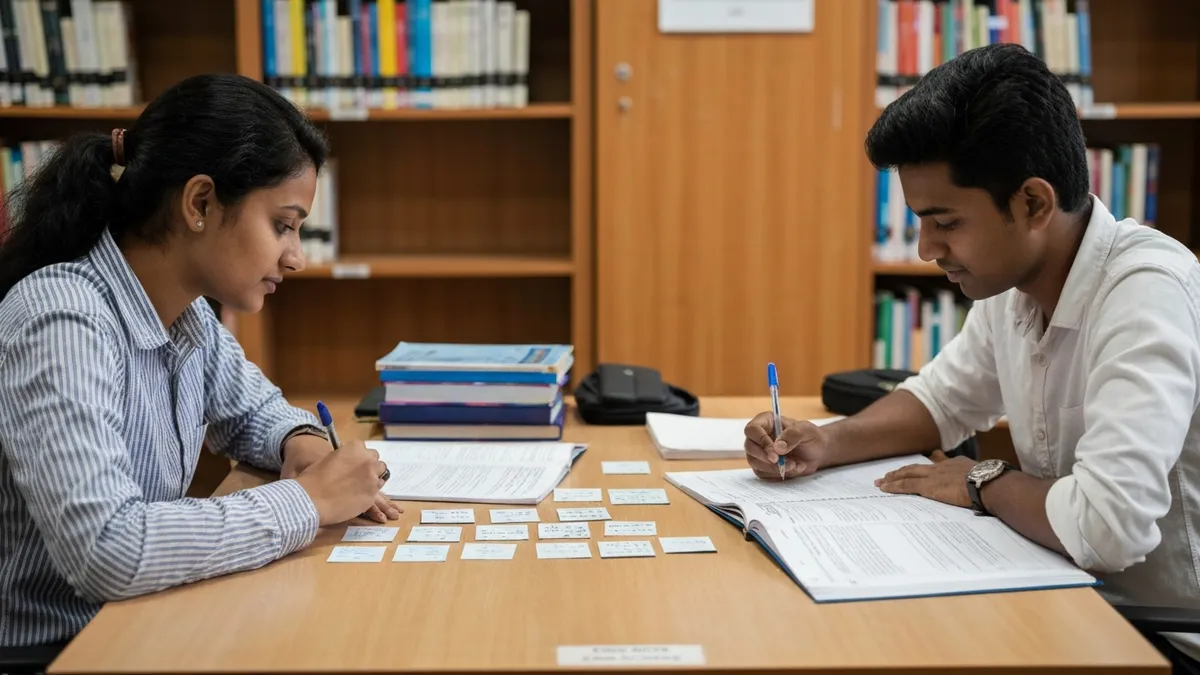
The General Awareness section benefits enormously from a memorization system. Use flashcards — physical index cards or a free app like Anki — to memorize static GK facts: important dates in Indian history, constitutional articles (1, 14, 15, 19, 21, 32, 44, 51A are frequently tested), names of first holders of constitutional offices, national parks and biosphere reserves, major rivers and their tributaries, important industrial and agricultural statistics from the Economic Survey, and recent recipients of Padma awards and sports honors. Review your flashcard deck for 20 minutes every evening to reinforce retention.
On exam day, manage your time at the section level first. If you find Session 1 particularly difficult — say the Numerical section has several unfamiliar question types — do not freeze. Mark those items for review, complete what you can confidently answer, and return to challenging questions with remaining time.
Because both sessions are on the same day, conserving mental energy between sessions matters too. Bring water, a light snack approved by the exam center, and your admit card with a valid photo ID. Arrive 30 minutes early to avoid check-in delays. Staying calm, systematic, and confident through both sessions is as important as the knowledge you have accumulated during preparation.
Sample SSC Practice Questions
Try these questions from our free SSC practice tests. The correct answer and an explanation follow each question.
Which ministry administers the Staff Selection Commission (SSC)?
- A. Ministry of Personnel, Public Grievances and Pensions
- B. Ministry of Home Affairs
- C. Ministry of Education
- D. Ministry of Finance
Answer: A. Ministry of Personnel, Public Grievances and Pensions
SSC functions under the Department of Personnel and Training in the Ministry of Personnel, Public Grievances and Pensions.
The Headquarters of the Staff Selection Commission (SSC) is located in:
- A. Mumbai
- B. Kolkata
- C. Chennai
- D. New Delhi
Answer: D. New Delhi
The Staff Selection Commission (SSC) headquarters is located in New Delhi.
The SSC CGL examination is conducted to recruit candidates for which type of posts?
- A. Group B and Group C posts
- B. Only Group A posts
- C. Only Group D posts
- D. Judicial service posts
Answer: A. Group B and Group C posts
SSC CGL recruits for various Group B and Group C posts across government departments.
The speed of light in a vacuum is approximately:
- A. 3 × 10⁶ m/s
- B. 3 × 10⁸ m/s
- C. 3 × 10¹⁰ m/s
- D. 3 × 10⁴ m/s
Answer: B. 3 × 10⁸ m/s
The speed of light in vacuum is approximately 3 × 10⁸ meters per second (about 300,000 km/s).
SSC Questions and Answers

SSC CGL 2025: Complete Study Guide, Exam Pattern, Eligibility, and Preparation Strategy

SSC CGL Tier 2 2025: Complete Study Guide, Exam Pattern, Applicant Statistics & Preparation Strategy

SSC Exam Date 2025: Complete Schedule, Key Deadlines, and How to Stay Ahead

SSC Government Jobs 2025: Complete Guide to Exams, Eligibility, Salaries, and Career Paths

SSC JE Admit Card 2025: Complete Guide to Download, Dates, and Exam Day Preparation
About the Author

Educational Psychologist & Academic Test Preparation Expert
Columbia University Teachers CollegeDr. Lisa Patel holds a Doctorate in Education from Columbia University Teachers College and has spent 17 years researching standardized test design and academic assessment. She has developed preparation programs for SAT, ACT, GRE, LSAT, UCAT, and numerous professional licensing exams, helping students of all backgrounds achieve their target scores.