
SIFT Test Locations: Complete Guide to Finding Your Testing Site 2026 October
Find SIFT test locations near you in 2026 October. Learn what SIFT means, how to schedule, and what to expect on test day. 🎯
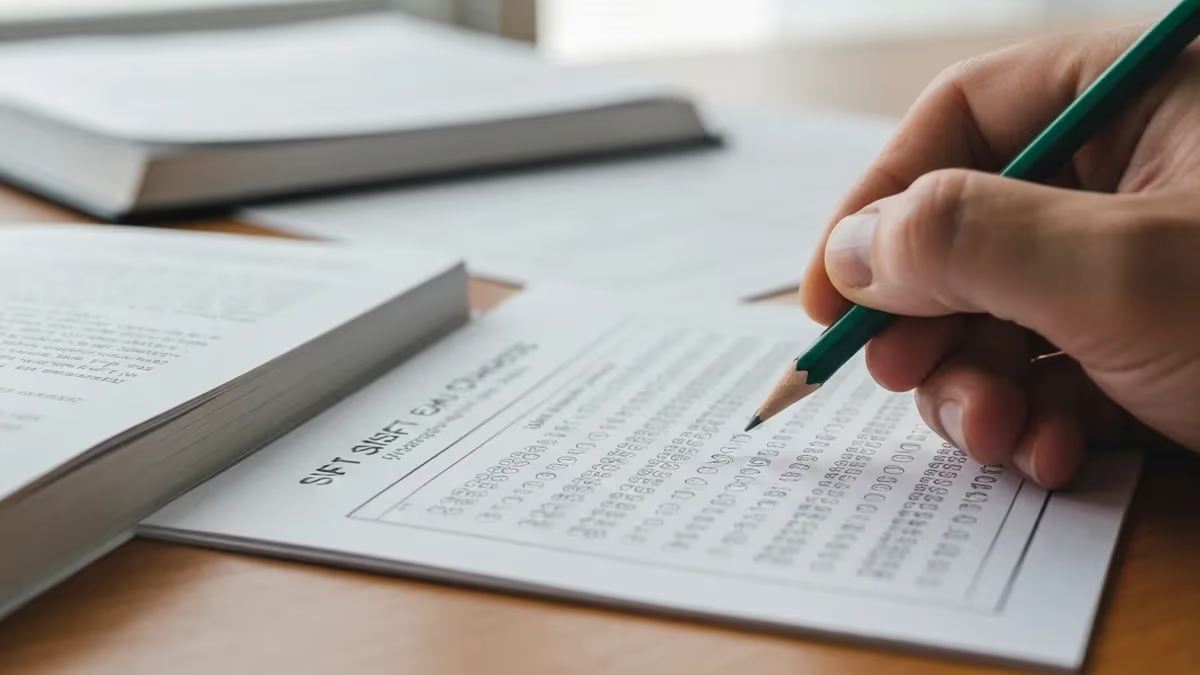
Understanding SIFT test locations is one of the first practical steps every aspiring Army aviator must take after learning the sift meaning and deciding to pursue a career in military aviation. The Selection Instrument for Flight Training — commonly known as the SIFT — is a standardized cognitive assessment administered exclusively through official Military Entrance Processing Stations (MEPS) and select Army installations across the United States. Knowing where to take this exam, how to schedule your appointment, and what to expect on test day can save you weeks of confusion and help you show up fully prepared.
The SIFT exam is not available at civilian testing centers, public libraries, or commercial proctoring services. This is a critical distinction that catches many candidates off guard. Because the test measures aptitude across seven distinct cognitive and knowledge domains — including simple drawings, hidden figures, Army Aviation Information, spatial apperception, reading comprehension, math skills, and mechanical comprehension — it must be administered under strictly controlled military conditions. Only authorized personnel at approved locations can schedule and proctor the exam.
Unlike the ASVAB, which has hundreds of testing sites nationwide and is routinely administered in high schools, the SIFT operates within a much narrower network. Most candidates take the SIFT at a MEPS facility, of which there are approximately 65 locations spread across every U.S. state and several territories. However, candidates already serving on active duty or in the National Guard may also test at designated Army post education centers, depending on their unit's arrangements with a Brigade Aviation Officer.
Scheduling is handled through your recruiting chain of command rather than through a public portal. Officer candidates work with their Warrant Officer recruiter or the S1 section of their unit to submit a testing request. The Army's Aviation Selection Test Battery (ASTB) scheduling system then assigns a date and location. Wait times can range from a few days to several weeks depending on demand at your nearest facility, so initiating the scheduling process early is strongly recommended — especially if you are targeting a specific Officer Candidate School class date.
The physical environment at SIFT testing locations is designed to minimize distraction and ensure test integrity. You will typically sit at an individual computer workstation in a secure room monitored by a trained proctor. The exam itself is entirely computer-based and adaptive in certain sections, meaning the difficulty of questions adjusts based on your performance. You cannot pause the exam mid-section, so arriving rested and mentally prepared is just as important as knowing the testing address.
One of the most common questions candidates ask is whether they can retake the SIFT at a different location if they are unhappy with their score. The answer is yes — you are permitted one retake after a mandatory 180-day waiting period, and you may take the retest at any authorized SIFT location, not necessarily the same one where you took your first attempt. This flexibility is useful for candidates who have relocated or who find a more convenient facility after their initial test.
This guide covers everything you need to know about SIFT test locations: where they are, how to schedule your appointment, what identification and materials to bring, and how to make the most of your testing day. Whether you are a college senior exploring Warrant Officer flight training, an enlisted soldier pursuing an aviation career, or a civilian officer candidate, the location logistics covered here will help you walk into your SIFT fully informed and confident.
SIFT Test Locations by the Numbers
Key Facts at a Glance
| Item | Value | Details |
|---|---|---|
| Retake Wait Period | 180 days | One lifetime retake allowed |
| Minimum Score | 40+ | Minimum competitive SIFT score |
| Scheduling Lead Time | 1-4 weeks | Typical appointment wait at MEPS |
SIFT Exam Format Overview
| Section | Questions | Time | Weight | Notes |
|---|---|---|---|---|
| Simple Drawings | 100 | 2 min | Adaptive | Pattern recognition under strict time pressure |
| Hidden Figures | 50 | 5 min | Adaptive | Spatial reasoning — find shapes within complex images |
| Army Aviation Information | 40 | 30 min | Key section | Fixed-wing and rotary-wing fundamentals |
| Spatial Apperception | 25 | 10 min | Adaptive | Determine aircraft attitude from cockpit view |
| Reading Comprehension | 20 | 30 min | Adaptive | CATB-format passages and inference questions |
| Math Skills Test | 40 | 40 min | Adaptive | Algebra, geometry, word problems |
| Mechanical Comprehension | 40 | 15 min | Adaptive | Gears, pulleys, levers, fluid dynamics |
| Total | ~175 items | ~2.5 hours | 100% |
SIFT test locations fall into two primary categories: Military Entrance Processing Stations (MEPS) and Army installation testing centers. For most civilian candidates and prior-service applicants who are not currently assigned to an active-duty unit, MEPS is the default and most accessible option. The network of 65-plus MEPS facilities covers every major metropolitan region in the United States, from large urban centers like Los Angeles, Chicago, and Atlanta to smaller cities serving rural populations. A comprehensive list of MEPS locations is maintained by the U.S. Military Entrance Processing Command (USMEPCOM) and is available through your recruiter.
Army installation testing centers are the second category of authorized SIFT sites, and they are primarily available to active-duty soldiers, National Guard members, and Army Reserve soldiers pursuing Warrant Officer flight training through their units. Installations like Fort Rucker (now Fort Novosel) in Alabama — the heart of Army aviation training — have their own dedicated testing infrastructure. Other major posts including Fort Bragg, Fort Campbell, Fort Hood, and Fort Wainwright in Alaska also have education centers equipped to administer the SIFT under certain scheduling arrangements coordinated through Aviation Brigade personnel.
For candidates considering where to take the exam, proximity is the obvious first factor, but it should not be the only one. Scheduling availability matters enormously: a MEPS facility 90 miles away with an appointment slot next week may be preferable to one 20 miles away with a six-week backlog. Your recruiter or S1 section can query availability across multiple sites and help you identify the fastest path to a test date. Don't hesitate to ask about options beyond your immediate area, especially if your class date timeline is tight.
It is worth noting that the term sift heads sometimes appears in online forums as slang for candidates who are deeply focused on SIFT preparation — a reflection of how seriously competitive applicants treat this exam. That level of seriousness is warranted. Aviation slots are limited, and recruiters at MEPS locations often see candidates who underestimated the logistics and showed up underprepared or without correct documentation. Taking time to research your specific testing location — including parking, check-in procedures, and ID requirements — removes unnecessary stress from test day.
International and overseas candidates face additional complexity. U.S. Army Recruiting Command does not maintain SIFT testing infrastructure outside the continental United States in most cases, though exceptions exist for candidates at certain overseas Army installations. Candidates currently stationed in Germany, South Korea, Japan, or other overseas theaters should contact their unit S1 well in advance to confirm whether local testing is feasible or whether they need to schedule around a stateside trip.
Some candidates ask whether Joint Service locations — such as naval bases or Air Force installations — can administer the SIFT. The answer is generally no. While those facilities may house MEPS detachments in some cases, the SIFT is Army-specific software administered only by personnel trained and credentialed by the Army's Human Resources Command aviation selection programs. A shared base with Army tenant units may be an exception, but this must be confirmed on a case-by-case basis through official Army channels.
The physical setup you can expect at most SIFT test locations is standardized to ensure fairness. You will sit at a desktop computer in a proctored room, typically alongside other candidates taking various military entrance assessments. The room is quiet, and personal items such as phones, watches, and notes are prohibited. Water and approved snacks may be allowed in a waiting area but not at the testing workstation. Knowing this in advance allows you to dress comfortably, eat a solid meal beforehand, and arrive mentally ready to perform.
How to Schedule Your SIFT Appointment
Civilian candidates — including college students, recent graduates, and civilians with no prior military service — must go through an Army Warrant Officer recruiter to schedule a SIFT appointment. Your recruiter submits a testing request to the nearest MEPS facility on your behalf, and you will receive confirmation of your date, time, and location via official correspondence. Recruiters can also request specific MEPS locations if distance or availability is a factor.
Once scheduled, you will receive a MEPS appointment letter that you must bring on test day along with two valid forms of government-issued photo identification. The most common accepted IDs are a valid state driver's license and a Social Security card or U.S. passport. Arrive at the MEPS facility at least 30 minutes before your scheduled test time, as check-in procedures — including ID verification and security screening — can take 15 to 20 minutes before you reach the testing room.

MEPS vs. Army Installation Testing: Pros and Cons
- +MEPS locations exist in every U.S. state, making them broadly accessible for civilian and prior-service candidates
- +MEPS facilities are experienced with high-volume testing and typically have well-maintained computer workstations
- +Scheduling through a MEPS is straightforward via your recruiter with a standardized appointment process
- +MEPS facilities often allow candidates to combine their SIFT with physical examination appointments to reduce travel days
- +MEPS proctor staff are familiar with SIFT-specific check-in requirements and can answer logistical questions
- +Results are transmitted electronically through official Army systems immediately upon completion, reducing delays in your packet submission
- −MEPS facilities are not always close to rural candidates and may require significant travel or overnight stays
- −MEPS scheduling can back up during peak recruiting periods, creating wait times of four to six weeks or longer
- −MEPS environments are often shared with ASVAB testers and medical processing candidates, which can feel hectic
- −Army installation testing centers are unavailable to civilian candidates without specific unit sponsorship
- −Limited testing windows (usually weekday mornings only) make scheduling difficult for working candidates
- −Retake scheduling at a different MEPS location requires additional coordination and may not always be granted quickly
SIFT Test Day Checklist
- ✓Bring two valid government-issued photo IDs, including your state driver's license or U.S. passport
- ✓Carry your official MEPS appointment confirmation letter or unit scheduling authorization document
- ✓Arrive at least 30 minutes before your scheduled test time to complete check-in and security screening
- ✓Eat a nutritious meal beforehand — testing sessions can last up to three hours without breaks
- ✓Dress in comfortable, layered clothing since testing room temperatures vary by facility
- ✓Leave all electronic devices, including smartphones, smartwatches, and earbuds, in your vehicle or a designated locker
- ✓Do not bring scratch paper, calculators, or study notes — none are permitted at the testing workstation
- ✓Get at least seven to eight hours of sleep the night before to optimize cognitive performance
- ✓Review your testing location address, parking instructions, and building entry procedures the day before
- ✓Confirm with your recruiter or S1 that your testing slot is confirmed and has not been rescheduled within 48 hours of your appointment
Your Score Is Permanent After Two Attempts
The Army allows only two lifetime SIFT attempts. Your best score is reported, but the second attempt is your final opportunity — there are no exceptions or waivers for additional retakes. This makes thorough preparation before your first attempt essential. Treat your first test as if it is your only shot, and use the 180-day waiting window before a retake to deeply address every weak subtest area.
Effective preparation for the SIFT begins long before you step foot in a testing location. The seven subtests span a wide range of cognitive domains, and no single study approach covers all of them equally. Successful candidates typically spend eight to twelve weeks in structured preparation, dedicating focused time to each subtest while also working on the overlapping skills — particularly spatial reasoning and mathematical problem-solving — that influence performance across multiple sections of the exam.
The Army Aviation Information subtest is the one area where content knowledge matters more than raw aptitude. Unlike the adaptive subtests that measure underlying cognitive ability, the Aviation Information section tests specific knowledge of how helicopters and fixed-wing aircraft fly, including topics like rotor systems, aerodynamics, weather patterns, instrument flight rules, and emergency procedures. Candidates without a background in aviation will need to deliberately study this material. Study resources include the FAA Helicopter Flying Handbook, the FAA Pilot's Handbook of Aeronautical Knowledge, and dedicated SIFT prep materials that summarize key aviation concepts in test-relevant terms.
Math preparation should focus on Algebra I and II, basic geometry, and word problems involving rates, ratios, and proportions. The SIFT math subtest is adaptive, meaning candidates who answer correctly will face progressively harder questions.
This is actually an advantage for well-prepared candidates — a strong performance in the early portion of the section signals high ability to the scoring algorithm and can significantly boost your overall composite score. Using timed practice sets is essential because the pace of the real exam is demanding and test-takers who are slow at arithmetic can run out of time even on questions they know how to solve.
Mechanical comprehension is another area that rewards dedicated study. If you have a background in engineering, construction, or hands-on mechanical work, you may already have an intuitive sense of how gears, levers, and pulleys behave. If not, working through illustrated practice problems — the kind that show gear trains and ask you to determine rotation direction and speed ratios — is the most effective approach. The SIFT mechanical comprehension section is not as time-pressured as the Simple Drawings subtest, but it rewards candidates who can visualize physical relationships quickly and accurately.
Spatial reasoning is tested directly in both the Hidden Figures and Spatial Apperception subtests, and indirectly in the Simple Drawings section. For Hidden Figures, the key skill is the ability to mentally isolate a target shape from a visually complex background — a skill that improves significantly with practice but is hard to develop through reading alone.
Dedicated spatial reasoning apps and puzzle books can accelerate improvement here. The Spatial Apperception subtest asks you to determine an aircraft's attitude — its pitch, roll, and heading — from a cockpit perspective view. This is an unusual skill for most people, but it becomes much more intuitive after working through dozens of practice images.
Reading comprehension is often the subtest that candidates spend the least time preparing for, and for many test-takers with strong language backgrounds, that is appropriate. However, the SIFT reading comprehension section uses a format similar to other military aptitude tests — short passages followed by inference and main idea questions — and candidates who are not strong readers in English should invest time here. The key preparation strategy is to practice reading dense, technical material and then summarizing its main argument in one or two sentences, which mirrors exactly what the test requires.
One of the most valuable things you can do in the weeks before your SIFT is take sift bakery-style practice runs — full-length timed simulations that approximate the real testing conditions. Sitting through a two-and-a-half-hour practice session reveals how your concentration holds up over time, which sections drain your mental energy the most, and whether your pacing strategy needs adjustment. Candidates who have done this report feeling significantly more composed on test day, because the experience is no longer entirely unfamiliar when they sit down at the actual testing workstation.
The Army grants candidates exactly one retake of the SIFT, and the mandatory waiting period between attempts is 180 days — approximately six months. There are no waivers, no exceptions, and no appeals process for additional attempts. If you score below your target on your second try, your aviation candidacy may be effectively closed until waivers are considered, and waivers for SIFT scores are rarely approved. Treat every preparation week before your first test as irreplaceable time.
Understanding SIFT retake rules and the score reporting process is essential for any candidate who does not achieve their target score on the first attempt. As noted, you are allowed exactly one lifetime retake, and you must wait a minimum of 180 days from the date of your first test before scheduling the second. During this waiting period, the Army strongly recommends that candidates work with a structured study plan to address identified weaknesses rather than simply waiting for the calendar to turn.
Your SIFT score is reported as a single composite number on a scale from 20 to 80, with 50 representing average performance. The minimum qualifying score is 40, but competitive aviation programs — particularly those for Warrant Officer candidates competing for limited slots — typically seek scores of 50 or higher. Some of the most competitive selection boards favor candidates with scores above 60. It is important to understand that the composite score blends performance across all seven subtests and that exceptional performance in some areas can partially offset weaker performance in others, though not without limit.
Score results are transmitted electronically through official Army Human Resources Command channels immediately upon test completion. You will not receive a paper score report at the testing center — your recruiter or S1 officer will access your score through official systems within one to three business days. In some cases, particularly at MEPS, the proctor can confirm whether you passed the minimum qualifying threshold before you leave the building, but the full composite score documentation comes through official channels.
Candidates who wish to check on their score status should contact their recruiter rather than attempting to access Army personnel systems directly. Civilian candidates do not have independent access to Army HR systems, and improper inquiries can create administrative confusion in your file. Your recruiter is your authorized point of contact for all score-related communication and will forward the official documentation needed for your Officer Selection File or Warrant Officer application packet.
The sift mystic aspects of score calculation — the adaptive algorithms, the exact weighting of each subtest — are not publicly disclosed by the Army, which is intentional. The Army wants candidates to prepare broadly across all domains rather than gaming the scoring formula. What is publicly known is that the composite score is norm-referenced, meaning your score reflects your performance relative to the historical population of SIFT test-takers, not an absolute standard. This means the scoring scale is periodically recalibrated as the test population changes.
After your score is confirmed and documented, it becomes a permanent part of your military personnel file. If you take a retake and score higher, the higher score is the one forwarded to selection boards, but both scores technically remain on record. Some selection boards may note that a candidate took two attempts, so your cover letter or interview may address this if asked. The best candidates — regardless of whether they needed one or two attempts — approach the question honestly and focus on what steps they took to improve.
Score validity does not expire in the traditional sense, but candidacy timelines are governed by age restrictions and commissioning windows that effectively create an expiration date for most candidates. Warrant Officer flight training candidates must complete Initial Entry Rotary Wing (IERW) training before their 33rd birthday (with some waivers possible to 35), meaning a strong SIFT score from your mid-20s remains valid for your candidacy as long as you meet age requirements at the time of flight school entry. Confirm your specific timeline with your recruiter to ensure your score remains actionable within your aviation career window.
In the final weeks before your SIFT, your preparation strategy should shift from broad learning to targeted refinement. If you have been working through study materials for several weeks, you should have a clear sense by now of which subtests feel strong and which remain challenging. Use this self-knowledge to allocate your remaining study time strategically rather than spending equal time on every section.
A candidate who already scores well on math and reading comprehension should invest the final two weeks heavily in spatial reasoning and aviation information, since those are the areas most likely to determine whether the composite score lands in the competitive range.
Sleep and cognitive performance are directly linked in ways that matter enormously for timed, adaptive tests like the SIFT. Research on high-stakes testing consistently shows that candidates who prioritize sleep in the final week of preparation outperform those who cram late into the night. The SIFT's adaptive sections in particular — where early correct answers unlock harder, higher-value questions — reward the kind of sharp, fast processing that only comes from a well-rested brain. Build your schedule so that the three nights before your test involve full, uninterrupted sleep rather than late-night review sessions.
Logistics management on test day should not be an afterthought. If your MEPS facility is more than an hour away, consider booking a hotel nearby the night before to eliminate commute stress on the morning of the exam.
Look up parking options in advance — some MEPS facilities are in downtown urban areas where parking can be limited or expensive, and arriving late due to parking difficulties is a completely avoidable performance disadvantage. Confirm the building address (not just the city name) because some MEPS facilities share a building with other federal agencies and signage at the entrance can be confusing.
During the test itself, pacing discipline is one of the most underrated success factors. For timed sections like Simple Drawings, where you have just two minutes for 100 items, the goal is not to achieve perfection — it is to maintain a fast, consistent rhythm.
Spending ten seconds on a single ambiguous drawing will cost you five other answers at the end of the section. For longer sections like Army Aviation Information and Math, use any remaining time at the end of the section to review flagged questions, but do not second-guess answers you felt confident about on the first pass.
Mental composure matters throughout the exam. If a question seems genuinely unfamiliar or harder than expected, that is not necessarily a bad sign — in adaptive sections, encountering harder questions means you are performing well and the algorithm is testing your ceiling. Stay calm, apply your best reasoning, and move forward. Anxiety about a single difficult question is far more damaging to your overall score than the question itself, because anxiety impairs the processing speed and working memory that the subsequent questions require.
After the exam, regardless of how you feel about your performance, take time to write down every topic area that felt difficult or unfamiliar while the experience is fresh. If you end up needing a retake, this post-exam debrief document will be the most useful preparation resource you have. Many candidates who ultimately achieve strong scores on their second attempt credit this kind of reflective documentation as the turning point in their preparation — it removes the guesswork from identifying where to focus and allows the 180-day waiting period to be used with genuine precision and purpose.
The SIFT is a demanding assessment, but it is also a learnable one. Thousands of soldiers and officer candidates every year walk into their MEPS or installation testing center with months of serious preparation behind them and walk out with scores that open the door to Army aviation careers. The combination of knowing your testing location logistics, scheduling your appointment early, and investing in systematic content preparation gives you the strongest possible foundation for that outcome. Start the process now — the earlier you begin, the more options you will have when it matters most.
Sample SIFT Exam Practice Questions
Try these questions from our free SIFT Exam practice tests. The correct answer and an explanation follow each question.
The SIFT Hidden Figures test is most closely related to which standardized psychological instrument?
- A. Minnesota Multiphasic Personality Inventory (MMPI)
- B. Witkin's Embedded Figures Test (EFT)
- C. Raven's Progressive Matrices
- D. Wechsler Adult Intelligence Scale (WAIS)
Answer: B. Witkin's Embedded Figures Test (EFT)
Witkin's Embedded Figures Test is the classic measure of field independence, and the SIFT Hidden Figures subtest draws directly from that paradigm.
Passage: 'The SIFT test measures aptitude for flight training, not current flying ability. Candidates with no prior flight experience can excel on the SIFT if they demonstrate strong spatial reasoning, mechanical comprehension, and learning capacity.' What does the passage indicate about prior flight experience?
- A. It is required to pass the SIFT test
- B. It guarantees a high score on spatial reasoning sections
- C. It is not necessary to excel on the SIFT
- D. It replaces the need for mechanical comprehension skills
Answer: C. It is not necessary to excel on the SIFT
The passage states that candidates with no prior flight experience can excel on the SIFT, indicating prior experience is not necessary.
On the SIFT Simple Drawings subtest, you must choose the answer figure that matches the target. What is the primary skill being tested?
- A. Mathematical calculation
- B. Spatial visualization and mental rotation
- C. Verbal reasoning
- D. Memory recall
Answer: B. Spatial visualization and mental rotation
The subtest measures spatial visualization—the ability to mentally rotate or manipulate figures to identify matches.
A crane lifts a 500-pound engine 8 feet into the air. If the lift takes 4 seconds to complete, what is the power expended by the crane, ignoring friction?
- A. 1000 ft-lbs/sec
- B. 4000 ft-lbs/sec
- C. 125 ft-lbs/sec
- D. 16,000 ft-lbs/sec
Answer: A. 1000 ft-lbs/sec
First, calculate the work done: Work = Force × Distance = 500 lbs × 8 ft = 4000 ft-lbs. Next, calculate the power, which is the rate at which work is done: Power = Work / Time = 4000 ft-lbs / 4 seconds = 1000 ft-lbs/sec.
SIFT Questions and Answers


About the Author

Educational Psychologist & Academic Test Preparation Expert
Columbia University Teachers CollegeDr. Lisa Patel holds a Doctorate in Education from Columbia University Teachers College and has spent 17 years researching standardized test design and academic assessment. She has developed preparation programs for SAT, ACT, GRE, LSAT, UCAT, and numerous professional licensing exams, helping students of all backgrounds achieve their target scores.
Join the Discussion
Connect with other students preparing for this exam. Share tips, ask questions, and get advice from people who have been there.
View discussion (9 replies)