
Who Is the Travis County Sheriff? Deputy Sheriff Roles, Salary & Career Guide
Who is the Travis County Sheriff? Learn about deputy sheriff roles, salary, hiring requirements, and how to pass the exam. 🏆 Full career guide inside.

If you have ever asked who is the Travis County Sheriff, you are not alone. Travis County, home to Austin, Texas, is one of the fastest-growing counties in the United States, and its Sheriff's Office plays a critical role in keeping millions of residents safe. The elected Travis County Sheriff oversees the county jail, unincorporated patrol zones, civil process service, and court security — responsibilities carried out daily by hundreds of dedicated deputy sheriffs working across multiple divisions.
A deputy sheriff is a sworn law enforcement officer appointed by an elected or appointed county sheriff to carry out the full range of law enforcement duties within a county's jurisdiction. Unlike municipal police officers, whose authority stops at city limits, deputy sheriffs typically have countywide — and in many states, statewide — jurisdiction. This distinction matters enormously for residents of large counties like Travis, where large swaths of unincorporated land fall outside any city's police reach.
The role of a sheriff's deputy is far more varied than most civilians realize. In a single week, a Travis County deputy might serve civil papers on a reluctant respondent, transport a high-risk inmate between facilities, respond to a burglary call in a rural neighborhood, and testify in court about an arrest made months earlier. This diversity of duties is part of what attracts career-minded individuals to the position — and part of what makes preparation for the hiring exam so important.
Understanding the structure of the Travis County Sheriff's Office also means understanding the relationship between the sheriff and deputy hierarchy. The Sheriff is an elected official who sets policy, manages budgets, and represents the office publicly. Directly below the Sheriff are chief deputies and majors, followed by captains and lieutenants who command specific bureaus. Front-line deputies — often called patrol deputies or simply deputy sheriffs — form the backbone of daily operations and are the officers most residents will ever interact with.
Compensation is a topic every prospective applicant wants to understand. Deputy sheriff salary levels in Travis County reflect the competitive Texas law enforcement market. Starting pay for a Travis County Sheriff's Office deputy typically ranges from the mid-$50,000s to the low $60,000s annually, with experienced deputies earning north of $75,000 after several years of service. The agency also offers strong benefits including health insurance, retirement through the Texas County and District Retirement System, and paid leave.
For anyone serious about joining Travis County law enforcement, the first concrete step is understanding the hiring exam. The deputy sheriff exam tests reading comprehension, writing ability, situational judgment, and basic mathematics — skills that translate directly into on-the-job performance. Learning how to become a sheriff deputy in Travis County means mastering these exam domains well before you ever sit in the testing room.
This article will walk you through the history and structure of the Travis County Sheriff's Office, explain what deputy sheriffs actually do day-to-day, break down salary and benefits, outline the hiring process, and give you actionable advice for acing the deputy sheriff exam. Whether you are a first-time applicant or a lateral transfer from another agency, the information here will help you approach the process with clarity and confidence.
Travis County Sheriff's Office by the Numbers

Travis County Sheriff's Office: Key Divisions & Bureaus
Deputies assigned to patrol respond to calls for service in unincorporated Travis County, conduct traffic enforcement, investigate crimes, and work alongside constables to cover areas outside Austin city limits. Patrol is typically the entry point for new deputies.
The Travis County Correctional Complex houses thousands of pre-trial detainees and sentenced inmates. Corrections deputies manage inmate movement, maintain facility security, conduct searches, and respond to emergencies inside the jail — a demanding specialty requiring specific training.
This division is responsible for serving court-ordered documents including eviction notices, subpoenas, restraining orders, and writs of execution. Civil process work requires strong communication skills and a thorough understanding of Texas civil law and procedure.
Detectives in the Criminal Investigations Division handle serious felony cases — homicide, sexual assault, robbery, and organized crime. Deputies typically need several years of patrol experience before transferring to CID and must complete specialized investigative training.
Deputies assigned to the Travis County Courthouse provide security screening, protect judges and court staff, maintain order in courtrooms, and transport high-risk defendants. This division works closely with district and county court judges on a daily basis.
Understanding what deputy sheriffs actually do on a daily basis is essential for anyone considering this career path. In Travis County, patrol deputies typically work rotating twelve-hour shifts covering the vast unincorporated regions of the county that lie outside Austin's city limits. During a single shift, a patrol deputy might respond to a domestic disturbance call in Pflugerville, investigate a vehicle theft in Manor, conduct a welfare check on an elderly resident in Lago Vista, and write accident reports from a two-car collision on a rural county road.
The diversity of assignments is one of the most compelling aspects of a deputy sheriff career. Unlike officers who work a single specialized unit for years, most deputies rotate through different assignments — patrol, corrections, civil process, and court security — giving them a genuinely broad law enforcement education. This cross-training makes deputies extraordinarily adaptable and builds a skill set that is highly valued in the private security and federal law enforcement sectors as well, should a deputy choose to transition careers later in life.
Civil process service is a particularly important and often overlooked function of the deputy sheriff association of duties. Travis County deputies serve tens of thousands of court documents each year, including evictions, restraining orders, child support enforcement papers, and civil summonses. Just as monongalia county sheriff's deputy lance kuretza demonstrates, serving papers requires careful documentation, legal knowledge, and the interpersonal skill to handle emotionally charged encounters professionally and safely.
Corrections duty is another major component of the Travis County Sheriff's Office mission. The Travis County Correctional Complex is one of the largest jail systems in Texas, and deputies assigned there manage everything from intake booking and classification to managing housing units with hundreds of inmates. Corrections deputies must be trained in use-of-force continuum, crisis intervention, mental health first aid, and suicide prevention — all areas where inadequate preparation can have life-or-death consequences.
Specialized units within the Travis County Sheriff's Office include the SWAT team, the K-9 unit, the Marine Unit (which patrols Lake Travis and other bodies of water), and the School Resource Deputy program. These positions are typically competitive, requiring deputies to apply internally after completing a probationary period and demonstrating strong performance on patrol. They also often require additional specialized training and certifications beyond the basic peace officer license.
Community engagement is increasingly central to the Travis County Sheriff's mission. Deputies participate in neighborhood watch programs, attend community association meetings, visit schools, and coordinate with social service agencies to connect residents with mental health and substance abuse resources. This community-policing philosophy reflects a national shift toward building trust between law enforcement agencies and the communities they serve, particularly in diverse urban-rural counties like Travis.
The role of technology in modern deputy sheriff work cannot be overstated. Travis County deputies use body-worn cameras, in-car digital video systems, computer-aided dispatch software, electronic citation systems, and advanced forensic tools. Understanding how to operate this technology accurately and ethically is now considered a core competency for all new deputies — and technology-related topics are increasingly appearing on deputy sheriff hiring exams across Texas and the nation.
Deputy Sheriff Salary: What You Can Earn in Travis County and Beyond
New deputies hired by the Travis County Sheriff's Office typically start between $55,000 and $62,000 per year, depending on their level of experience, education, and any prior law enforcement service. Deputies with a college degree or prior military service may qualify for accelerated starting pay. After completing the probationary period — typically twelve months — deputies become eligible for their first merit raise and can begin applying for specialty assignments.
In addition to base salary, Travis County deputies earn shift differentials for evening and overnight assignments, holiday pay, overtime compensation at time-and-a-half, and educational incentive pay for associates, bachelor's, or advanced degrees. When these supplemental earnings are included, total first-year compensation for many deputies exceeds $65,000 — making the Travis County Sheriff's Office one of the more competitive employers in Central Texas law enforcement.

Pros and Cons of Becoming a Travis County Deputy Sheriff
- +Countywide jurisdiction gives deputies broader law enforcement authority than most municipal officers
- +Diverse assignments across patrol, corrections, civil process, and investigations build a comprehensive skill set
- +Strong pension through TCDRS with potential retirement in your 40s or early 50s
- +Competitive salary with shift differentials, overtime, and educational incentive pay
- +Opportunities to advance into SWAT, K-9, CID, Marine Unit, and other specialty assignments
- +Meaningful community impact serving both urban and rural Travis County residents
- −Rotating shift work, including nights, weekends, and holidays, can strain family life
- −Corrections assignments can be psychologically demanding due to inmate management challenges
- −High-pressure situations and exposure to trauma increase risk of PTSD and burnout
- −The hiring process is lengthy — typically six to nine months from application to academy
- −Physical fitness standards are rigorous and must be maintained throughout an entire career
- −Political dynamics of working under an elected sheriff can create uncertainty during election years
Pros and Cons at a Glance
| Pros | Cons |
|---|---|
| Countywide jurisdiction gives deputies broader law enforcement authority than most municipal officers | Rotating shift work, including nights, weekends, and holidays, can strain family life |
| Diverse assignments across patrol, corrections, civil process, and investigations build a comprehensive skill set | Corrections assignments can be psychologically demanding due to inmate management challenges |
| Competitive salary with shift differentials, overtime, and educational incentive pay | High-pressure situations and exposure to trauma increase risk of PTSD and burnout |
| Meaningful community impact serving both urban and rural Travis County residents | The hiring process is lengthy — typically six to nine months from application to academy |
Travis County Deputy Sheriff Application Requirements Checklist
- ✓Be at least 18 years of age at the time of hire (21 for some assignments)
- ✓Hold a high school diploma or GED — a college degree earns additional hiring points
- ✓Possess a valid Texas driver's license with an acceptable driving record
- ✓Pass a comprehensive written entrance exam covering reading, writing, math, and judgment
- ✓Complete a physical fitness test including a timed 1.5-mile run, push-ups, and sit-ups
- ✓Successfully complete a thorough background investigation covering criminal, credit, and employment history
- ✓Pass a polygraph examination administered by the TCSO Background Investigations Unit
- ✓Receive medical and psychological clearance from licensed physicians designated by the agency
- ✓Complete a structured oral board interview panel with command staff evaluators
- ✓Hold or be eligible to obtain a Texas Commission on Law Enforcement (TCOLE) peace officer license
- ✓Demonstrate proficiency in English; bilingual Spanish speakers receive preference consideration
- ✓Commit to completing the TCSO basic peace officer academy if not already TCOLE certified
Bilingual Deputies Are in High Demand
Travis County has a significant Spanish-speaking population, and the Sheriff's Office actively seeks bilingual deputies. Applicants who are fluent in Spanish may receive preference during the hiring process and often qualify for language pay supplements once hired — an additional financial benefit on top of base deputy sheriff salary.
The question of deputy vs sheriff comes up constantly among people who are new to law enforcement career research, and it is worth addressing thoroughly. The Sheriff is an elected constitutional officer — in Texas, sheriffs are elected by county voters to four-year terms and serve as the chief law enforcement officer of their county. The Sheriff sets department policy, oversees budgets, manages personnel, and is accountable directly to voters rather than to any city council or county commission for most operational decisions. This elected status gives the Sheriff significant independence but also significant political exposure.
A deputy sheriff, by contrast, is an appointed employee of the Sheriff's Office. Deputies are hired through a competitive process, earn civil service protections in many jurisdictions, and serve at the pleasure of the elected Sheriff — though procedural due process protections typically make dismissal a formal process. The relationship between sheriff and deputy is fundamentally one of principal and agent: the Sheriff sets mission and standards, and deputies execute that mission on the ground every single day.
The distinction between a sheriff's deputy and a police officer is often misunderstood by the public but matters enormously in practice. A city police officer derives authority from their municipal employer and, in most states, has jurisdiction only within that city's boundaries. A deputy sheriff derives authority from the county and the state constitution, giving deputies jurisdiction throughout the entire county — including inside incorporated cities, though deputies typically defer to city police on calls within city limits as a matter of interagency protocol.
In Travis County specifically, the geographic division of labor means that Austin Police Department handles calls within Austin city limits, while Travis County Sheriff's deputies cover the unincorporated county areas. However, there are many situations where this boundary blurs — pursuits that cross jurisdictional lines, mutual aid agreements that bring deputies into city limits during major events or emergencies, and civil process service that can be executed anywhere in the county regardless of municipality.
Deputy sheriffs also have authority over the county jail that most municipal police departments do not. In Texas, county jails are statutorily the responsibility of the county sheriff, meaning that Travis County Sheriff's deputies run every aspect of the Travis County Correctional Complex — booking, classification, housing, medical care coordination, release, and transport. This correctional authority is a defining characteristic of the sheriff's office model and a significant responsibility that sets the role apart from city policing.
For readers who have seen news reports about incidents involving deputies in other jurisdictions — such as reports noting that pierce county sheriff's deputies are searching for two shooting suspects — it is worth noting that the investigative and patrol powers described in those reports are functionally identical to what Travis County deputies exercise. All sworn deputy sheriffs across the United States share the same basic constitutional framework of authority, even if specific state laws and local policies create operational differences from county to county.
The concept of a deputy sheriff association is also worth understanding. Most sheriff's offices across the country have a deputies' association or union that negotiates collective bargaining agreements covering wages, benefits, discipline procedures, and working conditions. These associations play an important role in shaping the day-to-day employment experience of deputies and are often involved in public advocacy on law enforcement policy issues at the county and state level.

The Travis County Sheriff's Office background investigation is one of the most comprehensive in Texas. Investigators review your criminal history, driving record, credit history, employment record, social media presence, and personal associations going back ten years or more. Any attempt to conceal or misrepresent information is grounds for immediate disqualification — and that disqualification is typically permanent. Pull your own background reports, correct any errors with credit bureaus, and be prepared to explain any negative items fully and honestly before your background interview.
Preparing for the Travis County Deputy Sheriff hiring exam requires a structured, disciplined approach that mirrors the kind of preparation top-performing candidates bring to any high-stakes professional credentialing process. The exam itself typically covers four core domains: reading comprehension, written communication, situational judgment, and basic mathematics. Each domain is weighted and scored, and your combined score determines whether you advance to the next stage of the hiring process — or are placed on a waiting list for a future cycle.
Reading comprehension on the deputy sheriff exam is not simply about understanding words on a page. Questions are designed to test your ability to extract specific information from policy documents, incident reports, legal statutes, and procedural manuals — exactly the type of documents you will work with daily as a deputy. Practice reading dense, technical text and answering specific factual questions about it under timed conditions. Speed and accuracy both matter, so practice pacing yourself to complete all questions within the allotted time.
Written communication questions assess your ability to write clearly, accurately, and professionally. Many exam formats include a scenario — you are given a brief description of an incident and asked to write a report summarizing what happened in proper sequential order. Graders evaluate grammar, punctuation, sentence structure, logical organization, and factual accuracy. Strong report-writing skills are not optional for deputies — every arrest, use of force, and civil service is documented in writing that may eventually appear in court.
Situational judgment questions are perhaps the most important section of the exam for predicting real-world performance. These questions present workplace scenarios involving ethical dilemmas, interpersonal conflicts, use-of-force decisions, and emergency response choices — then ask you to identify the best course of action from several plausible options. There are no trick questions, but the best answer is almost always the one that reflects calm, lawful, ethical, and policy-compliant behavior rather than the most aggressive or confrontational option.
Mathematics on the deputy sheriff exam covers the practical arithmetic deputies use on the job: calculating distances and time, computing percentages for report statistics, converting measurements, and solving basic algebra problems that might appear in evidence calculations or resource allocation scenarios. The math tested is generally at a high school level, but speed matters — allocating too much time to difficult math problems can cost you points on sections you would otherwise complete easily.
Physical fitness preparation should begin months before your application date. The Travis County Sheriff's Office physical fitness test is modeled on the Cooper Institute standards used throughout Texas law enforcement. You will need to complete a 1.5-mile timed run (typically under 16–17 minutes for most age groups), a minimum number of push-ups in one minute, a minimum number of sit-ups in one minute, and possibly additional exercises depending on the current testing protocol. Candidates who fail the fitness test are typically disqualified from the current cycle and must wait to reapply.
Oral board interviews are the final major hurdle before a conditional offer of employment. You will sit before a panel of three to five senior Travis County Sheriff's Office personnel who will ask structured behavioral interview questions following the STAR format (Situation, Task, Action, Result). Prepare specific examples from your work history, volunteer experience, military service, or academic career that demonstrate integrity, sound judgment, teamwork, leadership, and the ability to perform under pressure. Generic answers that lack specifics rarely impress experienced law enforcement evaluators.
Once you receive a conditional offer of employment from the Travis County Sheriff's Office, you enter the final phase of the hiring process — completing the peace officer academy (if you are not already TCOLE certified) and the agency's field training program. The TCSO basic peace officer academy runs approximately eighteen weeks and covers Texas criminal law, constitutional law, patrol procedures, defensive tactics, firearms proficiency, emergency vehicle operation, first aid, and report writing. The curriculum is demanding, and failure to maintain minimum academic and performance standards can result in termination.
Field training follows the academy and typically lasts an additional twelve to sixteen weeks. During this period, new deputies are assigned to experienced Field Training Officers (FTOs) who evaluate their performance on actual calls for service. FTOs assess everything from officer safety and radio communication to report quality and public interaction skills. The field training phase is where classroom knowledge is tested against real-world complexity — and it is the point where many candidates discover the gap between what they thought the job would be and what it actually demands.
Professional development does not stop after field training. Travis County deputies are expected to complete a minimum number of continuing education hours annually to maintain their TCOLE peace officer license, and the Sheriff's Office provides access to specialized training in areas like crisis intervention, de-escalation, trauma-informed policing, and advanced investigative techniques. Deputies who take advantage of these opportunities typically advance more quickly through the ranks and are more competitive for specialty assignments.
For candidates who want to maximize their competitiveness, pursuing an associate's or bachelor's degree in criminal justice, public administration, or a related field before applying is a concrete advantage. Many Texas sheriff's offices — including Travis County — offer education incentive pay that can add several thousand dollars annually to a deputy's salary. More importantly, college coursework in constitutional law, psychology, sociology, and communication directly improves performance on the hiring exam and in the field.
Networking with current Travis County Sheriff's Office deputies is another underutilized preparation strategy. Many departments offer ride-along programs that let civilians observe patrol deputies during actual shifts. A ride-along gives you an unfiltered view of the job's realities, helps you craft more authentic oral board answers, and can provide introductions to deputies who may later serve as references or informal mentors during your hiring process. Contact the TCSO Public Information Office to inquire about scheduling a ride-along.
Staying informed about Travis County government, local crime trends, and the Sheriff's Office's stated priorities is also valuable exam and interview preparation. Interviewers frequently ask candidates why they want to work specifically for the Travis County Sheriff's Office rather than another agency — and candidates who can speak knowledgeably about the department's community policing initiatives, recent policy changes, or the Sheriff's stated goals make a significantly stronger impression than those who give generic answers about wanting to help people.
Finally, approach the entire hiring process with patience and persistence. A six-to-nine month timeline is common, and it is not unusual for motivated, qualified candidates to be rejected in one hiring cycle and succeed in the next after addressing weaknesses identified during the process. The Travis County Sheriff's Office is a highly competitive employer — but for candidates who prepare thoroughly, maintain their integrity throughout the background process, and demonstrate genuine commitment to public service, a career as a Travis County deputy sheriff is an attainable and deeply rewarding goal.
Sample Sheriff - Deputy Sheriff Exam Practice Questions
Try these questions from our free Sheriff - Deputy Sheriff Exam practice tests. The correct answer and an explanation follow each question.
What is the primary responsibility of a Deputy Sheriff Correctional Officer?
- A. Conducting criminal investigations
- B. Enforcing traffic laws
- C. Maintaining the safety and security of the correctional facility
- D. Serving civil process papers
Answer: C. Maintaining the safety and security of the correctional facility
The primary responsibility of a Deputy Sheriff Correctional Officer is to maintain the safety and security of the correctional facility. This includes supervising inmates, preventing escapes, responding to emergencies, and ensuring a secure environment for both inmates and staff. Their role is critical for the orderly operation of the detention center.
Under which legal doctrine can a Deputy Sheriff be held liable for violating an individual's constitutional rights?
- A. Sovereign immunity
- B. Qualified immunity
- C. Absolute immunity
- D. Diplomatic immunity
Answer: B. Qualified immunity
Under the legal doctrine of qualified immunity, a Deputy Sheriff can be held liable for violating an individual's constitutional rights if their conduct violates clearly established statutory or constitutional rights, and a reasonable officer would have known about that right. This doctrine protects government officials from liability in civil lawsuits unless their conduct was objectively unreasonable in light of clearly established law.
During a lawful custodial arrest, a deputy sheriff may conduct a warrantless search of:
- A. The entire residence where the arrest took place
- B. The person arrested and the area within their immediate control
- C. All vehicles parked within 100 feet of the arrest location
- D. Any containers located anywhere on the premises
Answer: B. The person arrested and the area within their immediate control
A search incident to arrest is limited to the person of the arrestee and the area within their immediate reach, as established in Chimel v. California (1969).
The penal code states that for a person to be guilty of burglary, they must (1) enter a structure without permission and (2) do so with the intent to commit a crime therein. A deputy finds a suspect inside a homeowner's garage. Which of the following facts, if true, would allow the deputy to make a deductive conclusion that a burglary did *not* occur?
- A. The suspect provides definitive proof that he entered only to seek shelter from a sudden, life-threatening hailstorm.
- B. The suspect entered through an unlocked door.
- C. The homeowner did not see the suspect take anything.
- D. The suspect has no prior criminal record for theft.
Answer: A. The suspect provides definitive proof that he entered only to seek shelter from a sudden, life-threatening hailstorm.
Deductive reasoning requires applying a general rule to a specific instance. The law (general rule) requires the element of 'intent to commit a crime'. If it is definitively proven that the suspect's intent was something else (seeking shelter), then a key element of the crime is missing, and a deductive conclusion can be made that the act did not meet the legal definition of burglary. The other options do not definitively negate the element of intent.
Sheriff Questions and Answers
Ace the Sheriff (Deputy Sheriff Exam): Your Guide

What Happens When a Sheriff Comes to Evict You: A Complete Guide to the Eviction Process

Deputy vs Sheriff vs Officer: Key Differences Explained
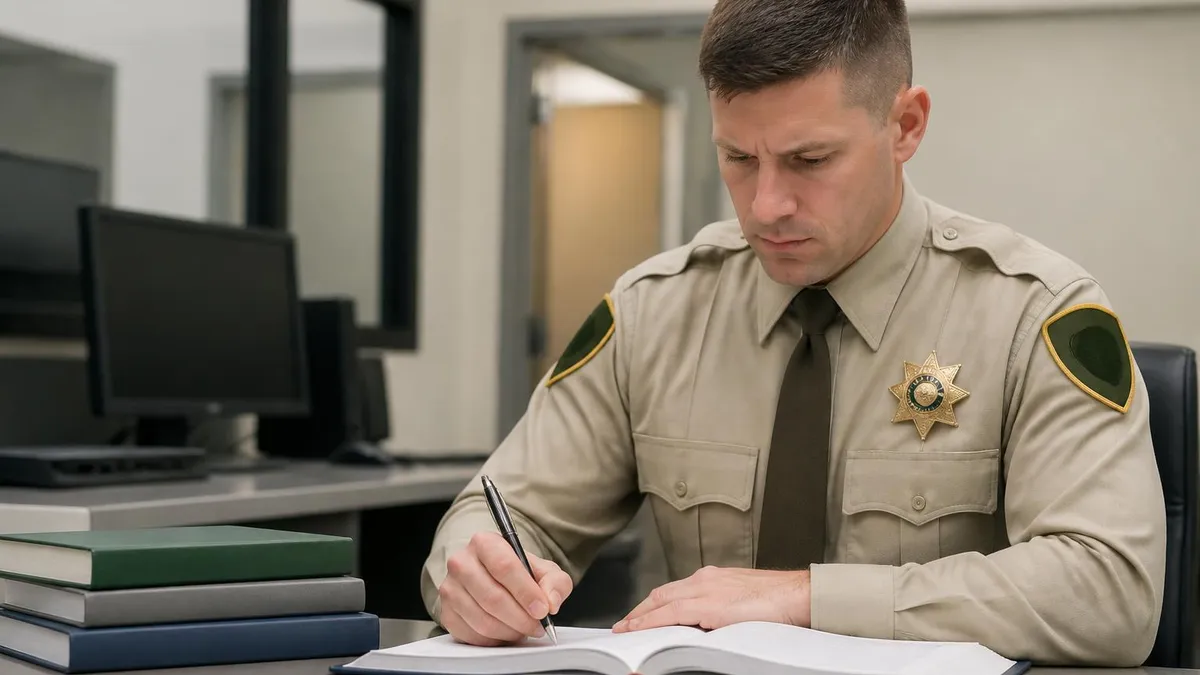
How Does a Sheriff Serve Papers? Civil Process, Cost, and What to Expect

Philadelphia Deputy Sheriff Recruit: Complete Hiring Process & Training Guide
About the Author
Law Enforcement Trainer & Civil Service Exam Specialist
John Jay College of Criminal JusticeMarcus B. Thompson earned his Master of Arts in Criminal Justice from John Jay College of Criminal Justice and served 12 years as a law enforcement officer before transitioning to full-time academy instruction. He is a POST-certified instructor who has prepared candidates for police entrance exams, firefighter assessments, and civil service examinations across dozens of agencies.
Join the Discussion
Connect with other students preparing for this exam. Share tips, ask questions, and get advice from people who have been there.
View discussion (7 replies)