
How to Become a Sheriff: Path, Requirements & State Guide 2026 October
Step-by-step guide to becoming a sheriff or deputy sheriff in CA, TX, NC, NJ, NY — requirements, timeline, career ladder, election path. 🗨️
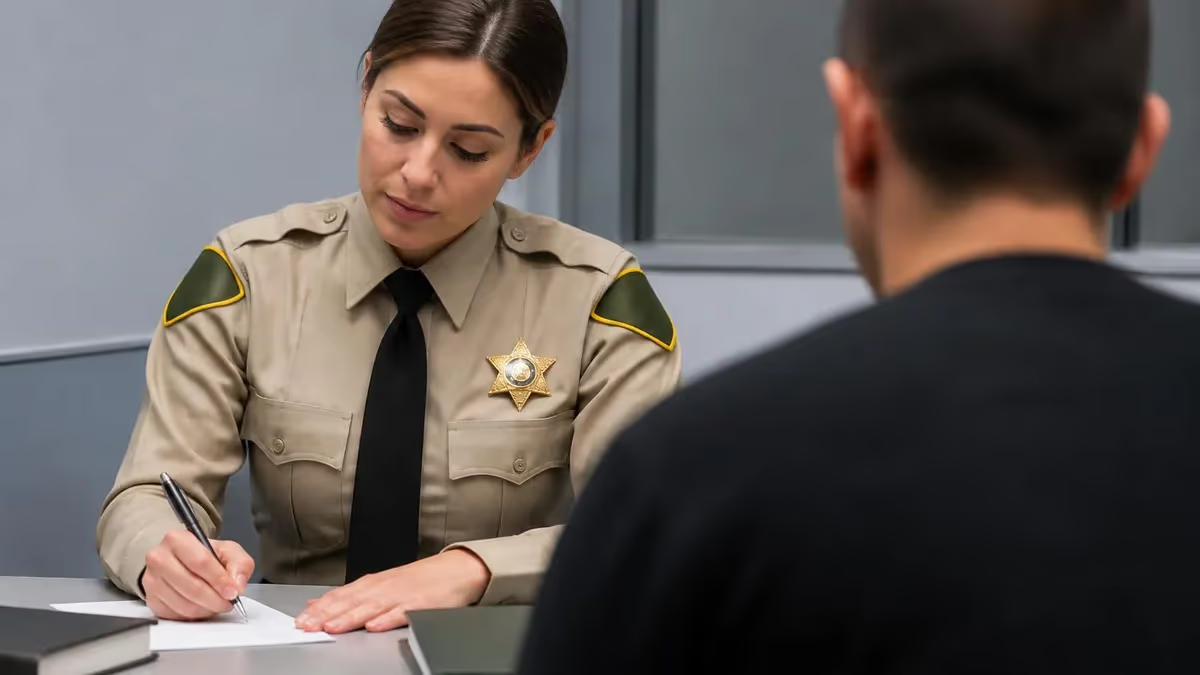
So you want to wear that star — the real one, the one elected by voters, not the badge you clip on after academy graduation. That's the first thing nobody tells you. Becoming a sheriff and becoming a deputy sheriff are two very different careers that share a uniform color and not much else. One you apply for. The other you have to win.
The path matters because the planning matters. If your goal is to run a county jail, supervise patrol divisions, and answer to taxpayers every four years, you're chasing an elected office — a political job with law enforcement teeth. If you want the boots-on-the-ground work — serving warrants, transporting prisoners, running radar on a county road at 2 a.m. — you're chasing a sworn deputy position, which is a hiring decision made by the sheriff who already holds office. Same building. Same chain of command. Wildly different qualification paths.
This guide walks you through both. We'll cover the federal floor of requirements that apply almost everywhere (citizenship, clean record, age 21, valid license), then the state-specific variations for California, Texas, North Carolina, New Jersey, and New York. We'll lay out the career ladder most elected sheriffs actually climbed — deputy, sergeant, lieutenant, captain, undersheriff, candidate — and we'll be honest about timelines. The deputy path runs 12 to 18 months from application to first solo patrol shift. The sheriff path, realistically, runs 15 to 25 years.
You'll see deputy sheriff roles referenced throughout because that's where almost every sheriff started. Even in counties where civilians can technically run for the office, voters tend to elect the candidate with a uniform in their campaign photo and twenty years of arrest reports on the desk. Politics rewards experience. So does the job itself.
Quick note on terminology before we go deeper: "sheriff officer" means different things in different jurisdictions. In Scotland and parts of the UK it's a court-process role. In the US it's loosely used for any sworn member of a sheriff's office, but the formal job title is almost always deputy sheriff, correctional officer, or court services officer. The elected boss is just "the Sheriff."

The Two Sheriff Paths — And Why Most People Confuse Them
Walk into any county sheriff's office in America and you'll meet roughly three categories of people. The sworn deputies — uniformed, armed, and badged. The civilian staff — dispatchers, records clerks, evidence custodians. And one person, usually with their photograph on the wall, who was elected. That one person is the Sheriff with a capital S. Everyone else who calls themselves a sheriff is technically a deputy sheriff working under the Sheriff's authority.
This matters when you're planning your career. A deputy sheriff is hired. You fill out an application, pass a written test, run a 1.5-mile, sit through a polygraph, and if everything clears, you're offered a seat in the academy. The county pays you to train. After certification you're sworn in, you carry a firearm, you make arrests. It's a job — a good one — but you can be fired, demoted, or transferred.
The Sheriff is different. The Sheriff is a constitutional officer in 48 states, elected directly by voters in a partisan or nonpartisan ballot. The position cannot be fired by the county council or the mayor. The only people who can remove a sitting Sheriff are the voters at the next election, the state attorney general in extreme misconduct cases, or a recall petition. That political insulation is by design — the framers of most state constitutions wanted a top cop who answered to the public, not to politicians.
Hawaii and Connecticut are the exceptions worth knowing. Hawaii has no county sheriffs at all — state sheriffs exist but they're appointed. Connecticut abolished elected sheriffs in 2000. Everywhere else, if you want the star with "Sheriff" engraved on it, you're running a campaign.
Sheriff vs. Deputy Sheriff — The One-Sentence Rule
A Sheriff is one elected person per county; a deputy sheriff is a sworn officer hired by that Sheriff to do the actual law enforcement work — and almost every Sheriff in America served as a deputy first.
Baseline Requirements You'll See in Almost Every State
Before we get into state-by-state quirks, here are the requirements that show up so consistently they might as well be federal. Memorize these because they form the floor of every deputy and sheriff candidate qualification check in the country.
US citizenship. Not permanent residency. Not work authorization. Citizenship. This is non-negotiable for sworn law enforcement positions in every state. Naturalized citizens are eligible the moment their certificate is issued.
Age 21 by appointment date. A few states allow application at 20 or even 18, but most require you to be 21 before you can carry a firearm in the line of duty. Texas allows 18 for jail deputies, 21 for patrol. California's POST minimum is 18 but most counties hire at 21.
High school diploma or GED. About 30% of agencies now require some college credits (typically 60 hours) and a small but growing number require a bachelor's degree. Federal agencies are stricter — sheriff's offices are usually not.
Valid driver's license. Most agencies require a license from the state where you'll work, issued for at least 12 months, with no DUI in the past 5–10 years and no more than minor moving violations.
Clean criminal record. No felony convictions, period. Misdemeanors are evaluated case by case but anything involving domestic violence, theft, or drug distribution is usually disqualifying. The Lautenberg Amendment makes domestic violence misdemeanors a firearms disqualifier under federal law — that alone ends most law enforcement careers before they start.
Physical fitness. Push-ups, sit-ups, 1.5-mile run, sometimes a vertical jump and a bench press. Standards vary but the 1.5-mile in 15 minutes or less is the most common floor. If you can run two miles in 18, you'll pass any agency test in the country.
Polygraph, psych eval, drug screen. The polygraph isn't always admissible in court but it's used aggressively in hiring. Lying on the application is the fastest way to get a rejection letter. Past drug use is almost always asked about — most agencies are looking at the last three years, and admitting old experimentation with marijuana rarely disqualifies anymore. Hard drugs, sale of drugs, or recent use absolutely does.
US citizen, 21+ by appointment date (some states 18–20 for jail roles), valid in-state driver's license held 12+ months.
High school diploma or GED minimum. 60 college credits preferred at ~30% of agencies. Bachelor's required for federal lateral moves.
No felony convictions, no domestic violence misdemeanors (Lautenberg disqualifier), clean credit and driving record reviewed.
1.5-mile run, push-ups, sit-ups, obstacle course. State-specific POST or PAT standards apply.
MMPI-2 inventory plus clinical interview with department psychologist. Looks for emotional stability, judgment, integrity.
Pre-test questionnaire, full exam, post-exam clarification. Catches inconsistencies between application and life history.
The Deputy Sheriff Path Step by Step
Let's walk through what actually happens between submitting your application and getting your first solo patrol assignment. The deputy hiring process is long, intentionally so — most counties are trying to weed out 90% of applicants before academy spending begins.
Step 1: Application and written exam. Most counties run the test 4–6 times a year. The exam covers reading comprehension, basic math, situational judgment, and sometimes a personality inventory. There's no real way to "cram" for it but practicing with realistic sample questions makes a huge difference in pass rates. The deputy sheriff exam questions on this site are written to mirror the format of California POST, NYSCS, and FDLE exams.
Step 2: Physical agility test. Usually scheduled within 60 days of passing the written. You'll do an obstacle course or a circuit — body drag, fence climb, sprint, push-ups, sit-ups, 1.5-mile run. Some states (Texas, Florida) use a graded TCOLE or FDLE standard. California uses POST PAT. Whatever the local flavor, train for it like it's a tryout because failing here is permanent for that hiring cycle.
Step 3: Oral board interview. Three to five officers sitting at a table asking scenario questions. "You stop a vehicle and the driver is your cousin — what do you do?" "A subordinate uses excessive force in front of you — what's your response?" There are no trick answers, but there are wrong ones. Honesty plus by-the-book ethics wins every time.
Step 4: Background investigation. This is where 30–40% of remaining candidates wash out. A background investigator interviews your neighbors, your old bosses, your ex-spouses, your high school principal sometimes. They pull your credit report, your driving record, your military discharge papers. If you have lied about anything earlier — even something small — it surfaces here.
Step 5: Polygraph, psych, medical. The polygraph confirms your background statements. The psych eval is a long written inventory (MMPI-2 usually) followed by a clinical interview. The medical includes a vision test (correctable to 20/20 in most states), hearing, and a basic physical.
Step 6: Conditional offer and academy. Academies run 16 to 28 weeks depending on the state. California POST regular basic course is 888 hours. Texas TCOLE basic is 696. New York is 638. You'll be paid as a cadet — usually $45,000 to $65,000 annualized while training — and you'll cover firearms, defensive tactics, vehicle operations, criminal law, traffic, and a long list of certifications.
Step 7: Field training (FTO). After academy, 12 to 16 weeks of riding with senior deputies, getting graded daily. Most agencies use the San Jose Model or a similar daily observation report system. Fail FTO and you're not made permanent.

How to become a sheriff in California: Apply through any of the 58 county sheriff's offices. POST minimum age 18; most counties require 21. US citizenship. High school diploma. POST regular basic course = 888 hours (about 6 months). California has the longest academy in the nation. Field training adds 16–20 weeks. After 1 year you're off probation. Promotion exams follow each rank. To run for Sheriff in California you need to be a citizen, registered voter in the county, and meet the POST executive-level requirements — practically, you need at least 5 years sworn law enforcement experience.
Common Disqualifiers That End Applications Early
Beyond the obvious felonies, here are the things that quietly kill more applications than anything else. Knowing these now lets you address them honestly rather than be surprised at the polygraph table.
Excessive recent debt or recent bankruptcy. Investigators read this as financial pressure that could lead to corruption. Most agencies want to see no judgments, no collections, and a debt-to-income ratio under 40%. Three years past a bankruptcy is usually fine if you've rebuilt.
Tattoos with gang affiliation, racist imagery, or anti-government symbols. Most agencies have written tattoo policies. Visible neck and face tattoos are still prohibited in about 70% of US sheriff's offices.
Social media history. Investigators pull your accounts back 10 years. Threats, racist posts, posed photos with illegal firearms, glorification of violence — all disqualifying. Scrub thoughtfully and honestly, but don't delete and lie about it.
Recent drug use (last 1–3 years depending on jurisdiction), any cocaine or methamphetamine use, any sale of any controlled substance regardless of conviction.
Pattern of moving violations or any DUI in the last 7 years. A single 10-year-old DUI may pass review at some agencies but never at others.
The Single Biggest Mistake First-Time Applicants Make
Applicants try to game the polygraph by minimizing past drug use, traffic incidents, or financial trouble. Nearly every county now uses pre-polygraph questionnaires and post-polygraph clarification interviews specifically designed to catch hedging. The lie matters more than the original behavior in almost every case.
Climbing the Ladder: Deputy to Sheriff
The reason elected sheriffs are almost always former deputies isn't about laws — it's about politics. Voters trust people who've worked the road. Here's the typical promotion ladder inside a US sheriff's office, with the years of service required for each step. Note these are typical numbers from medium-to-large counties; small rural counties may promote much faster, urban departments much slower.
Deputy sheriff (years 0–4): Patrol, transport, court services, jail rotations.
Senior deputy / corporal (years 4–7): Same duties with field training officer or specialty assignments — K9, SRO, traffic, marine.
Sergeant (years 7–12): First-line supervisor. Runs a shift, signs reports, handles personnel issues.
Lieutenant (years 12–17): Watch commander or unit commander. Budget responsibility, scheduling, internal investigations input.
Captain (years 17–22): Division head — patrol, investigations, corrections, support services. Reports to the chief deputy or undersheriff.
Undersheriff / chief deputy (years 20+): The Sheriff's number two. Often the person who runs day-to-day operations while the Sheriff handles politics and external affairs.
Sheriff (elected): Most successful candidates are sitting captains, undersheriffs, or retired chief deputies with name recognition in the county. Campaign fundraising, endorsements from deputy unions, and a clean disciplinary record matter as much as resume.
- ✓US citizen with proof of citizenship in hand (passport or naturalization certificate).
- ✓Age 21+ by your projected academy start date, or eligible age for jail-deputy entry in your state.
- ✓High school diploma or GED — order an official copy now; you'll need it 3+ times.
- ✓Valid driver's license held continuously for 12 months, no DUI in the last 7 years.
- ✓Credit report pulled and reviewed — clear collections, address negatives, lower utilization below 40%.
- ✓Social media accounts audited back 10 years; nothing offensive, racist, or violent visible.
- ✓Drug-free for at least 12 months (3 years for hard drugs) and prepared to be honest about it.
- ✓Physical conditioning at the level of 1.5 miles in 13 minutes, 35 push-ups, 35 sit-ups in 60 seconds.
- ✓Three professional references identified and notified — former bosses, military supervisors, instructors.
- ✓Application packet printed, copies made, deadlines tracked for at least two target counties.

Education and Study Tracks That Help You Move Up
The deputy entry exam tests basic skills, but promotion exams and command-staff appointments increasingly reward formal education. If you're thinking about study paths beyond the academy, here's what actually pays off — both in promotion potential and in pay incentives many counties offer (often $50–$150/month per degree level).
Associate's degree in criminal justice or homeland security. The cheapest meaningful credential. Most community colleges have law enforcement tracks designed around POST hours so you often earn academy credit toward the degree. Two years, $4,000–$8,000 at community-college rates.
Bachelor's in criminal justice, public administration, or psychology. Required for federal lateral moves (FBI, DEA, US Marshals) and increasingly preferred for lieutenant-and-above promotions in larger agencies. Public administration is the underrated pick — it teaches you budgets, HR, and policy, which is exactly what captains and undersheriffs spend their day doing.
FBI National Academy. A 10-week leadership program at Quantico for mid-career officers, by invitation. Graduating earns you "NA" after your name in every sheriff's-office circle that matters. About 250 spots per session. Sheriff candidates who attended frequently win elections on that credential alone.
Continuing education in specialty areas. Crisis intervention (CIT), drug recognition (DRE), accident reconstruction, SWAT, K9 handling, digital forensics. Each specialty cert opens a promotion lane and usually a 2–5% pay bump.
- +Job security: county positions are recession-resistant and pension-backed.
- +Pension: 20–30 year retirement at 50–75% of final salary in most states.
- +Variety: patrol, investigations, corrections, court services, K9, SWAT, marine — many career lanes.
- +Path to leadership: clear promotion ladder with measurable milestones.
- +Public trust: in most rural and suburban counties, the badge still carries community respect.
- +Pay incentives: education, language, and specialty certs add real money to the base.
- −Shift work: nights, weekends, and holidays for the first 5–10 years.
- −Physical and psychological toll: trauma exposure is real and cumulative.
- −Pay ceiling: deputy salaries in low-cost-of-living counties top out around $65,000 even after 15 years.
- −Political exposure: every controversial arrest can become a campaign issue if you ever run.
- −Family strain: divorce rates in law enforcement run roughly 1.5x the national average.
- −Slow advancement in large agencies: 10+ years to make sergeant is common.
Running for Sheriff: The Election Reality
So you've put in 20 years, you're a captain, and you're thinking about the top job. Here's what running actually looks like, with no political romanticism attached.
Campaign budgets in mid-sized US counties (populations 100,000–500,000) usually run $50,000 to $250,000. In large urban counties — Los Angeles, Harris, Cook, Miami-Dade — modern sheriff campaigns have crossed $5 million. The money comes from individual donors, deputy union PACs (often the biggest single check), retired law enforcement networks, and your own savings.
You need petition signatures to get on the ballot — anywhere from 50 to 5,000 depending on the state and party path. You need party endorsement in partisan-ballot states (most of the South and Midwest), or nonpartisan ballot access (California, parts of the West).
You'll campaign on your record. Voters want to know about your arrest record, your community policing philosophy, your jail management plans (jails are usually the single biggest line in a sheriff's budget), and how you'll handle ICE detainers, school resource officers, and the dozen other cultural-flashpoint issues that now define modern law enforcement politics.
The good news: incumbency wins about 75% of contested sheriff elections, but open seats — when the sitting Sheriff retires or term-limits out — see real competition. Plan your run around an open seat if at all possible. Challenging a sitting Sheriff who has the deputy union behind them is the hardest race in local politics.
Timeline Honesty: How Long Does Any of This Take?
Let's do the math out loud because guides often soften this. From the day you mail your first deputy sheriff application to the day you stand at a podium accepting victory on election night, the median timeline in the United States is between 18 and 23 years. Some have done it in 12. A few have done it in 30. None have done it in 5.
If you're 22 right now, you'd be looking at a realistic shot at the Sheriff's office somewhere between 40 and 47 — which is actually the sweet spot for first-time candidates because voters trust experience but reward energy. If you're 35 starting today, you're probably looking at a single elected term in your late 50s, which is still achievable but requires fast-tracking through the deputy ranks.
The shortest credible path is rural. Counties with fewer than 25,000 residents often promote within 3–5 years per rank and have less internal competition for the elected job. The longest path is urban — big-city sheriff's offices in California, New York, Texas, and Florida can have 30-year veterans still wearing sergeant stripes.
Plan accordingly. The decision you're making isn't a one-year career switch — it's a 20-year arc. Worth the time? For the right person, absolutely. The hours are tough, the politics are tougher, but very few jobs let you walk into a room and have everyone in it stand up because of the office you hold.
Sheriff Questions and Answers
About the Author
Law Enforcement Trainer & Civil Service Exam Specialist
John Jay College of Criminal JusticeMarcus B. Thompson earned his Master of Arts in Criminal Justice from John Jay College of Criminal Justice and served 12 years as a law enforcement officer before transitioning to full-time academy instruction. He is a POST-certified instructor who has prepared candidates for police entrance exams, firefighter assessments, and civil service examinations across dozens of agencies.
Join the Discussion
Connect with other students preparing for this exam. Share tips, ask questions, and get advice from people who have been there.
View discussion (7 replies)