
Deputy Cook County Sheriff: Complete Guide to Roles, Pay, and Hiring in America's Second-Largest Sheriff's Office
✍🏼 Deputy Cook County Sheriff guide: salary, hiring steps, training, county-by-county differences, and exam prep tips for aspiring deputy sheriffs in 2026 October.
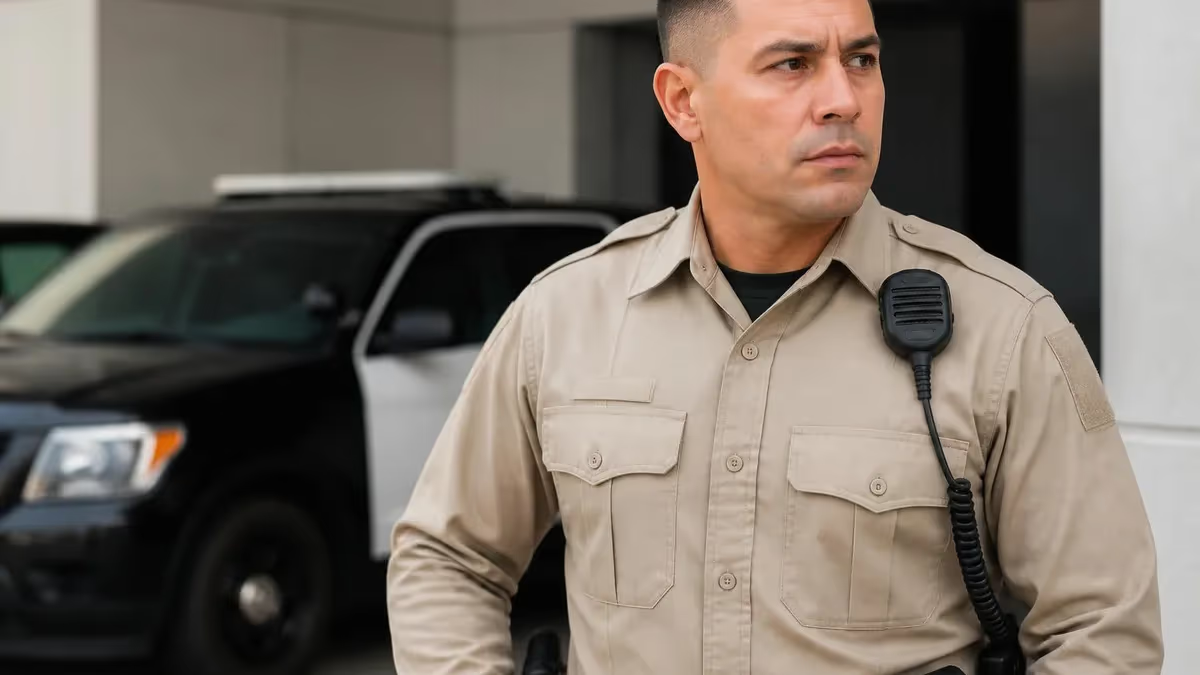
Becoming a deputy Cook County Sheriff means joining one of the largest sheriff's offices in the United States, with more than 6,900 sworn personnel patrolling jails, courthouses, and unincorporated neighborhoods across Chicago's surrounding suburbs. The Cook County Sheriff's Office covers approximately 946 square miles, serves over five million residents, and operates the second-largest single-site jail in America. For aspiring law enforcement professionals, this department offers a unique blend of urban policing, corrections experience, and court security work that few other agencies can match in scale or variety.
The role of a deputy sheriff varies dramatically from one county to another, even within the same state. A deputy in rural Pima County, Arizona may spend the day patrolling 9,000 square miles of desert and responding to remote calls, while a deputy in Cook County, Illinois could be processing detainees, transporting inmates between courthouses, or working a tactical response team. Understanding these geographic and operational differences matters because pay, training requirements, daily duties, and promotion paths often hinge on which county hires you.
This guide walks through everything you need to know about becoming a deputy sheriff by county, with Cook County as the anchor example. We'll cover hiring timelines, salary structures, certification standards, and the practical differences between urban, suburban, and rural sheriff jobs. You'll also see how the written exam is structured, what physical fitness benchmarks you'll need to hit, and how to research the specific requirements of any sheriff's office in the country before applying. Many candidates start the journey without knowing how the sheriff deputy pay scale shifts based on rank, shift differential, and years of service.
Cook County is a useful benchmark because its size forces specialization. New recruits typically begin in the Department of Corrections, working inside the Cermak Health Services area or general population housing, before competing for transfers to patrol, courts, fugitive units, or specialized teams like K-9, marine, or aviation. This corrections-first model is common in large counties such as Los Angeles, Harris (Houston), and Miami-Dade. By contrast, smaller counties often hire directly into patrol and never require time in the jail.
Pay is another area where county-by-county research pays off literally. Cook County deputies start around $66,000 to $74,000 annually with regular step increases, plus uniform allowances, overtime, and pension contributions. Compare that to a rural Illinois county where starting pay may sit closer to $48,000, or to large California counties where deputies can clear $110,000 before overtime. Housing costs, commute distance, and union strength all factor into whether a number sounds good on paper but works out in real life.
Finally, the cultural reality of deputy work differs by county. Some offices lean heavily into community policing, school resource officer programs, and civil process. Others are tactical, narcotics-heavy, or focused on courthouse security. Knowing which model fits your goals helps you target the right counties, prepare for the right exam, and walk into the oral board ready to answer questions that match the agency's actual mission rather than a generic law enforcement template.
Whether your goal is Cook County specifically or a smaller suburban office, the path forward shares a common spine: pass the written exam, clear the physical agility test, survive the background investigation, complete a polygraph and psychological evaluation, and graduate from the academy. The details just shift by geography.
Cook County Sheriff by the Numbers

Cook County Deputy Sheriff Hiring Timeline
Online Application
Written Exam
Physical Agility Test
Background & Polygraph
Psych & Medical
Academy
So what is a deputy sheriff actually doing day-to-day? In Cook County, the answer depends on which division you're assigned to. The Department of Corrections houses roughly 5,500 to 6,500 pretrial detainees on any given day at the Cook County Jail complex in the Little Village neighborhood of Chicago. Deputies working corrections supervise housing units, escort detainees to medical and court appearances, conduct cell searches, and respond to fights, medical emergencies, and contraband incidents. It's demanding work that builds the situational awareness and report-writing skills that serve every later assignment.
The Court Services division handles security inside the Daley Center, Criminal Courts at 26th and California, and suburban courthouses in Rolling Meadows, Skokie, Markham, Maywood, and Bridgeview. Deputies screen visitors, secure courtrooms, protect judges and witnesses, and transport in-custody defendants between holding cells and hearings. Civil Process deputies serve eviction notices, summonses, and orders of protection, often interacting with residents during stressful life events that require empathy alongside enforcement.
Patrol deputies work in unincorporated areas of Cook County and contract communities that don't operate their own police departments. They respond to 911 calls, investigate accidents, conduct traffic enforcement, and follow up on neighborhood complaints. Specialized units include the Sheriff's Police Department, Fugitive Apprehension Unit, Gang Intelligence, Vice, and the SORT tactical team. The variety means a 25-year career inside one agency can feel like five different careers stacked end to end.
A deputy sheriff is fundamentally different from a municipal police officer in a few ways. Sheriffs are constitutional officers elected directly by voters in 48 of 50 states, which gives them political independence and broader jurisdictional reach. Deputies inherit that authority and typically operate county-wide rather than within a single city's borders. They also handle responsibilities municipal police don't: running jails, providing courthouse security, serving civil papers, and conducting evictions. This wider scope is one reason the question of sheriff and deputy roles versus city officers comes up so often during career research.
The role also carries significant report-writing, testimony, and procedural responsibilities. Every use of force gets reviewed. Every search and seizure needs to survive a suppression hearing. Every detainee booking creates a paper trail that may surface in litigation years later. Strong written communication, attention to detail, and emotional regulation under pressure are job requirements, not soft skills. Candidates who treat the academy's report-writing block as filler usually struggle in their first six months on the road or in the jail.
Schedule is another factor worth understanding. Cook County deputies generally work eight-hour or twelve-hour shifts on rotating schedules that include nights, weekends, and holidays. Senior deputies with bid seniority can lock in preferred shifts and days off, but new hires take what's available. The trade-off for the irregular hours includes substantial overtime opportunities, holiday pay multipliers, and a pension system that rewards long careers with reliable retirement income.
Finally, the human side of the work matters. Deputies see people on the worst day of their lives: arrest, eviction, mental health crisis, domestic violence, custody disputes. The ones who last in this career develop a sustainable approach to emotional load, lean on peer support networks, and maintain a life outside the badge. Burnout is real and preventable with the right habits and culture.
Sheriff Practice Test Questions
Prepare for the Sheriff - Deputy Sheriff Exam exam with our free practice test modules. Each quiz covers key topics to help you pass on your first try.
Sheriff Applicable Laws and Regulations
Sheriff Exam Questions covering Applicable Laws and Regulations. Master Sheriff Test concepts for certification prep.
Sheriff Basic Mathematics Application
Free Sheriff Practice Test featuring Basic Mathematics Application. Improve your Sheriff Exam score with mock test prep.
Sheriff Community Policing Principles
Sheriff Mock Exam on Community Policing Principles. Sheriff Study Guide questions to pass on your first try.
Sheriff Correctional Officer Practices
Sheriff Test Prep for Correctional Officer Practices. Practice Sheriff Quiz questions and boost your score.
Sheriff Criminal Investigation Procedures
Sheriff Questions and Answers on Criminal Investigation Procedures. Free Sheriff practice for exam readiness.
Sheriff Deductive and Inductive Reasoning
Sheriff Mock Test covering Deductive and Inductive Reasoning. Online Sheriff Test practice with instant feedback.
Sheriff Evidence Collection and Preservation
Free Sheriff Quiz on Evidence Collection and Preservation. Sheriff Exam prep questions with detailed explanations.
Sheriff First Aid and Emergency Response
Sheriff Practice Questions for First Aid and Emergency Response. Build confidence for your Sheriff certification exam.
Sheriff Observation and Memory Recall
Sheriff Test Online for Observation and Memory Recall. Free practice with instant results and feedback.
Sheriff Officer Duties and Responsibilities
Sheriff Study Material on Officer Duties and Responsibilities. Prepare effectively with real exam-style questions.
Sheriff Patrol Procedures and Techniques
Free Sheriff Test covering Patrol Procedures and Techniques. Practice and track your Sheriff exam readiness.
Sheriff Professional Ethics and Situationa...
Sheriff Exam Questions covering Professional Ethics and Situational Judgment. Master Sheriff Test concepts for certification prep.
Sheriff Reading Comprehension Skills
Free Sheriff Practice Test featuring Reading Comprehension Skills. Improve your Sheriff Exam score with mock test prep.
Sheriff Report Writing and Grammar
Sheriff Mock Exam on Report Writing and Grammar. Sheriff Study Guide questions to pass on your first try.
Sheriff Report Writing and Written Communi...
Sheriff Test Prep for Report Writing and Written Communication. Practice Sheriff Quiz questions and boost your score.
Sheriff Situational Judgment Scenarios
Sheriff Questions and Answers on Situational Judgment Scenarios. Free Sheriff practice for exam readiness.
Deputy Sheriff Roles Compared by County Size
Large counties like Cook (IL), Los Angeles (CA), Harris (TX), and Miami-Dade (FL) employ thousands of deputies and run massive jail systems. New hires almost always start in corrections, where they spend two to five years before competing for transfers to patrol or specialized assignments. The scale creates opportunities to specialize in narcotics, gangs, marine patrol, K-9, tactical response, fugitive recovery, or aviation that smaller offices simply can't support.
Pay tends to be higher to match cost of living, with strong union contracts driving step raises and longevity pay. The trade-off is intense competition for promotion, longer commutes inside dense metro areas, and political scrutiny that comes with policing high-profile jurisdictions. Deputies in these offices also handle a wider variety of calls because of population density and the constant flow of inmates, court hearings, and civil process volume.

Deputy Sheriff vs Municipal Police: Pros and Cons
- +Broader county-wide jurisdiction with more varied assignments across patrol, jail, and court
- +Constitutional independence — the sheriff answers to voters, not a mayor or city council
- +Strong pension systems funded through state and county retirement plans
- +Multiple career tracks within one agency: corrections, courts, civil, patrol, tactical
- +Opportunities for specialized teams like marine, aviation, mounted, and K-9 units
- +Civil process work like evictions and warrants builds skills city officers rarely develop
- +Often higher overtime availability due to 24/7 jail and court coverage requirements
- −Most large counties require corrections experience before patrol assignments
- −Rotating shifts including nights, weekends, holidays for the first 5 to 10 years
- −Higher exposure to communicable diseases and assaults inside the jail environment
- −Political turnover when a new sheriff is elected can shift priorities and assignments
- −Larger jurisdictions mean longer response times and driving distances on patrol
- −Mandatory overtime during staffing shortages can interfere with planned time off
- −Promotion processes are highly competitive in large agencies with thousands of deputies
Pros and Cons at a Glance
| Pros | Cons |
|---|---|
| Broader county-wide jurisdiction with more varied assignments across patrol, jail, and court | Most large counties require corrections experience before patrol assignments |
| Constitutional independence — the sheriff answers to voters, not a mayor or city council | Higher exposure to communicable diseases and assaults inside the jail environment |
| Strong pension systems funded through state and county retirement plans | Political turnover when a new sheriff is elected can shift priorities and assignments |
| Multiple career tracks within one agency: corrections, courts, civil, patrol, tactical | Larger jurisdictions mean longer response times and driving distances on patrol |
| Civil process work like evictions and warrants builds skills city officers rarely develop | Mandatory overtime during staffing shortages can interfere with planned time off |
Deputy Sheriff Application Checklist
- ✓Verify you meet the minimum age requirement of 21 by your hire date in most counties
- ✓Hold a valid US driver's license with a clean three-year driving record
- ✓Obtain a certified copy of your high school diploma or GED, plus any college transcripts
- ✓Gather DD-214 documentation if you served in the military for veterans' preference points
- ✓Collect three to five professional references with current contact information
- ✓Review your social media history and remove anything that would not survive a background check
- ✓Pull your own credit report and address any collections, judgments, or significant delinquencies
- ✓Complete a practice physical agility test at least eight weeks before your scheduled PT date
- ✓Study the written exam content areas using free practice questions and full-length timed tests
- ✓Prepare a clear, honest narrative about any past drug use, arrests, or employment terminations
Apply when the list is open, not when you feel ready
Cook County opens applications for cycles that may not return for 12 to 24 months. Submit your application during the open window even if you're still preparing physically or financially — the timeline from application to academy is six to twelve months, which gives you plenty of room to train. Missing an open posting can delay your career start by two full years.
Salary is one of the most concrete reasons to compare deputy sheriff jobs by county before applying. In Cook County, a new deputy sheriff starts around $66,000 to $74,000 annually depending on the contract year, with step increases every 12 to 18 months that push the rate to roughly $94,000 by year seven or eight. Overtime, court appearance pay, shift differentials, and longevity bonuses commonly add 15 to 30 percent on top of base pay. Deputies promoted to sergeant, lieutenant, or commander can earn $110,000 to $160,000 in base salary alone before any extras.
Benefits inside Cook County include enrollment in the Cook County Pension Fund, which is a defined-benefit plan paying a percentage of final average salary based on years of service. After 20 years of service, deputies can retire with substantial monthly pension payments for the rest of their lives, plus retiree health insurance contributions in many cases. This pension structure is increasingly rare in private-sector careers and remains one of the strongest financial arguments for choosing public-sector law enforcement.
Other counties differ significantly. In Los Angeles County, deputy sheriffs start at roughly $74,000 to $80,000 and reach $120,000 within seven years. Harris County, Texas pays new deputies $58,000 to $65,000 with mid-career around $85,000. Smaller rural Illinois counties might start at $42,000 to $52,000 with a maximum of $70,000 after 20 years. The math gets complicated when you factor in cost of living: $80,000 in San Bernardino County goes further than $80,000 in Marin County, even though they're both California.
Specialty pay adds another layer. Deputies assigned to K-9 units typically receive an additional hour or two of pay daily to compensate for at-home dog care. SWAT or tactical team members earn stipends for training time and call-outs. Bilingual deputies often receive monthly language pay when their second language is documented through a proficiency test. Detective and investigator promotions usually carry rank-based step increases plus take-home vehicle assignments worth several thousand dollars annually.
Pension multipliers also vary by state and county. Illinois sheriff pensions use a 2.5 percent multiplier for many tier-one members, meaning 25 years of service yields roughly 62.5 percent of final average salary as a pension. Tier-two members hired more recently use a lower multiplier and a higher retirement age. Understanding which tier you'll fall into is critical for retirement planning. The full picture of deputy sheriff salary details across ranks, overtime, and pension multipliers is worth studying before signing an offer letter.
Health insurance, life insurance, dental, vision, deferred compensation, and tuition reimbursement round out the benefits package. Many counties offer 457(b) deferred compensation plans that let deputies set aside pretax income on top of their pension, and some match a percentage of contributions. Tuition reimbursement programs in larger counties cover college courses up to a set dollar amount per year, which is useful for deputies pursuing a bachelor's or master's degree that supports promotion eligibility.
Don't forget the financial value of paid academy training. Cook County and most large counties pay full salary plus benefits during the 16 to 20 weeks of academy instruction. That's effectively a paid education in law enforcement worth $25,000 to $30,000 in compensation alone, before you even hit the street. Smaller agencies sometimes require recruits to attend an unpaid academy on their own dime, which can cost $5,000 to $8,000 in tuition plus lost wages during the training period.

Lying or omitting information on your application is the fastest way to fail the background investigation. Investigators routinely uncover prior employment terminations, juvenile arrests, and drug use through database searches and reference interviews. Disclose everything honestly — most past mistakes are forgivable, but dishonesty during the hiring process is not. Recent or current drug use, felony convictions, and patterns of dishonesty are the most common disqualifiers.
The Cook County Sheriff's Training Academy is a paid 16 to 20 week program that prepares recruits for sworn duty. The curriculum is built around Illinois Law Enforcement Training and Standards Board (ILETSB) requirements for basic correctional officer or basic law enforcement certification, depending on the recruit's assigned division. Classroom instruction covers Illinois Compiled Statutes, constitutional law, search and seizure case law, use of force standards, and arrest procedures. Recruits study the same legal principles tested on the written exam, but in much greater depth.
Defensive tactics instruction focuses on control holds, ground fighting, weapon retention, and the use of intermediate weapons like batons, OC spray, and TASER. Recruits drill these skills daily until they become reflexive responses under stress. Firearms training covers handgun fundamentals, qualification courses, low-light shooting, and judgmental use of force scenarios. Cook County recruits typically qualify with a Glock service pistol and learn shotgun and patrol rifle systems before graduation.
Emergency vehicle operations course (EVOC) teaches pursuit driving, evasive maneuvers, and stop techniques on a closed course. Recruits experience skid recovery, high-speed lane changes, and the physical sensations of pursuit driving in a controlled environment. This block of training is critical because vehicle accidents are one of the leading causes of officer injury and death nationally. Defensive driving discipline learned in academy carries over to every shift for the rest of a deputy's career.
Corrections-specific blocks cover inmate classification, contraband searches, suicide prevention, gang identification, and use of force inside a jail. Recruits learn the legal differences between pretrial detention and post-conviction incarceration, the rules governing use of restraints, and the procedures for cell extractions and transports. These skills apply directly to the day-one assignment at the Cook County Jail and remain useful even after a transfer to patrol or courts years later.
Field training comes after the academy graduation. New deputies are paired with a Field Training Officer (FTO) for eight to sixteen weeks of supervised on-the-job learning. The FTO evaluates the new deputy daily on standardized performance categories, with formal weekly reviews. Successful completion of field training is required before a deputy is allowed to work solo. Recruits who struggle in field training may be assigned a remedial period, transferred to a different FTO, or released from employment depending on the deficiencies identified.
Many counties supplement basic academy training with continuing professional education throughout a deputy's career. Annual in-service training typically covers 40 hours of legal updates, firearms requalification, defensive tactics refreshers, first aid certification, and emerging topics like crisis intervention, fair and impartial policing, and de-escalation. Some counties require additional specialty certifications for assignment to K-9, SWAT, detective, or court services. Deputies who actively pursue advanced training tend to move up faster and earn premium assignments.
The academy experience is also a chance to build relationships with classmates who will become your professional network for the next 25 years. Many lifelong friendships, partnerships, and mentor relationships start in the recruit class. Take the academy seriously, show up early, study at night, support struggling classmates, and treat instructors with respect. The reputation you build during those 20 weeks follows you through promotion boards, transfer requests, and assignment decisions for the rest of your career.
Practical preparation separates the candidates who make it from those who wash out. Start your physical training at least three months before any scheduled PT test. Build a base of cardiovascular endurance with three to four runs per week, gradually increasing distance until you can comfortably finish 1.5 miles in under 13 minutes. Add strength training twice weekly focused on push-ups, sit-ups, planks, and full-body movements like squats and deadlifts. Most candidates fail PT not because of the standards themselves but because they trained for two weeks instead of twelve.
Written exam prep should be steady rather than crammed. Devote 60 to 90 minutes daily for six to eight weeks before your scheduled exam date. Rotate between reading comprehension, math word problems, situational judgment scenarios, and grammar review. Take at least three full-length timed practice exams in the final two weeks to build your stamina and pacing. Identify your weakest topic and spend extra time there rather than reviewing material you've already mastered. Most exams allow you to skip and return, so practice that strategy during timed runs.
For the oral board, prepare answers to common scenario questions before walking in. Examples include: How would you handle a fellow deputy you saw stealing from an inmate? What would you do if your supervisor gave you an order you believed was unlawful? Why do you want to be a deputy sheriff? Practice answering out loud, not just in your head. Record yourself, listen back, and tighten responses to two minutes or less. Panel members lose interest in rambling answers and reward clear, confident, ethical reasoning under pressure.
The background investigation goes faster and smoother when you organize documentation in advance. Create a single folder containing your birth certificate, Social Security card, driver's license copy, high school diploma, college transcripts, DD-214, marriage and divorce documents, every previous address for the last 10 years, every job for the last 10 years with supervisor contact information, and three to five personal references. Investigators are happy when you make their job easy, and a smooth background process can shave weeks off your timeline.
Polygraph preparation is mostly about telling the truth. Examiners are trained to detect deception, but the more common reason candidates fail is anxiety reactions to questions they're worried about. Address your concerns honestly during the pre-test interview rather than hoping they won't come up. If you used marijuana five times in college, say so. If you took a piece of office equipment from a former job, say so. Most counties have published disqualifier timelines, and old, disclosed minor incidents rarely block hiring.
Manage your social media presence carefully during the application process. Investigators will find your Facebook, Instagram, X, TikTok, LinkedIn, and any forums you've posted under your real name. Review every post going back five to seven years. Remove anything that involves drug use, illegal activity, extreme political content, or unprofessional behavior. Don't delete everything wholesale right before applying — that's a red flag too. Clean it up gradually and maintain a professional online presence going forward as standard career hygiene.
Finally, build resilience for the inevitable setbacks. You may not pass the exam on the first attempt. You may sit on an eligibility list for 18 months before a class opens. You may make it through nine steps of hiring only to be told to wait for the next academy cycle. Stay in shape, keep studying, and don't take the wait personally. The candidates who eventually pin on the star are the ones who treat the hiring process as a marathon, not a sprint.
Sample Sheriff - Deputy Sheriff Exam Practice Questions
Try these questions from our free Sheriff - Deputy Sheriff Exam practice tests. The correct answer and an explanation follow each question.
You pull over a vehicle for a traffic violation and realize the driver is a fellow deputy from a neighboring precinct whom you do not know personally. The deputy asks for 'professional courtesy.' What is the most appropriate action?
- A. Let the deputy go with a verbal warning, regardless of the violation's severity.
- B. Issue a citation or a warning based on the same criteria you would use for any other driver.
- C. Call your supervisor to ask how to handle the situation.
- D. Pretend you did not hear them and issue a citation immediately.
Answer: B. Issue a citation or a warning based on the same criteria you would use for any other driver.
The law must be applied equally to everyone, regardless of their profession. Granting 'professional courtesy' by ignoring a violation is unethical and undermines the principle of impartial enforcement. You must proceed with the traffic stop as you would for any other citizen.
Under which legal doctrine can a Deputy Sheriff be held liable for violating an individual's constitutional rights?
- A. Sovereign immunity
- B. Qualified immunity
- C. Absolute immunity
- D. Diplomatic immunity
Answer: B. Qualified immunity
Under the legal doctrine of qualified immunity, a Deputy Sheriff can be held liable for violating an individual's constitutional rights if their conduct violates clearly established statutory or constitutional rights, and a reasonable officer would have known about that right. This doctrine protects government officials from liability in civil lawsuits unless their conduct was objectively unreasonable in light of clearly established law.
A department policy states: 'Any deputy who discharges their firearm in the line of duty must submit a use-of-force report within 24 hours.' Deputy Miller discharged her firearm during a call. Based on this policy, which of the following is a logically certain conclusion?
- A. Deputy Miller must submit a use-of-force report within 24 hours.
- B. An investigation into the incident will be launched immediately.
- C. Deputy Miller was justified in using her firearm.
- D. Deputy Miller will be placed on administrative leave.
Answer: A. Deputy Miller must submit a use-of-force report within 24 hours.
This is an example of deductive reasoning, which involves applying a general rule to a specific case. The policy is the general rule, and Deputy Miller's action is the specific case. The policy directly mandates the report, making that the only conclusion that is logically certain from the information provided.
A deputy works a total of 46 hours in one week. The department pays overtime at a rate of 1.5 times the regular hourly wage for any hours worked over 40. If the deputy's regular hourly wage is $28.00, what is the deputy's total gross pay for the week?
- A. $1,288.00
- B. $1,372.00
- C. $1,932.00
- D. $1,120.00
Answer: B. $1,372.00
First, calculate the regular pay for the first 40 hours: 40 hours * $28.00/hour = $1,120.00. Next, determine the number of overtime hours: 46 total hours - 40 regular hours = 6 overtime hours. Then, calculate the overtime pay rate: $28.00 * 1.5 = $42.00/hour. Calculate the total overtime pay: 6 hours * $42.00/hour = $252.00. Finally, add the regular pay and overtime pay together: $1,120.00 + $252.00 = $1,372.00.
Sheriff Questions and Answers
Deputy Sheriff Salary 2026: Real Pay Numbers by State, Rank, and Years of Service

How to Become a Deputy Sheriff: Requirements, Training, and Career Path 2026
What Is a Deputy Sheriff? Complete Guide to the Role, Duties, and Career Path in 2026

Sheriff Deputy Exam: Complete Guide to the Written Test, Fitness, and Interview 2026
Sheriff Practice Test Video Answers
About the Author
Law Enforcement Trainer & Civil Service Exam Specialist
John Jay College of Criminal JusticeMarcus B. Thompson earned his Master of Arts in Criminal Justice from John Jay College of Criminal Justice and served 12 years as a law enforcement officer before transitioning to full-time academy instruction. He is a POST-certified instructor who has prepared candidates for police entrance exams, firefighter assessments, and civil service examinations across dozens of agencies.
Join the Discussion
Connect with other students preparing for this exam. Share tips, ask questions, and get advice from people who have been there.
View discussion (7 replies)