
Chemistry Regents Test: Complete Study Guide & Exam Prep 2026 September
Master the chemistry regents test with our 2026 September guide. Exam format, scoring, study tips & free practice questions. 📚 Start prepping today!
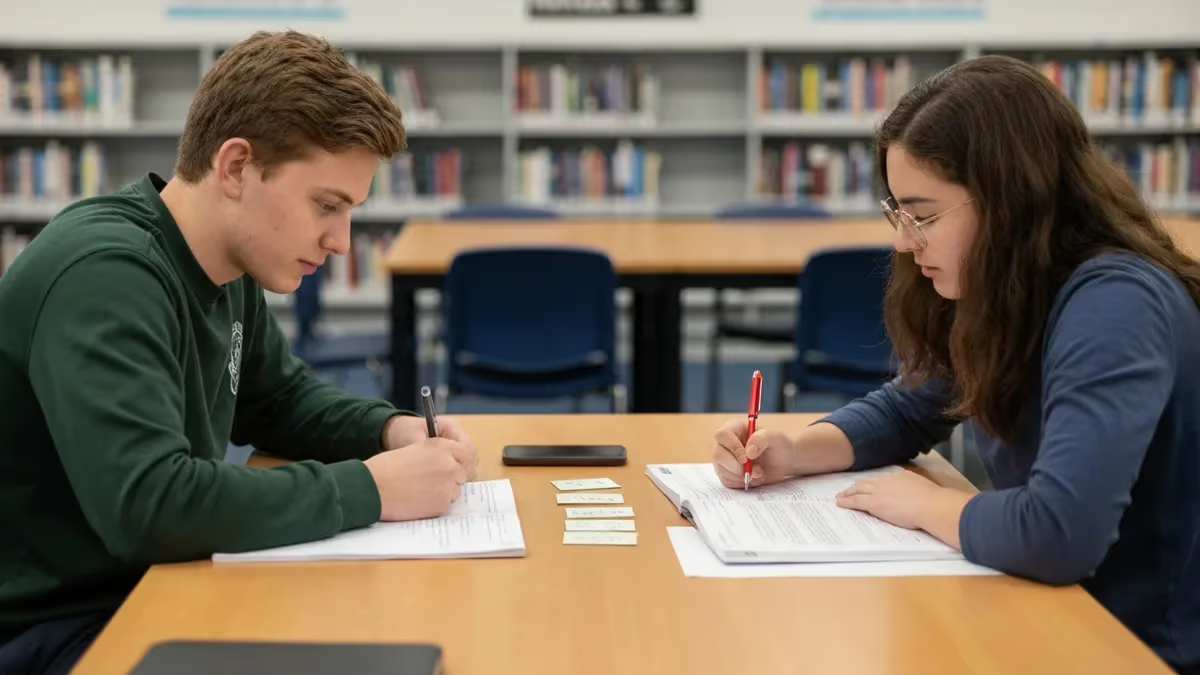
The chemistry regents test is one of the most widely taken science exams in New York State, required for a Regents diploma and respected by colleges as a rigorous measure of scientific understanding. Every year, tens of thousands of students sit for this three-hour examination, tackling questions on atomic structure, bonding, the periodic table, kinetics, equilibrium, electrochemistry, and organic chemistry. Whether you're aiming for a passing score of 65 or pushing toward a mastery level of 85 or higher, understanding exactly what the exam demands is the single most important first step in your preparation.
Many students find chemistry intimidating because it combines abstract theory with detailed mathematical problem-solving. You need to balance equations, calculate molar mass, interpret phase diagrams, and apply Le Chatelier's principle — all within the same three-hour window. The good news is that the New York State Education Department publishes the Core Curriculum, which tells you precisely which topics will appear, leaving no ambiguity about what to study. If you organize your preparation around that document, you won't waste hours on material that won't show up on exam day.
A common point of confusion for students searching for resources is stumbling across unrelated results — searches for regents dr regents dr garage sometimes surface non-academic content. This guide cuts through that noise and delivers a focused, accurate breakdown of everything you need to know about the NYS Chemistry Regents examination so that your study time is productive from day one.
One of the most effective strategies for chemistry regents preparation is working with released past exams. The NYSED makes available several years of prior exams along with official scoring keys, allowing you to practice under realistic timed conditions and then compare your answers to model responses. Many students who score 85 or above report completing at least five to seven full practice exams before their test date, reviewing every incorrect answer to understand the underlying concept rather than simply memorizing the correct choice.
Understanding the scoring system is equally important. The Chemistry Regents is scored on a 0–100 scale, but your raw point total is converted to a scale score using a conversion chart released on the day of the exam. Part A (multiple choice) and Part B-1 (multiple choice) are machine-scored, while Part B-2 and Part C require hand-written responses that trained teachers evaluate using scoring rubrics. Knowing how points are weighted across sections helps you allocate your study effort strategically, focusing more energy on areas where you can pick up the most points.
Alongside the chemistry regents test, New York students often juggle preparation for the algebra 1 regents, the Living Environment Regents, and the US History Regents, all of which may fall within the same examination period in June or August. Building an integrated study calendar that spreads review across all your Regents subjects prevents the last-minute cramming that tends to hurt performance in lab-based sciences like chemistry, where procedural knowledge and conceptual understanding must work together.
This guide covers every major dimension of the Chemistry Regents: the official exam format and section breakdown, the highest-priority content areas, a proven study schedule, tips for the constructed-response questions, and common mistakes students make that can be avoided with the right preparation strategy. Bookmark this page and return to it throughout your study period — the more familiar you become with the exam's structure and expectations, the more confident you will feel walking into the test center on exam day.
NYS Chemistry Regents by the Numbers

Chemistry Regents Exam Format
| Section | Questions | Time | Weight | Notes |
|---|---|---|---|---|
| Part A — Multiple Choice | 30 | ~50 min | 35% | All topics; one point each |
| Part B-1 — Multiple Choice | 20 | ~35 min | 24% | Data analysis & application |
| Part B-2 — Constructed Response | 15 | ~40 min | 18% | Short answer; partial credit available |
| Part C — Extended Response | 20 | ~55 min | 23% | Lab-based; rubric-scored |
| Total | 85 | 3 hours | 100% |
The NYS Chemistry Regents Core Curriculum is organized into twelve major units, but not all units carry equal weight on the actual exam. The NYSED's own examination specifications indicate that atomic concepts, the periodic table and periodicity, bonding, and chemical reactions (including stoichiometry) together account for roughly 50 percent of the total raw points available. If you have limited study time, concentrating your energy on these four areas will give you the greatest return on investment before you branch out into electrochemistry, organic chemistry, and nuclear chemistry.
Atomic structure questions typically ask students to identify the number of protons, neutrons, and electrons in neutral atoms and common ions, to interpret electron configurations, and to explain the relationship between electron energy levels and the emission spectra visible in the Reference Tables. The Reference Tables — officially called the Chemistry Reference Tables — are provided during the exam and contain the periodic table, solubility rules, activity series, standard electrode potentials, and much more. Learning to navigate the Reference Tables quickly and accurately is one of the highest-leverage skills you can develop.
Bonding is another heavily tested area that often trips up students. You must understand the difference between ionic, covalent, and metallic bonding; be able to predict bond polarity from electronegativity values; and explain how intermolecular forces like hydrogen bonding, dipole-dipole forces, and London dispersion forces affect physical properties such as boiling point and solubility. Many multiple-choice questions present two or three substances and ask you to rank them by boiling point — a question that is straightforward if you have mastered intermolecular forces, but nearly impossible to guess correctly.
Chemical kinetics and equilibrium form another cluster of high-priority content. Students need to understand how concentration, temperature, surface area, and catalysts affect reaction rates, and how Le Chatelier's principle predicts the shift in equilibrium when conditions change. These topics lend themselves well to Part C extended-response questions, where the exam might describe an industrial process like the Haber synthesis of ammonia and ask you to explain how changing conditions would affect yield. Practicing with those open-ended scenarios requires not just knowing the principle but also writing clearly and completely enough to earn full rubric credit.
Electrochemistry appears in both the multiple-choice and extended-response sections. Questions range from identifying oxidation and reduction half-reactions to calculating cell voltage using the Standard Electrode Potential table in the Reference Tables. Students often confuse the signs and directions — remembering that oxidation occurs at the anode and reduction at the cathode, and that electrons flow from anode to cathode through the external circuit, gives you an anchor that keeps the details straight. Practice drawing and labeling a simple voltaic cell until you can do it from memory in under two minutes.
Organic chemistry is introduced at a survey level on the Chemistry Regents, covering the major functional groups (alkanes, alkenes, alkynes, alcohols, aldehydes, ketones, esters, and amines), IUPAC naming conventions for simple hydrocarbons, and basic organic reactions like addition, substitution, fermentation, saponification, and polymerization. While the depth is less than what you would see in an AP Chemistry course, students are still expected to identify structures, name compounds, and predict products — skills that require practice with structural diagrams rather than just reading the textbook definitions.
Students who also need to prepare for the geometry regents will recognize that many of the same study habits transfer across exams: work with official released tests, analyze your error patterns, and review the underlying concept — not just the answer — for every question you miss. The chemistry regents test rewards students who understand the why behind each rule and formula, not just those who have memorized isolated facts. Building that deeper understanding is the goal of every study session you complete between now and exam day.
Living Environment Regents vs. Chemistry Regents: Key Differences
The living environment regents centers on biology — cell biology, genetics, evolution, ecology, and human physiology — while the chemistry regents test dives into physical and chemical phenomena like atomic theory, thermodynamics, and chemical reactions. Students who are strong in memorization-heavy biology sometimes struggle with the more mathematical demands of chemistry, where calculating molar mass, balancing redox equations, and applying stoichiometric ratios are everyday skills that require both conceptual understanding and numerical accuracy.
Chemistry also relies more heavily on the Reference Tables, which function almost like an open-book resource during the exam. By contrast, the Living Environment Regents tests recall of biological diagrams and vocabulary more directly. Students preparing for both exams in the same season should budget significantly more practice time for chemistry's quantitative problem types, treating each formula in the Reference Tables as a tool to master rather than a shortcut to find on test day.

Advantages and Challenges of the Chemistry Regents Test
- +Reference Tables are provided during the exam, reducing pure memorization demands
- +Official past exams are freely available from NYSED for realistic practice
- +Scale score conversion often allows students to pass even with several raw-point errors
- +Mastery score of 85+ can fulfill science requirements for competitive college programs
- +Clear curriculum document (Core Curriculum) specifies exactly what will be tested
- +Partial credit is available on constructed-response sections, rewarding partial understanding
- −Three-hour exam duration requires strong stamina and time management
- −Mathematical problem-solving (stoichiometry, electrochemistry) is more demanding than many other Regents
- −Statewide pass rate around 54% means more than four in ten test-takers do not pass on the first attempt
- −Part C rubric scoring can feel unpredictable if you haven't practiced writing complete scientific explanations
- −Topics like organic nomenclature and nuclear chemistry require rote learning that some students find tedious
- −Exam is offered only in June and August, limiting re-take opportunities within a school year
Pros and Cons at a Glance
| Pros | Cons |
|---|---|
| Reference Tables are provided during the exam, reducing pure memorization demands | Three-hour exam duration requires strong stamina and time management |
| Official past exams are freely available from NYSED for realistic practice | Mathematical problem-solving (stoichiometry, electrochemistry) is more demanding than many other Regents |
| Scale score conversion often allows students to pass even with several raw-point errors | Part C rubric scoring can feel unpredictable if you haven't practiced writing complete scientific explanations |
| Clear curriculum document (Core Curriculum) specifies exactly what will be tested | Topics like organic nomenclature and nuclear chemistry require rote learning that some students find tedious |
| Partial credit is available on constructed-response sections, rewarding partial understanding | Exam is offered only in June and August, limiting re-take opportunities within a school year |
Chemistry Regents Test Preparation Checklist
- ✓Download and print the most recent NYS Chemistry Core Curriculum from the NYSED website.
- ✓Obtain a copy of the Chemistry Reference Tables and practice locating every table within 10 seconds.
- ✓Complete at least five released Chemistry Regents exams under timed, exam-day conditions.
- ✓Review every incorrect answer by finding the underlying concept in your notes or review book.
- ✓Memorize the oxidation states of common ions and practice balancing redox equations daily for two weeks.
- ✓Practice writing complete Part C responses using official scoring rubrics to self-evaluate your answers.
- ✓Create a formula card for stoichiometry calculations: moles, molar mass, percent composition, and limiting reagents.
- ✓Study the solubility rules table until you can predict whether any common ionic compound dissolves in water.
- ✓Schedule at least one full timed practice run within 72 hours of your actual exam date.
- ✓Confirm your test center location, required identification, and permitted materials the evening before the exam.

The Reference Tables Are Your Secret Weapon
Students who master the Chemistry Reference Tables before exam day consistently outperform those who treat them as a backup resource. Spend at least three dedicated sessions doing nothing but navigating the tables — finding standard electrode potentials, reading the activity series, and using the solubility guidelines — until the lookup feels automatic. On exam day, efficient table use can save you 15 to 20 minutes that you redirect to checking constructed-response answers.
Scoring well on the Chemistry Regents test requires a clear-eyed understanding of how the four parts contribute to your final scale score. Part A, which consists of 30 multiple-choice questions worth one raw point each, is pure objective scoring — no partial credit, no room for interpretation.
The key to Part A is both accuracy and efficiency: most students should be able to work through all 30 questions in roughly 40 to 50 minutes, leaving adequate time for the more demanding written sections. If you find yourself spending more than two minutes on any single multiple-choice question, skip it, move on, and return at the end.
Part B-1 is also multiple choice, with 20 questions that tend to be more analytical than Part A. These items frequently reference data tables, graphs, or diagrams embedded in the question, and they test your ability to apply concepts to unfamiliar scenarios rather than simply recall definitions. Practicing with these items requires a slightly different mental approach: read the question stem carefully before looking at the answer choices, identify exactly what the question is asking, and then use the Reference Tables to confirm your reasoning before committing to an answer.
Part B-2 transitions into written responses, and this is where many students lose unnecessary points by writing incomplete answers. A typical Part B-2 question might show a titration curve and ask you to identify the equivalence point and explain what is happening chemically at that stage of the titration.
A one-sentence answer is almost never sufficient for full credit. Train yourself to write in complete scientific sentences that state the claim, connect it to a relevant principle, and reference the specific data or observation that supports your conclusion. Two to three sentences per sub-question is a reliable target for most Part B-2 items.
Part C is the most open-ended section of the exam and is explicitly tied to the laboratory investigations described in the Core Curriculum. Questions in Part C often present a scenario based on a standard lab setup — a voltaic cell, a reaction rate experiment, or a titration — and ask you to predict outcomes, explain observations, and draw conclusions.
Because Part C responses are graded by teachers using a detailed scoring rubric, the language you use matters enormously. Vague answers that reference the right concept but fail to name it precisely often receive partial credit rather than full credit, so precision in scientific vocabulary is a scoring strategy, not just a stylistic preference.
The conversion chart published on exam day is both a comfort and a source of anxiety for students. The comfort: on difficult administrations, the chart is generous, and a raw score of 55 out of 85 might convert to a passing scale score of 65. The anxiety: you never know in advance how generous the curve will be, so you cannot plan to rely on it.
The safest strategy is to target a raw score of at least 60 to 65 points on your practice exams, which historically produces a scale score comfortably above 65 on nearly every administration. Students targeting 85 should aim for 70 to 75 raw points to give themselves a buffer.
Time management during the actual exam deserves as much attention as content review. Many students spend too long on Part C because the open-ended format invites over-writing, and then rush through the constructed-response verification at the end. A practical time allocation is 50 minutes for Part A, 35 minutes for Part B-1, 40 minutes for Part B-2, 55 minutes for Part C, and 20 minutes for review. Practicing with this time budget during your full practice exams builds the habit before exam day, so it feels natural rather than forced when you're sitting in the actual test room.
Students who have already passed the algebra 2 regents or the geometry regents will have a meaningful head start on the mathematical demands of chemistry, particularly in stoichiometry and electrochemistry calculations. Dimensional analysis, which students first encounter in algebra, is the backbone of mole-to-gram conversions, percent composition calculations, and molarity problems. If you feel rusty on unit conversions and ratio-proportion setups, a brief algebra review during the early weeks of your chemistry prep will pay dividends throughout the rest of your study schedule.
The Chemistry Regents is administered only in June and August each year. If you miss the June administration, the August make-up is your next opportunity — but August scores are not always processed before fall semester enrollment deadlines at some colleges and programs. Check your school's specific registration cutoff dates in early spring and confirm your exam date in writing with your guidance counselor to avoid missing the only window available before your diploma deadline.
The final weeks before the chemistry regents test are best spent consolidating what you already know rather than trying to learn entirely new content. At this stage, your primary tools should be released past exams, the Reference Tables, and a targeted review of your personal error log — the record you have kept throughout your preparation of which question types and which content areas have caused you the most difficulty.
Students who enter the final two weeks without an error log tend to review material randomly, spending time on topics they already understand and underinvesting in the areas where they are most likely to drop points on exam day.
One of the most powerful final-prep strategies is to work through the constructed-response portions of at least three past exams and then compare your answers to the official model responses published by NYSED.
Pay particular attention to the vocabulary used in the model responses — words like "increases," "decreases," "shifts right," "greater than," and "exothermic" appear again and again, and learning to deploy them with the same precision as the model responses is the fastest path to maximizing your Part B-2 and Part C scores. Many students who review model responses for the first time are surprised by how concise and precise they are — a good model response rarely runs more than three or four sentences per sub-question.
For students using online resources, the practice available through regents dr+regents dr garage pages can sometimes surface useful cross-subject study tips that apply broadly across all Regents examinations. The habits that produce high scores are largely the same regardless of subject: consistent practice under timed conditions, systematic error analysis, and a genuine effort to understand the underlying concept behind every question you miss rather than just noting the correct answer and moving on.
The Reference Tables deserve a final mention in the context of last-minute preparation. In the week before the exam, go through every table systematically and make sure you know what each one is for. The Table of Standard Electrode Potentials is used for electrochemistry calculations. The Solubility Guidelines table tells you whether a precipitate forms in a double-replacement reaction.
The Heats of Reaction table is used for thermochemistry calculations. The Organic Chemistry table lists functional groups. Many students have the tables memorized by exam day simply as a result of using them repeatedly during practice — but if you haven't reached that level of familiarity yet, a targeted 30-minute review of each table's purpose and typical use cases will significantly reduce your lookup time on exam day.
On the morning of the exam, arrive at your test center with sufficient time to settle in without rushing. Bring your school-issued identification, two or three sharpened pencils, a pen (required for some written sections at certain schools), and a permitted calculator.
Most schools allow a basic scientific calculator for the Chemistry Regents; check your school's specific policy in advance, because calculators with computer algebra system (CAS) functionality are typically prohibited. Eat a balanced meal before the exam — your brain is doing three hours of intensive work, and low blood sugar is a performance risk that is entirely within your control to prevent.
During the exam itself, use the full three hours. Students who finish early and hand in their papers 45 minutes before time is called are almost always leaving points on the table. Use extra time to re-read your Part B-2 and Part C responses looking for places where you stated a claim but forgot to explain the mechanism, or where you could add a specific piece of data from the question to strengthen your answer.
Rubric readers reward completeness, and adding two sentences to a thin response can turn a one-point answer into a two-point answer across multiple questions — a difference that, on the scale score conversion, can move you from a 63 to a 67 or from a 78 to an 83.
Finally, remember that the chemistry regents test, like all New York State Regents examinations, is designed to be passable by a well-prepared student who has engaged seriously with the curriculum throughout the school year. The exam is not designed to trick you or to test obscure knowledge that appears nowhere in the Core Curriculum.
Every question has a clear, defensible answer that follows directly from principles taught in a standard high school chemistry course. With organized preparation, consistent practice, and smart use of the Reference Tables, you are fully capable of earning the score you need. Trust your preparation, stay calm on exam day, and write complete, precise answers on every constructed-response question.
Practical test-taking strategies for the Chemistry Regents go well beyond content knowledge and touch on how you physically and mentally manage a three-hour high-stakes examination. One of the most underrated skills is process of elimination on multiple-choice questions.
Even when you are not 100 percent certain of the correct answer, you can often eliminate one or two obviously incorrect choices by applying basic principles — for example, ruling out any answer that violates the law of conservation of mass, or eliminating a choice that describes a property characteristic of metals when the question asks about nonmetals. Narrowing a four-choice question to two options increases your probability of a correct guess from 25 percent to 50 percent, which matters when you are uncertain.
For stoichiometry problems, always write out the dimensional analysis setup before doing any arithmetic. Students who skip this step and try to do stoichiometry in their heads are far more likely to invert a conversion factor or forget to account for the molar ratio between reactants and products. The extra 30 seconds spent writing the full setup is almost always recovered — and then some — by the reduction in careless errors. Bring this habit from your practice sessions into the actual exam so it feels automatic rather than effortful.
When writing Part C responses, use a structured approach: state your claim in the first sentence, provide the chemical reason or principle in the second sentence, and reference specific data from the question or the Reference Tables in the third sentence. This three-sentence structure ensures that your answer contains all the elements a rubric reader is looking for — assertion, explanation, and evidence. Students who write longer answers without this structure often scatter the required elements across five or six sentences in a way that makes them harder for a time-pressured rubric reader to identify and credit.
Managing test anxiety is a legitimate preparation topic that many students overlook until the night before the exam. Research consistently shows that low to moderate arousal improves performance on cognitively demanding tasks, but high anxiety impairs working memory — the mental workspace where you are doing stoichiometry calculations and balancing equations.
The best anxiety-management strategy is preparation itself: students who have done seven or eight full practice exams under timed conditions walk into the real exam with a deep familiarity that replaces anxiety with confidence. But in the days immediately before the exam, techniques like controlled breathing, adequate sleep, and avoiding last-minute cramming sessions that extend past midnight are all evidence-based ways to keep your anxiety at a productive rather than impairing level.
Sleep deserves special emphasis. The night before the exam is not the time to review organic nomenclature for the first time or to work through a new practice test. Your brain consolidates the knowledge you have already acquired during sleep, so a full eight hours the night before the exam is more valuable than two additional hours of studying followed by six hours of sleep. Many students report feeling sharper and more focused on exam day when they stopped studying by 9 pm the evening before and prioritized rest — a counterintuitive but well-supported approach.
After the exam, you will receive your score report within approximately four to six weeks for June administrations, with August scores typically available in September. Your score report will show your scale score, your raw score on each part, and your performance relative to the state average.
If you did not pass, the score report is an invaluable diagnostic tool: it tells you precisely which parts of the exam cost you the most points, which in turn tells you exactly where to focus for a re-take in August or the following June. Students who use their score reports strategically to guide re-take preparation consistently improve their scores on the second attempt.
Whatever your goal — passing for a Regents diploma, scoring 85 for mastery recognition, or building chemistry knowledge for an AP course or college science requirement — the chemistry regents test is a concrete, achievable target that rewards systematic preparation. The curriculum is public, the past exams are free, and the scoring rubrics are published. Every resource you need to succeed is available to you. Start early, practice consistently, analyze your errors honestly, and walk into that exam room knowing that you have done the preparation necessary to perform at your best.
Regents Questions and Answers

About the Author

Educational Psychologist & Academic Test Preparation Expert
Columbia University Teachers CollegeDr. Lisa Patel holds a Doctorate in Education from Columbia University Teachers College and has spent 17 years researching standardized test design and academic assessment. She has developed preparation programs for SAT, ACT, GRE, LSAT, UCAT, and numerous professional licensing exams, helping students of all backgrounds achieve their target scores.