
QEI Meaning: What Is a Qualified Elevator Inspector? 2026 September
Learn QEI meaning, certification requirements, duties & salary. 🎯 Complete career overview for aspiring Qualified Elevator Inspectors in the US.
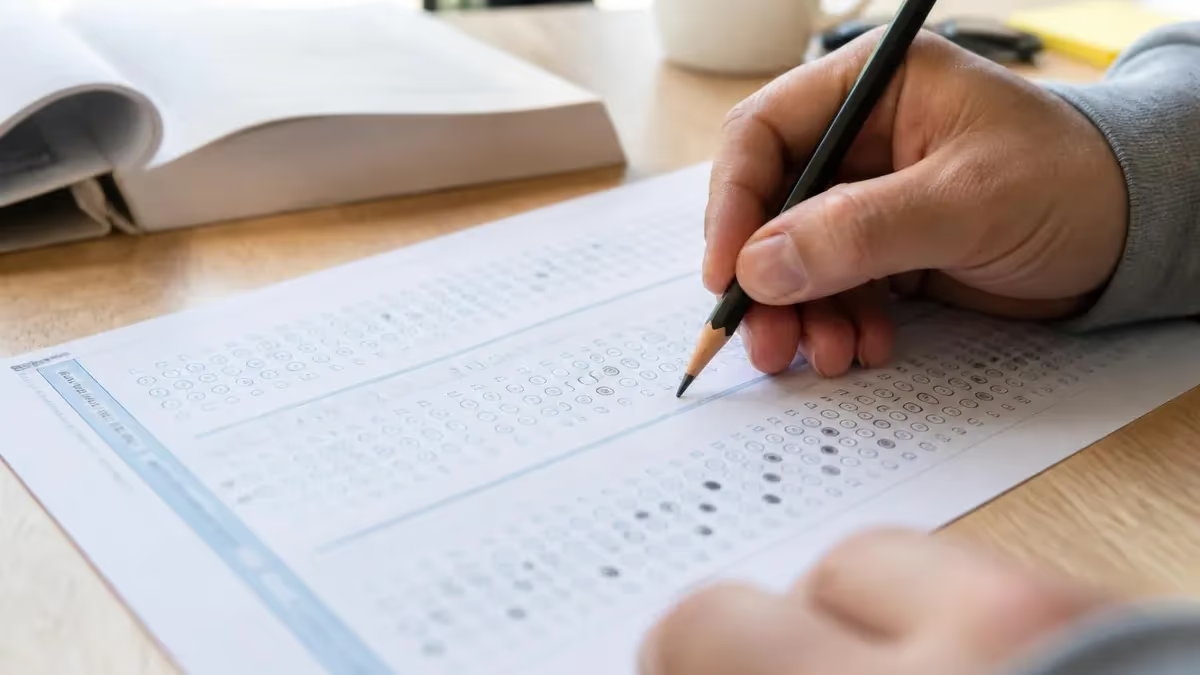
The QEI meaning stands for Qualified Elevator Inspector, a nationally recognized credential issued by the National Association of Elevator Safety Authorities International (NAESAI). A QEI is a trained professional authorized to conduct safety inspections on elevators, escalators, moving walks, and other vertical transportation equipment across the United States. The credential verifies that an inspector has the technical knowledge and hands-on experience required to evaluate equipment against the ASME A17.1 Safety Code for Elevators and Escalators.
Becoming a QEI is one of the most significant career milestones in the elevator industry. Inspectors who hold this credential are trusted by building owners, municipalities, insurance carriers, and state agencies to certify that vertical transportation equipment is safe for public use. Without a formal QEI certification, many jurisdictions will not permit an individual to conduct official elevator inspections, making this credential practically mandatory for anyone pursuing a full-time inspection career.
The credential traces its roots to the broader elevator safety movement in the United States, which accelerated following high-profile elevator accidents in the mid-twentieth century. NAESAI was founded specifically to standardize inspector qualifications, and the QEI exam became the gold-standard evaluation tool for that purpose. Today, tens of thousands of QEI-certified inspectors work across all fifty states and several US territories.
If you are researching what is qei from a career standpoint, it helps to understand that the designation is not just an academic certificate — it carries legal weight. Many state governments reference the QEI credential directly in their elevator inspection statutes, requiring that all third-party inspectors hold active certification before performing inspections that localities will accept. This legal recognition elevates the QEI above a simple industry badge.
The work itself is as much about public safety as it is about technical compliance. A QEI-certified inspector examines hundreds of mechanical, electrical, and structural components during each inspection visit. They check door-locking mechanisms, emergency brake systems, pit conditions, machine room equipment, governor assemblies, and safety circuits, among many other items. A single missed defect can have life-threatening consequences, so thoroughness and technical precision are non-negotiable professional traits.
The demand for QEI-certified inspectors has grown steadily over the past decade, driven by aging building infrastructure, stricter state and local inspection codes, and the rapid installation of new elevator equipment in urban construction projects. According to industry employment data, elevator inspectors are among the higher-paid inspection professionals in the skilled trades, with median annual salaries well above the national average for all building inspectors. The credential therefore represents both a public safety function and a lucrative career pathway for qualified individuals.
This article provides a comprehensive overview of the QEI credential — what it means, what inspectors actually do on the job, the requirements to earn the certification, the career benefits it unlocks, and practical advice for preparing for the QEI examination. Whether you are an elevator mechanic considering a move into inspection, or a recent graduate exploring the skilled trades, this guide will give you the foundational knowledge to make an informed decision about pursuing this credential.
QEI Certification by the Numbers

QEI Certification Requirements at a Glance
Applicants must hold a high school diploma or equivalent. An associate degree or vocational training in electrical or mechanical engineering is not mandatory but improves exam performance and is increasingly common among applicants.
A minimum of five years of verifiable elevator industry experience is required. This experience must involve direct hands-on work with elevator equipment — installation, maintenance, repair, or inspection — supervised by a licensed professional.
Candidates must demonstrate mastery of ASME A17.1, ASME A17.2, ASME A18.1, and applicable ANSI/ICC A117.1 accessibility standards. These are the primary code references tested on the QEI examination.
Candidates must pass the standardized QEI examination administered by NAESAI. The exam consists of 170 multiple-choice questions covering safety codes, inspection procedures, and equipment standards, completed within a three-hour window.
Applicants submit a completed application with documentation of experience and pay the applicable examination fee. Applications are reviewed by NAESAI before exam scheduling is confirmed and an admission ticket is issued.
The day-to-day duties of a QEI-certified inspector are far more extensive than most people outside the elevator industry realize. An inspector's primary responsibility is to verify that every installed elevator, escalator, dumbwaiter, moving walk, platform lift, or stairway chair lift in their jurisdiction complies with the applicable edition of the ASME A17.1 Safety Code. This involves a systematic, component-by-component examination that follows the procedures outlined in ASME A17.2, the companion guide for elevator inspection and testing.
Inspectors begin each site visit with a review of the equipment's maintenance records and previous inspection reports. This paperwork review helps identify recurring problems, outstanding violation notices, and the history of any major component replacements. A thorough inspector does not walk into a machine room cold — they arrive with context about the equipment's operational history, which allows them to focus additional scrutiny on areas that have previously produced deficiencies or that involve recently replaced parts.
The physical inspection itself is divided into several major phases. Inspectors examine the machine room and control space, checking that temperature, lighting, housekeeping, and fire suppression conditions all meet code requirements. They verify the condition of the drive machine, motor, brake, governor, and controller. They inspect ropes or chains for wear, corrosion, and proper tension. They examine the hoistway, checking guide rails, buffers, counterweights, limit switches, and pit equipment. They also conduct a detailed examination of all landing entrances and the car itself, including doors, safety devices, lighting, and ventilation.
After the visual and mechanical inspection, QEI-certified inspectors conduct or witness performance tests. These tests include full-load and no-load operation, emergency stop tests, door force tests, door re-opening device tests, and safety tests such as governor tripping. For hydraulic elevators, inspectors witness pressure relief valve tests and check for leaks in the hydraulic system. For newer equipment, they may also evaluate electronic control system parameters and fault logs.
When deficiencies are found, the inspector has legal authority — in most jurisdictions — to issue a notice of violation or, in cases of immediate danger, to order the equipment out of service until repairs are completed. This enforcement authority distinguishes a QEI-certified inspector from an ordinary maintenance technician. Inspectors must document every finding accurately and issue formal inspection reports that become part of the public record maintained by the local authority having jurisdiction (AHJ).
QEI inspectors also play an important role in new construction and major modernization projects. Before a newly installed elevator can be placed into service for the first time, it must pass an acceptance inspection conducted by a QEI. This acceptance inspection is often more detailed than a periodic inspection because the inspector must verify that every component has been installed correctly and that all required tests have been performed and witnessed. Errors caught at acceptance prevent dangerous conditions from ever reaching building occupants.
Finally, many QEI inspectors serve as consultants or expert witnesses in litigation involving elevator accidents, property damage claims, or code compliance disputes. Their credential lends authority to their technical opinions, and courts frequently accept QEI-certified inspectors as qualified experts in elevator safety matters. This consulting dimension of the work adds both income potential and professional prestige to the QEI designation.
QEI Certification Pathways and Code References
The ASME A17.1 Safety Code for Elevators and Escalators is the foundational document every QEI candidate must master. Updated on a three-year cycle, this code covers design, construction, installation, operation, inspection, testing, maintenance, alteration, and repair requirements for elevators and escalators in the United States. The code is organized into numbered requirements, and exam questions frequently cite specific requirement numbers, making familiarity with the code's structure critically important for passing the QEI exam on the first attempt.
QEI candidates should obtain the most recent edition of A17.1 and work through it systematically, paying special attention to Part 2 (Electric Elevators), Part 3 (Hydraulic Elevators), and Part 8 (Special Application Elevators). Many experienced QEI inspectors recommend using the ASME A17.2 Inspection and Testing guide alongside A17.1 because it translates the code requirements into practical inspection procedures, giving candidates a clearer picture of how abstract code language translates into real-world inspection tasks.

Is Pursuing QEI Certification Worth It?
- +Legally recognized credential accepted by nearly all US state elevator inspection programs
- +Significant salary premium over non-certified elevator industry workers
- +High job security driven by mandatory inspection laws and aging infrastructure
- +Pathway to independent consulting, expert witness work, and private inspection firms
- +Credential is portable — recognized nationally, enabling relocation without re-licensing
- +Growing demand as urban construction and elevator modernization projects accelerate nationwide
- −Requires a minimum of five years of hands-on elevator industry experience before eligibility
- −Exam is challenging — covers a broad range of ASME codes and requires deep technical knowledge
- −Initial study investment is significant, often requiring purchase of multiple ASME code books
- −Credential must be renewed every three years through continuing education units (CEUs)
- −Work involves physical demands including confined spaces, heights, and machinery environments
- −Liability exposure is high — errors in inspection reports can result in legal and professional consequences
QEI Exam Preparation Checklist
- ✓Obtain the current edition of ASME A17.1 Safety Code for Elevators and Escalators and read it cover to cover.
- ✓Study ASME A17.2 Inspection and Testing guide to understand how code requirements translate into field procedures.
- ✓Review ASME A18.1 Standard for Platform Lifts and Stairway Chairlifts in its entirety.
- ✓Familiarize yourself with ANSI/ICC A117.1 Accessible and Usable Buildings and Facilities requirements.
- ✓Complete at least 500 QEI practice questions spread across all major code areas before exam day.
- ✓Take timed full-length mock exams to build stamina for the three-hour closed-book examination format.
- ✓Focus extra study time on sections where practice tests show consistent weakness or below-average scores.
- ✓Review NAESAI's published exam content outline to confirm you have covered all weighted topic areas.
- ✓Submit your NAESAI application at least eight weeks before your target exam date to allow processing time.
- ✓On exam day, arrive early, bring valid photo identification, and avoid cramming in the final 24 hours.
The QEI Exam Is Open to Code Interpretation — Not Just Memorization
Many QEI candidates underestimate the exam by treating it as a pure memorization exercise. In reality, roughly 40% of exam questions require you to apply code language to a described scenario and determine the correct inspection action or required measurement. Practicing scenario-based questions alongside code reading is the single most effective strategy for first-time pass success.
The career and salary outlook for QEI-certified inspectors is exceptionally strong relative to most skilled trades credentials. According to US Bureau of Labor Statistics occupational data for construction and building inspectors, elevator inspectors consistently rank among the highest-paid subcategories within that occupational group. Entry-level inspectors with a freshly earned QEI certification typically start in the range of $55,000 to $65,000 per year, while inspectors with five or more years of post-certification experience frequently earn between $80,000 and $100,000 annually in major metropolitan markets.
Geographic location plays a major role in compensation. States with high construction activity, dense urban populations, and robust elevator fleets — such as New York, California, Illinois, Texas, and Florida — offer the highest wages for QEI-certified inspectors. New York City, in particular, has some of the most stringent elevator inspection requirements in the country and correspondingly high compensation rates. Inspectors working for the New York City Department of Buildings or large private inspection firms in the city can earn well above the national median.
Employment settings for QEI inspectors vary widely. A substantial portion work directly for state or municipal government agencies as public employees. These positions typically offer strong benefits, pension plans, and job security, though salaries may be slightly lower than private-sector equivalents. Other inspectors work for private elevator inspection companies that contract with building owners, insurance carriers, and property management firms. A smaller but growing segment works as independent consultants, building their own client rosters and setting their own schedules.
The elevator industry as a whole is expected to grow over the next decade, driven by several converging trends. First, the United States has an enormous installed base of older elevator equipment — estimates suggest that hundreds of thousands of elevators are over twenty years old — and these units require more frequent inspection and maintenance attention. Second, new construction continues at a significant pace in major cities, adding thousands of new elevator installations that require acceptance inspections and ongoing periodic inspections. Third, ADA-driven retrofits and accessibility upgrades in existing buildings add to the inspection workload.
Beyond traditional inspection roles, QEI-certified professionals often advance into supervisory and management positions within inspection departments. Senior inspectors may oversee teams of junior inspectors, review inspection reports for technical accuracy, and serve as liaisons between inspection agencies and the elevator industry. Some QEI holders transition into roles as elevator code consultants, helping architects, engineers, and building owners navigate complex code compliance questions during design and renovation projects.
The QEI credential also serves as a foundation for additional professional development. Many QEI-certified inspectors pursue supplementary credentials such as the NAESAI Certified Elevator Inspector (CEI), state-specific licenses required in jurisdictions that maintain their own inspector licensing programs, or specialized training in newer elevator technologies including machine-room-less (MRL) systems, destination dispatch systems, and seismic retrofit equipment. Each additional credential expands an inspector's marketability and earning potential.
From a job satisfaction standpoint, many QEI inspectors cite the direct public safety impact of their work as a primary source of professional fulfillment. Unlike some technical roles where the connection between daily tasks and real-world outcomes is abstract, elevator inspection has an immediate and tangible safety dimension. Every deficiency an inspector catches and requires to be corrected is potentially a serious injury or fatality prevented. This sense of purpose attracts and retains motivated professionals who take pride in the rigor and integrity of their inspection work.
Holding a QEI certification does not automatically authorize you to conduct official elevator inspections in every US jurisdiction. Approximately half of all states maintain their own elevator inspector licensing programs, and some require inspectors to hold both a QEI certification AND a state-issued license. Always verify the specific requirements of the state or municipality where you intend to work before accepting inspection assignments, as performing inspections without proper state authorization can result in fines and license revocation.
Maintaining an active QEI certification requires more than simply passing the initial examination. NAESAI requires certified inspectors to renew their credential every three years by completing a specified number of continuing education units (CEUs). The renewal requirement exists because elevator technology, building codes, and inspection standards evolve continuously. An inspector who earned their QEI a decade ago and never engaged in continuing education would lack knowledge of current ASME code editions, new equipment types, and updated inspection procedures.
CEUs can be earned through a variety of channels. NAESAI-approved training programs offered by elevator industry associations — including the National Elevator Industry Educational Program (NEIEP) and the Elevator Escalator Safety Foundation (EESF) — provide structured coursework that qualifies for CEU credit. State elevator inspector conferences, technical seminars hosted by equipment manufacturers, and online training modules approved by NAESAI are additional sources. Inspectors should maintain careful documentation of all completed training activities because NAESAI conducts random audits of renewal applications.
In addition to CEU requirements, QEI-certified inspectors must maintain their knowledge of the current ASME A17.1 edition in effect in their jurisdiction. Because ASME updates the code every three years, inspectors often face the challenge of applying multiple code editions simultaneously — the currently adopted edition in their state, the previous edition for older equipment, and the current national edition for new installations. Understanding the nuances of which edition applies to a given piece of equipment is a skill that develops with experience and is a common source of confusion for newer inspectors.
Professional organizations play a valuable role in supporting QEI-certified inspectors throughout their careers. NAESAI itself offers technical resources, inspection guidance publications, and a network of experienced inspectors that newer QEI holders can consult when facing unusual or ambiguous inspection situations. The National Elevator Industry Inc. (NEII) and regional elevator associations also offer networking events, technical conferences, and legislative advocacy that affect inspection standards and working conditions.
Many experienced QEI inspectors recommend that newer credential holders join at least one professional organization early in their career. The networking benefits are practical as well as social — peer connections with other inspectors frequently lead to job opportunities, consulting referrals, and access to informal technical expertise that is not available in any code book. The elevator inspection community in most states is relatively small, and professional reputation is built through consistent, high-quality work that other inspectors and industry stakeholders observe and discuss over time.
For inspectors working in jurisdictions that require both a QEI and a state license, renewal timelines may differ between the two credentials. It is important to track renewal deadlines for each separately and to ensure that CEUs accepted by NAESAI also satisfy state licensing renewal requirements — this is not always the case, and double-counting CEUs without verifying state acceptance can result in an unintentional lapse in licensure status.
Finally, QEI inspectors should stay current with emerging elevator technologies as they enter widespread use. Machine-room-less elevators, which relocate the drive machine and controls to the hoistway, require inspection approaches that differ from traditional equipment configurations. Hydraulic elevators using submersible power units, destination dispatch systems integrating elevator operation with building access control, and earthquake-resistant construction features in seismic zones all represent areas where continuing education provides direct, practical value. The most respected QEI inspectors are those who treat their initial certification not as a finish line, but as the beginning of a career-long commitment to technical excellence.
Practical preparation for the QEI exam goes beyond reading code books and answering practice questions. Experienced inspectors who have mentored QEI candidates consistently emphasize the value of spending time in the field alongside a working QEI inspector before the examination. Observing how an experienced inspector moves through a site visit, organizes their inspection sequence, handles unexpected findings, and completes documentation gives candidates a contextual understanding of the work that no study guide can fully replicate.
When you begin structured study, prioritize the sections of ASME A17.1 that are weighted most heavily on the QEI exam. According to NAESAI's published content outline, electric traction elevators and hydraulic elevators together account for the majority of exam questions. Doors, car safety devices, and hoistway requirements are consistently high-volume testing areas. Dedicate at least 60% of your study time to these domains before branching into less heavily tested areas such as dumbwaiters, moving walks, and residential elevators.
Time management during the exam itself is a skill worth practicing deliberately. The QEI exam allows three hours for 170 questions, giving you approximately one minute and three seconds per question. Many candidates find that code-reference questions — where they must recall a specific requirement number or measurement — take longer than scenario-based questions. Practicing with timed mock exams helps you develop a personal pacing strategy so that you never find yourself with 40 questions remaining and only 20 minutes on the clock.
On exam day, the closed-book format means all code knowledge must come from memory. This is the single feature of the QEI exam that surprises candidates who work daily with code books open on their desks. Building recall — not just recognition — requires active study techniques. Flashcards for specific code requirements, practice quizzes that require recall rather than recognition, and teaching material to peers are all effective recall-building strategies that work better than passive re-reading of the code text.
After passing the QEI exam, new inspectors should seek out a structured onboarding experience within their first inspection role rather than immediately operating fully independently. Working alongside a senior inspector for the first several months provides invaluable exposure to the full range of equipment types, building configurations, and inspection challenges that a new inspector is unlikely to encounter during exam preparation alone. This mentorship period also helps new inspectors develop the professional judgment needed to handle situations that fall outside the black-and-white language of the code.
Documentation quality is another professional skill that new QEI inspectors should invest in developing early. Inspection reports are legal documents — they are reviewed by building owners, attorneys, insurance adjusters, and government regulators. Reports that are vague, poorly organized, or that use inconsistent terminology create professional liability and undermine the inspector's credibility. Many experienced QEI inspectors recommend reviewing inspection reports written by respected senior colleagues as models of clear, precise technical writing.
Ultimately, the QEI credential is most valuable when it is paired with a genuine commitment to the public safety mission it represents. The elevator industry is a relatively small professional community, and inspectors who develop reputations for thoroughness, technical accuracy, and professional integrity find that their careers grow through referrals and recognition far more than through credential accumulation alone. Earning the QEI is the essential first step — building a career worthy of it is the lifelong work that follows.
QEI Questions and Answers

About the Author

Educational Psychologist & Academic Test Preparation Expert
Columbia University Teachers CollegeDr. Lisa Patel holds a Doctorate in Education from Columbia University Teachers College and has spent 17 years researching standardized test design and academic assessment. She has developed preparation programs for SAT, ACT, GRE, LSAT, UCAT, and numerous professional licensing exams, helping students of all backgrounds achieve their target scores.