
PSSA Calendar: Complete Testing Schedule and Key Dates for Pennsylvania Students
📚 PSSA calendar guide: testing windows, key dates, prep timelines & what to expect. Everything PA students and families need to plan ahead.
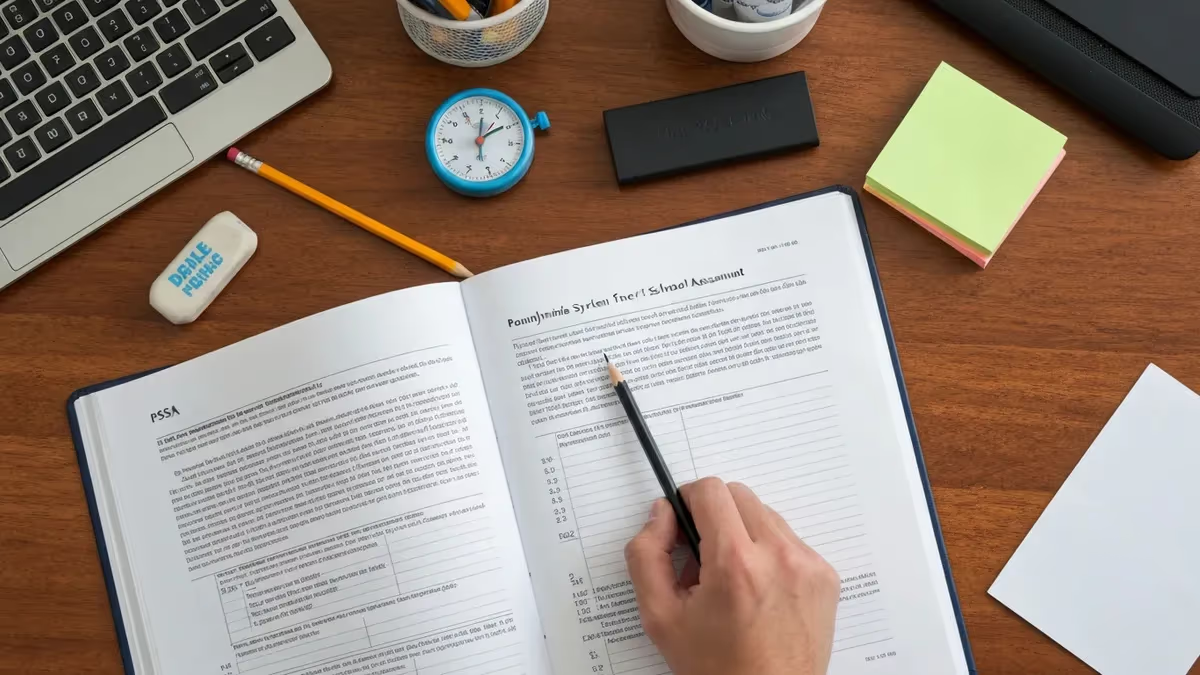
The PSSA calendar is one of the most important planning tools for Pennsylvania students, parents, and educators each school year. The Pennsylvania System of School Assessment — commonly known as the PSSA — is administered annually in grades 3 through 8 and measures proficiency in English Language Arts, Mathematics, and Science. Knowing exactly when testing windows open, when makeup days are scheduled, and when results are released allows families to plan vacations, afterschool commitments, and study schedules around these critical assessment dates.
Pennsylvania's Department of Education sets the PSSA testing window each spring, typically spanning several weeks in late March through early May. Schools are given flexibility to schedule specific test days within that window, which means the exact calendar varies slightly from district to district. However, the statewide window remains consistent from year to year, giving families a reliable framework for long-range planning. Checking with your child's school principal or district assessment coordinator is always the best way to confirm your local schedule.
Understanding the PSSA calendar goes beyond simply knowing test dates. It also means being aware of accommodation request deadlines, the timeline for receiving score reports, and the windows during which appeals or re-scores can be requested. Each of these milestones has its own deadline, and missing one can have real consequences — from a student losing access to needed accommodations to a family missing the chance to review a disputed score. Staying on top of these dates is as important as the academic preparation itself.
Parents often ask whether PSSA testing windows are the same every year. In general, the spring window has remained stable, but the Pennsylvania Department of Education does occasionally shift specific dates due to legislative changes, budget cycles, or statewide school calendar adjustments. Subscribing to your school district's email alerts and periodically checking the PDE website ensures you always have the most current information without relying on memory or word-of-mouth from prior years.
For students who want to get a head start on pssa calendar planning and academic preparation simultaneously, building a personal study schedule around the published testing window is a proven strategy. When students know exactly how many weeks remain before their first PSSA session, they can break their preparation into manageable phases — reviewing past material, practicing under timed conditions, and doing final review in the days leading up to the test. This structured approach reduces last-minute anxiety and increases the likelihood of performing at or above grade level.
Teachers and school counselors use the PSSA calendar to align classroom instruction with the assessment timeline. The weeks immediately preceding the testing window are typically reserved for review, practice testing, and addressing individual learning gaps. Schools may also adjust homework loads and extracurricular schedules during this period to give students adequate rest and focus time. Families who understand the testing calendar can reinforce these efforts at home by maintaining consistent bedtimes, healthy meals, and a positive, low-stress environment as test day approaches.
This comprehensive guide walks through everything you need to know about the PSSA calendar: the structure of the testing window, grade-level schedules, makeup day procedures, score release timelines, and practical tips for using the calendar to maximize your child's preparation. Whether you are a parent mapping out the school year, a student trying to build a study plan, or an educator looking for a clear overview to share with families, this guide provides the detail you need to navigate the PSSA testing season with confidence.
PSSA Testing by the Numbers

PSSA Testing Window: Year-Round Calendar Overview
September – October: PDE Releases Draft Calendar
November – January: District Finalization
February – March: Pre-Test Preparation Phase
Late March – Early May: Active PSSA Testing Window
May – July: Scoring and Data Processing
August: Score Reports Released to Families
The PSSA testing schedule is structured around specific subject areas at each grade level, and understanding this grade-by-grade breakdown helps families and students know exactly what to expect during the testing window. All students in grades 3 through 8 are assessed in both English Language Arts and Mathematics every single year. Science assessments, however, are only administered in two specific grade levels: grade 4 and grade 8. This targeted approach to science testing allows the state to measure foundational science literacy at two critical developmental checkpoints in a student's academic career.
For English Language Arts, the PSSA tests a range of reading comprehension and writing skills. Students at every grade level from 3 through 8 will encounter passages drawn from literary and informational texts, followed by multiple-choice and evidence-based selected response questions. Older grades are also expected to complete text-dependent analysis tasks, which require written responses that cite specific evidence from reading passages. The ELA portion of the PSSA is typically administered across multiple sessions spread over two or three school days to avoid test-fatigue during any single sitting.
The Mathematics section of the PSSA aligns with Pennsylvania's academic standards and covers a progression of content appropriate for each grade level. Third graders are assessed primarily on operations and algebraic thinking, number and operations in base ten, measurement and data, and basic geometry. By the time students reach grade 8, the mathematics content has expanded to include expressions and equations, functions, the number system, geometry, and statistics and probability. Understanding which mathematical domains are tested at each grade can help students and teachers prioritize review topics in the weeks leading up to the testing window.
The Science PSSA, administered in grades 4 and 8, covers Pennsylvania's academic standards for science with an emphasis on the Next Generation Science Standards framework. Fourth grade science content focuses on life science, physical science, earth and space science, and the nature of science. Eighth grade science expands these domains and introduces more complex concepts including forces and motion, energy, wave properties, genetics, ecology, and Earth's systems. Students who start reviewing these domains early and in an organized way tend to perform significantly better than those who cram in the final days before testing.
Parents sometimes wonder whether their child needs to be present for every day of the PSSA testing window or just specific days. In practice, each district schedules specific sessions for each grade and subject. A third-grade student, for example, may only need to be present on three or four designated days for their ELA and Math sessions — not for the entire multi-week window.
Your child's teacher or homeroom contact should be able to confirm exactly which days your child is scheduled for their specific assessments, making it easy to coordinate any necessary medical appointments or family obligations around those dates.
For students receiving special education services or English Learner support, the testing calendar includes additional considerations. Some students may take the PSSA with extended time, in smaller groups, or with other accommodations specified in their Individualized Education Program or 504 Plan. These accommodations must be documented and approved before the testing window opens — they cannot be added mid-window after testing has already begun for that student. Families who are unsure whether their child's accommodations are properly in place should contact the school's special education coordinator or assessment director well in advance of the testing window.
It is also worth noting that Pennsylvania offers the PASA (Pennsylvania Alternate System of Assessment) for students with the most significant cognitive disabilities. These students follow a different assessment calendar and testing format entirely. If your child participates in the PASA rather than the standard PSSA, your child's case manager will provide a separate calendar and set of preparation guidelines specific to that assessment. The two assessments run on overlapping but distinct schedules, so it is important to clarify with your school which assessment applies to your child.
PSSA Calendar: Key Phases of the Testing Year
Students who are absent during their scheduled PSSA session are entitled to makeup testing within the same testing window. Schools designate specific makeup days — typically scheduled at the end of each subject's primary testing block — so that absent students do not fall too far behind the rest of their class. Parents should notify the school as early as possible when a child will be absent during a scheduled test day so administrators can make the appropriate arrangements and reserve a makeup slot.
Makeup sessions are administered under the same standardized conditions as the original test — same time limits, same materials, and same security protocols. Students who miss both the primary and makeup sessions due to extended illness or emergency may receive an absence code on their score report rather than a scoreable result. In such cases, the student's assessment record reflects the absence rather than a score, which is different from receiving a low performance score. Families in this situation should speak with the district assessment coordinator to understand what documentation may be needed.
Benefits and Challenges of a Fixed PSSA Calendar
- +Predictable spring window allows families to plan vacations and events around testing season well in advance
- +Consistent annual schedule lets teachers align curriculum pacing to have all content covered before the window opens
- +Multi-week window gives districts flexibility to schedule tests around local holidays, sports seasons, and school events
- +Makeup day provisions within the window ensure absent students still have a fair opportunity to complete the assessment
- +Early score release in August allows teachers to use data to inform fall instructional planning for incoming students
- +Clear accommodation deadlines give families advance notice to ensure IEP and 504 documentation is properly in place
- −District-specific scheduling within the state window means parents cannot rely on a single date for all Pennsylvania schools
- −Long gap between testing (May) and score release (August) leaves families without results for the entire summer
- −Spring testing window coincides with high-activity periods including spring sports, concerts, and end-of-year events
- −Accommodation deadlines can be missed by families who are new to the district or unaware of the process
- −Students absent for extended periods may miss both primary and makeup sessions, resulting in no scoreable data
- −Multiple subjects tested across several days can create cumulative fatigue, especially for younger students in grades 3–4
PSSA Prep Checklist: Month-by-Month Action Steps
- ✓September: Confirm your child's grade level and which PSSA subjects they will be tested in this year
- ✓October: Check the Pennsylvania Department of Education website for the newly released statewide testing window
- ✓November: Contact your child's teacher to verify any accommodation plans are current and properly documented
- ✓December: Review your child's most recent report card and identify subject areas that may need additional focus
- ✓January: Begin a light weekly review routine using released PSSA practice questions in ELA and Math
- ✓February: Increase practice frequency to three or four sessions per week; focus on weak domains identified earlier
- ✓March: Confirm your district's specific testing days with the school office and mark them on your family calendar
- ✓Late March: Ensure your child is getting 8–10 hours of sleep nightly and eating a nutritious breakfast each morning
- ✓Testing Week: Keep your child's schedule calm and predictable — avoid late nights, new activities, or major changes
- ✓Post-Test (May–July): Monitor your school district's website and email for announcements about score release dates
Start Your Calendar Planning in September — Not March
Families who begin tracking the PSSA calendar in early fall have significantly more time to secure accommodations, build study habits, and plan around test days. The accommodation documentation process alone can take six to eight weeks — waiting until February or March puts families at serious risk of missing critical deadlines and losing access to supports their child is legally entitled to receive.
The score release timeline is one of the most frequently asked-about aspects of the PSSA calendar, and for good reason: a gap of three to four months between testing and receiving results can feel like a long wait for parents who are eager to understand how their child performed. The delay exists because of the complex scoring and data quality processes that must occur after the testing window closes. Unlike a classroom test that a teacher can grade overnight, the PSSA involves hundreds of thousands of students across the state, and written response items require human scoring by trained raters.
When score reports do arrive — typically in late August — they contain significantly more information than a simple pass or fail designation. The Individual Student Report breaks down performance into four achievement levels: Below Basic, Basic, Proficient, and Advanced. Proficient and Advanced are considered meeting the state's academic standards. Below Basic and Basic indicate that a student has not yet demonstrated grade-level proficiency and may benefit from additional instructional support in the coming school year. Importantly, a single year's score is one data point, not a definitive verdict on a student's abilities or potential.
Parents who receive their child's score report and have questions about what the results mean should request a conference with their child's teacher or school counselor. Many districts host back-to-school nights or parent information sessions in September where PSSA results are explained in context. Teachers can help families understand not just the overall score level, but also which specific skill areas within ELA, Math, or Science their child excelled in versus areas where additional practice would be beneficial. This targeted information is often more actionable than the headline performance level alone.
For families who believe their child's score does not accurately reflect their abilities, a re-score request is an option. Pennsylvania allows families to submit a formal request for their child's written response items to be reviewed and rescored by a different set of trained raters. There is a specific deadline for these requests — typically 30 to 60 days from the date the score report was distributed — so families must act promptly if they wish to pursue this option. The district assessment coordinator can walk you through the request process and any applicable fees or requirements.
It is also worth understanding how PSSA scores are used beyond the individual student level. Schools and districts use aggregated PSSA data to evaluate the effectiveness of instructional programs, identify achievement gaps among student subgroups, and make decisions about resource allocation.
Pennsylvania also uses PSSA data as one component of its school accountability system, which evaluates school performance across multiple measures including academic achievement, academic growth, graduation rates, and English Language proficiency for EL students. Parents who want to understand how their child's school is performing at the aggregate level can access publicly available school performance data through the PDE data portal.
Growth measures are particularly important to understand when reviewing PSSA score reports over multiple years. A student whose score remains in the Basic range but shows substantial year-over-year growth is making meaningful academic progress, even if they have not yet reached Proficient. Pennsylvania's accountability system rewards schools where students show strong growth trajectories, not just schools where students arrive already performing at high levels. Encouraging your child to view their PSSA results as a growth indicator — not a fixed judgment — creates a healthier mindset around assessment and academic improvement.
Finally, parents should be aware that PSSA scores are not used to determine grade promotion or retention in Pennsylvania. Promotion decisions remain at the discretion of local school districts and are based on a comprehensive review of classroom performance, teacher recommendations, and other factors — not PSSA results alone.
This means a Below Basic score on the PSSA does not automatically mean a student will repeat a grade. However, it does serve as a signal that additional academic support may be warranted, and families are encouraged to work with their school to develop a plan for addressing identified learning gaps before the next school year progresses too far.

Accommodation requests for the PSSA — including extended time, read-aloud supports, or small group testing — must be formally documented in an IEP or 504 Plan before the testing window opens. Most districts set internal deadlines in January or February. If your child needs accommodations that are not yet on file, contact your school's special education coordinator immediately — the documentation process can take six to eight weeks.
Test week itself deserves its own set of strategies, because even students who have prepared thoroughly can underperform if they are not in the right physical and mental condition when they sit down to test. Sleep is the single most impactful factor that families can control in the days leading up to PSSA sessions.
Research consistently shows that adolescents who get eight to ten hours of sleep the night before a high-stakes assessment perform measurably better on memory, reasoning, and reading comprehension tasks than peers who stayed up late studying. In the final week before testing, prioritize sleep above all other preparation activities.
Nutrition on test mornings is equally important, particularly for students in the younger grades. A breakfast that includes protein, complex carbohydrates, and healthy fats — such as eggs with whole-grain toast, or yogurt with fruit and granola — provides steady energy and cognitive fuel without the blood sugar spike and crash associated with sugary cereals or pastries. Students who routinely skip breakfast should make a special effort to eat on PSSA mornings, even if it means waking up slightly earlier than usual to allow time for a proper meal before the bus arrives.
Reducing external stressors during testing week can have a surprisingly large positive impact on student performance. This might mean temporarily pausing particularly demanding extracurricular commitments, avoiding scheduling medical appointments or family disruptions on test days, and maintaining a consistent bedtime and wake-up routine. For students who experience test anxiety, spending five to ten minutes on a simple breathing or mindfulness exercise before leaving for school can help activate the parasympathetic nervous system and reduce cortisol levels that interfere with clear thinking during assessments.
Parents play a crucial role in setting the emotional tone during PSSA week. Children pick up on parental anxiety, so families who express calm confidence — rather than excessive worry or pressure — tend to have children who approach the test with greater self-assurance. Phrases like "You've been working hard all year and you're ready for this" are more helpful than "This is really important, don't mess it up." Keeping household conversations about the PSSA positive, brief, and matter-of-fact helps students see the assessment as a normal part of school life rather than an overwhelming high-stakes event.
On the morning of each test session, students should arrive at school on time or slightly early to avoid the stress of rushing. Having all necessary materials — pencils, any permitted tools, and any required documentation for accommodations — ready the night before reduces morning chaos. Students who use assistive technology or specific accommodation setups should verify with their teacher that everything will be in place before the session begins. A calm, organized morning sets a positive tone for the hours of focused work ahead.
During the actual test, students should remember a few key strategies that consistently improve performance across assessment types. Reading each question carefully before looking at answer choices, eliminating obviously wrong answers before selecting among the remaining options, and flagging difficult questions to return to rather than getting stuck are all techniques that help students work efficiently within time limits. For written response questions, taking sixty seconds to outline key points before writing produces more organized, evidence-rich responses than starting to write immediately without any planning.
After each test session, it is tempting for students to replay questions they are unsure about and talk through their answers with classmates. However, comparing answers after the fact tends to create anxiety without serving any constructive purpose — the answers cannot be changed once submitted.
Encourage your child to mentally close the chapter on each completed session, get a good meal and some physical activity in the afternoon, and arrive the next morning feeling fresh and ready for the next subject. Focusing on what is ahead, rather than what is already done, is the most productive mindset during a multi-day testing schedule.
Building a practical, realistic study plan in the months leading up to the PSSA testing window is the most effective thing students and families can do to improve performance. The key principle of effective PSSA preparation is consistency over intensity: thirty minutes of focused practice four or five days per week from January through March will produce far better results than marathon cramming sessions in the week before the test. The brain consolidates learning during sleep, which means spaced repetition over many weeks is neurologically superior to last-minute mass practice.
One of the best preparation resources available to Pennsylvania students is the collection of released PSSA items published annually by the Pennsylvania Department of Education. These are actual questions from previous years' assessments, organized by grade level and subject. Working through released items familiarizes students with the question formats, the level of complexity expected, and the types of evidence-based thinking the PSSA rewards. Unlike generic practice books, released items are calibrated to the exact Pennsylvania academic standards that will be assessed, making them the most targeted preparation material available.
For ELA preparation specifically, students should prioritize reading broadly across both literary and informational text genres. The PSSA draws passages from a wide range of topics — science, history, biography, fiction, poetry — and students who read regularly across different genres develop the flexible comprehension skills needed to navigate unfamiliar texts under timed conditions. Encouraging your child to read for twenty to thirty minutes each evening, discussing what they read at dinner, and asking them to identify the main idea and key supporting details are all habits that build PSSA-relevant skills naturally and enjoyably.
Mathematics preparation benefits most from a domain-by-domain review approach rather than random practice across all topics. Using the PSSA Math standards for your child's grade level as a checklist, work through each domain systematically — identifying areas of strength that need only light review versus areas of weakness that require deeper reteaching and more extensive practice. Online tools, classroom resources, and released PSSA Math items can all be organized around this domain-by-domain framework to ensure no tested topic is overlooked before the window opens.
For grade 4 and grade 8 students preparing for the Science PSSA, the preparation challenge is different because science content is broad and students may not have reviewed some topics since earlier in the school year. Creating a topic checklist based on the Pennsylvania science standards — covering life science, physical science, earth and space science, and the nature of science — and working through each systematically helps ensure students feel confident across the full breadth of content. Connecting science concepts to real-world examples and everyday observations makes abstract content more memorable and easier to retrieve during testing.
Study groups can be a powerful preparation tool for older students, particularly those in grades 6 through 8. Working through practice problems with a small group of classmates encourages students to articulate their thinking, hear different problem-solving approaches, and catch each other's misconceptions before they become habits. Parents can facilitate this by hosting study sessions at home, providing snacks, and giving students a quiet space to work through released PSSA items together. The social dimension of collaborative study also makes preparation feel less isolating and more motivating.
Finally, building in regular breaks and reward milestones during your preparation plan prevents burnout and keeps motivation high over the many weeks between January and the testing window. Celebrating when a student masters a previously difficult skill — with praise, a small treat, or a fun activity — reinforces the connection between effort and progress.
Students who approach the PSSA with a growth mindset — believing that preparation genuinely improves performance — tend to engage more fully with practice materials and show greater resilience when they encounter difficult questions on test day. The calendar is your roadmap; consistent effort is the vehicle that gets you to the destination.
PSSA Questions and Answers

PSSA Prep: Study Guide for Pennsylvania Students

PA Department of Education PSSA: Complete Guide for Pennsylvania Students and Families

PSSA Calculator Policy: What Every Pennsylvania Student Needs to Know

PSSA Testing: Pennsylvania System of School Assessment Guide

Motivational Quotes for PSSA Testing: Inspire Pennsylvania Students to Do Their Best
About the Author

Educational Psychologist & Academic Test Preparation Expert
Columbia University Teachers CollegeDr. Lisa Patel holds a Doctorate in Education from Columbia University Teachers College and has spent 17 years researching standardized test design and academic assessment. She has developed preparation programs for SAT, ACT, GRE, LSAT, UCAT, and numerous professional licensing exams, helping students of all backgrounds achieve their target scores.
Join the Discussion
Connect with other students preparing for this exam. Share tips, ask questions, and get advice from people who have been there.
View discussion (8 replies)