

PS Practice Test
Updated October 2026Facts verified Oct 25, 2026 against NCEES
Starting a career as a professional land surveyor means knowing the industry's rules and licenses well. The PS (Professional Licensed Surveyor) Test is key to getting your surveying license. It lets you do boundary, construction, geodetic, photogrammetric, cadastral, and GIS mapping surveys in the U.S. This guide will get you ready for the PS Test. It will give you the knowledge and tips to pass this important exam.
The PS has 100 questions, takes about 7 hours and costs $375[1][2] (NCEES, verified Oct 25, 2026).
- The NCEES PS exam contains 100 questions.[1]
- Examinees have 7 hours to complete the NCEES PS exam, including a tutorial and an optional scheduled break.[1]
- NCEES reports all PS exam results as pass or fail, and examinees who fail receive a diagnostic report.[2]
- The NCEES PS exam fee is $375, payable directly to NCEES.[2]
- NCEES allows one PS exam attempt per testing window and no more than three attempts in a 12-month period.[2]
- The NCEES Principles and Practice of Surveying (PS) exam is administered year-round by computer-based testing at approved Pearson test centers.[2]
- The NCEES PS exam is designed for surveyors who have gained at least four years of professional experience, and some state boards require an application before registration.[2]
- NCEES PS exam results are typically available within 7–10 business days.[2]
Numbers in brackets link to the official sources listed under Sources & last verified. Dates that have passed are removed automatically.
PS Exam at a Glance
| Item | Detail | Source · Verified |
|---|---|---|
| Number of questions | 100 questions[1] | NCEES · Oct 25, 2026 |
| Time limit | 7 hours (includes tutorial and optional break)[1] | NCEES · Oct 25, 2026 |
| Passing score | Reported as pass or fail[2] | NCEES · Oct 25, 2026 |
| Exam fee | $375 exam fee paid to NCEES[2] | NCEES · Oct 25, 2026 |
| Retake policy | 1 attempt per testing window, max 3 per 12 months[2] | NCEES · Oct 25, 2026 |
| Delivery | Year-round computer-based test at approved Pearson test centers[2] | NCEES · Oct 25, 2026 |
| Eligibility | At least 4 years of professional experience; state board rules apply[2] | NCEES · Oct 25, 2026 |
| Score release | Typically within 7–10 business days[2] | NCEES · Oct 25, 2026 |
What changed for PS in 2026
- Oct 25, 2026: Delivery changed to Year-round computer-based test at approved Pearson test centers (previously Year-round CBT at Pearson VUE test centers).[2]
- Oct 25, 2026: Eligibility changed to At least 4 years of professional experience; state board rules apply (previously Designed for surveyors with at least 4 years of professional experience; state board rules apply).[2]
- Oct 25, 2026: Score release changed to Typically within 7–10 business days (previously Typically 7–10 business days).[2]
According to NCEES, “Examinees have 7 hours to complete the exam, which contains 100 questions.”[1]
PS Practice Test Questions
Prepare for the PS - Professional Licensed Surveyor exam with our free practice test modules. Each quiz covers key topics to help you pass on your first try.
PS Boundary Law & Riparian Rights
PS Exam Questions covering Boundary Law & Riparian Rights. Master PS Test concepts for certification prep.
PS Construction Layout & Staking
Free PS Practice Test featuring Construction Layout & Staking. Improve your PS Exam score with mock test prep.
PS Geodetic Datums & Coordinate Systems
PS Mock Exam on Geodetic Datums & Coordinate Systems. PS Study Guide questions to pass on your first try.
PS GNSS & RTK Survey Technology
PS Test Prep for GNSS & RTK Survey Technology. Practice PS Quiz questions and boost your score.
PS Land Measurement & Boundary Determination
PS Questions and Answers on Land Measurement & Boundary Determination. Free PS practice for exam readiness.
PS Legal Descriptions & Deed Interpretation
PS Mock Test covering Legal Descriptions & Deed Interpretation. Online PS Test practice with instant feedback.
PS Legal & Ethical Considerations in Surve...
Free PS Quiz on Legal & Ethical Considerations in Surveying. PS Exam prep questions with detailed explanations.
PS Photogrammetry & Remote Sensing
PS Practice Questions for Photogrammetry & Remote Sensing. Build confidence for your PS certification exam.
PS Professional Liability & Ethics
PS Test Online for Professional Liability & Ethics. Free practice with instant results and feedback.
PS Map Projections & Cartography
PS Study Material on PS Map Projections & Cartography. Prepare effectively with real exam-style questions.
PS Public Land Survey System (PLSS)
Free PS Test covering PS Public Land Survey System (PLSS). Practice and track your PS exam readiness.
PS Surveying Equipment & Technology
PS Exam Questions covering Surveying Equipment & Technology. Master PS Test concepts for certification prep.
PS Surveying Methods & Techniques
Free PS Practice Test featuring Surveying Methods & Techniques. Improve your PS Exam score with mock test prep.
Worked examples: how to reason through PS questions
These are practice questions written for this site, not questions from the real exam. Each explanation shows why the right answer is right and why the others are wrong.
Example 1
Question: What is the standard procedure for checking the accuracy of a building layout before concrete is poured?
- Measure diagonals of each rectangular bay and compare them to computed values
- Re-shoot each corner with GPS
- Confirm that all angles turn to exactly 90°00'00"
- Recheck only the longest dimension of the structure
Answer: A. Measure diagonals of each rectangular bay and compare them to computed values
Explanation:
The correct answer is to measure the diagonals of each rectangular bay and compare them with the computed values. Diagonals test the shape and the side lengths together, so a layout that is skewed or the wrong size will show up as a mismatch.
Re-shooting corners with GPS is wrong because it repeats positioning without checking the geometry between points, and it is not the standard check for a building layout. Confirming that every angle turns to exactly 90°00'00" is wrong because no instrument reading is perfect, and angles alone do not catch linear errors. Rechecking only the longest dimension is wrong because it leaves the other dimensions and the squareness unchecked.
Rule to remember: use an independent check that tests both angles and distances before the work is locked in.
Example 2
Question: Which quality assurance method is most commonly applied in professional liability & ethics to verify that PS professional standards are being met?
- Informal self-assessment without external validation
- Structured audits, peer reviews, and performance metrics aligned with industry benchmarks
- Relying on client satisfaction surveys as the sole measure of quality
- Annual reviews conducted exclusively by non-technical management
Answer: B. Structured audits, peer reviews, and performance metrics aligned with industry benchmarks
Explanation:
The correct answer is structured audits, peer reviews and performance metrics aligned with industry benchmarks. These give outside, measurable evidence that professional standards are being met.
Informal self-assessment without external validation is wrong because nobody independent checks the result, so blind spots stay hidden. Relying on client satisfaction surveys alone is wrong because a satisfied client may not know whether the work meets technical or legal standards. Annual reviews run only by non-technical management are wrong because the reviewers cannot judge the technical quality of the work.
Rule to remember: quality assurance needs a documented process, a technically qualified reviewer and measurable criteria, not opinion alone.
Example 3
Question: What is the term for the fractional sections created along the north and west edges of a PLSS township to account for convergence and measurement errors?
- Lots
- Aliquot parts
- Government lots
- Excess sections
Answer: C. Government lots
Explanation:
The correct answer is government lots. They are irregular fractional parcels along the north and west edges of a township, where convergence and measurement errors are absorbed.
Lots is wrong because it is a general word for a parcel and does not name this specific PLSS feature. Aliquot parts is wrong because those are regular fractional divisions of a section, such as halves and quarters, not the irregular ones created to absorb error. Excess sections is wrong because it is not a standard PLSS term for these parcels.
Rule to remember: regular divisions are aliquot parts, while irregular fractional areas created where errors accumulate are government lots.
How to use these practice tests
Start with the NCEES PS exam page and the exam specifications it links to. Read the format, the topic list and the rules on retakes, then confirm your state board's requirements. That tells you what you are practising for.
Next, take one of our practice sets cold, for example Traverse & Leveling Calculations, and do not look anything up while you answer. Mark every question you got wrong or guessed. For each one, write a single line stating the rule you missed, then go back to your reference books or your state's statutes and read the source.
Rotate through the other sets, including Legal Descriptions & Deed Interpretation, PLSS, Geodetic Datums & Coordinate Systems and Professional Liability & Ethics. Give extra time to the topics where your notes pile up. Retake a set only after a few days so you are recalling the rule and not the answer.
In the last stretch, practise sitting through a long session without breaks in your focus, since the real exam is a single long sitting with one optional break. Our questions are written by us and are not real exam items, so use them to find weak spots, not to predict your result.
Key Takeaways
Free PS Practice Test Online
- The PS Test is a crucial certification exam for land surveyors in the United States.
- Understanding the test's format, content, and scoring is essential for effective preparation.
- Familiarizing yourself with surveying regulations, principles, and best practices can significantly improve your performance.
- Developing effective test-taking strategies, such as time management and critical thinking, can boost your chances of passing the exam.
- Continuous learning and staying up-to-date with industry trends and technologies can enhance your knowledge and competency as a professional land surveyor.
Understanding the PS (Professional Licensed Surveyor) Test
To become a professional land surveyor, you need a surveying certification. This usually means passing the PS (Professional Surveyor) exam. The test checks your knowledge, skills, and if you follow industry rules.
What is a Professional Land Surveyor?
A professional land surveyor is very skilled. They measure, map, and define land boundaries. They work in many fields, like boundary surveys and construction surveys.
They use surveying instruments and surveying software for precise work.
Importance of Surveying Certification
Getting a surveying certification, like the PS (Professional Surveyor) license, is key. It shows you know surveying principles and follow rules. The surveyor licensing process checks your skills.
It includes tests like the boundary survey test and cadastral mapping assessment. This makes sure only the best professionals do the job.
| Surveying Certification Requirements | Typical Exam Domains |
|---|---|
|
|
Preparing for the PS Exam
To pass the Professional Surveyor (PS) exam, you need to prepare well and plan smart. Whether you want to get your surveying license or update your credentials, knowing the test and how to take it are key steps.
Study Resources and Materials
Starting with a good study plan is crucial. Luckily, many study resources and materials can help you feel ready for the surveying exam:

- Official surveying board exam study guides and practice tests from your state's regulatory body
- Online professional surveying test prep courses and tutorials
- Textbooks and reference materials made for the geomatics licensing exam
- Talking to experienced professional licensed surveyors and going to industry events for tips
Test-Taking Strategies
Knowing how to take the test is just as important as knowing the material. Here are some tips for the professional survey exam:
- Learn the exam format, question types, and time limits to plan your strategy
- Work on listening and reading well to understand each question fully
- Use good time management to stay on pace and avoid rushing
- Get familiar with the formulas, conversion tables, and reference materials you can use during the exam
With the right study resources and materials and smart test-taking strategies, you can feel confident in the surveying qualification or surveying regulatory exam. This will help you succeed.
PS (Professional Licensed Surveyor) Test Domains
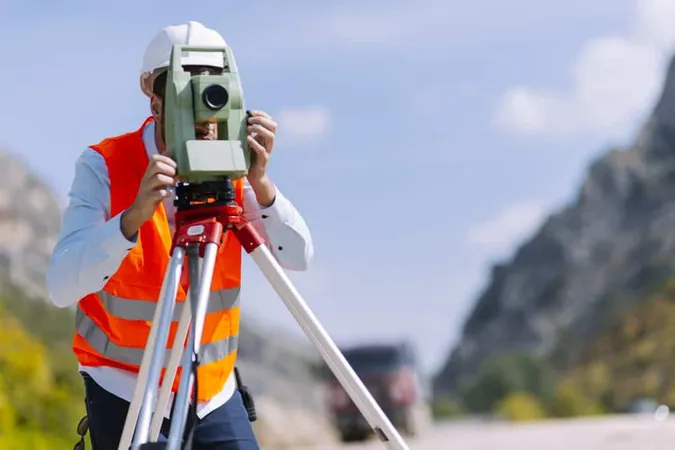
The PS (Professional Licensed Surveyor) Test covers many important areas. These include boundary surveying, construction surveying, and geodetic surveying. You'll also learn about photogrammetric mapping, cadastral surveying, and GIS mapping. Mastering these skills is key to passing the exam.
Boundary surveying is about finding property lines and boundaries. It uses legal descriptions, deed research, and field measurements. Construction surveying focuses on laying out buildings, roads, and infrastructure with precision.

Geodetic surveying maps the Earth's surface using advanced methods like triangulation and GPS. Photogrammetric mapping uses aerial and satellite images to create detailed maps and models. Cadastral surveying handles legal land ownership and property rights.
GIS mapping combines data from different sources for analysis and visualization. Being good in these areas will help you pass the PS (Professional Licensed Surveyor) Test. It also prepares you for the duties of a licensed surveyor.
Conclusion
Becoming a Professional Licensed Surveyor is a significant milestone in the career of a land surveyor, and passing the PS (Professional Surveyor) Test is essential to achieving this goal. The test not only verifies your knowledge and skills in surveying but also ensures that you are equipped to handle real-world challenges in the field. By understanding the test’s content, domains, and structure, you can develop a solid preparation plan and approach the exam with confidence.
With the right study resources, test-taking strategies, and dedication, you can successfully pass the PS Test and take your career to the next level. Remember that continuous learning, networking with industry professionals, and staying updated with new trends and technologies are key to long-term success as a licensed surveyor. Prepare thoroughly, practice wisely, and embrace the opportunity to become a certified professional land surveyor, knowing that your work will make a meaningful impact in the world of surveying and beyond.
PS: Pros and Cons
- +PS exam preparation strengthens your knowledge across all domains
- +Passing the exam proves competency to employers and clients
- +Study materials and practice tests are widely available
- +Exam-based credentials are portable across states and employers
- +Clear exam objectives help focus your study plan effectively
- −Exam anxiety can affect performance — practice tests help reduce it
- −Registration fees are non-refundable if you miss your test date
- −Limited retake opportunities may apply with waiting periods
- −Exam content updates periodically — use current study materials
- −Testing center availability may require advance scheduling
PS Exam Flashcards: Key Facts
📝 How many questions are on the PS exam and how long is it?
The NCEES Principles and Practice of Surveying (PS) exam has 100 questions and examinees get 7 hours, which also covers a tutorial and an optional scheduled break. It is a computer-based, closed-book exam with an electronic reference and uses U.S. Customary units.
START PS PRACTICE TEST💵 How much does the PS exam cost?
NCEES charges a $375 exam fee, paid directly to NCEES when you register through MyNCEES. Your state licensing board may charge its own separate application fee, and cancelling before the NCEES deadline refunds the exam fee minus a $50 processing fee.
START PS PRACTICE TEST📅 When can I take the PS exam and how often can I retake it?
The PS exam is offered year-round as a computer-based test at approved Pearson VUE test centers. NCEES allows one attempt per testing window and no more than three attempts in any 12-month period.
START PS PRACTICE TEST📚 What topics are on the PS exam?
Under the current NCEES specification the 100 questions cover five areas: Legal Principles (18–27), Professional Survey Practices (22–33), Standards and Specifications (8–12), Business Practices (13–19), and Areas of Practice (24–36). Boundary law and evidence evaluation run through several of these areas.
START PS PRACTICE TEST🔄 Is the PS exam changing in 2027?
Yes. A new NCEES PS specification takes effect in July 2027 with six areas, including Legal Principles (23–35 questions) and a separate Areas of Practice/Types of Surveys (Boundary Division) section (15–23). It also adds more explicit GNSS, RTK, PPP and LiDAR content.
START PS PRACTICE TEST📊 What is the PS exam pass rate?
NCEES reports a 63% pass rate for first-time PS examinees (614 takers) and 40% for repeat takers (411), in figures last updated July 2026. Pass rates are published for January–June and July–December testing populations.
START PS PRACTICE TEST✅ What score do you need to pass the PS exam?
NCEES does not publish a fixed percentage needed to pass; results are reported only as pass or fail. If you fail, you get a diagnostic report showing your performance in each major topic, while passing examinees receive no diagnostic report.
START PS PRACTICE TEST🧮 Which calculators are allowed on the PS exam?
For 2026 exams NCEES permits only Casio fx-115 and fx-991 models, the HP 33s and HP 35s, and Texas Instruments TI-30X and TI-36X models. Any other calculator, including graphing models, is not allowed in the test center.
START PS PRACTICE TEST📖 Can I use a reference book on the PS exam?
You cannot bring printed references. NCEES supplies an electronic PS Reference Handbook on screen during the exam, and you can download a free copy through your MyNCEES account to learn its layout before test day.
START PS PRACTICE TEST🧭 What is the difference between the FS and PS exams?
The Fundamentals of Surveying (FS) exam is the entry-level test, with 110 questions in 6 hours, SI and U.S. units, and a $225 fee. The PS exam is designed for surveyors with at least four years of professional experience; your state board sets the exact licensure requirements.
START PS PRACTICE TESTPS Questions and Answers
Official Resources
- NCEES Principles and Practice of Surveying (PS) Exam — The exam owner’s page with the current fee, exam specifications, calculator policy, pass rates and registration.
- NCEES Member Licensing Board Directory — Find your state surveying licensing board, which sets eligibility and approves you to sit for the PS exam.
- Bureau of Land Management Cadastral Survey — The federal agency responsible for the Public Land Survey System and its official survey records and manuals.
Sources & last verified
- NCEES — number of questions, time limit (official source). “Examinees have 7 hours to complete the exam, which contains 100 questions.” Verified Oct 25, 2026.
- NCEES — exam fee, passing score, retake policy, delivery (official source). “A $375 exam fee is payable directly to NCEES.” Verified Oct 25, 2026 · source checked Oct 21, 2026.
How we verify: editorial & fact-checking policy. Report an error: contact us.
How this page was made: written with AI tools and published by Nathan Beja, founder of Practice Test Geeks, who is responsible for its content. Exam facts are checked against the official sources listed below. Not reviewed by a subject-matter expert. Editorial policy
Sources & references
Exam facts on this page (fees, format, dates, passing scores) are checked against these official sources; the date is our last check. Editorial policy
- ncees.org — Test delivery, eligibility, fees, passing score, retake policy, score release, exam format, time limit · verified Oct 2026