
Parole Officer vs Probation Officer: Full 2026 October Guide
Parole officer vs probation officer: legal authority, daily duties, caseloads, salary, training. Federal and state community supervision compared. ❓

Walk into any community supervision office in the US and you will find two job titles that sound nearly identical but mean very different things: probation officer and parole officer. To the public they blur together. To the courts, the corrections system, and the people on supervised release, the distinction matters every single day. One officer keeps people out of prison. The other supervises them after prison.
This guide breaks down the real differences. We will cover who places offenders under each kind of supervision, daily duties, how caseloads compare in size and risk, salaries across state and federal jurisdictions, and the career path into either role. Both job titles fall under "community corrections" or "community supervision" (CS), and both involve case management, monitoring conditions of release, and reporting to a court or board — but the legal source of authority, the population supervised, and the politics around each role differ sharply.
Want to test your knowledge along the way? Our free probation officer practice test covers the legal terminology, case scenarios, and ethical questions that show up on civil service exams nationwide.
Probation is ordered by a judge at sentencing as an alternative to prison. Parole is granted by a board after incarceration, releasing someone early to finish their sentence in the community.
What a probation officer actually does
A probation officer supervises people who have been sentenced to community supervision instead of prison, or in lieu of incarceration. The key word is instead. A judge, at the moment of sentencing, decides that incarceration is not the right outcome for this particular defendant and this particular offense. The person goes home, they keep their job, they sleep in their own bed — but they answer to a probation officer for the next one to ten years, sometimes longer for serious felonies.
Probation is pre-prison. Or rather, it is the alternative to prison. The officer's job is to make sure the conditions the court imposed get followed: regular check-ins, drug tests, treatment programs, restitution payments, no-contact orders, employment verification, curfews, GPS monitoring in some cases, and absolutely no new arrests. Break one of those conditions and the officer can recommend revocation, which means the suspended prison sentence kicks in and the person goes inside.
Caseloads vary wildly by jurisdiction and offense type. A general adult probation officer in a mid-sized county might carry 80 to 120 active cases. A specialized officer handling sex offenders or mental health caseloads might carry 25 to 40. Federal probation officers — who work under the United States Probation and Pretrial Services — typically hold 50 to 60 cases, with heavier paperwork demands because federal sentencing guidelines are unforgiving.
For a deeper look at the role, see our breakdown of what is a probation officer and the day-to-day responsibilities.

Community supervision by the numbers
What a parole officer actually does
A parole officer supervises people who have been released from prison early on conditional liberty. Notice the contrast: prison happened. The person served part of their sentence inside a state or federal facility, and a parole board (in most states) decided they had earned conditional release before the maximum date. The remainder of the sentence is served in the community under parole supervision.
This is post-prison. The officer is monitoring someone who was, by definition, incarcerated for an offense the system considered serious enough to warrant prison time. Conditions of parole often look similar to probation conditions on paper — drug tests, treatment, curfews, employment — but the underlying risk profile differs sharply. Parolees have a documented criminal history, time served inside, and the reentry challenges that come with months or years behind bars: gaps in employment, broken family ties, exposure to prison social networks, and often untreated trauma.
Caseloads sit slightly smaller on average than probation. State parole officers typically carry 40 to 80 cases, with specialty caseloads (sex offender, gang, high-risk) dropping into the 20 to 35 range. The federal system technically does not have parole anymore — Congress abolished it in 1987 with the Sentencing Reform Act — but US Probation Officers handle supervised release, which is functionally similar.
Federal parole was abolished in 1987
The Sentencing Reform Act of 1984 eliminated federal parole for offenses committed after November 1, 1987. Federal sentences now include a fixed period of supervised release after prison, handled by US Probation Officers — not a separate federal parole agency.
The legal difference: judge vs board, pre-prison vs post-prison
Here is the cleanest way to remember which is which. Probation is ordered by a judge at sentencing. Parole is granted by a board after incarceration. Two completely different decision points, two different legal mechanisms, two different sets of authorities supervising the resulting release.
When a judge sentences a defendant to probation, the sentence might read "five years incarceration, suspended, with three years supervised probation." The five years sits in the background as a threat — break the rules and the suspended sentence activates. The probation officer's use comes from that threat. The court that imposed the sentence retains jurisdiction throughout the probation period.
Parole works differently. The sentencing judge imposed actual prison time. The person went to prison, served some portion of it, and then a parole board (or in some states, the department of corrections) reviewed the case and decided to release them under supervision. The remaining sentence converts to community time, but the parolee is still legally in the custody of the department of corrections. Violating parole means returning to prison to finish the original sentence, often with new time added.
The federal twist matters. In 1987, federal parole was abolished. People sentenced in federal court for crimes committed after November 1, 1987 are not eligible for parole at all. Instead, federal sentences include a fixed period of "supervised release" that begins after the prison term — and US Probation Officers handle it. So if someone says they are on "federal parole," they are either talking about an old case from before 1987 or they are using the wrong word. The correct term is supervised release.
Probation vs parole at a glance
Probation: ordered by a sentencing judge. Parole: granted by a parole board (or in some states, the department of corrections) after the offender has served prison time.
Probation: instead of prison, or as an alternative to incarceration. Parole: after release from prison, on conditional liberty for the remainder of the sentence.
Probation: often first-time and lower-level offenders. Parole: documented criminal history and prison time served, generally higher risk.
Probation: handled by US Probation and Pretrial Services. Parole: abolished federally in 1987 — replaced with supervised release, also run by US Probation.
Where the two jobs overlap day-to-day
Read any officer's daily log and the two jobs look almost identical from the outside. Drug tests get administered. Home visits happen, scheduled and unscheduled. Employment is verified by phone or in person. Treatment compliance gets checked across anger management, substance abuse counseling, mental health appointments, sex offender therapy. Reports go to the court or the parole board. Violations get documented and recommendations forwarded up the chain.
The overlap runs so deep that many jurisdictions combine the two roles entirely. Texas, Florida, Arizona, and several other states use the title Community Corrections Officer (CCO) or Probation/Parole Officer (PPO) for someone carrying a mixed caseload — both populations supervised by the same officer. Other states split them down the middle, with separate agencies handling each.
Daily duties side by side
Both officers maintain detailed case files, document every contact, write progress reports, and recommend changes in supervision intensity. Many use the same case management software (e.g., CIS, OBSCIS) across probation and parole within a single state.
Where the two jobs actually differ in practice
Caseload risk profile is the biggest practical difference. Probation cases skew toward first-time offenders, lower-level felonies, and misdemeanors — people who often still have jobs, intact families, and housing. The supervision goal is preventing the next offense. Parole cases come out of prison, which means a documented prior conviction serious enough for incarceration, and parolees often arrive with nothing — no job, no permanent address, sometimes no ID, frequently estranged family.
The tone of supervision differs too. Probation leans rehabilitative, focused on preventing escalation. Parole leans surveillance-heavy, particularly in the first six months out, when the parolee is adjusting to civilian life under tight conditions. Reentry planning — connecting people to transitional housing, employment programs, healthcare, and substance abuse treatment — becomes the parole officer's biggest task during the high-risk first 90 days. Agencies using evidence-based practices like the Risk-Need-Responsivity (RNR) model calibrate supervision intensity to match risk level.
State, federal, and local jurisdiction
The community supervision system in the US is a patchwork. Federal probation officers work for US Probation and Pretrial Services within the federal judiciary, supervising people convicted in federal court and those on supervised release post-incarceration. Roughly 7,000 federal probation officers operate across 94 districts. State officers work for various agencies — sometimes the department of corrections, sometimes a stand-alone probation department, sometimes the judicial branch — and most counties also run their own local probation departments for misdemeanor and lower-level felony cases. The closer you get to the federal level, the more standardized the role becomes.
If someone says they are on "federal parole" for an offense committed after 1987, they are using the wrong term. The correct term is supervised release, which is functionally similar but legally distinct. State parole still exists everywhere.
A day in the life: probation officer
Morning starts at the office. Coffee, computer login, voicemails from the night before — usually one or two from family members reporting a probationer relapse, plus a handful from defense attorneys asking about upcoming court dates. The officer pulls the day's schedule: three office visits booked for the morning, two home visits scheduled for the afternoon, one court appearance at 2pm for a violation hearing.
First office visit is a 28-year-old probationer six months into a three-year sentence for felony drug possession. The officer reviews the urinalysis results from last week (clean), confirms employment (still at the warehouse), updates the case notes, collects the monthly supervision fee, and discusses progress in the mandated substance abuse treatment. Total time, 25 minutes.
Two more office visits go similarly. Then lunch at the desk while writing a presentence investigation report — a detailed background workup for a defendant the court is about to sentence. Probation officers do these for nearly every felony case, gathering criminal history, family information, employment, education, and a sentencing recommendation. The PSI is dense, often 15 to 25 pages, and judges rely heavily on the officer's recommendation.
Afternoon means hitting the road. Two home visits, both unannounced. First house is fine — probationer is home, the place is reasonably clean, no signs of drug use. Second house, no one answers. The officer documents the attempt and tries to call. No answer. That goes in the file as a missed contact, three of which in 90 days triggers a violation report. By 4pm the officer is back at the courthouse for the violation hearing on a different case. Done by 5:30, sometimes later if the docket runs long.

What a daily caseload includes
- ✓Review overnight voicemails and emails from family, attorneys, treatment providers
- ✓Conduct office visits with scheduled supervisees, document contacts
- ✓Administer urinalysis tests and review lab results
- ✓Verify employment by phone or in-person visit
- ✓Write presentence investigation reports for upcoming sentencings
- ✓Conduct scheduled and unannounced home visits
- ✓Attend court appearances for violation hearings or sentencings
- ✓Update case files in the agency's case management system
- ✓Coordinate with treatment providers, employers, and social services
A day in the life: parole officer
A parole officer's day looks similar on the surface and very different underneath. Morning at the office, same computer work, same case notes, same paperwork — but the population coming through the door has a different profile. The first parolee of the day was released from prison eight weeks ago after serving 11 years for armed robbery.
The conversation runs longer because reentry challenges are stacking up: the job at the auto shop fell through, his cousin's place is no longer a workable address, and his elderly mother's health has deteriorated. The officer spends 45 minutes on logistics — connecting him to a workforce development program, calling a transitional housing nonprofit, scheduling a referral to a reentry case manager.
Mid-morning, the officer handles a more routine check-in: a parolee 14 months out, employed, stable, urinalysis clean for nine straight months. The conversation is brief and focuses on the next milestone — possible reduction in reporting frequency from weekly to bi-weekly. The officer documents the recommendation in the file and forwards it up the chain.
Afternoon brings a tougher visit. The officer drives to a known address to do an unannounced home visit on a parolee with a documented gang affiliation. Two other officers come along — agency policy for high-risk cases. The parolee answers the door. The home check confirms no weapons in plain view, no unauthorized people present, no signs of substance use. Twenty minutes, in and out.
By late afternoon the officer is at a community treatment center for a multidisciplinary meeting on a parolee with co-occurring mental health and substance abuse issues. The team — parole officer, therapist, peer support specialist, public defender — discusses progress and adjusts the treatment plan. These wraparound case management sessions are part of evidence-based parole supervision and reflect the shift toward the RNR model.
Salary by jurisdiction (2026)
Caseload size, risk, and specialty assignments
Standard adult probation caseloads in the US run between 50 and 120 cases per officer. Parole caseloads sit slightly smaller, typically 40 to 80. The American Probation and Parole Association recommends caseloads around 50 for general supervision and 20 for intensive cases. Reality varies — Texas TDCJ parole officers carry 65 to 75, California parole agents carry 40 to 60, New York DOCCS sits somewhere in between.
Specialty caseloads exist on both sides. Sex offender officers carry 20 to 30 cases with polygraph testing and GPS monitoring. Domestic violence units focus on victim contact and no-contact enforcement. Drug court teams meet weekly with treatment providers. Mental health caseloads require crisis response training. Gang units share intelligence with law enforcement. Juvenile probation sits in its own track, with family-focused supervision and school monitoring.
Probation vs parole as a career
- +Probation: more preventive and rehabilitative focus
- +Probation: closer working relationship with the courts
- +Probation: caseload often includes lower-risk first-time offenders
- +Parole: smaller caseloads on average than probation
- +Parole: meaningful reentry work, helping people rebuild post-prison
- +Both: stable government employment with pension and benefits
- +Both: clear promotion ladder with senior and supervisor levels
- +Both: federal track available for higher pay and structured advancement
- −Probation: heavy presentence investigation paperwork
- −Probation: caseloads often exceed recommended limits
- −Parole: higher-risk caseload with greater officer safety concerns
- −Parole: emotionally heavy work with frequent setbacks
- −Both: secondary trauma from working with high-needs populations
- −Both: bureaucratic frustrations with overburdened agencies
- −Both: budget-driven hiring freezes and salary compression
- −Both: public misunderstanding of the role and its purpose
Pros and Cons at a Glance
| Pros | Cons |
|---|---|
| Probation: more preventive and rehabilitative focus | Probation: heavy presentence investigation paperwork |
| Probation: closer working relationship with the courts | Probation: caseloads often exceed recommended limits |
| Probation: caseload often includes lower-risk first-time offenders | Parole: higher-risk caseload with greater officer safety concerns |
| Parole: smaller caseloads on average than probation | Parole: emotionally heavy work with frequent setbacks |
| Parole: meaningful reentry work, helping people rebuild post-prison | Both: secondary trauma from working with high-needs populations |
| Both: stable government employment with pension and benefits | Both: bureaucratic frustrations with overburdened agencies |
Salary, hiring path, and academy training
Pay varies more by jurisdiction than by job title. State probation and parole officers earn roughly the same because both fall under the same civil service pay scale. Federal probation pays the most. Local county positions pay the least. See the salary band breakdown above for typical 2026 ranges.
Hiring requires a bachelor's degree in nearly every state. Criminal justice is the most common major, followed by social work, psychology, and sociology. Some states accept relevant work experience in lieu of a four-year degree, but federal positions require the degree without exception.
Academy training runs six to sixteen weeks depending on the state. Federal officers train at the Federal Judicial Center in Washington, then move into on-the-job training in their assigned district. State academies cover firearms (in armed jurisdictions), defensive tactics, legal procedure, case management software, and supervision techniques. Continuing education requirements typically add 40 hours per year. For more on getting hired, see our guide to probation officer jobs and the application process.
Hiring requirements at a glance
- ✓Bachelor's degree (criminal justice, social work, psychology, sociology)
- ✓US citizenship for federal positions; check state rules for state positions
- ✓Clean criminal record — most felonies disqualifying, misdemeanors case-by-case
- ✓Pass a civil service exam (NCJOSI, state-specific, or federal Pathways)
- ✓Pass physical fitness test (1.5 mile run, push-ups, sit-ups)
- ✓Pass background investigation including credit, social media, references
- ✓Pass drug test and sometimes polygraph
- ✓Complete academy training (6-16 weeks depending on state)
- ✓Complete on-the-job training and probationary period (typically 12 months)
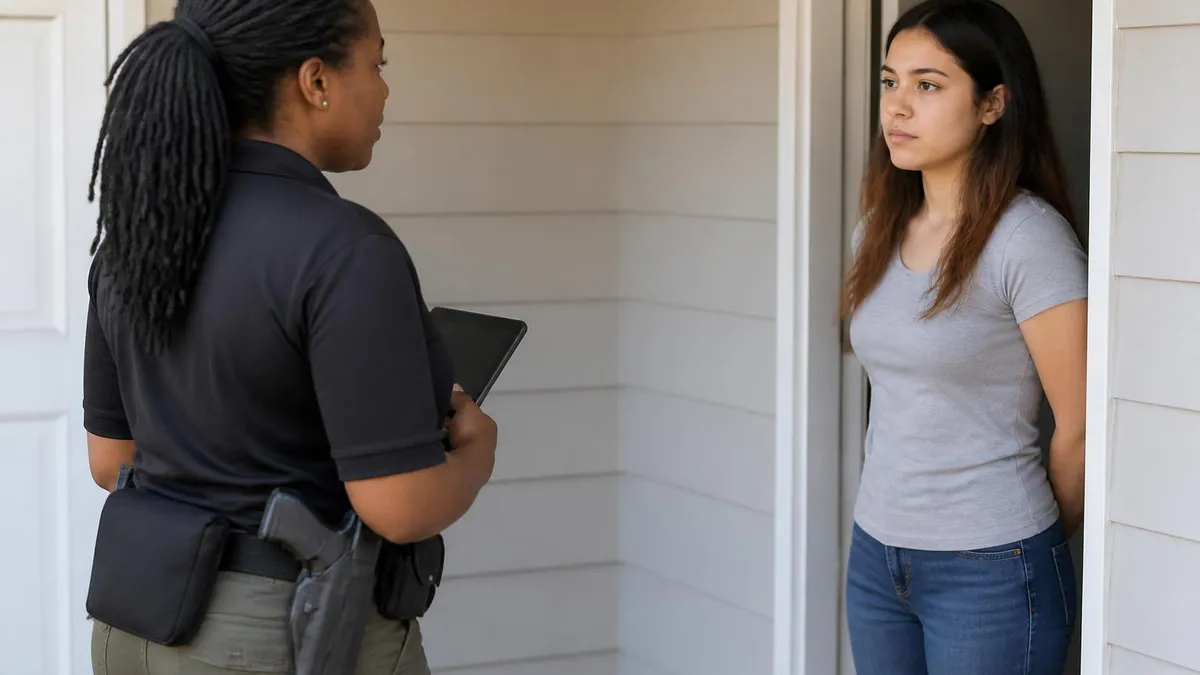
Are probation and parole officers armed?
It depends on the jurisdiction. State parole officers are commonly armed — about two-thirds of state parole agencies authorize firearms, and many require them. State probation officers are armed in about half of US states. Federal probation officers are authorized to carry firearms (since 1995) but the decision to actually carry is up to the individual officer and the district policy.
Whether armed or not, the officer is a sworn law enforcement officer in most jurisdictions, with arrest authority for violations of supervision. The "are probation officers law enforcement" question gets asked constantly because the answer varies. In federal service, yes — US Probation Officers are federal law enforcement. In most states, yes — state probation and parole officers have peace officer status. In some counties, especially for misdemeanor probation, the officer may have limited authority that does not include arrest powers.
If you are choosing between the two careers and the law enforcement aspect matters to you, ask the specific question during your application: does this position carry peace officer or law enforcement officer status? Will I be armed? What is the use-of-force policy?
In most US states and at the federal level, yes — probation and parole officers are sworn peace officers with arrest authority for supervision violations. Some county-level misdemeanor probation roles have more limited authority. Confirm peace officer status when applying.
Career path and promotion structure
The promotional ladder looks similar across both job titles. Most agencies follow some variation of:
- Probation/Parole Officer I — Entry level. First two to three years. Smaller or general caseloads, close supervision by a senior officer.
- Probation/Parole Officer II — Mid-level. Three to seven years in. Independent caseloads, possible specialty assignment.
- Senior Probation/Parole Officer — Seven to fifteen years. Mentoring junior officers, complex caseloads, courtroom expertise.
- Supervisor — Manages a unit of 5 to 8 officers. Reviews violation reports, signs off on revocations, handles personnel issues.
- District/Unit Director — Manages multiple units, sometimes a whole geographic district. Budget and policy responsibility.
- Deputy Chief / Chief — Top of the agency, sometimes appointed by the governor or chief judge.
Lateral moves are also common. A line officer might move from general supervision to a drug court team, to a special victims unit, to a presentence investigation desk. Each move builds the resume for eventual promotion. Many senior officers in federal probation started as state officers and moved into the federal system after five or ten years.
Promotion ladder timeline
Civil service exams and entry requirements
Most state and county positions require a competitive civil service exam. The NCJOSI is the most common across state and local agencies, testing reading, writing, judgment, ethics, and math. State-specific exams add their own format on top — New York State Parole Officer exam, California CDCR Cadet exam, Texas TDCJ exam, Florida DOC. Federal positions post on USAJobs.gov and use a structured Pathways assessment, often followed by a writing sample and a panel interview.
Physical fitness testing is part of the process in most jurisdictions. Expect a 1.5-mile run, push-ups, sit-ups, and sometimes a sit-and-reach using the Cooper Standards. Background checks are exhaustive — credit history, prior employers, social media, drug history, even family contacts. A felony conviction is usually disqualifying. Misdemeanors get reviewed case by case. Studying for the exam? Our probation officer practice test covers the format and question types you will see on civil service exams nationwide.
Top employers
Federal probation across 94 districts. Handles federal probation, supervised release (post-1987), pretrial services, and presentence investigations.
Largest state parole agency in the US. Division of Adult Parole Operations supervises parolees released from California state prisons.
Department of Corrections and Community Supervision runs both prisons and parole supervision statewide, including the New York State Parole Officer track.
Statewide parole supervision in Texas. Probation runs separately through county-level Community Supervision and Corrections Departments (CSCDs).
Notable agencies on both sides
Mapping out where to apply? The largest probation employers include US Probation and Pretrial Services (94 federal districts), the 58 California county probation departments, Texas CSCDs, the Florida DOC Probation Division, the New York City Department of Probation, and Illinois Adult Probation (Cook County is the largest single department). On the parole side, the California CDCR Division of Adult Parole Operations is the biggest agency in the US, followed by New York DOCCS, the Texas TDCJ Parole Division, the Pennsylvania Board of Probation and Parole, and the Florida Commission on Offender Review.
Remember — there is no separate federal parole agency. Federal supervised release runs through US Probation.
Reform pressure points
Reform issues and the future of community supervision
Community supervision sits at the center of criminal justice reform debates. Technical violations — missing a curfew, failing a drug test, skipping a treatment session — account for roughly 25% of all state prison admissions, prompting several states to cap the prison time imposable for non-criminal violations. Caseload size is another flashpoint. Officers carrying 100+ cases cannot do meaningful supervision, and reform advocates push for caseload caps and risk-based monitoring.
Reentry support is the third pillar. Parolees face their highest relapse risk in the first 90 days post-release, and agencies that fund strong reentry programs see significantly lower revocation rates. Fee structures draw similar criticism — monthly probation supervision fees of $30 to $80 function as a regressive tax on people trying to rebuild. Several states have eliminated or income-scaled these fees in recent years.
The RNR model — calibrate supervision intensity to risk, target the needs that drive criminal behavior, deliver services in a way the offender can respond to — is the gold standard for community supervision. Almost every state agency has it in policy. Implementation in practice is the harder part.
Choosing between the two careers
If you are deciding which path to pursue, a few practical considerations:
Choose probation if you are drawn to prevention work — keeping people out of prison, working with first-time offenders, conducting presentence investigations, working closely with the courts. Probation tends to suit officers who enjoy the rehabilitative side and the case management dimension.
Choose parole if you are drawn to reentry work — helping people come back into society after incarceration, navigating high-risk caseloads, coordinating with treatment and housing providers. Parole suits officers who can handle the harder population and the surveillance-heavy first months of post-prison supervision.
Or — and this is the most common path nationally — choose a state that combines the two roles. Texas, Florida, Arizona, and several others run mixed caseloads under a single job title. You get exposure to both populations, more career flexibility, and a smaller learning curve when you want to specialize later.
Federal probation is its own track. The pay is higher, the caseloads are smaller, the work is more administrative, and the standards are higher. Most federal probation officers come in with five or more years of prior experience in state or local probation, a master's degree, or both. Worth the climb if you are committed.
Which path fits which personality
Choose probation. The job leans toward keeping people from going to prison in the first place. Presentence investigations, court reports, working with first-time offenders, and rehabilitative case management make up the core of the role.
Common misconceptions about both roles
One last cluster of things people get wrong. People often say probation and parole officers are basically social workers. Partly true — the case management element is real, and many officers have social work backgrounds. But these officers also have arrest authority, conduct searches, carry firearms in many states, and write reports that can send people back to prison. The blend of law enforcement and case management is what makes the job distinctive.
Another myth: "parole is just early release." Technically and legally yes, but supervision continues. A person on parole is still serving their sentence in the community. Violate conditions and they return to finish the time. Parole is conditional liberty, not freedom. The flip side myth — "probation means you got off easy" — falls apart fast when you look at a five-year felony probation order with 80 conditions, monthly fees, weekly drug tests, GPS monitoring, and a no-contact order with your own kids. Probation is restrictive. It is just not behind bars.
One more. You do not need to be a former cop to do this work. Most probation and parole officers come straight out of college with a bachelor's degree. Diverse backgrounds — social work, education, military, even teaching — fill the ranks. If you are studying for a civil service exam or want to test what you have learned, our free probation officer study guide walks through case scenarios, legal terminology, and ethical decision-making.
Sample Probation Officer Practice Questions
Try these questions from our free Probation Officer practice tests. The correct answer and an explanation follow each question.
What is the main difference between probation and parole?
- A. Probation is a sentence served in the community instead of incarceration; parole is supervised release after serving prison time
- B. They are identical legal terms
- C. Probation applies only to juveniles
- D. Parole is decided by a jury
Answer: A. Probation is a sentence served in the community instead of incarceration; parole is supervised release after serving prison time
Probation is an alternative to incarceration, while parole follows a period of imprisonment.
Which of the following conditions of probation has been consistently upheld as constitutional by U.S. courts?
- A. Requiring an offender to donate to a political party
- B. Requiring an offender to submit to drug testing
- C. Prohibiting an offender from ever marrying
- D. Requiring the offender to work unpaid for the probation department
Answer: B. Requiring an offender to submit to drug testing
Mandatory drug testing is a widely upheld condition because it serves a legitimate government interest in monitoring compliance and public safety.
What should you do when you encounter an unfamiliar question?
- A. Leave it blank
- B. Use process of elimination, apply fundamental principles, and make an educated guess
- C. Panic
- D. Copy from another test-taker
Answer: B. Use process of elimination, apply fundamental principles, and make an educated guess
Even unfamiliar questions can be approached by eliminating obviously wrong answers and applying core concepts you do know.
Jack is a 15-year-old street gang member who is suspected of committing a variety of violent offenses, including armed robbery. Which of the following things is most likely to have contributed to Jack's juvenile delinquency?
- A. faulty personality development
- B. genetic abnormality
- C. his social environment
- D. his family's economic need
Answer: C. his social environment
Juvenile delinquency, especially involvement in street gangs and violent offenses, is most strongly influenced by a young person's social environment. Factors such as peer pressure, neighborhood conditions, lack of positive role models, and exposure to crime within their community significantly contribute to such behaviors. While other factors can play a role, the social context is often paramount.
Probation Officer Questions and Answers
About the Author
Law Enforcement Trainer & Civil Service Exam Specialist
John Jay College of Criminal JusticeMarcus B. Thompson earned his Master of Arts in Criminal Justice from John Jay College of Criminal Justice and served 12 years as a law enforcement officer before transitioning to full-time academy instruction. He is a POST-certified instructor who has prepared candidates for police entrance exams, firefighter assessments, and civil service examinations across dozens of agencies.