
Praxis 5001 Study Guide: Reading and Language Arts Prep for Elementary Education
Master praxis elementary education reading and language arts with this complete study guide. Tips, practice tests, schedules & more. 📚

The praxis elementary education reading and language arts subtest is one of the most demanding sections of the Praxis 5001 Multi-Subject exam, and it is the area where many aspiring elementary teachers invest the greatest study time. This subtest assesses your ability to teach foundational literacy skills, including phonological awareness, phonics, vocabulary development, reading comprehension, and written expression. Practice with the free Praxis 5001 - Praxis Elementary Education practice test on PracticeTestGeeks (7 questions with answer explanations).
Whether you are preparing for the combined multi-subject exam or focusing specifically on this component, building a thorough, organized study plan is the single most important step toward passing. Use this guide alongside a dedicated praxis 5002 study guide resource to reinforce your preparation across every domain.
Many candidates underestimate the breadth of content covered in the reading and language arts section. The subtest goes well beyond simple grammar rules or basic phonics. You will be expected to demonstrate knowledge of research-based reading instruction models, including the Science of Reading framework, as well as developmental writing stages, literary analysis at the elementary level, and the use of formative assessment data to guide instruction. Understanding how children acquire language and literacy—from early phonemic awareness through fluent, strategic reading—forms the backbone of what ETS tests in this subtest.
One of the most effective strategies for approaching this exam is to break your preparation into manageable weekly phases. Candidates who spread their studying over eight to twelve weeks consistently report higher confidence and better scores than those who try to cram all the material into a short window. Dedicate early weeks to content review of foundational literacy concepts, then transition to mixed practice questions, timed simulations, and targeted review of weak areas. Tracking your performance on practice tests allows you to identify specific domains where additional study will yield the greatest score gains.
The reading and language arts subtest includes multiple-choice questions that test both declarative knowledge—what you know about literacy theory and practice—and applied knowledge, such as analyzing a classroom scenario and selecting the most appropriate instructional response. Applied questions are particularly important to practice because they require you to synthesize knowledge from several areas simultaneously. For example, a scenario might describe a second-grade student who struggles with decoding multisyllabic words, and you will need to select the best phonics-based intervention strategy from the answer choices provided.
Vocabulary instruction is another high-priority area on this subtest. The exam tests your understanding of direct vocabulary instruction strategies, morphological awareness (prefixes, suffixes, root words), and context-clue strategies. Many candidates have strong intuitive vocabulary knowledge but lack familiarity with the research-based frameworks ETS expects you to apply. Reviewing academic sources such as the National Reading Panel report and Beck, McKeown, and Kucan's tiered vocabulary framework will give you the theoretical grounding the exam demands and help you distinguish between correct and distracting answer choices.
Written expression questions on this subtest require you to understand the stages of the writing process—prewriting, drafting, revising, editing, and publishing—as well as genre-specific writing instruction across narrative, informational, and persuasive text types. You should also be familiar with grammar conventions, sentence structure, mechanics, and how to teach these skills in a developmentally appropriate, integrated way rather than through isolated drill. The exam often presents sample student writing and asks you to identify the most appropriate instructional next step, so practicing with authentic student writing samples is extremely valuable preparation.
Finally, comprehension strategy instruction is a cornerstone of the reading and language arts subtest. You will need to know evidence-based comprehension strategies including predicting, visualizing, making connections, asking questions, determining main idea, and summarizing. Understanding how to scaffold these strategies for diverse learners—including English Language Learners and students with learning disabilities—is also tested. As you prepare, focus on connecting theoretical knowledge to practical classroom application, because the most challenging questions on this subtest demand both.
Free Praxis 5001 - Praxis Elementary Education Study Tools
Interactive Praxis 5001 - Praxis Elementary Education resources on PracticeTestGeeks, free to start:
- Free Praxis 5001 Basic Questions and Answers — 7 questions with answer explanations
- Praxis 5001 - Praxis Elementary Education flashcards — review key terms and concepts card by card
- Praxis 5001 - Praxis Elementary Education study guide — topic-by-topic overview of what the exam covers
- Praxis 5001 - Praxis Elementary Education cheat sheet — one-page printable summary for last-minute review
Praxis 5001 by the Numbers
- Praxis Elementary Education: Multiple Subjects (5001) contains 245 questions across its four subtests. (Educational Testing Service)
- The Praxis Elementary Education: Mathematics Subtest (5003) contains 50 selected-response and numeric-entry questions. (Educational Testing Service)
- The Praxis Elementary Education: Mathematics Subtest (5003) allows 65 minutes. (Educational Testing Service)
- The official Praxis 5001 study companion specifies 60 minutes for the Elementary Education: Science Subtest (5005). (Educational Testing Service)
- Praxis Elementary Education: Multiple Subjects (5001) passing requirements depend on the state or licensing agency rather than a national ETS passing score. (Educational Testing Service)
- A Praxis 5001 retake must be scheduled for a test date at least 28 days after the previous attempt. (Educational Testing Service)
- ETS states that Praxis scores, including Praxis 5001 scores, are valid for ten years and can be sent through additional score reports during that period. (Educational Testing Service)
- Praxis Elementary Education: Multiple Subjects (5001) is offered on computer at test centers or online at home. (Educational Testing Service)
- Praxis 5001 official score-release dates must be checked using the ETS score-reporting calendar for the selected test date and delivery method. (Educational Testing Service)
Facts verified Oct 17, 2026 against Educational Testing Service. Dates that have passed are removed automatically.
Praxis 5001 Exam at a Glance
| Item | Detail | Official source |
|---|---|---|
| Number of questions | 245 questions across four subtests | Educational Testing Service |
| Number of questions (Mathematics (5003)) | 50 selected-response and numeric-entry questions | Educational Testing Service |
| Number of questions (Reading and Language Arts (5002)) | 80 selected-response questions | Educational Testing Service |
| Number of questions (Science (5005)) | 55 selected-response questions | Educational Testing Service |
| Number of questions (Social Studies (5004)) | 60 selected-response questions | Educational Testing Service |
| Time limit (Mathematics (5003)) | 65 minutes | Educational Testing Service |
| Time limit (Science (5005)) | 60 minutes in the official study companion | Educational Testing Service |
| Passing score | Set by the state or licensing agency | Educational Testing Service |
| Retake policy | At least 28 days between attempts | Educational Testing Service |
| Validity | Scores valid for 10 years under ETS policy | Educational Testing Service |
| Delivery | Computer-based at a test center or online at home | Educational Testing Service |
| Score release | Check the ETS calendar for the test date and delivery method | Educational Testing Service |
| Testing window | At-home testing available seven days a week | Educational Testing Service |
Facts verified Oct 17, 2026 against Educational Testing Service. Dates that have passed are removed automatically.

10-Week Praxis 5001 Study Schedule
- ▸Review phoneme segmentation and blending concepts
- ▸Study systematic phonics scope and sequence
- ▸Complete 20 practice questions on decoding
- ▸Study fluency benchmarks by grade level
- ▸Review tiered vocabulary frameworks (Beck et al.)
- ▸Practice 25 questions on vocabulary strategies
- ▸Learn all 7 major comprehension strategies
- ▸Study text structure (narrative vs. informational)
- ▸Complete a full reading subtest practice set
- ▸Review 5 stages of the writing process
- ▸Study genre-specific writing instruction
- ▸Analyze sample student writing for instructional next steps
- ▸Review sentence structure and grammar rules
- ▸Study developmental spelling stages
- ▸Complete 30 grammar and conventions questions
- ▸Cover number sense and operations
- ▸Review geometry and measurement concepts
- ▸Complete a full math subtest timed practice
- ▸Review key social studies standards (geography, civics, history)
- ▸Study life science, earth science, and physical science basics
- ▸Complete 40 mixed social studies and science questions
- ▸Review visual arts and music fundamentals
- ▸Study health education standards
- ▸Complete arts and PE practice question sets
- ▸Complete two full 175-question timed practice exams
- ▸Score and analyze results by domain
- ▸Identify top three weak areas for targeted review
- ▸Drill weakest content areas intensively
- ▸Review all flagged practice questions
- ▸Rest day before exam, light review of key terms only
Understanding the content architecture of the Praxis 5001 is essential before diving into subject-specific review. The exam is organized into four major subtests: Reading and Language Arts, Mathematics, Social Studies, and Science, with an additional section covering Health, Physical Education, Fine Arts, and General Knowledge. Each subtest has a defined weight in the overall score, and the Reading and Language Arts section carries the greatest weight at approximately 30 percent of the total exam. This means that strong performance in literacy content directly drives your overall passing chances more than any other single area.
Within Reading and Language Arts, ETS organizes the tested content into five broad categories. The first is Foundational Literacy Skills, which includes phonological awareness, phonics and decoding, fluency, and early print concepts. The second is Vocabulary Acquisition and Use, covering direct instruction strategies, morphological analysis, and context clues.
The third is Reading Comprehension, which includes literary analysis, informational text comprehension, and comprehension strategy instruction. The fourth is Written Expression, encompassing the writing process, genre-specific writing, grammar, and mechanics. The fifth is Language and Literacy Development, covering how students acquire language and how to support diverse learners, including ELLs and students with reading difficulties.
Phonological awareness deserves special attention because it is a foundational prerequisite to reading acquisition, and it is frequently misunderstood by test-takers. Phonological awareness refers to the ability to hear and manipulate the sound structure of language, independent of print. This includes skills like rhyming, syllable counting, onset-rime manipulation, and phoneme isolation. Phonemic awareness—the most advanced phonological skill—specifically involves working with individual phonemes, the smallest units of sound. The Praxis exam often tests your ability to distinguish between these levels of awareness and to identify appropriate activities for each developmental stage.
Phonics instruction, by contrast, is the systematic teaching of the correspondence between letters and sounds. Research strongly supports explicit, systematic phonics instruction as the most effective approach for beginning readers, and the Science of Reading movement has brought renewed emphasis to this evidence base in recent years.
For the exam, you should be familiar with the major phonics patterns (CVC, CVCe, consonant blends, digraphs, diphthongs, r-controlled vowels, and multisyllabic word patterns) and the typical instructional sequence in which they are introduced. Questions may ask you to identify the phonics skill being practiced in a given activity or to select the most appropriate next step in a scope and sequence.
Reading fluency is often defined by three components: accuracy, rate, and prosody (expression). Research by Rasinski and others has established clear grade-level fluency benchmarks that are frequently referenced on the exam. Fluency instruction typically involves repeated reading, paired reading, reader's theater, and other methods that provide students with meaningful practice reading connected text at an appropriate instructional level. A key distinction the exam tests is between fluency as an end goal versus fluency as a bridge to comprehension—strong test-takers understand that fluency instruction is ultimately in service of reading comprehension, not an isolated skill.
Comprehension instruction has been transformed by research from the National Reading Panel and subsequent cognitive science work. The exam expects you to know explicit comprehension strategy instruction, including how to model strategies through think-alouds, how to guide students through collaborative practice, and how to scaffold independent strategy application. Text structure knowledge—understanding how both narrative and informational texts are organized—is another key comprehension topic. For informational texts, students benefit from understanding structures like description, sequence, comparison, cause-effect, and problem-solution, all of which are tested on the Praxis.
Writing instruction on the exam spans the full writing process as well as genre-specific instruction across narrative, opinion/argumentative, and informational writing. You should understand how to use mentor texts, how to teach revision versus editing as distinct processes, and how to provide effective written feedback to student writers. The exam may also ask about writing workshop models, the six traits of writing framework, or standards-aligned writing instruction. Grammar and mechanics instruction is most effective when integrated into authentic writing contexts rather than taught in isolation—a principle the exam frequently tests through scenario-based questions.
Study Strategies by Domain: Reading, Writing, and Language Arts
For the reading comprehension domain, the most effective study strategy is to practice identifying comprehension strategies in context rather than simply memorizing their names. Work through sample classroom scenarios and ask yourself: what strategy is this teacher modeling, and is it developmentally appropriate for the grade level described? Reviewing the gradual release of responsibility framework—I do, We do, You do—will help you answer questions about how to scaffold comprehension strategy instruction across a lesson sequence. Also study text complexity and how to select appropriate texts for instruction using qualitative, quantitative, and reader-task criteria.
Informational text comprehension deserves dedicated study time because it is frequently underweighted by candidates who focus primarily on narrative literacy. Practice distinguishing between the major informational text structures: description, sequence, comparison/contrast, cause and effect, and problem/solution. Know how to teach students to use graphic organizers that match each text structure. Questions about close reading, evidence-based responses, and text-dependent questions are also common, especially for upper elementary grade-level scenarios. Aim for at least two full practice sets focused exclusively on informational comprehension before your exam date.

Praxis 5001 Self-Study vs. Structured Test Prep Course
- +Self-study allows you to focus time on your personal weak areas rather than following a generic syllabus
- +Free and low-cost resources (ETS study companion, practice tests, this guide) make self-study highly affordable
- +Flexible scheduling lets you study at your own pace around student teaching and coursework obligations
- +Building your own study schedule reinforces time-management skills valued in teaching careers
- +Online practice question banks allow unlimited repetition of specific content domains until mastery
- +Many candidates pass on first attempt using free resources combined with disciplined daily practice
- −Without external accountability, it is easy to procrastinate or to under-study low-interest content areas
- −Self-study candidates may lack access to expert explanations for challenging question types
- −Identifying your own knowledge gaps requires honest self-assessment that some candidates avoid
- −Structured courses provide score guarantees and retake support that self-study cannot replicate
- −Group study dynamics in prep courses can improve motivation and expose you to diverse perspectives on scenarios
- −Some prep courses include live tutoring and personalized feedback on practice essays that self-study cannot provide
Complete Praxis 5001 Reading and Language Arts Prep Checklist
- ✓Download and read the official ETS Praxis 5001 Study Companion for the reading and language arts subtest.
- ✓Review all five phonological awareness levels: rhyme, syllable, onset-rime, phoneme isolation, and phoneme manipulation.
- ✓Create a phonics scope-and-sequence chart covering all major patterns from CVC through multisyllabic words.
- ✓Study the Science of Reading framework and its five pillars: phonemic awareness, phonics, fluency, vocabulary, and comprehension.
- ✓Memorize end-of-year oral reading fluency benchmarks for grades 1 through 5.
- ✓Practice identifying Tier 1, Tier 2, and Tier 3 vocabulary in sample passages and lesson scenarios.
- ✓Review all six stages of the writing process and the instructional focus appropriate at each stage.
- ✓Study the five developmental spelling stages and the characteristics of student writing at each stage.
- ✓Complete at least three full-length timed practice tests under realistic exam conditions.
- ✓Analyze every missed practice question by content category and track patterns to guide targeted review.
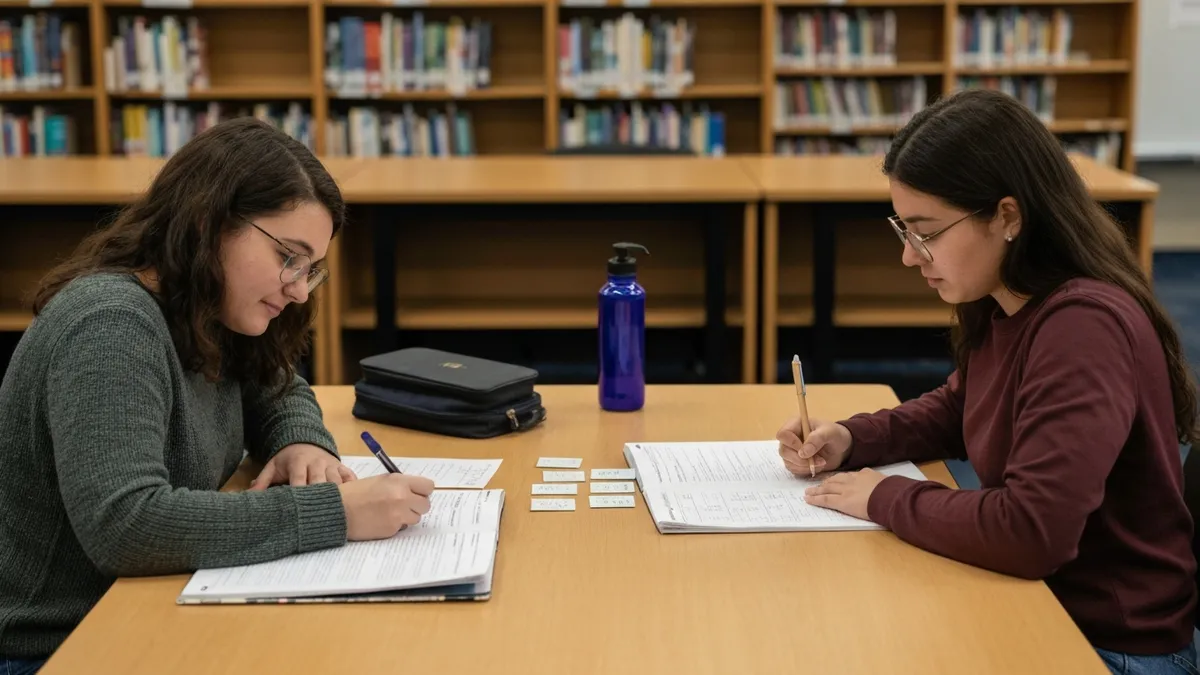
The Science of Reading is Your Secret Weapon
The most recent revisions to the Praxis 5001 place heavy emphasis on evidence-based, structured literacy practices aligned with the Science of Reading. Candidates who understand the five pillars of reading instruction—phonemic awareness, phonics, fluency, vocabulary, and comprehension—and can apply them to classroom scenarios answer approximately 20-25% more questions correctly than those who rely on intuition alone. Invest at least two full study sessions in mastering this framework before exam day.
Taking full-length practice tests is the single most powerful preparation strategy available to Praxis 5001 candidates, yet many test-takers skip this step or treat practice tests as supplemental rather than central to their preparation. Authentic timed practice replicates the cognitive demands of the real exam far more effectively than content review alone. When you complete a 175-question timed exam under realistic conditions—no interruptions, no phone, same time of day as your real test—you build the mental endurance and time-management habits that directly translate to better performance on exam day.
After completing each practice test, spend at least as much time reviewing your results as you spent taking the test. For every question you missed, identify whether the error was a content knowledge gap, a careless misread, or a reasoning error under the distractor effect. Distractor-driven errors—where you knew the right answer but were drawn to a plausible wrong answer—are particularly important to analyze because they reveal the exact thinking traps the test-writers are trying to create. Understanding why wrong answers are wrong is just as valuable as knowing why correct answers are correct.
ETS provides official Praxis 5001 practice tests through their website, and these are the gold standard for preparation because they reflect the actual item formats, difficulty distribution, and content weighting of the real exam. Use official practice materials for your timed full-length simulations and reserve third-party question banks for supplemental drilling on specific content domains. Third-party questions vary considerably in quality and alignment to current exam specifications, so always cross-reference what you learn from unofficial sources with the official ETS Study Companion.
When analyzing your practice test performance, organize your results by the five content categories within Reading and Language Arts: Foundational Literacy Skills, Vocabulary, Reading Comprehension, Written Expression, and Language and Literacy Development. If you consistently score below 70 percent in any category, that area deserves at least two additional dedicated study sessions before your exam date. If you are scoring above 85 percent in a category, shift time toward your weaker domains—over-studying your strongest areas produces diminishing returns when exam day approaches.
Scenario-based questions on the Praxis 5001 require a distinct approach compared to factual recall questions. For scenario questions, read the classroom situation carefully before looking at the answer choices—form your own prediction of the best instructional response before the distractors influence your thinking. The wrong answers on scenario questions are often partially correct, which is precisely what makes them difficult. ETS designs distractors that represent real instructional approaches that are simply not the best choice given the specific details of the scenario. Slowing down to read every answer choice fully before selecting is essential on these question types.
Time management during the actual exam requires deliberate practice to master. With 175 questions and approximately 180 minutes of testing time (the actual per-subtest timing varies), you have roughly one minute per question on average. In practice, factual recall questions should take 30-45 seconds each, leaving extra time for complex scenario questions that may require 90-120 seconds. During your timed practice tests, monitor your pace every 30 questions by checking the clock. If you are falling behind, practice skipping difficult questions immediately and returning to them after completing the rest of the section.
The night before your exam, avoid intensive studying. Research on memory consolidation consistently shows that adequate sleep is more beneficial to test performance than late-night cramming. Instead, spend 30 minutes doing a light review of your most important notes—the phonics scope and sequence chart, the five reading pillars, and the writing stages you have committed to memory. Prepare everything you need for exam day (identification, registration confirmation, directions to the testing center) and get to bed at your normal time. Arriving at the testing center early and calm is worth more than any last-minute review session.
Register for the Praxis 5001 well in advance of your state's teacher certification deadline—most states require official score reports to be submitted directly to the state education agency, and score processing takes up to 10-16 business days after your test date. Missing a score submission deadline can delay your license by an entire semester. Check your state's specific cut score requirement before registering, as passing scores vary by state (commonly between 157 and 167).
The final weeks of your Praxis 5001 preparation should shift from broad content review to targeted, high-intensity practice on your most persistent weak areas. By this point in your study plan, you have completed at least two full timed practice tests and have clear data about which content categories cost you the most points. The most efficient use of your remaining preparation time is to focus approximately 60 percent of your study sessions on those weak areas while using the remaining 40 percent for mixed practice to maintain performance across all domains.
For reading and language arts specifically, the final weeks are an excellent time to focus on applied, scenario-based questions because these are the highest-difficulty items on the subtest and the ones most likely to separate passing candidates from borderline candidates. Create a flashcard or summary sheet for each major instructional framework tested on the exam: the gradual release of responsibility model, Bloom's Taxonomy applied to comprehension questioning, the five pillars of reading instruction, Beck's three-tier vocabulary model, and the developmental spelling stages. Review these frameworks daily during your final two weeks so they are immediately accessible during the exam.
Building your ability to analyze student work samples is another high-yield activity for final-week preparation. The Praxis 5001 frequently presents a sample of student writing, a reading response, or a piece of student-produced text and asks you to identify the most appropriate instructional next step. Practice this skill by finding authentic elementary student writing samples online and asking yourself: what is this student doing well, what is the most significant area for growth, and what specific strategy would I teach next? This exercise closely mirrors the thinking required by the most challenging scenario questions on the real exam.
Grammar and language conventions deserve a dedicated final-week review session even if you feel confident in this area, because the exam tests these skills in ways that differ from how most adults think about grammar. The Praxis tests grammar within the context of student writing and literacy instruction, not as isolated rules.
You should be able to identify a student's grammatical error in a writing sample, name the specific convention being violated, and select the most appropriate mini-lesson or instructional approach to address it. Review the Common Core Language Standards for grades K-6, as these provide an organized, grade-level scope and sequence for conventions instruction that aligns well with what ETS tests.
In the final days before your exam, take one more full-length timed practice test under authentic conditions. Do not save this test for the night before—complete it three to four days before your exam date so you have time to review your results and do any final targeted review. This final practice test also serves as a confidence builder: if you score at or above the passing threshold, you can approach exam day knowing you have already demonstrated you can pass. If you score below the threshold, you still have a few days to address specific gaps without panic.
Test-taking strategies matter significantly on multiple-choice exams like the Praxis 5001. Learn to identify and avoid common distractor patterns: answers that are true statements but do not address the specific question asked, answers that represent outdated instructional practices no longer supported by research, and answers that are appropriate for a different grade level than the one described in the scenario. When you encounter a question where two answer choices both seem correct, use the process of eliminating the answer that is more general, less research-supported, or less directly targeted to the specific student need described in the scenario.
Reviewing your classroom experiences and field placement observations can also be a surprisingly effective final-week strategy. The applied scenario questions on the Praxis 5001 are grounded in realistic classroom situations, and your own memories of effective literacy instruction you have observed or provided can help you connect abstract knowledge to concrete practice. Think about specific lessons or student interactions where you saw phonics instruction, comprehension strategy modeling, or writing conferences in action. That lived experience, combined with your academic preparation, gives you a powerful foundation for answering the most challenging scenario questions on exam day.
Practical test-day habits can make a meaningful difference in your performance on the Praxis 5001, and building these habits during your practice sessions is the best way to ensure they are automatic when it matters most. Arrive at the testing center at least 20 minutes early to allow time for check-in procedures, which typically include identity verification, signing in, and receiving your assigned testing station. Arriving rushed or flustered uses cognitive resources that you need for the exam itself. Bring your valid government-issued photo identification and your ETS registration confirmation—without these, you cannot be admitted to test.
During the exam, use the flagging feature in the computer-based testing interface to mark questions you are uncertain about so you can return to them after completing the questions you are confident in. A common time-management mistake is spending too long on a single difficult question while easier questions remain unanswered.
It is always better to give every question your best quick attempt and then return for a second look than to leave questions unanswered because you ran out of time. Even an educated guess on a question you are uncertain about has a 25 percent chance of being correct on a four-option question—leaving it blank guarantees zero points.
For scenario-based questions in the reading and language arts section, a proven strategy is to read the question stem before reading the scenario. When you know what the question is asking—for example, what is the most appropriate next instructional step for this student?—you can read the scenario with a focused lens and pick up the most relevant details more efficiently. Then, after reading the scenario, predict your answer before looking at the choices. This prediction step prevents the distractors from anchoring your thinking to a wrong answer before you have reasoned through the problem independently.
Managing test anxiety is a legitimate part of Praxis preparation that many candidates overlook. The most effective strategies for reducing test anxiety are thorough preparation (which you have built through your eight-to-ten-week study plan), positive visualization (imagining yourself reading questions calmly and selecting correct answers confidently), and controlled breathing techniques to use if you feel anxious during the exam. A slow, four-count inhale followed by a six-count exhale activates the parasympathetic nervous system and reduces the fight-or-flight response that makes anxious test-takers rush through questions or second-guess correct answers.
If you do not pass on your first attempt, the Praxis 5001 can be retaken after a 21-day waiting period. Use your score report strategically—ETS provides a score breakdown by content category, which tells you exactly where to focus your preparation for your retake.
Many candidates who do not pass on their first attempt do pass on their second or third attempt, especially when they use detailed score feedback to target their weakest content areas. Do not be discouraged by a first attempt that falls below the passing threshold; treat it as an extremely detailed diagnostic that tells you precisely where to invest your next round of study time.
Building a study group with peers who are also preparing for the Praxis 5001 can significantly accelerate your preparation, particularly for scenario-based questions. Discussing why different answer choices are correct or incorrect with someone else forces you to articulate your reasoning in a way that reading alone does not. Study groups also provide accountability, exposure to different ways of thinking about classroom scenarios, and mutual support during a demanding preparation period. If in-person study groups are not feasible, online forums and social media communities of Praxis test-takers can provide similar benefits through asynchronous discussion of practice questions and study strategies.
Ultimately, passing the Praxis 5001 Reading and Language Arts subtest is an achievable goal for any candidate who invests in systematic, evidence-based preparation. The content tested on this exam is the same content you will use every day as an elementary teacher: teaching children to read, write, and communicate effectively is the most important work of the elementary grades, and the Praxis measures your readiness to do that work well.
Approach your preparation not just as test prep but as professional development that will make you a more knowledgeable, more effective literacy teacher from the first day you set foot in your classroom.
Sample Praxis 5001 - Praxis Elementary Education Practice Questions
Try these questions from our free Praxis 5001 - Praxis Elementary Education practice tests. The correct answer and an explanation follow each question.
An elementary teacher integrates social studies with language arts by having students read historical fiction. What is a key benefit of this interdisciplinary approach?
- A. It replaces the need for direct social studies instruction
- B. It builds historical context and literacy skills simultaneously
- C. It is only effective for advanced readers
- D. It eliminates the need for primary source analysis
Answer: B. It builds historical context and literacy skills simultaneously
Historical fiction provides narrative context for historical periods while developing literacy skills, making interdisciplinary connections that deepen learning in both subjects.
Erikson's stage 'Industry vs. Inferiority' occurs during elementary school years. A positive resolution leads to:
- A. A strong sense of personal identity
- B. Feelings of competence and capability
- C. Autonomy and independence from parents
- D. Trust in caregivers
Answer: B. Feelings of competence and capability
When children successfully master skills and tasks during the Industry vs. Inferiority stage, they develop a sense of competence and industry.
Which factor is considered the most powerful influence on children's early language development?
- A. Screen time exposure
- B. Educational toys
- C. Quality and quantity of adult conversation and interaction
- D. Formal instruction beginning at age 2
Answer: C. Quality and quantity of adult conversation and interaction
Research consistently shows that the richness of adult-child verbal interaction — including quantity, variety, and responsiveness — is the strongest predictor of children's language development.
An elementary social studies unit focuses on community helpers and their roles. Which NCSS thematic strand does this best address?
- A. Time, Continuity, and Change
- B. People, Places, and Environments
- C. Individual Development and Identity
- D. Power, Authority, and Governance
Answer: B. People, Places, and Environments
Studying community helpers and their roles in the local area aligns with the 'People, Places, and Environments' NCSS strand, which explores how people interact with their communities.
Take the full Praxis 5001 - Praxis Elementary Education practice test
Praxis 5001 Questions and Answers

Praxis 5001 Practice Test: Free Questions & Complete Prep Guide

Ace Your Praxis 5001 Elementary Education Test

Praxis 5001 Quizlet: Best Flashcard Strategies and Free Practice Tests for Elementary Education

Praxis Elementary Education (5001): Complete Guide to Passing the Multi-Subject Exam

Praxis 5001 Study Guide: Complete Prep Plan for Elementary Education
How this page was made: written with AI tools and published by Nathan Beja, founder of Practice Test Geeks, who is responsible for its content. Exam facts are checked against the official sources listed below. Not reviewed by a subject-matter expert. Editorial policy
Sources & references
Exam facts on this page (fees, format, dates, passing scores) are checked against these official sources; the date is our last check. Editorial policy
- praxis.ets.org — Retake fee, score validity, test dates, retake policy, passing score, exam format, time limit, test delivery, fees · verified Oct 2026