
Pellet B Practice Test 2026 — California POST Written Exam Prep Guide
Get ready for your Pellet B certification. 🏆 Practice questions with step-by-step answer explanations and instant scoring.
What Is the Pellet B Test?
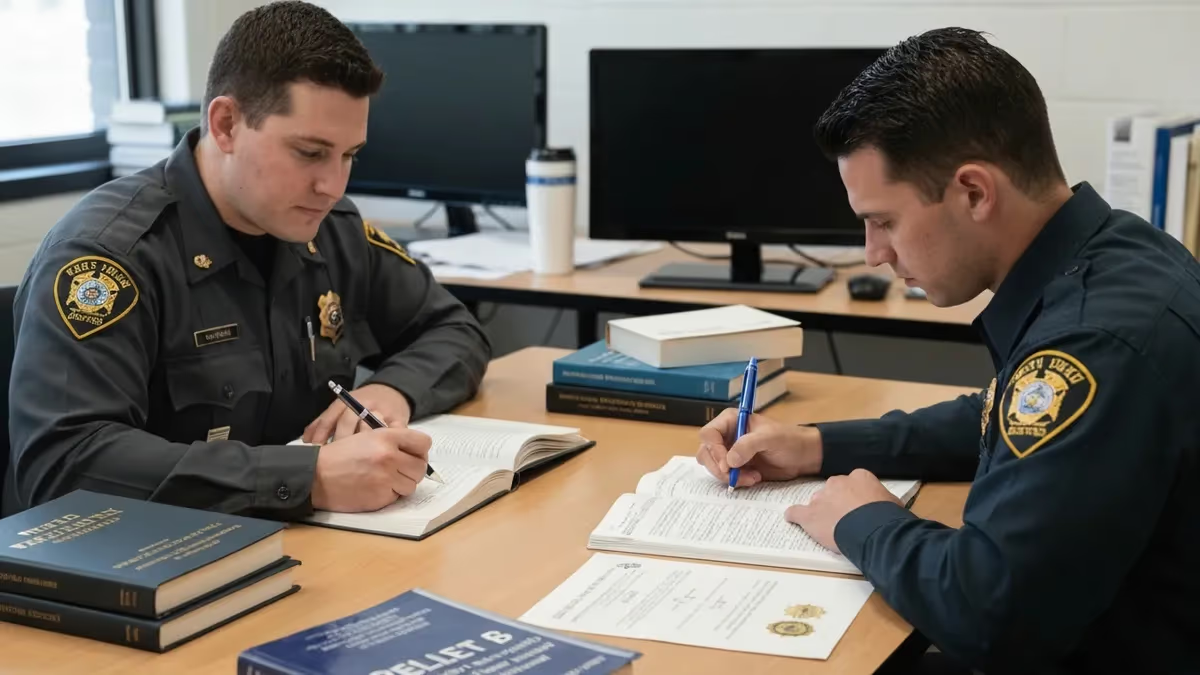
The Pellet B is a standardized written examination developed and validated under California POST (Peace Officer Standards and Training) guidelines. It is formally known as the POST Entry-Level Law Enforcement Test Battery (PELLETB) and is used by hundreds of California law enforcement agencies to evaluate candidates for sworn peace officer positions. Practice with the free PELLET B practice test on PracticeTestGeeks (9 questions with answer explanations).
Unlike many other law enforcement entrance exams, the Pellet B does not test knowledge of criminal law, police procedures, or law enforcement tactics. Instead, it measures the general cognitive abilities and written communication skills that are considered essential for success in a law enforcement career — specifically reading comprehension, writing ability, and logical reasoning.
The exam is administered by Cooperative Personnel Services (CPS HR Consulting) on behalf of agencies, or agencies may administer it directly through POST. Candidates typically take the Pellet B early in the hiring process, often before the physical agility test, background investigation, or polygraph examination.
Test Format and Sections
The Pellet B consists of approximately 100 to 105 questions divided across four main sections. The total testing time is approximately 2.5 hours. Understanding each section gives you a significant advantage when preparing.
- The reading part of the PELLET B is a single reading comprehension sub-test with 20 to 24 multiple-choice items. The CLOZE sub-test was removed on January 1, 2025. (California Commission on Peace Officer Standards and Training)
- The writing part of the PELLET B has 45 to 54 multiple-choice items across three sub-tests: spelling, vocabulary and clarity. (California Commission on Peace Officer Standards and Training)
- POST lets each hiring agency set its own PELLET B passing score but recommends a T-score of 42 or above. T-scores have a mean of 50 and a standard deviation of 10. (California Commission on Peace Officer Standards and Training)
- POST puts no expiry date on a PELLET B score, but each hiring department can set its own time limit for accepting older scores. (California Commission on Peace Officer Standards and Training)
- Only authorized California law enforcement agencies may give the PELLET B, and only inside California. POST's applicant FAQ says it is given in paper-and-pencil format. (California Commission on Peace Officer Standards and Training)
- To take the PELLET B, applicants must contact California law enforcement agencies or basic training academies that give it. POST does not keep a list of testing locations or test dates. (California Commission on Peace Officer Standards and Training)
- The agency or academy that gave the PELLET B must give each applicant their reading, writing and total T-scores in writing within 30 days of the test. POST does not give scores to applicants. (California Commission on Peace Officer Standards and Training)
Facts verified Oct 20, 2026 against California Commission on Peace Officer Standards and Training. Dates that have passed are removed automatically.
PELLET B Exam at a Glance
| Item | Detail | Official source |
|---|---|---|
| Number of questions (Reading Test) | 20–24 reading comprehension items | California Commission on Peace Officer Standards and Training |
| Number of questions (Writing Test) | 45–54 multiple-choice items (spelling, vocabulary, clarity) | California Commission on Peace Officer Standards and Training |
| Passing score | Set by each agency; POST recommends a T-score of 42 or higher | California Commission on Peace Officer Standards and Training |
| Validity | No POST expiry; agencies may set their own limits | California Commission on Peace Officer Standards and Training |
| Delivery | In person, through authorized California agencies (paper-and-pencil) | California Commission on Peace Officer Standards and Training |
| Eligibility | Register through a participating agency or academy; POST does not schedule tests | California Commission on Peace Officer Standards and Training |
| Score release | Within 30 days, from the testing agency | California Commission on Peace Officer Standards and Training |
Facts verified Oct 20, 2026 against California Commission on Peace Officer Standards and Training. Dates that have passed are removed automatically.
Free PELLET B Test Study Tools
Interactive PELLET B Test resources on PracticeTestGeeks, free to start:
- PELLET B Test flashcards — review key terms and concepts card by card
- PELLET B Test study guide — topic-by-topic overview of what the exam covers
- PELLET B Test cheat sheet — one-page printable summary for last-minute review
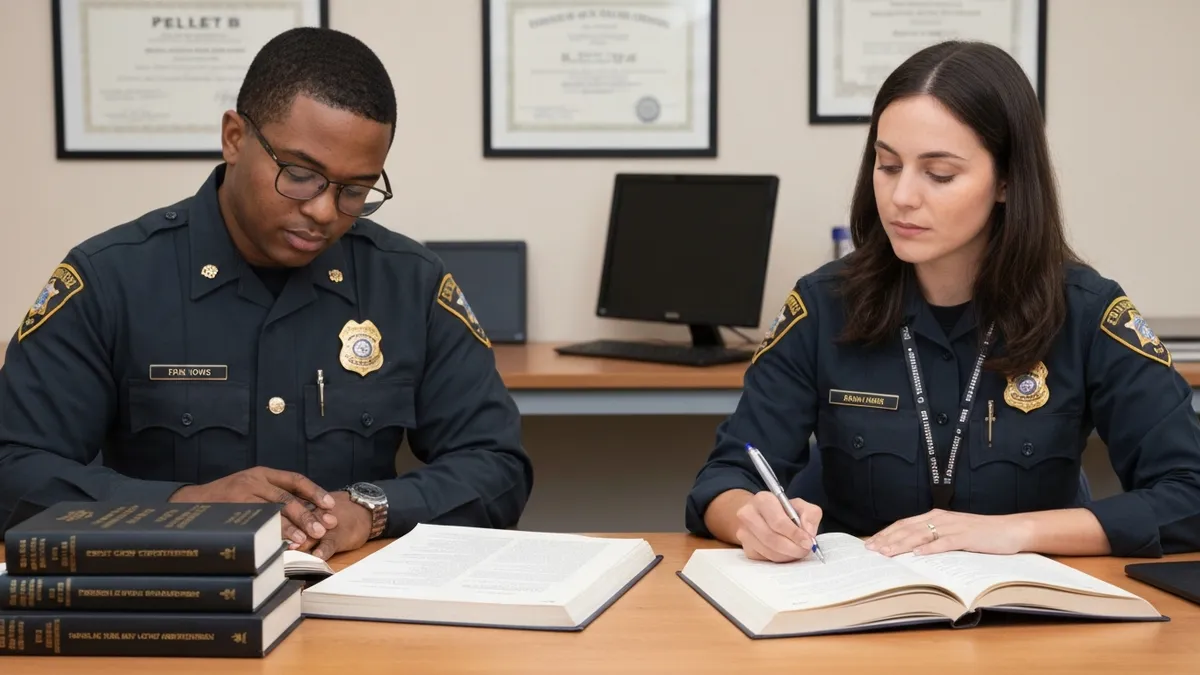
- ✓Read news articles, editorials, and non-fiction books daily to build reading comprehension speed and accuracy
- ✓Practice identifying main ideas, supporting details, and inferences from passages
- ✓Review the 500 most commonly misspelled words in English
- ✓Study grammar rules: subject-verb agreement, pronoun usage, comma placement, and parallel structure
- ✓Complete sentence correction and sentence-completion practice sets
- ✓Drill logical reasoning question types: analogies, number sequences, deductive arguments, and pattern recognition
- ✓Take timed full-length Pellet B practice tests to build pacing and endurance
- ✓Review your mistakes after each practice session and focus on weak areas
- ✓Simulate test-day conditions: quiet environment, no notes, strict 2.5-hour limit
- ✓Research the specific T-score cutoff for every agency you are applying to
Scoring and Passing Requirements
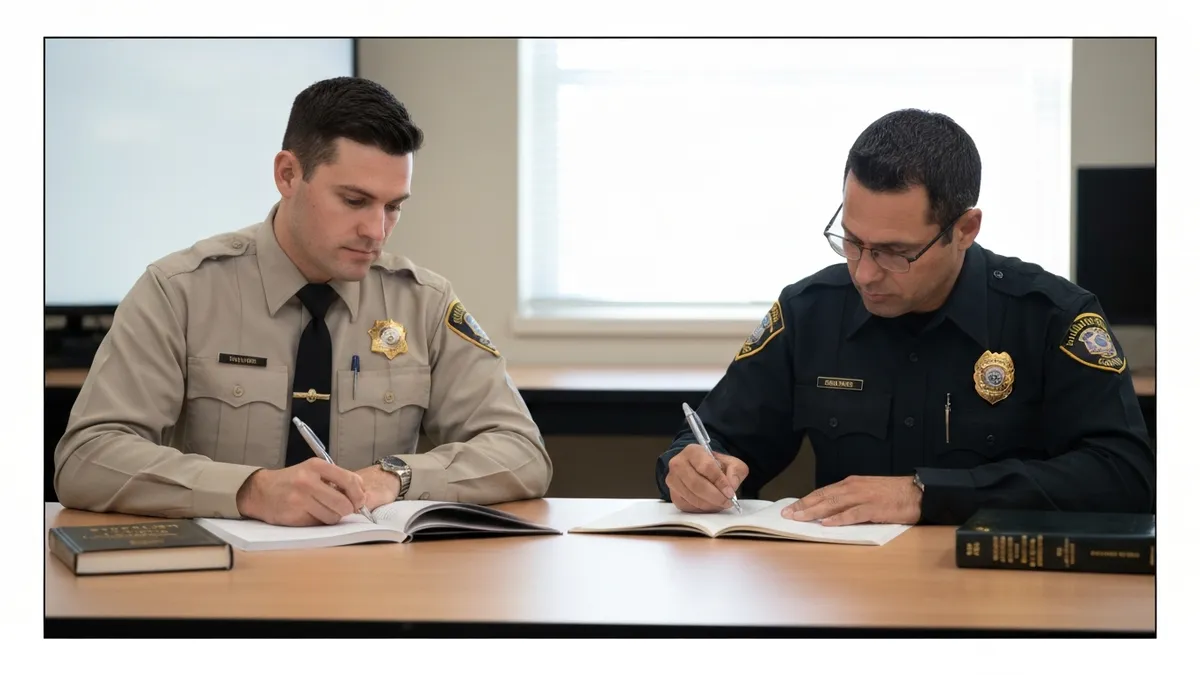
The minimum passing T-score is set by each individual agency, not by POST directly. As a general guideline, a T-score of 42 is considered the baseline floor for many agencies, while more competitive or large urban agencies may require a score of 50 or higher. There is no universal statewide cutoff.
Candidates who do not achieve the required T-score can typically retake the exam after a waiting period specified by the administering agency. Some agencies allow retesting after 30 days; others impose longer waiting periods. Always confirm retake policies with the specific agency before your exam date.
It is also worth noting that a high Pellet B score does not guarantee hiring — it is one component of a multi-stage hiring process that typically includes a physical agility test, oral board interview, polygraph examination, psychological evaluation, background investigation, and medical exam. However, a strong Pellet B score can make your application more competitive, particularly at agencies with many applicants.
Who Administers the Pellet B?
The Pellet B is administered under California POST oversight. Many agencies contract with CPS HR Consulting (formerly Cooperative Personnel Services) to schedule and proctor the exam. Some larger agencies — such as the Los Angeles Police Department — administer their own POST-validated testing process. Always verify the specific exam format and scheduling process with the agency you are applying to, as procedures can vary.
How to Prepare for the Pellet B
Effective preparation for the Pellet B focuses on three areas: reading comprehension, written English skills, and logical reasoning. Since the exam tests cognitive ability rather than law enforcement knowledge, your preparation should resemble academic test prep more than police academy study.
Reading Comprehension: The best long-term preparation is wide reading. Candidates who regularly read newspapers, legal documents, policy reports, and non-fiction books tend to perform significantly better on the reading section. For immediate test prep, practice reading dense passages and answering questions about the main idea, author's intent, vocabulary in context, and logical conclusions.
You can link your reading practice to a Pellet B test session to get familiar with the types of passages and question formats used on the actual exam.
Writing Ability: Focus on spelling and grammar. The writing section does not require you to write an essay — it uses multiple-choice questions that ask you to identify correct or incorrect usage. Common topics include: commonly confused words (their/there/they're), punctuation rules, subject-verb agreement, sentence fragments, and run-on sentences.
Logical Reasoning: Practice with analogy questions (A is to B as C is to D), number sequence completion, categorization problems, and basic deductive logic. If you have taken the LSAT, GRE, or similar standardized tests, some of the logical reasoning format will feel familiar. If not, working through a reasoning workbook for 2 to 3 weeks before your exam will yield noticeable improvement.
For candidates interested in related California law enforcement hiring processes, reviewing a CJBAT practice test — used by many Florida agencies — provides useful cognitive ability test practice that transfers well to the Pellet B format.
- +Validates your knowledge and skills objectively
- +Increases job market competitiveness
- +Provides structured learning goals
- +Networking opportunities with other certified professionals
- −Study materials can be expensive
- −Exam anxiety can affect performance
- −Requires dedicated preparation time
- −Retake fees apply if you don't pass
Pros and Cons at a Glance
| Pros | Cons |
|---|---|
| Validates your knowledge and skills objectively | Study materials can be expensive |
| Increases job market competitiveness | Exam anxiety can affect performance |
| Provides structured learning goals | Requires dedicated preparation time |
| Networking opportunities with other certified professionals | Retake fees apply if you don't pass |
Sample PELLET B Test Practice Questions
Try these questions from our free PELLET B Test practice tests. The correct answer and an explanation follow each question.
Review this case number sequence: 2026-0431, 2026-0432, 2026-0433, 2026-0435, 2026-0436. What is missing?
- A. 2026-0434
- B. 2026-0437
- C. 2026-0430
- D. 2026-0434.5
Answer: A. 2026-0434
The sequential pattern increases by 1. The gap between 0433 and 0435 means 0434 is missing.
All California peace officers must complete POST-certified training. Officer Daniels has not completed POST-certified training. What can be concluded?
- A. Officer Daniels is not a California peace officer
- B. Officer Daniels is a California peace officer
- C. Officer Daniels may or may not be a California peace officer
- D. No conclusion can be drawn
Answer: A. Officer Daniels is not a California peace officer
If all California peace officers must complete POST training and Daniels has not, then Daniels is not a California peace officer.
What is the main purpose of reading comprehension in the PELLET B exam?
- A. To memorize laws.
- B. To understand and interpret written materials accurately
- C. To practice handwriting skills.
- D. To guess meanings without reading.
Answer: B. To understand and interpret written materials accurately
The main purpose of reading comprehension in the PELLET B exam is to assess a candidate's ability to accurately understand, analyze, and interpret written information. This skill is crucial for law enforcement, as officers must comprehend reports, laws, and other critical documents precisely. It ensures they can extract relevant details and make informed decisions based on written materials.
New recruits must complete a minimum of 664 hours of _____ training at a POST-certified academy before they can be assigned to patrol duties.
- A. basic
- B. basically
- C. base
- D. basis
Answer: A. basic
'Basic' is the correct adjective modifying 'training,' referring to the foundational law enforcement training required in California.
FAQ
More Law Enforcement Exam Resources
How this page was made: written with AI tools. Exam facts are checked against the official sources listed below. Not reviewed by a subject-matter expert. Editorial policy
Sources & references
Exam facts on this page (fees, format, dates, passing scores) are checked against these official sources; the date is our last check. Editorial policy
- post.ca.gov — Test delivery, eligibility, score validity · verified Oct 2026
- post.ca.gov — Passing score, score release · verified Oct 2026
- post.ca.gov — Exam format · verified Oct 2026