
ParaPro Practice Test 2026 September — Assessment Guide for Paraprofessionals
Boost your ParaPro exam score with practice questions and detailed answer explanations. 💯 Track progress with instant feedback.
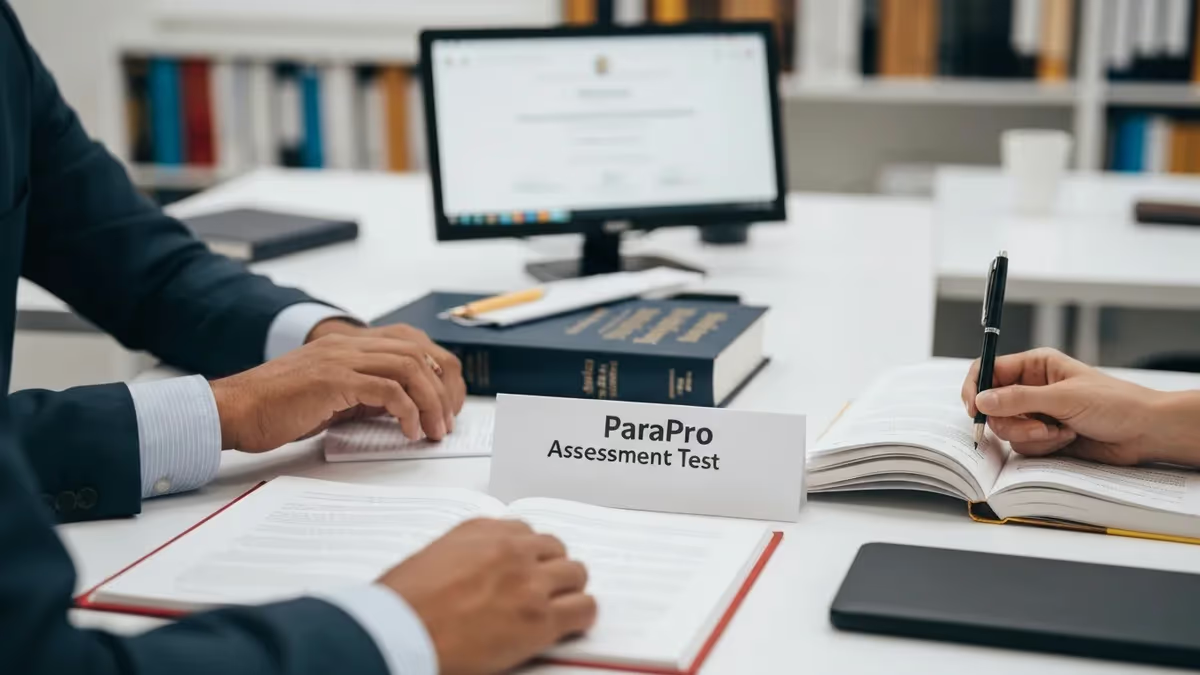
What Is the ParaPro Assessment?
The ParaPro Assessment is a standardized exam developed by Educational Testing Service (ETS) that measures the knowledge and skills of paraprofessionals — including teacher's aides, instructional assistants, paraeducators, and classroom assistants — who work in K-12 school settings.
Under the No Child Left Behind (NCLB) Act, school districts receiving Title I federal funds are required to employ paraprofessionals who have demonstrated competency through an ETS-approved assessment or by completing 48 college credit hours (or an associate's degree or higher). The ParaPro Assessment is the most widely accepted pathway to meeting this federal requirement.
If you are preparing for a paraprofessional position in a Title I school, taking a ParaPro assessment test before test day is the single most effective preparation strategy. Familiarity with the question formats in all three sections — reading, mathematics, and writing — significantly reduces test-day anxiety and improves performance.
Paraprofessionals who earn competitive scores typically qualify for positions offering salaries between $25,000 and $42,000 per year, with districts that enforce ParaPro requirements often providing better compensation and benefits packages.

Test Logistics
The ParaPro Assessment consists of 90 total questions administered over 2 hours and 30 minutes. The test is available in both computer-based and paper-based formats at ETS-approved testing centers. Some school districts also arrange school-based testing sessions for groups of candidates.
The test fee is approximately $55 for paper-based and $55–$65 for computer-based delivery, depending on the testing center. Registration is handled directly through ETS.
One important advantage of the ParaPro Assessment: scores do not expire at the federal level, though individual states and districts may apply their own validity policies. Always confirm requirements with the district where you are applying.
It is also worth noting that passing the ParaPro Assessment alone does not grant full paraprofessional qualification in most states. Candidates must also meet the 48 college credit hours requirement or hold an associate's degree or higher, as mandated by NCLB. Confirm your state's specific requirements before applying.

- ✓Review the official ETS ParaPro Assessment Study Companion for content outlines and sample questions
- ✓Take a timed <a href="/parapro-assessment-test">ParaPro practice test</a> to establish a baseline score before studying
- ✓Follow a structured <a href="/parapro-assessment-test-30-day-study-plan">ParaPro study plan</a> covering all three sections over 30 days
- ✓Practice math word problems that include classroom and instructional contexts — do not study math in isolation
- ✓Complete targeted <a href="/parapro-math-skills-practice-test-video-answers">ParaPro math practice</a> and <a href="/parapro-reading-skills-practice-test-video-answers">ParaPro reading practice</a> sessions for each section
- ✓In the final week, simulate full 2.5-hour timed test conditions at least twice to build endurance
ParaPro Preparation Strategies
Effective preparation for the ParaPro Assessment requires a targeted approach that treats each section differently. Here is what experienced test-takers and educators recommend:
Mathematics Section
The mathematics section is where many candidates struggle most. Questions are rarely presented as pure arithmetic — they are embedded in classroom scenarios, such as calculating the ratio of students to materials, interpreting a bar graph from a lesson, or solving a word problem a paraprofessional might help a student work through. As a result, even candidates with solid math skills can be caught off guard by the contextual framing.
Practice ParaPro math practice sessions using question banks that mirror the real ETS format. Focus on data interpretation (tables, charts, and graphs), basic algebraic expressions, and geometry fundamentals such as area and perimeter.
Reading Section
The reading section tests not just comprehension but the ability to apply reading skills — inferring meaning, identifying the main idea, and determining vocabulary from context. Reviewing ParaPro reading practice materials helps build fluency with the passage-based question format.
Pay particular attention to applied skills questions in this section: they ask how you would use a given passage or skill in a classroom instruction scenario, requiring you to think like a paraprofessional rather than simply a test-taker.
Writing Section
The writing section emphasizes error identification and sentence-level revision. You will not be asked to write anything — instead, you identify errors in grammar, punctuation, usage, and sentence structure within provided text. Consistent practice identifying comma splices, subject-verb agreement errors, and misused modifiers is the most direct path to a high writing score.
Using Video-Based Resources
Many candidates benefit from watching worked-through explanations. The ParaPro video questions and answers resource walks through question types step-by-step, making it especially useful for visual learners or candidates who have been out of an academic environment for some time.
How to Pass the ParaPro Exam
Candidates who want a comprehensive strategy should read the full how to pass ParaPro exam guide, which covers time management on test day, question elimination strategies, and how to approach applied skills questions across all three sections. Combining this guide with a structured practice schedule consistently produces the best outcomes.
- +Industry-recognized credential boosts your resume
- +Higher earning potential (10-20% salary increase on average)
- +Demonstrates commitment to professional development
- +Opens doors to advanced career opportunities
- −Exam preparation requires significant time investment (4-8 weeks)
- −Certification fees can be $100-$400+
- −May require continuing education to maintain
- −Some employers may not require certification
Join the Discussion
Connect with other students preparing for this exam. Share tips, ask questions, and get advice from people who have been there.
View discussion (8 replies)