
What Is OSHA 10? Complete Guide to the 10-Hour Card 2026 October
What is OSHA 10? Learn what the 10-hour card covers, who needs it, how much it costs, and how to verify your training is legitimate. ✏️
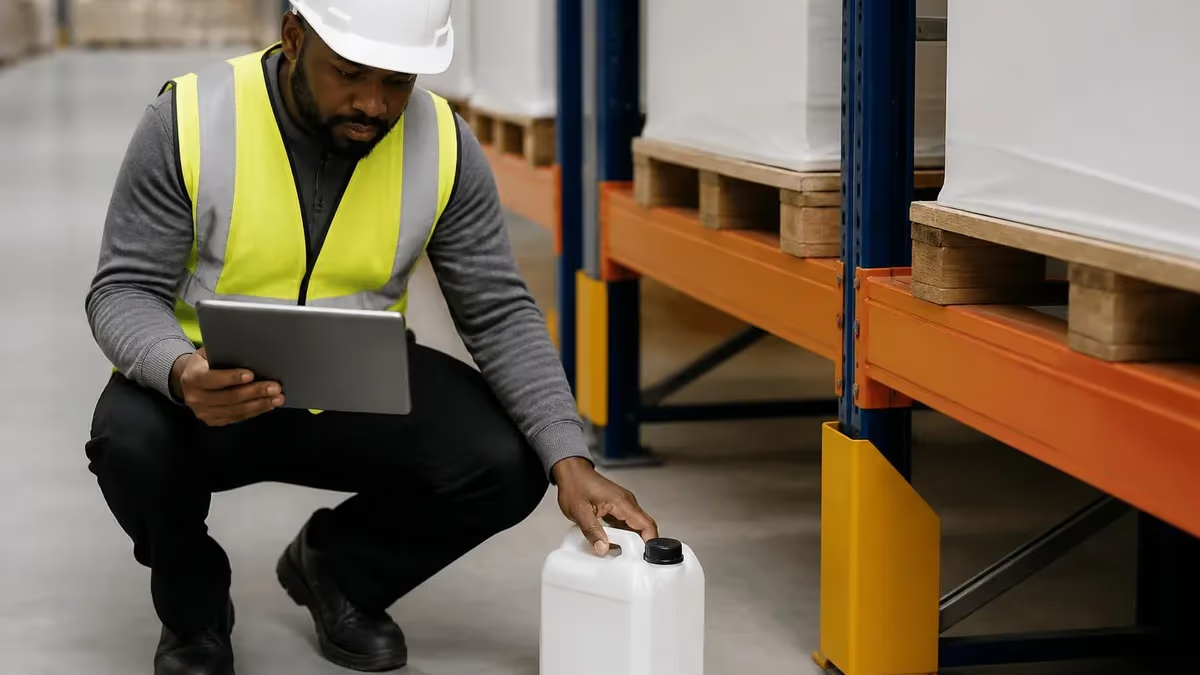
So you've been told you need an OSHA 10 card before starting a new job, and now you're scrambling to figure out what that even means. Don't worry, you're not alone. Thousands of workers every week ask the same question, and the good news is the answer isn't complicated. OSHA 10 is a 10-hour workplace safety training program developed by the Occupational Safety and Health Administration, the federal agency that sets and enforces safety rules across most American workplaces.
The training exists because too many workers get hurt or killed on the job each year, and most of those incidents trace back to hazards that could have been spotted and avoided. OSHA designed the 10-hour course to give entry-level workers a baseline understanding of those hazards before they ever set foot on a job site. It covers the basics: how to recognize unsafe conditions, what your rights are as a worker, and what the boss is legally required to do to keep you safe.
There are two main flavors of OSHA 10 you'll run into. The Construction version is for folks heading to building sites, road crews, demolition gigs, and similar work. The General Industry version covers warehouses, factories, healthcare settings, manufacturing plants, and most other workplaces. Some states like New York, Connecticut, Massachusetts, Missouri, Nevada, New Hampshire, Rhode Island, and Pennsylvania actually require the card by law for certain jobs. Even where it's not legally required, plenty of employers and general contractors won't let you on site without one.
Here's something a lot of people miss. The card doesn't expire on a federal level, but many states and employers treat it as valid for three to five years before asking for a refresher. The training itself can be done online at your own pace or in a classroom over a day or two. Once you finish, you get a wallet-sized plastic card from the Department of Labor, usually within two weeks of completing the course.
OSHA 10 at a Glance
The 10-hour figure isn't arbitrary. OSHA calculated it as the minimum time needed to walk a brand-new worker through the most common dangers they'll face on the job, plus enough background on worker rights and reporting procedures to make the training actually useful. Cram a worker through a quick orientation video and you've taught them nothing. Stretch it past 10 hours and you start losing attention. The sweet spot landed at ten.
You might wonder why the agency settled on two versions instead of one universal course. The answer is practical. A drywall installer and a hospital orderly face wildly different risks. Falls from height, scaffold collapse, and trench cave-ins dominate construction. Bloodborne pathogens, slip-and-fall on wet floors, and chemical exposure dominate general industry. Mixing those topics into a single course would shortchange both groups, so OSHA built two tracks. Pick the one that matches the work you're about to do.

OSHA 10 Card vs OSHA 30 Card. The 10-hour card is for entry-level workers. The 30-hour card is meant for supervisors, foremen, safety officers, and anyone with responsibility over other workers. If you're just starting out, the 10 is what you need. If you're moving into a lead role or running a crew, the 30-hour version goes deeper into hazard prevention, accident investigation, and OSHA standards interpretation.
One thing worth pointing out. The card itself doesn't actually certify you to operate any specific equipment. It's not a forklift license, it's not a confined-space certification, and it definitely isn't a substitute for trade-specific training. What it does is prove you've sat through the baseline safety material every worker should know before stepping onto an active site. Think of it as the floor, not the ceiling. Most employers layer additional training on top once you're hired.
The other thing that surprises folks is how much of the course is about your rights, not just hazards. You'll spend a chunk of the training learning that you can refuse imminent-danger work, that you can request OSHA inspections, that retaliation against you for raising safety issues is illegal, and that your employer has to provide most personal protective equipment at no cost to you. That's intentional. OSHA figured workers who know their rights are workers who speak up, and workers who speak up tend to live longer.
What the OSHA 10 Course Actually Covers
Worker rights, employer responsibilities, the OSH Act of 1970, how to file a complaint, and what an inspection looks like.
Falls, struck-by, caught-in/between, and electrocution — the Fatal Four causes that kill most workers each year.
Hard hats, eye protection, respirators, fall harnesses, hearing protection — when to use them and how to inspect them.
Chemical hazards, hazard communication, GHS labeling, safety data sheets, and how chemicals enter the body.
Lifting techniques, forklift safety, rigging basics, and how to avoid musculoskeletal injuries.
Industry-specific content like trenching, scaffolds, cranes, welding, or healthcare-specific hazards depending on your course version.
The breakdown of hours inside the 10 isn't even across all topics. OSHA mandates a minimum amount of time on certain mandatory subjects, and the rest gets split between elective topics chosen by the trainer or course provider. For the Construction version, you're guaranteed at least one full hour on the introduction, an hour on OSHA inspections and citations, and substantial time on the Fatal Four. The remaining hours flex based on what trades the course is geared toward.
If you're taking the course online, you'll move through modules at your own pace, with knowledge-check quizzes scattered throughout. Most online providers space the material across multiple sessions because OSHA caps how much you can complete in a single day. You can't sit down and bang out all 10 hours in one marathon afternoon. The agency limits training to roughly 7.5 hours per 24-hour period, which is why even online courses typically stretch across two or three sittings.
Online vs In-Person OSHA 10

The choice between online and in-person isn't just about convenience. It's also about whether the card will actually be accepted where you need it. New York City, for example, has its own Site Safety Training requirements layered on top of OSHA's baseline, and the city historically preferred in-person training before relaxing some of those rules during the pandemic. Always check with the contractor or job site you're heading to before locking in a course format.
The trainers themselves matter more than the platform. Every legitimate OSHA 10 course is taught or authored by someone who completed the OSHA Outreach Trainer program — typically a multi-day course at an OSHA Training Institute Education Center. These authorized trainers receive the actual cards from the Department of Labor and distribute them to students who pass. If a course doesn't go through an authorized outreach trainer, the card you get isn't real, no matter how official the certificate looks.
There's a thriving black market in counterfeit OSHA 10 and OSHA 30 cards, especially online. Buying one is a federal crime, and so is presenting one on a job site. If your employer finds out the card is fake, you'll be fired and potentially prosecuted. Always train through an authorized OSHA Outreach Trainer or an Education Center, and verify the trainer's credentials before paying. Real cards come from the Department of Labor printed on plastic with a unique serial number, not as a PDF you print at home.
Verification is straightforward. Every authorized trainer has a unique trainer number issued by OSHA. Legitimate cards display that number along with the student's name, the date of training, and the course type. Some contractors and state agencies now run cards through OSHA's online verification database before allowing workers on site. If your card can't be verified, it's worthless to you regardless of what you paid.
That brings up another point worth driving home. OSHA itself doesn't sell the course or issue cards directly to students. The agency authorizes private training providers and individual trainers to deliver the curriculum on its behalf. So when you see a website claiming to be "the official OSHA training site," that's marketing, not reality. Stick to providers listed in OSHA's outreach training directory, ask your trainer for their authorization number, and don't pay upfront for a card you haven't earned yet.
Before You Sign Up for OSHA 10
- ✓Confirm with your employer or job site which version you need — Construction or General Industry
- ✓Check whether your state requires the card or has additional training requirements layered on top
- ✓Verify the training provider uses an authorized OSHA Outreach Trainer
- ✓Ask the trainer for their OSHA-issued authorization number
- ✓Make sure the course is delivered in a language you can fully understand
- ✓Allow 1-2 weeks after completion for your plastic card to arrive by mail
- ✓Save your temporary completion certificate as proof until the card shows up
- ✓Bookmark OSHA's card verification tool in case an employer questions your credentials
Once you've finished the course, your trainer reports your completion to OSHA, and the Department of Labor mails the physical card. That mail step is why you can't skip the course and get a card the same day. Trainers are required to hold onto records for at least five years, and OSHA audits providers to make sure the cards being issued actually match real completion records. The bureaucracy is annoying but it's also what keeps the credential meaningful.
If you lose osha certificate verification the trainer who issued it can usually print a replacement for a small fee, typically $15 to $25. OSHA itself doesn't reissue cards directly. That's another reason to keep your trainer's contact info even after the course ends. If the original training provider has gone out of business, you may have to retake the course entirely, since OSHA doesn't maintain a central registry that lets a different trainer reissue someone else's card.

Is OSHA 10 Worth Getting on Your Own?
- +Many jobs won't hire you without it — having the card already makes you more marketable
- +Online courses are cheap, often under $80, and reimbursable by most employers once hired
- +The training genuinely teaches you how to recognize hazards that could injure or kill you
- +Knowing your worker rights makes you harder to push around on safety issues
- +Card stays valid for years in most states — one-time cost, long-term benefit
- +Required by law in several states for construction work, so it's not optional anyway
- −Some employers prefer to provide training in-house, so paying out of pocket may be wasted money
- −The card doesn't certify you for specific equipment like forklifts or cranes
- −Online versions occasionally aren't accepted by all contractors or states
- −Refresher requirements vary by state, so you may need to retake every few years
- −It's not a substitute for trade-specific apprenticeship or skills training
Pros and Cons at a Glance
| Pros | Cons |
|---|---|
| Many jobs won't hire you without it — having the card already makes you more marketable | Some employers prefer to provide training in-house, so paying out of pocket may be wasted money |
| The training genuinely teaches you how to recognize hazards that could injure or kill you | The card doesn't certify you for specific equipment like forklifts or cranes |
| Knowing your worker rights makes you harder to push around on safety issues | Online versions occasionally aren't accepted by all contractors or states |
| Card stays valid for years in most states — one-time cost, long-term benefit | Refresher requirements vary by state, so you may need to retake every few years |
| Required by law in several states for construction work, so it's not optional anyway | It's not a substitute for trade-specific apprenticeship or skills training |
The decision usually comes down to where you are in your career. If you're already working somewhere that'll pay for the training, wait and let them cover it. If you're job-hunting and seeing "OSHA 10 required" pop up in listings, biting the bullet and getting it yourself can move you to the top of the pile. Recruiters in construction especially love seeing the card already in hand because it means you're ready to start immediately without a delay for training.
Apprentices in registered trade programs almost always get OSHA 10 baked into their first-year curriculum. If you're going through a union apprenticeship for electrical, plumbing, sheet metal, carpentry, or any of the other building trades, you'll earn the card as part of your normal training without paying extra. Same goes for many vocational high school programs and community college certificate tracks in construction management or HVAC.
For folks transitioning into industrial or warehouse work, the General Industry version covers what you need. Amazon, FedEx, UPS, and most large manufacturers run their own internal safety programs that meet or exceed OSHA's baseline, but having the 10-hour card on your résumé shows you take safety seriously before they even meet you. That signal matters in entry-level hiring where most candidates look interchangeable on paper.
Sample OSHA Safety Certificate Practice Questions
Try these questions from our free OSHA Safety Certificate practice tests. The correct answer and an explanation follow each question.
Under OSHA 29 CFR 1910.146, what is the definition of a permit-required confined space?
- A. A space large enough to enter, with limited entry/exit, and not designed for continuous occupancy, plus one or more serious hazard
- B. Any space that requires a ladder to enter
- C. Any underground vault or tank
- D. A space that requires two or more employees to access
Answer: A. A space large enough to enter, with limited entry/exit, and not designed for continuous occupancy, plus one or more serious hazard
OSHA defines a permit-required confined space as a space meeting all three size/entry criteria AND containing at least one serious hazard such as a hazardous atmosphere, engulfment risk, or converging walls.
What information must be included in a written Respiratory Protection Program required by OSHA?
- A. Only the types of respirators available for purchase
- B. Procedures for selecting, using, fitting, inspecting, cleaning, and storing respirators
- C. Only employee training schedules
- D. A list of approved respirator vendors
Answer: B. Procedures for selecting, using, fitting, inspecting, cleaning, and storing respirators
OSHA's standard requires a comprehensive written program covering respirator selection, use, medical evaluation, fit testing, maintenance, and training.
At what height in general industry does OSHA require fall protection?
- A. 2 feet
- B. 4 feet
- C. 10 feet
- D. 20 feet
Answer: B. 4 feet
In general industry, fall protection is generally required at 4 feet.
What does the term 'permissible exposure limit' (PEL) refer to in OSHA regulations?
- A. The maximum allowable concentration of a substance in workplace air
- B. The maximum number of hours an employee can work per shift
- C. The minimum ventilation rate required in enclosed spaces
- D. The required distance from hazardous machinery
Answer: A. The maximum allowable concentration of a substance in workplace air
A PEL is the legal limit for a worker's exposure to a chemical substance or physical agent in workplace air.
OSHA Questions and Answers
The bottom line on what OSHA 10 actually is. It's a 10-hour introductory safety training that gives entry-level workers the baseline knowledge they need to recognize hazards, understand their rights, and stay alive on the job. It's not a license, it's not a substitute for trade training, and it doesn't certify you to run any specific equipment. What it does is open doors. Plenty of jobs simply won't hire you without it, and for the eight states that require it by law, you can't legally work certain trades without one in your pocket.
If you're heading into construction, get the Construction version. Industrial or warehouse work, grab General Industry. Don't pay for a course your employer would have provided for free, but don't sit on your hands either if you're trying to get hired right now. The card is cheap, the training is genuinely useful, and the credential lasts for years. Just make sure the trainer is authorized, the provider is legit, and the card you receive is verifiable through OSHA's database.
Take your time studying. The course material covers real risks that injure or kill thousands of workers every year, and treating it like a box to check shortchanges you and your future coworkers. Skim through the slides if you must, but actually engage with the Fatal Four content, the PPE sections, and the worker rights material.
Those are the parts that will pay off on day one of a real job site, when you're trying to figure out whether the scaffold you're about to climb actually meets standards or whether the chemical your boss is asking you to pour is something you should be wearing a respirator for.
OSHA 10 is the starting line. It's not the finish. But for tens of thousands of workers every year, it's the thing that keeps them out of the hospital long enough to learn the rest of the job.
Key Takeaway: OSHA 10 is the federal baseline for entry-level worker safety training. It's not optional in eight states and increasingly required by major contractors nationwide. The card itself costs less than dinner for two and stays valid for years, making it one of the highest-value credentials a new worker can earn.
OSHA 10 by the Numbers
One area new workers overlook is the role of state plans. OSHA operates as a federal agency, but more than two dozen states run their own OSHA-approved programs. These state plans must meet or exceed federal standards, but they often add requirements unique to local industries. California's Cal/OSHA is the obvious example.
It maintains its own heat illness prevention standards, its own ergonomics rules for repetitive motion injuries, and its own enforcement structure that's tougher than federal OSHA in many areas. Workers in California might end up taking a state-specific safety course in addition to OSHA 10, or instead of it depending on the employer.
Washington, Oregon, Michigan, and Kentucky run similar state plans. If you're working in a state plan jurisdiction, the OSHA 10 card you earn is still valid because the federal curriculum forms the floor. But your state may layer additional training expectations on top, so don't assume a federal card alone closes every gap.
Another underappreciated angle is the role of OSHA 10 for non-construction workers who occasionally enter construction sites. Engineers visiting a project, safety auditors, project managers, owner representatives, and inspectors all benefit from holding the construction version of the card. Many large general contractors won't let anyone past the site fence without it, even briefcase-carrying office staff doing a one-hour walkthrough. If your work occasionally takes you onto active builds, the Construction version of OSHA 10 is the right pick even if your day job is sitting at a desk.
The economics of training also deserve a mention. Authorized outreach trainers earn relatively modest fees per student, which keeps the program accessible. OSHA itself doesn't profit from the cards. The agency's role is curriculum oversight, trainer authorization, and card production. Course providers compete on price, customer experience, and added features like mobile-friendly content, multiple-language support, and progress tracking. That competition tends to keep online prices in the $60-90 range and in-person prices in the $150-300 range across most of the country.
Finally, the card opens conversations. Walk into a temporary staffing agency or union hiring hall with an OSHA 10 already on your record, and the person across the desk knows you've at least done the homework. That's a small but real signal in a hiring environment where most entry-level candidates show up with nothing more than a willingness to work hard. Combined with a clean driving record, basic tools, and reliable transportation, the OSHA 10 card can move you from "we'll call you" to "can you start Monday" faster than almost any other low-cost credential.
About the Author

Certified Safety Professional & OSHA Compliance Expert
Indiana University of Pennsylvania Safety SciencesDr. William Foster holds a PhD in Safety Science from Indiana University of Pennsylvania and is a Certified Safety Professional (CSP) and Certified Hazardous Materials Manager. With 20 years of occupational health and safety management experience across construction, manufacturing, and chemical industries, he coaches safety professionals through OSHA certification, CSP, CHST, and safety management licensing programs.
Join the Discussion
Connect with other students preparing for this exam. Share tips, ask questions, and get advice from people who have been there.
View discussion (8 replies)