
Does Your OSHA Card Expire? Complete Guide to OSHA Certification Validity and Renewal
Does OSHA card expire? ✅ Learn validity periods, renewal rules, and what happens when your OSHA certification lapses. Full guide for workers.
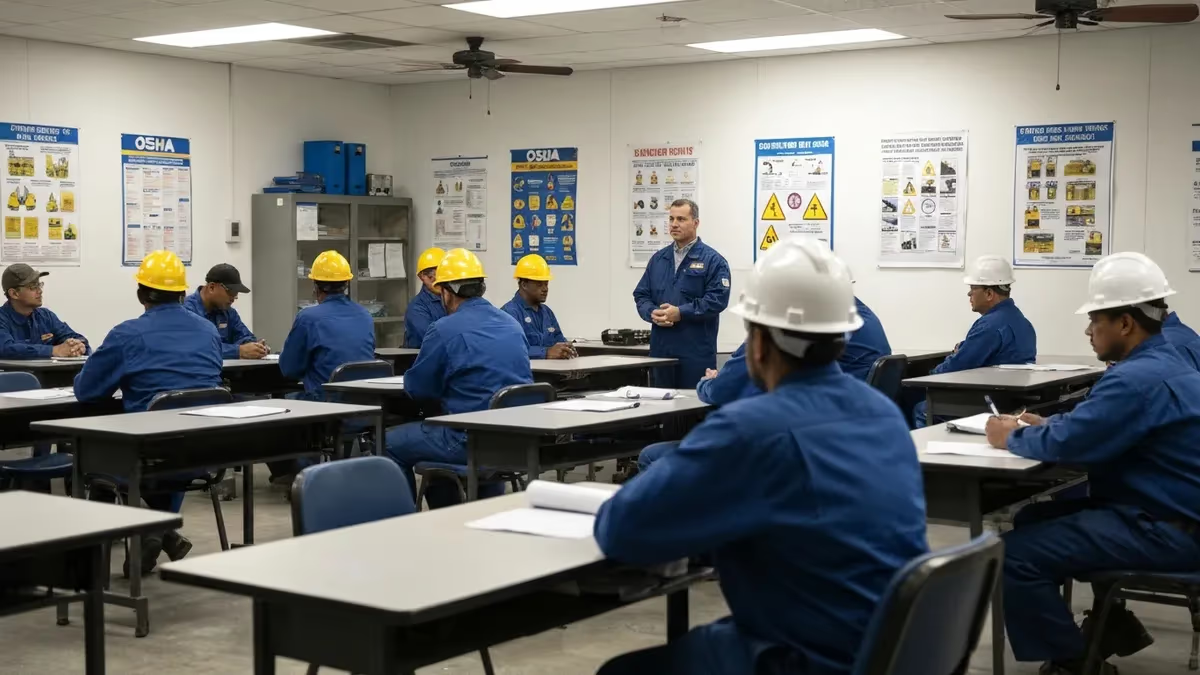
If you are wondering whether your OSHA card expires, the short answer is: it depends on which type of OSHA training or certification you hold. For the widely recognized OSHA 10-Hour and OSHA 30-Hour outreach training cards, there is no official expiration date set by OSHA itself — these cards do not technically expire under federal rules. However, many employers, state agencies, and project owners impose their own renewal requirements, typically every three to five years, making it essential for workers to understand exactly what their card covers and how long their employer considers it valid.
The question of whether an OSHA card expires is more nuanced than most workers realize. OSHA outreach program completion cards are issued by the OSHA Training Institute and are proof that you completed a safety awareness course — not a professional license or a regulated credential subject to mandatory renewal. That said, the construction industry in particular has moved aggressively toward requiring refresher training, and several states including New York, Nevada, and California have enacted laws mandating periodic renewal of OSHA outreach cards. If you work across state lines or on federally funded projects, these requirements can vary significantly.
For crane operators specifically, the situation is quite different. The OSHA crane operator certification standard under 29 CFR 1926.1427 requires certified crane operators to hold accredited third-party certification from organizations such as NCCCO, NCCER, or similar bodies. These crane operator certifications do carry hard expiration dates — typically five years — and must be renewed through written and practical re-examination before the expiration date to remain compliant. Operators who let their certification lapse face work stoppages and potential enforcement actions.
Understanding which category your credential falls into is the first step in managing your training record. The OSHA outreach card (the wallet-sized card you receive after completing a 10-hour or 30-hour course) is distinct from employer-based qualifications, state licenses, and third-party certifications. Each of these layers has its own validity period and renewal pathway, and confusing them can lead to costly surprises at the job site gate or during an OSHA compliance inspection.
Workers who want to understand the full picture of osha card expire rules should also be aware that some industries treat these cards as baseline awareness training rather than standalone qualifications. In oil and gas, maritime, healthcare, and manufacturing, additional site-specific or industry-specific training is layered on top of the OSHA outreach card, and those supplemental credentials may carry their own renewal cycles that are completely independent of your outreach card status.
In practical terms, the best approach is to treat your OSHA outreach card as having a useful shelf life of three years, even if your state or employer has not yet mandated renewal. Refresher training keeps your hazard recognition skills sharp, reflects updated OSHA standards, and signals to employers that you take workplace safety seriously. Many training providers offer streamlined refresher courses that take far less time than the original course, making renewal manageable even for busy workers and supervisors in the field.
This guide covers everything you need to know about OSHA card validity: the technical rules behind expiration, the differences between card types, state-specific renewal mandates, what to do if your card has lapsed, and how to stay compliant in demanding industries like crane operation and construction. Whether you hold an OSHA 10 card or a full crane operator certification, you will find the answers you need in the sections below.
OSHA Card Expiration by the Numbers
Key Facts at a Glance
| Item | Value | Details |
|---|---|---|
| Typical Employer Renewal Requirement | 3–5 yrs | Most job sites require refresher within 5 years |
| NCCCO Crane Operator Certification Validity | 5 yrs | Hard expiration under 29 CFR 1926.1427 |
| States with Mandatory OSHA Card Renewal Laws | 8+ | Including NY, NV, MA, and CA jurisdictions |
| OSHA Outreach Course Hours | 10 / 30 | 10-hr for workers, 30-hr for supervisors |

Types of OSHA Cards and What Each One Covers
Issued to entry-level workers after completing a 10-hour construction or general industry safety awareness course. No federal expiration date, but many employers require renewal every 3 to 5 years. Covers basic hazard recognition and emergency procedures.
Designed for supervisors, foremen, and safety officers who need deeper hazard management knowledge. Same federal no-expiry rule as the 10-hour card, but professional associations and large contractors often mandate periodic refresher training for cardholders.
A regulated, accredited credential required under 29 CFR 1926.1427 for crane operators in construction. Carries a hard 5-year expiration date. Must be renewed through written and practical re-examination before expiry to maintain legal compliance.
Some states issue their own safety credentials — such as New York's Site Safety Training card — with explicit expiration dates ranging from 3 to 5 years. These supersede federal outreach card rules within that state's jurisdiction and carry enforcement consequences.
The OSHA 10-hour and 30-hour outreach training cards issued through the OSHA Training Institute do not expire under any federal rule. When you complete an OSHA 10 or OSHA 30 course through an authorized outreach trainer, you receive a card that serves as a permanent record of your completion.
OSHA's official position is that it does not require holders of these cards to renew them on any set schedule. The card documents a training event, not an ongoing professional status, which is a crucial distinction that surprises many workers who assume their card will automatically become invalid after a few years.
However, the absence of a federal expiration does not mean your card will be universally accepted indefinitely. The construction industry has largely moved beyond treating these cards as lifetime credentials. Major general contractors, public works agencies, and union halls routinely specify in their site safety plans and collective bargaining agreements that OSHA outreach cards must have been obtained within the past three to five years.
A card from 2012 may technically never expire under federal rules, but a site superintendent has every right to send you home until you complete a refresher course if your employer's policy requires a card issued within the last five years.
The practical reality is that OSHA standards themselves are updated regularly. The Hazard Communication Standard was revised in 2012 and is being updated again to align with the revised Global Harmonization System. Silica dust exposure limits were tightened dramatically in 2016. Fall protection rules have been refined multiple times. An OSHA 10 card issued in 2009 was earned under a different regulatory landscape, which is a key reason why employers and trainers alike recommend refreshing your training every three to five years even without a legal mandate to do so.
For workers in specific trades, the renewal question takes on added urgency. Electricians, scaffolding erectors, and confined space entry workers often face additional employer-driven training requirements that run on their own renewal cycles. These supplemental qualifications are layered on top of your OSHA outreach card and are independent of it — meaning you could have a perfectly valid OSHA 30 card and still be pulled from a confined space entry job because your confined space training certification lapsed six months ago.
Workers who obtained their OSHA training before a major standard revision should seriously consider voluntary renewal. When OSHA significantly updates a standard that is directly relevant to your trade — such as the 2015 cranes and derricks revisions or the 2017 walking-working surfaces updates — the older card does not reflect the new requirements. Employers conducting their own due diligence will often spot outdated training dates and flag workers for refresher courses before assigning them to hazardous tasks covered by the updated standard.
From a liability standpoint, employers have strong incentives to require periodic renewal of OSHA outreach cards. If an incident occurs and it is discovered that a worker's OSHA training was from fifteen years ago, the employer faces greater scrutiny during an OSHA investigation. Maintaining a workforce with recent, documented training reduces that liability exposure and demonstrates the good-faith effort toward compliance that OSHA considers when assessing penalties. This employer-side calculus is what drives voluntary renewal requirements even in states where no law mandates it.
For those studying for OSHA-related exams or seeking to understand the regulatory framework, a strong grasp of how training credentials work — and where they do and do not carry expiration dates — is essential. The nuances between outreach cards, third-party certifications, and state-issued credentials come up frequently in practice testing and real-world compliance scenarios alike, making this one of the most practically valuable areas of OSHA knowledge to master.
State and Employer OSHA Card Renewal Requirements
Several states have enacted specific laws requiring workers to renew their OSHA outreach training on a defined schedule. New York City's Local Law 196 requires Site Safety Training cards that must be renewed every five years. Nevada mandates that construction workers complete refresher training every three years. Massachusetts requires periodic safety training renewal for certain trade license holders, effectively tying OSHA training currency to their licensing status. These state-level mandates carry real enforcement teeth — violations can result in removal from job sites, fines, and suspension of contractor registrations.
Workers in these high-mandate states should build renewal dates into their career calendars well in advance. Because OSHA authorized outreach trainers are in high demand in these jurisdictions, scheduling courses six to eight weeks before your renewal deadline is strongly advisable. Many community colleges, trade unions, and private safety training companies offer both in-person and online refresher options that are significantly shorter than the original course, ranging from four to eight hours for a condensed refresher format in states that accept them.
Renewing Your OSHA Card: Is It Worth It Before You Have To?
- +Keeps you current on updated OSHA standards and new hazard communication requirements
- +Satisfies most employer and contractor renewal policies before they become a barrier to employment
- +Demonstrates commitment to workplace safety, which is valued by employers during hiring decisions
- +Reduces personal liability and demonstrates good faith in the event of an incident investigation
- +Many refresher courses take only 4 to 8 hours, far less than the original 10 or 30-hour course
- +Voluntary renewal gives you control over timing rather than being forced into emergency renewal at job start
- −No federal legal requirement means some workers view renewal as an unnecessary cost and time burden
- −Refresher training costs range from $75 to $250 depending on provider and course length
- −Time away from work or personal time needed to complete the course may be inconvenient
- −Online refresher course quality varies widely, and some employers do not accept all online formats
- −In states without mandates, renewed cards offer no practical advantage over original cards for some employers
- −Renewal does not extend the original card — a new card is issued, which can cause confusion in some payroll and HR systems
OSHA Card Renewal Checklist: Steps Every Worker Should Take
- ✓Locate your original OSHA outreach card and record the issuance date in your personal training log.
- ✓Check your state's specific laws to determine if a mandatory renewal period applies to your trade.
- ✓Review your employer's safety manual or site-specific safety plan for internal card currency requirements.
- ✓If working on a federal project, read the contract's EM 385-1-1 or equivalent safety specification for renewal thresholds.
- ✓Contact your union's training coordinator to confirm any collective bargaining renewal requirements.
- ✓Choose an OSHA-authorized outreach trainer for your refresher — verify their authorization on OSHA's website.
- ✓Confirm whether your employer accepts online refresher courses or requires in-person training.
- ✓Schedule your refresher course at least 6 to 8 weeks before your employer's renewal deadline.
- ✓Keep a digital copy of your new card stored in email or cloud storage as a backup to the physical card.
- ✓Update your resume and employer HR file with your new card's issuance date immediately after completion.
Three Years Is the Practical Safe Harbor
Even though OSHA outreach cards carry no federal expiration date, treating three years as your personal renewal threshold satisfies the broadest range of employer, state, and federal contract requirements. Workers who renew proactively on a three-year cycle are never caught off-guard at a project mobilization gate, and they consistently report faster onboarding on high-security federal and military construction projects where training documentation is verified before site access is granted.
For crane operators working in construction, the expiration question is answered with much less ambiguity than it is for general outreach training cardholders. Under 29 CFR 1926.1427, OSHA's crane operator certification standard that took full effect in 2018, all crane operators on construction sites must hold certification from an accredited third-party certifying organization.
The two most widely recognized bodies are the National Commission for the Certification of Crane Operators (NCCCO) and the National Center for Construction Education and Research (NCCER). Both organizations issue certifications that are valid for exactly five years from the date of passing the required written and practical examinations.
When a crane operator's NCCCO or NCCER certification expires, the consequences are immediate and serious. An operator with a lapsed certification is no longer legally permitted to operate a crane on a covered construction site. The employer is in violation of 29 CFR 1926.1427 if they allow an uncertified operator to run crane equipment, and this is one of the violations OSHA investigators specifically look for in the aftermath of crane accidents — which remain among the most catastrophic and high-profile construction incidents. Penalties for willful violations in this area can reach tens of thousands of dollars per citation.
The renewal process for crane operator certification involves retaking both the written examination and the practical examination before the five-year mark. NCCCO does not offer a streamlined renewal path that bypasses examination — operators must demonstrate continued competency through testing. This is a meaningful distinction from the outreach training card, where a shorter refresher course can satisfy many employer and state requirements. Crane operators should begin the renewal process at least six months before expiration to allow time for scheduling both components of the examination and receiving the renewed credential in time.
Employer-conducted qualification is a separate layer that runs alongside third-party certification. Under 29 CFR 1926.1427, employers are also responsible for evaluating whether their certified operators are qualified to operate the specific types and capacities of cranes used on their job sites. This employer qualification does not carry a federally defined expiration, but it must be conducted whenever an operator is assigned to a crane type or capacity that differs significantly from what they have previously operated. Changes in crane technology, lift configurations, or job site conditions can trigger the need for a new employer qualification evaluation.
Apprentice crane operators working under the direct supervision of a qualified operator have different compliance requirements. They are not required to hold full certification while in apprenticeship status, but the supervising operator must hold a valid, unexpired certification and must be physically present during all crane operations by the apprentice. Once an apprenticeship program is completed, operators typically have a defined window to obtain their third-party certification before the exemption period ends and full certification compliance is required.
Annual inspections and operator documentation requirements also interact with certification status. Crane operators are required under 29 CFR 1926.1412 to conduct pre-shift visual inspections and document findings. If an operator's certification has lapsed and they are conducting inspections without authorization to operate, both the inspection documentation and any subsequent crane operations become legally problematic. Maintaining certification currency is therefore not just about the right to operate — it affects the validity of the entire documented safety management chain for crane activities on the job site.
For workers preparing for NCCCO examinations or studying crane safety regulations, understanding the five-year certification cycle and the difference between third-party certification and employer qualification is fundamental knowledge. These regulatory distinctions are tested frequently in OSHA-related certification examinations and are directly relevant to real-world compliance situations that arise on construction sites every day.

NCCCO and NCCER crane operator certifications do not have a grace period after the five-year expiration date. Once expired, the operator must fully retake both written and practical examinations to regain certified status. There is no expedited renewal path, and operating a crane with an expired certification on a construction site is a direct OSHA violation that can result in immediate stop-work orders, substantial employer penalties, and potential personal liability for the operator. Begin the renewal process no later than six months before your certification expiration date.
If your OSHA outreach card has lapsed — either by your employer's renewal policy or by a state mandate — the path to getting current is straightforward, and in most cases you do not need to retake the full original course. For OSHA 10 cardholders, many authorized outreach trainers offer condensed refresher options that cover updated content without requiring you to sit through the entire ten-hour curriculum again.
For OSHA 30 cardholders, similar refresher formats are available through OSHA Training Institute Education Centers across the country. The key is to use only OSHA-authorized trainers to ensure your new card is recognized by employers and state agencies.
Workers who have lost their original OSHA outreach card and need to prove their training history have limited options. OSHA does not maintain a central database of outreach training completions that employers or workers can query. The record of your training exists with the authorized trainer who issued your card and with the OSHA Training Institute, but retrieval of lost card records can take significant time and may not be possible if the original trainer is no longer active.
The most practical solution when a card is lost is to simply retake the training and obtain a new card — it is typically faster and less expensive than attempting to track down records from a course completed years ago.
For workers whose lapsed card situation is the result of a state mandate violation — for example, a New York City worker whose Site Safety Training card expired — the process for getting back into compliance involves both completing the required refresher training and potentially paying any associated late renewal fees to the state agency.
Some states have amnesty periods or streamlined re-enrollment processes for workers who fall out of compliance, particularly when the lapse occurred due to a medical leave, military deployment, or other documented extraordinary circumstance. Consulting with your union or employer's safety director is the fastest way to navigate state-specific re-enrollment procedures.
Employers who discover that workers have lapsed OSHA outreach cards should address the situation proactively rather than waiting for an OSHA inspection to surface the issue. Scheduling group refresher training for affected workers demonstrates the good-faith compliance effort that OSHA considers favorably when evaluating employer safety programs. Many training providers offer on-site group courses that can be scheduled during a single workday, minimizing productivity impact while bringing an entire crew back into compliance simultaneously. Documenting the training promptly and updating personnel files ensures the record is available if needed during a future compliance review.
Workers returning to the construction industry after an extended absence should treat their OSHA outreach card as effectively lapsed for employer purposes, even if it technically carries no federal expiration. The construction industry changes rapidly — new standards, new equipment, new hazard communication requirements — and a worker re-entering after five or more years away will genuinely benefit from refresher training, not just for compliance purposes but for their own safety awareness. Refresher training also signals to new employers that the returning worker is serious about professional development and current with industry practices.
Online OSHA refresher training has expanded significantly since 2020, giving workers more flexibility in how they meet renewal requirements. OSHA-authorized online outreach courses are available from multiple accredited providers and can be completed on a worker's own schedule without the need to travel to a training facility.
However, it is critical to verify that the online provider is actually authorized by OSHA's Outreach Training Program before enrolling — some non-authorized providers sell certificates that look official but are not recognized by employers, unions, or state agencies. The OSHA website maintains a searchable list of authorized trainers that workers can consult before purchasing any online course.
Finally, workers in industries where OSHA outreach training is just one layer of a broader training and certification ecosystem should map out all of their credentials and their respective renewal dates in a single personal training record. The intersection of OSHA outreach cards, trade licenses, third-party certifications, employer qualifications, and state-specific cards means that most experienced construction workers are managing multiple expiration timelines simultaneously. A simple spreadsheet or phone calendar reminder set 90 days before each renewal deadline can prevent the kind of last-minute scramble that disrupts projects and creates compliance headaches for both workers and their employers.
Staying on top of your OSHA training currency is ultimately an investment in your career stability, not just a compliance checkbox. Workers with documented, current OSHA training are consistently more competitive in the labor market, more likely to be selected for supervisory advancement, and better positioned to pass job site safety audits without incident. Employers and project owners have become increasingly sophisticated about pre-employment training verification, and the workers who maintain clean, current training records experience far fewer delays and disruptions when moving between projects or employers.
Building a habit of proactive renewal also makes the process far less stressful than reactive renewal under deadline pressure. Workers who schedule refresher training during slower work periods — winter months in cold climates, between project phases, or during planned downtime — find that the time investment is minimal and the peace of mind is substantial. Treating your OSHA card the same way you treat a driver's license — as something to renew well before it becomes an obstacle — is a mindset shift that pays dividends throughout a construction career.
For supervisors and safety officers, modeling good renewal behavior for your team has an outsized organizational impact. When team leads and foremen maintain current OSHA 30-hour cards and remind crew members to renew their OSHA 10 cards proactively, the entire workforce's training currency improves. This cascading effect reduces the likelihood of enforcement actions, lowers workers' compensation claims, and contributes to the kind of safety culture that attracts better clients and earns project reputation in competitive markets.
Technology is increasingly helping workers manage their training records. Several states and major contractors now use digital credentialing platforms that send automatic renewal reminders and allow instant verification of training currency by project managers and site superintendents. Workers who upload their credentials to platforms such as NCCER's Registry System or their state's equivalent digital verification system can share their training records instantly via QR code or portal link, eliminating the paper card entirely for many verification purposes. Adopting these digital tools early positions workers well for the direction the industry is heading in training documentation.
For workers specifically in the crane operation sector, the stakes of maintaining certification currency are among the highest in any construction trade. The catastrophic potential of crane failures means that regulators, employers, and insurance carriers scrutinize crane operator credentials more rigorously than almost any other trade qualification. An operator with a spotless certification renewal history — never lapsed, always renewed in advance — is a demonstrably lower risk profile for employers and carries that reputational advantage through every job application and contract negotiation.
The intersection of OSHA outreach training and third-party certification creates a layered compliance picture that rewards workers who take a systematic, organized approach to their credentials. Understanding which of your cards technically expires and which does not, knowing your state's specific rules, and anticipating your employer's requirements before they ask is the mark of a true safety professional. These qualities distinguish the workers who build long, uninterrupted careers in safety-critical industries from those who encounter repeated compliance obstacles that slow their advancement.
As you continue building your OSHA knowledge and preparing for certification examinations, practice testing remains one of the most effective tools available. Consistent practice with realistic, exam-style questions sharpens both your factual recall of OSHA regulations and your ability to apply that knowledge to scenario-based questions — the format that most OSHA-related exams and certification tests favor. The quiz resources linked throughout this article are designed to reinforce exactly these skills across the full range of topics that OSHA-certified workers and crane operators need to master.
Sample OSHA - OSHA Certified Crane Operator Practice Questions
Try these questions from our free OSHA - OSHA Certified Crane Operator practice tests. The correct answer and an explanation follow each question.
How does OSHA enforce crane safety regulations?
- A. Voluntary surveys
- B. Certification giveaways
- C. Site inspections and citations
- D. Phone surveys
Answer: C. Site inspections and citations
OSHA enforces its safety regulations primarily through unannounced site inspections conducted by compliance officers. If violations are found during these inspections, OSHA issues citations and proposes penalties to employers. This enforcement mechanism ensures that employers comply with safety standards, including those for crane operations, thereby protecting workers.
Under OSHA 1926.1427, an employer may use which alternative to third-party certification?
- A. An in-house written test only
- B. An audit-based qualification program accredited by an ANSI/ASTM-approved body
- C. A state DMV-issued crane license
- D. A 40-hour on-the-job training record
Answer: B. An audit-based qualification program accredited by an ANSI/ASTM-approved body
Employers may use an audited employer program that meets ANSI/ASTM F2082 as an alternative to third-party certification.
What does OSHA stand for?
- A. Office of Safety Hazard Authority
- B. Occupational Safety and Health Administration
- C. Organized Standard Health Agency
- D. Operator Safety Handling Act
Answer: B. Occupational Safety and Health Administration
OSHA stands for the Occupational Safety and Health Administration, a federal agency of the United States Department of Labor. Its primary mission is to ensure safe and healthful working conditions for workers by setting and enforcing standards and by providing training, outreach, education, and assistance. Understanding this acronym is fundamental for anyone working in regulated industries.
What minimum clearance distance does OSHA require when crane operations are conducted near power lines energized between 350 kV and 1,000 kV?
- A. 10 feet
- B. 25 feet
- C. 35 feet
- D. 50 feet
Answer: C. 35 feet
OSHA 1926.1408 requires a minimum approach distance of 35 feet for power lines energized between 350 kV and 1,000 kV.
Take the full OSHA - OSHA Certified Crane Operator practice test
OSHA Questions and Answers

OSHA 100: Complete Guide to Crane Safety Awareness Training and Certification

OSHA Train the Trainer Certification: Complete Guide for Workplace Safety Instructors

OSHA Restaurant Safety: Complete Guide to Workplace Compliance, Hazard Prevention, and Employee Training for Food Service Operations

360 Training OSHA 10: Complete Guide to Online OSHA 10-Hour Construction and General Industry Certification Courses

OSHA SDS Sheets: Complete Guide to Safety Data Sheets and Hazard Communication
About the Author

Certified Safety Professional & OSHA Compliance Expert
Indiana University of Pennsylvania Safety SciencesDr. William Foster holds a PhD in Safety Science from Indiana University of Pennsylvania and is a Certified Safety Professional (CSP) and Certified Hazardous Materials Manager. With 20 years of occupational health and safety management experience across construction, manufacturing, and chemical industries, he coaches safety professionals through OSHA certification, CSP, CHST, and safety management licensing programs.
Join the Discussion
Connect with other students preparing for this exam. Share tips, ask questions, and get advice from people who have been there.
View discussion (8 replies)