
OET Practice Tests: Free Sample Tests for All Sub-Tests 2026
Prepare for the OET certification. Practice questions with answer explanations covering all exam domains. 📗

OET practice tests are the most effective tool available for OET preparation. The exam is unique among English language proficiency tests because every component is set in a healthcare context — the listening passages feature medical consultations, the reading texts come from clinical sources, the writing task requires a letter of referral or discharge letter, and the speaking roleplay simulates a patient interaction. General English test preparation materials don't adequately prepare candidates for these healthcare-specific formats. OET-specific practice tests do, because they replicate not just the difficulty level but the subject matter and task structure that define OET performance. Practice with the free Occupational English practice test on PracticeTestGeeks (300+ questions with answer explanations).
OET is accepted for professional registration and immigration purposes in Australia, the United Kingdom, New Zealand, Ireland, Singapore, Dubai, and a growing number of other jurisdictions. Nurses, doctors, dentists, pharmacists, physiotherapists, occupational therapists, dietitians, radiographers, veterinarians, and other healthcare professionals use OET to demonstrate English language competency for registration with professional bodies and immigration authorities. The exam is offered by Cambridge Boxhill Language Assessment and is available in both computer-based and paper-based formats at authorized test centers worldwide.
The OET grading system uses a scale from A (highest) to E (lowest) for each sub-test, with most professional registration bodies and immigration authorities requiring a minimum grade of B on each component. Some authorities accept a C+ in certain sub-tests under specific conditions. Knowing your target grade before you begin preparation helps you calibrate how much practice and improvement you need — candidates who are close to the B threshold have a different preparation focus than those who are significantly below it. Practice tests with scoring guidance help you estimate where you currently stand and track improvement over time.
OET is scored differently from IELTS and other general English tests. Rather than a numerical score, each sub-test is graded on a letter scale, and the passing standard for most registration purposes is a grade of B. Understanding what a B grade requires on each sub-test -- and which sub-tests you currently meet that standard on -- allows candidates to focus practice time where it will have the most impact on their overall result. Using scored practice tests to benchmark your current level before beginning intensive preparation is the most efficient starting point for an OET study plan.
OET: upcoming dates and official changes
- Sep 1, 2026: OET stopped issuing digital badges on 1 September 2026. (Cambridge Boxhill Language Assessment Unit Trust (CBLA), trading as OET)
Facts verified Oct 18, 2026 against Cambridge Boxhill Language Assessment Unit Trust (CBLA), trading as OET. Dates that have passed are removed automatically.
- The OET Speaking sub-test lasts approximately 20 minutes. (cambridgeenglish.org)
- OET has no universal passing score; candidates must meet the requirements of their recognising board or council. (cambridgeenglish.org)
- OET permits individual paper sub-test bookings after a previous full OET Test, subject to venue availability and acceptance of partial results by the receiving organisation. (Cambridge Boxhill Language Assessment Unit Trust (CBLA), trading as OET)
- The authority receiving OET results determines how long it recognises them as valid. (cambridgeenglish.org)
- OET is offered on paper, on computer at a venue, and through OET@Home. (cambridgeenglish.org)
- OET requires the identification recorded in the candidate's booking account to match the identification presented on test day. (Cambridge Boxhill Language Assessment Unit Trust (CBLA), trading as OET)
- OET on Computer results can be released as little as 48 hours after all four sub-tests are completed, with 95% released within six calendar days. (Cambridge Boxhill Language Assessment Unit Trust (CBLA), trading as OET)
- OET on Paper results are released from 13 days after the test outside India and the Philippines. (Cambridge Boxhill Language Assessment Unit Trust (CBLA), trading as OET)
Facts verified Oct 18, 2026 against Cambridge Boxhill Language Assessment Unit Trust (CBLA), trading as OET. Dates that have passed are removed automatically.
OET Exam at a Glance
| Item | Detail | Official source |
|---|---|---|
| Time limit (Speaking) | Approximately 20 minutes | cambridgeenglish.org |
| Passing score | No universal pass score | cambridgeenglish.org |
| Retake policy (OET on Paper — individual sub-tests) | Previous full test required; receiving organisation must accept partial results | Cambridge Boxhill Language Assessment Unit Trust (CBLA), trading as OET |
| Validity | Determined by the recognising authority | cambridgeenglish.org |
| Delivery | Paper, computer at a venue, or OET@Home | cambridgeenglish.org |
| Eligibility | Booking ID must match test-day ID | Cambridge Boxhill Language Assessment Unit Trust (CBLA), trading as OET |
| Score release (OET on Computer) | As little as 48 hours; 95% within 6 calendar days | Cambridge Boxhill Language Assessment Unit Trust (CBLA), trading as OET |
| Score release (OET on Paper) | From 13 days outside India and the Philippines | Cambridge Boxhill Language Assessment Unit Trust (CBLA), trading as OET |
| Registration deadline (OET on Computer / OET@Home) | 7 days before the test | Cambridge Boxhill Language Assessment Unit Trust (CBLA), trading as OET |
| Registration deadline (OET on Paper) | 24 days before the test | Cambridge Boxhill Language Assessment Unit Trust (CBLA), trading as OET |
Facts verified Oct 18, 2026 against Cambridge Boxhill Language Assessment Unit Trust (CBLA), trading as OET. Dates that have passed are removed automatically.
Free Occupational English Test Study Tools
Interactive Occupational English Test resources on PracticeTestGeeks, free to start:
- OET Practice Test Nursing 1 — 25 questions with instant scoring and answer explanations
- Occupational English Test flashcards — review key terms and concepts card by card
- Occupational English Test study guide — topic-by-topic overview of what the exam covers
- Occupational English Test cheat sheet — one-page printable summary for last-minute review
The OET consists of four sub-tests: Listening, Reading, Writing, and Speaking. Each is assessed independently, and candidates receive a separate grade for each component. All four sub-tests are set in healthcare contexts — the exam was specifically designed for healthcare professionals, so the language tested reflects clinical settings, patient interactions, and medical documentation rather than general academic or professional English.
The Listening sub-test lasts approximately 40 minutes and consists of three parts. Part A involves completing notes based on two consultations between a health professional and a patient. Part B tests comprehension of short extracts from healthcare settings. Part C requires candidates to answer questions about longer monologues or interviews on health-related topics. The listening content is recorded at natural speech speed with authentic accent variation, preparing candidates for real clinical communication rather than idealized test-room English.
The Reading sub-test lasts 60 minutes and consists of three parts testing different reading skills. Part A requires candidates to skim and scan four short texts to answer questions quickly — the most time-pressured section. Part B tests careful reading of short hospital workplace texts. Part C tests detailed reading and comprehension of two longer texts from health-related sources. Time management is critical in OET Reading, particularly in Part A where skimming speed matters significantly.
The Writing sub-test allows 45 minutes for candidates to write a letter — typically a letter of referral, discharge, or transfer — based on case notes provided in the test. The letter must be addressed to a specific professional recipient (another healthcare provider or a community service) and must select, transform, and communicate the relevant clinical information from the case notes in appropriate professional English. The writing sub-test is marked by trained assessors using a detailed rubric that evaluates purpose, content, conciseness/clarity, genre and style, organization and layout, and language.
The Speaking sub-test is conducted face-to-face or via video and consists of two roleplay tasks, each approximately five minutes long. In each roleplay, the candidate plays a health professional interacting with a patient or caregiver played by an interlocutor. The scenarios are drawn from real clinical situations relevant to the candidate's healthcare profession. The Speaking sub-test assesses the ability to communicate clearly, empathetically, and professionally in a simulated clinical encounter — skills that directly reflect day-to-day professional practice.
Understanding the OET format is prerequisite knowledge for effective practice test use. Candidates who sit a practice test without knowing what each part requires often find that format confusion -- not language limitation -- is the biggest obstacle. A brief orientation to the structure of each sub-test before beginning practice tests makes the practice itself far more productive, because candidates can focus on the language skills being assessed rather than figuring out what the task is asking.
For a fuller set of questions on this topic, see our oet sample test resource.
For a fuller set of questions on this topic, see our oet sample test resource.
For a fuller set of questions on this topic, see our does oet accepted in usa resource.

The OET Writing and Speaking sub-tests are profession-specific — nurses take a nursing-specific Writing task and Speaking roleplay scenarios, doctors take medicine-specific content, and so on for each of the 12 healthcare professions OET covers. Listening and Reading are the same for all professions. When using OET practice tests, ensure that Writing and Speaking materials correspond to your specific healthcare profession, not a different profession's version of the test.
OET Listening Practice Test
An OET listening practice test is the same for every candidate: unlike Writing and Speaking, the Listening and Reading sub-tests are not profession-specific, so an OET listening sample for nurses is simply the standard Listening paper taken by doctors, pharmacists and every other profession. Nurses do not need to hunt for a separate nursing version of Listening; any authentic OET Listening material is the right material.
A good practice paper reproduces the three parts of the real sub-test. Part A plays consultations between a health professional and a patient while you complete case notes; Part B uses short extracts from workplace situations such as handovers, briefings and team discussions; Part C uses longer presentations or interviews on health topics. Nurses tend to find Part A consultations familiar but should still drill the note-completion skill, because spelling and precise clinical detail count.
When choosing an OET sample test for nurses, pair the official Listening sample with the nursing-specific Writing case notes and Speaking role-play cards, so that one practice session covers all four sub-tests in the form a nurse will actually meet on test day.
OET Listening practice tests should replicate the three-part structure of the actual sub-test, including healthcare-specific vocabulary, natural speech speed, and authentic accent variation. A common mistake in OET Listening preparation is using general English listening resources — news broadcasts, podcasts, general academic listening materials — which develop English listening skills generally but don't develop the specific skill of following clinical conversations and extracting precise clinical information while simultaneously completing structured notes.
For Part A practice specifically, the key skill is writing while listening — completing gap-fill notes accurately while the recording plays without pausing. Candidates who have not practiced this multitasking skill find it harder than expected on exam day even when their general listening comprehension is strong. Deliberate practice with Part A format — playing recordings at natural speed while completing note templates, without rewinding — develops the in-the-moment processing speed that Part A requires.
For Part C, which features longer extracts on health-related topics (healthcare policy, medical research, public health topics), academic listening practice is relevant but should be supplemented with OET-specific materials that use healthcare subject matter. Vocabulary from Part C often includes health policy and research methodology language that general listening resources don't emphasize. Candidates who regularly read or listen to health news and medical journalism build Part C vocabulary naturally alongside formal study.
Accent familiarity is an underappreciated preparation factor for OET Listening. The exam features recordings with authentic accent variation from healthcare contexts -- Australian, British, New Zealand, and other English accents appear. Candidates whose primary listening exposure has been to a single accent variety sometimes find that unfamiliar accents affect their comprehension of healthcare vocabulary they actually know. Regular exposure to a variety of English accents through healthcare media, recordings, and podcasts -- not just OET practice tests -- builds the accent flexibility that consistent Listening performance requires across multiple test sittings.
OET Reading Part A gives you 15 minutes to answer 20 questions across four texts -- that is less than 1 minute per question. Skimming and scanning for specific information (dates, names, procedures, statistics) is the right strategy. Reading every word of every text in Part A will leave you running out of time. Parts B and C are slower-paced and reward careful reading. Practice each part with its appropriate strategy, not a single uniform approach to the whole sub-test.
OET Reading practice tests need to replicate the time pressure of the actual sub-test, particularly for Part A. With only 15 minutes to answer 20 questions across four texts in Part A, candidates who read every word rather than skim and scan effectively will run out of time before answering all questions. Every OET reading sample test you attempt should be timed, especially Part A, to build the skimming speed and question-navigation strategy that Part A demands — practicing Part A untimed gives a false picture of actual performance.
Part C reading practice benefits from broader medical reading beyond strictly OET-format practice tests. Candidates who regularly read articles from medical journals, public health reports, and healthcare news develop familiarity with the vocabulary, sentence structure, and argument organization used in academic and professional health writing. This background knowledge helps with both reading speed and comprehension accuracy, because recognizing familiar structures and terminology reduces the cognitive load of processing each text from scratch.
When reviewing practice test answers for Reading, pay attention to the distinction between what the text actually says versus what you assumed it said based on background knowledge. OET Reading tests comprehension of the specific text, not general medical knowledge — an answer that's medically correct but not supported by the passage is wrong. Practicing this precision of text-based answering helps eliminate a common error type in OET Reading where medical background knowledge leads candidates to select answers that seem correct but weren't actually stated in the passage.
Building academic reading speed is a longer-term preparation investment that pays off in OET Reading performance. Part A requires candidates to locate specific information across four texts quickly -- a skill that improves with regular exposure to dense written texts at natural reading speed. Candidates who read academic and professional English regularly in their work or study have a natural advantage here. Candidates who primarily consume English through spoken or informal channels may find that consistent daily reading of health-related texts over several weeks meaningfully improves their Part A speed and accuracy beyond what targeted test practice alone achieves.

Official Sample Tests vs Free OET Practice Tests
Candidates searching for an OET test sample usually find two kinds of material, and both have a place in a study plan. The OET official sample tests are published by the test developer at oet.com and mirror the live exam exactly: one full OET reading sample test with Parts A, B and C plus an answer key, Listening audio with a transcript and answer key, Writing case notes with a sample letter for each of the 12 professions, and Speaking role-play cards for the candidate and the interlocutor. They are the most reliable benchmark of where you stand. Their limitation is quantity: only a handful of full papers exist, so using them all in week one leaves nothing for a realistic dress rehearsal.
Free OET practice tests like the ones on this page solve the volume problem: you can drill each question format repeatedly, read an explanation for every answer, and build the timed skimming habit Reading Part A demands (20 questions in 15 minutes) without spending an official paper on it. Sit one official paper cold to find your weakest sub-test, work through the OET practice tests free on this site until your accuracy is consistently above 80 percent, then save the remaining official papers for timed full-length runs in the final two weeks. Check your Listening and Reading raw scores against the published grade bands: a score in the region of 30 out of 42 on each of those sub-tests has historically corresponded to the Grade B (350) that most regulators require.
OET Writing practice requires feedback to be useful. Unlike Listening and Reading, where answer keys provide clear right/wrong guidance, Writing is assessed on multiple dimensions by trained human raters. A candidate who practices OET Writing without ever receiving feedback on their actual letter quality may develop habits that limit their score without realizing it — awkward clinical register, inappropriate inclusion of case note abbreviations, poor organization, or language errors that affect clarity.
Working with an OET preparation tutor or using a service that provides written feedback on practice letters is the most efficient way to identify and correct these issues before the actual exam.
OET Speaking practice with a partner or tutor replicates the interactive nature of the sub-test in a way that solo preparation cannot. The Speaking sub-test requires improvised professional communication in response to a patient's verbal and emotional cues — skills that develop through repeated practice in live roleplay, not through reading about communication strategies. Candidates who have completed many timed OET Speaking roleplays before exam day enter the actual sub-test with muscle memory for the format, the timing, and the communication moves that high-scoring responses require.
The OET Writing sub-test specifically assesses whether candidates can transform raw clinical case notes into a professional letter that would serve its purpose in a real healthcare context. This is a distinct skill from general English writing ability.
A candidate with excellent general English writing might produce a letter that reads well but fails to include clinically relevant information from the case notes, or includes inappropriate detail, or uses the wrong letter format for the recipient type. Studying a marked OET test sample letter alongside its case notes shows exactly which details a Grade B answer selects and which it leaves out. OET Writing practice with case notes -- rather than open-ended writing practice -- is the specific task type that develops the letter-writing skill OET assesses.
When reviewing OET practice test results, use the official OET marking criteria and sample answer keys from Cambridge Boxhill Language Assessment rather than just counting right and wrong answers. For Writing and Speaking, unofficial mark schemes may not reflect the actual criteria used by OET assessors, leading candidates to either over-estimate or under-estimate their likely score on the real exam.
OET Practice Test
An OET practice test is most useful when it is treated as a diagnosis, not a verdict. Take your first full OET practice test before you start serious study, mark it against the official answer keys and marking criteria, and note which sub-test sits furthest below the grade your recognising board or council requires. That gap, rather than your overall impression, should decide how you divide your study time.
Plan on three kinds of practice. Short, untimed drills build accuracy on a single question type. Timed sub-test runs build pace, especially for Reading Part A and Listening note completion. Full-length runs build stamina and test-day routine. If you plan to sit OET on Computer or OET@Home, do at least one full run on a screen with headphones, because reading long texts on a monitor and typing notes feel different from working on paper.
OET practice tests are most effective when used diagnostically — not just to measure your score but to identify specific skill gaps. After completing a practice test, analyze your errors by type: Were mistakes due to vocabulary gaps, time management issues, difficulty with specific accents, unfamiliarity with task format, or language production problems in Writing and Speaking?
Each error type points to a different remediation. Vocabulary gaps suggest targeted vocabulary study. Time management errors suggest more timed practice. Format unfamiliarity suggests more exposure to the specific task type. Categorizing errors before deciding how to remediate is more efficient than generic re-study.
Simulate realistic exam conditions when taking practice tests. Sit at a desk, eliminate distractions, use the allocated time strictly, and complete all four sub-tests in a single sitting at least once before your actual exam — the OET official sample tests are the best material for that full-length run because they are built by the test developer, and they let you sit an OET mock test free of charge. The stamina required to perform well across approximately three hours of healthcare English testing is a real factor that only full-length practice tests under realistic conditions can develop. Candidates who have only practiced individual sub-tests in isolation sometimes find that fatigue affects their performance on later sub-tests on exam day — a problem that regular full-length simulation addresses.
Track your scores across multiple practice tests to observe improvement over time. Scores that fluctuate between practice tests are normal, but the general trajectory should be upward over weeks of consistent study. If scores plateau or decline despite continued study, that signals a need to change your preparation approach — seeking feedback from a tutor, changing your study materials, or specifically targeting the sub-test or skill area where improvement has stalled.
Most candidates who study for four to eight weeks with targeted, feedback-driven preparation see meaningful score improvement; candidates who study more casually over the same period tend to plateau sooner.
Candidates preparing for OET benefit from understanding the specific marking criteria used for each sub-test, not just what a high score looks like in general terms. The OET Writing sub-test, for example, is assessed on six criteria: purpose, content, conciseness and clarity, genre and style, organization and layout, and language.
Candidates who know these criteria and check their practice letters against each one before submission have a more reliable quality-assurance process than candidates who revise based only on general impressions of whether the letter reads well. The marking criteria are publicly available from Cambridge Boxhill Language Assessment and should be part of every serious OET Writing preparation strategy. Candidates who review their practice test performance systematically -- not just noting the final score but understanding what drove each result -- build a preparation process that improves more reliably than those who simply repeat practice tests without analysis.
OET Speaking Sample
An OET speaking sample is a role-play card that shows the scenario a candidate receives, the task to achieve, and how a patient or carer responds. The Speaking sub-test lasts approximately 20 minutes and is profession-specific, so a nurse should practise nursing cards and a doctor should practise medicine cards rather than borrowing another profession's sample.
When you study any OET speaking sample, read the candidate card first and note the setting, the patient's situation and the communication goals. Then listen for how a strong performance opens the conversation, checks the patient's understanding, explains medical information in plain language and responds to worry with empathy. Finally, record yourself on a similar card and compare your pacing, vocabulary and relationship-building with the sample.
The official sample materials are published by OET, and using them alongside timed practice with a partner or tutor gives the most realistic preparation. Always check the marking criteria for Speaking so you know what assessors reward, not just what sounds fluent.
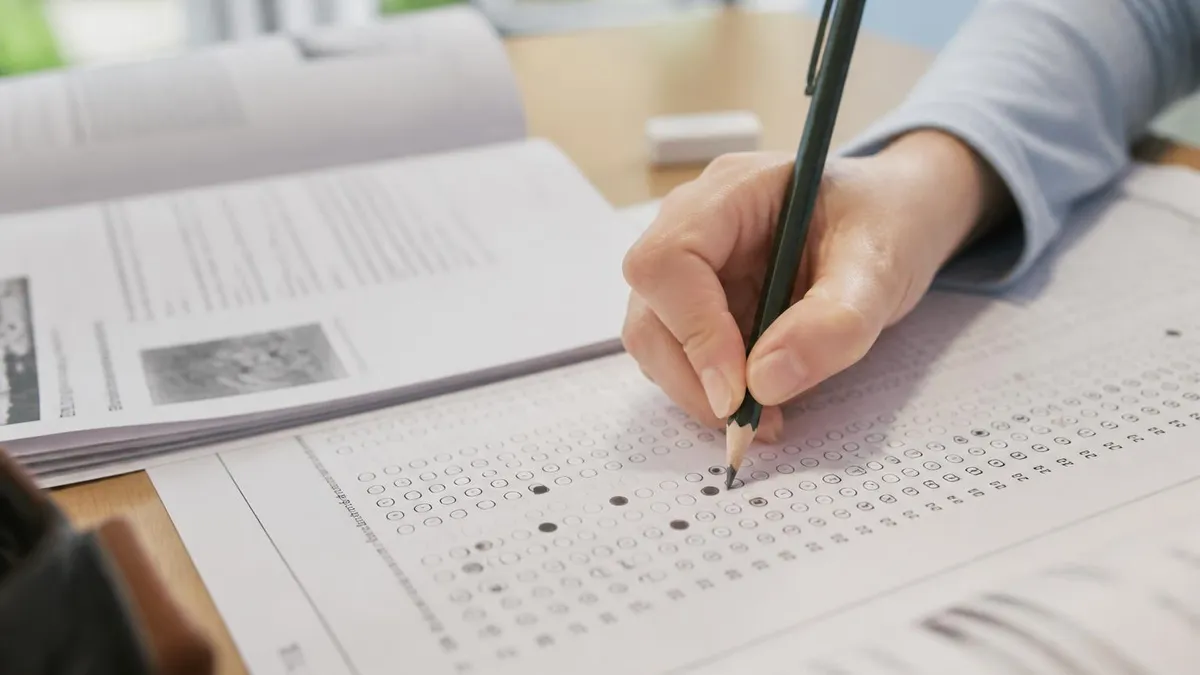
- ✓Complete at least one full-length OET practice test under timed, realistic conditions before your exam
- ✓Use profession-specific Writing and Speaking practice materials matching your healthcare profession
- ✓Time all Part A Reading practice sessions (15 minutes) to develop skimming speed
- ✓Practice Part A Listening note-completion without pausing the recording
- ✓Seek written feedback on at least 3 to 5 Writing practice letters before the actual exam
- ✓Complete Speaking roleplays with a partner or tutor, not just solo preparation
- ✓Analyze practice test errors by type to target your study efforts effectively
- ✓Review OET marking criteria for Writing so your practice letters reflect what assessors are looking for
OET Pros and Cons
- +OET practice tests reveal knowledge gaps that content review alone can't identify
- +Timed practice builds the pace needed for the real exam
- +Reviewing wrong answers is the highest-ROI study activity
- +Multiple free sources available
- +Score tracking shows measurable readiness
- −Third-party tests vary in quality and exam alignment
- −Taking tests before content review produces misleading scores
- −Memorizing answers without understanding concepts doesn't transfer
- −Authentic official practice material is limited
- −Practice scores don't perfectly predict actual exam performance
Pros and Cons at a Glance
| Pros | Cons |
|---|---|
| OET practice tests reveal knowledge gaps that content review alone can't identify | Third-party tests vary in quality and exam alignment |
| Timed practice builds the pace needed for the real exam | Taking tests before content review produces misleading scores |
| Reviewing wrong answers is the highest-ROI study activity | Memorizing answers without understanding concepts doesn't transfer |
| Multiple free sources available | Authentic official practice material is limited |
| Score tracking shows measurable readiness | Practice scores don't perfectly predict actual exam performance |
Official Resources
- Official OET sample tests — the test developer's free full-length Listening, Reading, Writing and Speaking sample papers with answer keys for every profession.
- NMC English language requirements — the UK Nursing and Midwifery Council's current OET grade requirements for nurses and midwives joining the register.
- Ahpra English language skills registration standard — the Australian regulator's accepted tests and minimum OET grades for registered health practitioners.




Sample Occupational English Test Practice Questions
Try these questions from our free Occupational English Test practice tests. The correct answer and an explanation follow each question.
A doctor says, "We'll start with blood tests, and depending on those results, possibly an ultrasound later." What is the immediate next step?
- A. Blood tests
- B. An ultrasound
- C. Surgery
- D. A referral
Answer: A. Blood tests
Blood tests come first; the ultrasound is conditional and later.
You hear a veterinarian discussing her role in the management of her practice. What does she think of her role?
- A. She values the greater understanding it gives her of her work.
- B. She admits that things have gotten a lot more complicated
- C. She wishes her employer was more concerned about the finances.
- D. She's perfect for the role
Answer: A. She values the greater understanding it gives her of her work.
The veterinarian expresses a positive view of her management role within the practice. She particularly values the enhanced understanding it provides her regarding the overall operations and intricacies of her work. This deeper insight allows her to appreciate the broader context of her daily tasks and the practice's functioning.
At a staff training day, you hear two trainee doctors participating in an activity. What does the activity give practice in?
- A. prioritising patients
- B. working with consultants
- C. writing case notes
- D. comprehending the situation
Answer: A. prioritising patients
During the staff training day, the activity involving the two trainee doctors is designed to provide practice in prioritizing patients. This exercise likely simulates real-world scenarios where doctors must quickly assess multiple patients' conditions and determine the most critical cases to address first, honing their decision-making skills under pressure.
What distinguishes OET Listening content from general English listening tests?
- A. All content is set within healthcare professional contexts
- B. It uses simplified vocabulary for non-native speakers
- C. It tests academic medical research comprehension
- D. It focuses on patient narratives only
Answer: A. All content is set within healthcare professional contexts
OET Listening exclusively uses healthcare professional contexts, making it directly relevant to clinical communication skills.
Take the full Occupational English Test practice test
OET Practice Tests: Questions and Answers
How this page was made: written with AI tools and published by Nathan Beja, founder of Practice Test Geeks, who is responsible for its content. Exam facts are checked against the official sources listed below. Not reviewed by a subject-matter expert. Editorial policy
Sources & references
Exam facts on this page (fees, format, dates, passing scores) are checked against these official sources; the date is our last check. Editorial policy
- cambridgeenglish.org — Time limit, passing score, score validity, test delivery · verified Oct 2026
- support.oet.com — Score release, eligibility, retake policy, registration deadline, exam information · verified Oct 2026