
Top Ten Nursing Schools in Georgia 2026 October: Rankings & NCLEX Pass Rates
Top ten nursing schools in Georgia ranked by NCLEX pass rate, cost, and acceptance — 📝 Emory, Georgia State, Mercer, Augusta, and 6 more. Real 2026 October data.
Why Nursing School Rankings Matter in Georgia
Georgia ranks 8th nationally in nursing employment, with roughly 84,000 active RNs serving 11 million residents. The state median RN wage hit $79,890 in 2024 — modest compared to California's $133,340 but with cost-of-living offsets that make Georgia salaries highly competitive in purchasing power. More importantly, Georgia hospitals face the same nursing shortage crisis driving national wage growth: Atlanta-area health systems Emory Healthcare, Wellstar, Piedmont, and Northside collectively post 4,200+ open RN positions on any given week, and sign-on bonuses of $15,000-$30,000 are now standard for new grads in critical care, ER, and L&D.
The right Georgia nursing school changes more than your tuition bill. NCLEX-RN pass rates vary from 65% to 99% across Georgia programs, and Magnet-designated hospitals — the highest tier of nursing employers — heavily favor graduates of programs with sustained pass rates above 90%. Choose the wrong school and you can graduate with $80,000 in debt and limited interview callbacks. Choose right and you'll have multiple competing offers before commencement. This guide ranks Georgia's top ten nursing schools by NCLEX pass rate, cost, acceptance rate, and post-graduation employment — the four metrics that actually predict career outcomes.
The numbers behind Georgia's nursing-school market explain why ranking accuracy matters so much. Georgia State alone produced 412 BSN graduates in 2024 — more than any other Georgia program — yet sits third on most ranking lists because Mercer and Emory edge it on NCLEX pass rates. Meanwhile, smaller schools like Brenau University graduate just 80-100 BSN students per year but maintain 88%+ pass rates that beat several larger competitors. Volume and quality don't move together in nursing education, so checking the latest NCSBN pass-rate data for each school is non-negotiable before applying.
Georgia's nursing-school ecosystem also rewards in-state residents in ways most applicants don't realize. HOPE Scholarship recipients can transfer between Georgia public universities mid-program without losing tuition coverage, which means an admit to Albany State who later transfers to Georgia State retains the HOPE benefit at the new institution. Private schools (Emory, Mercer, Brenau) accept HOPE only as a small institutional credit ($4,000-$8,000/year), but their internal grant programs frequently cover 60-70% of cost-of-attendance for in-state students earning under $150,000/year household income.

Georgia nursing snapshot (2024-25)
The Top Ten Nursing Schools in Georgia 2026
The rankings below blend 2024 NCLEX-RN first-time pass rates, total cost of attendance, acceptance rates, and post-graduation employment at Magnet hospitals. Programs that lost accreditation or saw pass rates below 75% are excluded entirely — the bottom of Georgia's nursing-school list is dangerous territory you should not enter. These ten programs all maintain CCNE or ACEN accreditation and produce graduates who consistently land jobs at Emory Healthcare, Children's Healthcare of Atlanta, Augusta University Health, Wellstar, Northside, and Piedmont.
Emory University's Nell Hodgson Woodruff School of Nursing leads the rankings on virtually every metric. The traditional BSN runs four years at $61,000/year sticker (most students pay under $30,000 after aid), with 96% first-time NCLEX-RN pass rate and 100% job-placement within six months of graduation. Emory's accelerated BSN (for non-nursing bachelor's holders) finishes in 15 months at $63,200 total tuition — competitive with our broader accelerated nursing program roundup.
Mercer University's Georgia Baptist College of Nursing comes next: 99% NCLEX pass rate in 2024, $50,300/year sticker, 78% acceptance rate. Georgia State University rounds out the top three with the highest acceptance rate among ranked programs (84%) and the lowest sticker price at $9,900/year for in-state students.
Augusta University Health Sciences follows in fourth place on this ranking. Augusta has the strongest clinical partnerships of any non-Atlanta Georgia school — its students rotate through AU Medical Center (the state's third-largest hospital), the Charlie Norwood VA, and East Georgia Regional. The 92% NCLEX pass rate is consistent year-over-year, and in-state tuition under $11,000 makes Augusta arguably the best value of the top five programs.
Kennesaw State University sits fifth and is the largest BSN program in Georgia by enrollment (1,000+ students at any given time). Kennesaw's clinical partnership with Wellstar Health System places students in 11 hospitals across north metro Atlanta — broad exposure that translates into job offers from multiple Wellstar facilities before graduation. The accelerated BSN at Kennesaw is one of the few Georgia ABSN programs accepting non-traditional applicants over age 35 without bias in admissions reviews.
Georgia Southern (sixth) operates campuses in Statesboro and Savannah, giving south Georgia residents a strong path that avoids Atlanta commute or relocation. Brenau University (seventh, private) maintains close ties to Northeast Georgia Health System and produces a high percentage of graduates entering psychiatric and pediatric specialties. Clayton State, Albany State, and Valdosta State (eighth through tenth) all deliver solid pass rates at the lowest tuition tier in the state — under $8,000/year for residents.
One small but telling detail: top-3 Georgia programs all publish their NCSBN-reported pass rates publicly and update them annually. Schools further down the ranking sometimes obscure these numbers behind login walls or quote multi-year averages that hide a poor recent year. If a school doesn't post its most recent single-year NCLEX pass rate on its admissions page, treat that as a red flag worth a phone call to the program director before applying.
Tuition and Aid by Program
Sticker price varies wildly across Georgia's top nursing schools. Public universities cost $7,000-$11,000 per year for in-state students — Kennesaw State, Georgia Southern, Clayton State, and Albany State all sit under $8,000. Private schools (Emory, Mercer, Brenau) run $30,000-$61,000 per year sticker, but generous institutional grants and HOPE Scholarship eligibility push net costs much lower. Emory's average financial aid package covers 70% of need-based costs for Georgia residents; Mercer offers up to $25,000/year in merit grants for HOPE Scholar applicants.
The single biggest aid lever for Georgia residents is the Zell Miller / HOPE Scholarship. HOPE pays full in-state tuition at Georgia public universities for students with 3.0+ high school GPA; Zell Miller raises that to 3.7+. Both scholarships cover the BSN at Georgia State, Augusta, Kennesaw State, Georgia Southern, Clayton State, Albany State, and Valdosta State. Combined with the standard FAFSA federal aid package, HOPE-eligible students often graduate from a state BSN program with under $15,000 in debt. For private school admits, our scholarships for college sophomores guide lists 40+ underclassman awards that stack with institutional grants.
Federal aid layers significantly on top of state programs for Georgia residents. The maximum Pell Grant ($7,395 in 2024-25) goes to students with Expected Family Contribution below $7,000, and most BSN students qualify for at least partial Pell. Federal Direct Subsidized Loans add another $5,500/year (freshman) up to $7,500/year (junior/senior) at fixed interest under 6%. Combined Pell + HOPE + Subsidized covers the entire cost of attendance at every Georgia public university for students with demonstrated financial need.
Private school aid math runs differently. Emory uses need-blind admissions for U.S. citizens and pledges to meet 100% of demonstrated financial need with grants (not loans) for families earning under $100,000/year. Mercer awards merit scholarships based on TEAS score and prereq GPA — students with 3.8+ GPA and TEAS 85+ routinely receive $20,000-$30,000/year in merit grants. Brenau caps merit aid at $18,000/year. None of these private schools participate in the HOPE program directly, but the institutional aid effectively replaces it for high-credential admits.

Admissions Bar — What Each School Actually Requires
Admission to Georgia's top nursing programs is competitive but not impossible. Emory University expects 3.7+ unweighted GPA in prerequisites (anatomy, physiology, microbiology, chemistry, statistics, psychology), TEAS composite of 80+, and 2-3 strong letters of recommendation. The 2024 admitted cohort had average SAT 1380, ACT 31. Mercer's threshold is similar: 3.6+ prereq GPA, TEAS 78+, and demonstrated healthcare experience (CNA work, hospital volunteering, or shadowing). Georgia State and Augusta University use holistic review with lower hard cutoffs (3.2+ GPA, TEAS 68+), making them strong targets for transfer students or career-changers.
The TEAS exam is the single biggest predictor of admission across Georgia programs. A 75th-percentile composite score (roughly 78 on the new scoring scale) puts you in the top tier at any program. Free ATI TEAS practice tests and the official ATI study manual are the most efficient prep path. Plan 8-12 weeks of structured study before sitting for the exam.
Each retake costs $115, and most schools accept your highest score across attempts. For an even faster path if you already hold a bachelor's degree, the 12-month accelerated BSN route is offered at Emory, Mercer, and Kennesaw State. Cross-check your background against the how to become an RN nurse walkthrough to confirm prerequisites before you apply.
Prerequisite course planning is where most Georgia nursing applicants stumble. Each program publishes a unique prereq list with specific course numbers — Emory accepts only its own anatomy course unless transferring from select feeder schools, while Georgia State accepts equivalent anatomy from any accredited Georgia institution. Mismatched prereqs are the #1 reason applications get rejected on technical grounds. Build a one-page spreadsheet listing each target school's required courses, then complete the most restrictive set at a community college before applying.
Healthcare experience matters more than many applicants assume. Mercer explicitly weighs 100+ hours of healthcare volunteering or paid work into admissions decisions. Emory's interview round (only 30% of applicants reach it) focuses heavily on prior patient-care experience and the candidate's articulated reason for choosing nursing over PA, MD, or pre-health alternatives. Georgia State and Augusta don't require experience but admit candidates with healthcare work history at meaningfully higher rates.
Georgia nursing school application checklist
- ✓Complete prereqs with 3.5+ GPA (A&P I/II, microbiology, chemistry, statistics, psychology, nutrition)
- ✓TEAS or HESI A2 — aim for 78+ composite for top-3 programs
- ✓Application essay (250-500 words; concrete healthcare experience required)
- ✓Two letters of recommendation — one from a healthcare professional, one from a prereq professor
- ✓Background check + drug screen (most programs require pre-admission)
- ✓BLS (Basic Life Support) certification — $80, often required at first clinical rotation
- ✓Immunizations current: MMR, Tdap, Hep B, varicella, flu, COVID, TB
- ✓FAFSA submitted by October 15 for maximum HOPE + need-based aid
Online Nursing School in Georgia
True online pre-licensure nursing programs don't exist anywhere — clinical hours have to happen in-person under preceptor supervision. What does exist in Georgia is hybrid BSN coursework (lectures online, labs and clinicals in person) and fully-online RN-to-BSN bridge programs for current RNs upgrading their credential. Georgia State, Kennesaw State, Albany State, Valdosta State, and Clayton State all offer accredited online RN-to-BSN tracks completing in 12-18 months at $4,500-$12,000 total — among the cheapest in the Southeast. See our RN to BSN programs roundup for full state-by-state comparison.
For pre-licensure students who want maximum flexibility, hybrid ABSN options at Emory and Mercer cluster on-campus weeks 2-3 days twice a month, with the remainder online. This is realistic for working students within 90 minutes of campus. Fully online ADN bridge programs from out-of-state schools (Western Governors, Aspen, etc.) accept Georgia students, but verify the program's clinical partners exist near your home before enrolling — driving 4 hours each way to a clinical site is the most common reason students drop out of online programs.
One Georgia-specific online benefit: state public universities all participate in the Common Application for Nursing Education (eCANE) system. This unified application lets you apply to multiple Georgia BSN programs with a single fee ($45) and one set of transcripts. The eCANE system also tracks your TEAS scores across schools so you don't have to request multiple ETS or ATI score reports. Time-saver of about 6-8 hours plus $200+ in duplicate application fees.
If you're between options, hybrid ABSN programs from Mercer or Emory may be your best path. Both let you complete didactic content online while clustering clinical and lab hours on campus 2-3 times per month. Real-world catch: the on-campus weeks are intensive (40+ hours), so plan to take vacation or unpaid leave from work during those stretches.

Georgia Nursing School vs. Other States
If you have flexibility on where to attend, Georgia compares favorably with neighboring states. Florida and Tennessee BSN programs run roughly the same tuition, but Florida lacks an equivalent of the HOPE Scholarship and Tennessee's TN Promise covers community college only. South Carolina offers strong nursing programs at MUSC and Clemson, but tuition for out-of-state students runs 3x in-state rates.
California and New York both have higher post-grad wages but cost of living eats 40-60% of that wage premium. For a deeper rankings comparison across the country, our Vanderbilt School of Nursing profile (the Tennessee leader) and the broader RN-to-BSN programs roundup provide cross-state context.
One Georgia-specific advantage often overlooked: the state participates in the Nurse Licensure Compact (NLC). Once you hold a Georgia RN license, you can practice in 41 member states without applying for additional licenses. This is huge for travel nurses and military spouses. Texas, Florida, North Carolina, Tennessee, South Carolina, and Alabama are all compact members — your Georgia license travels across the entire Southeast.
For travel-nurse hopefuls, Georgia's compact license offers immediate flexibility to take 13-week assignments in 41 states without re-licensing. Compare that to California, which requires full state licensure for any practice (even a single shift) — California's RN application takes 3-6 months and costs $350. Travel nurses based in Georgia can accept California assignments only by paying for and waiting on a California license; meanwhile, Georgia-based travelers can pick up assignments in Texas, Florida, Tennessee, North Carolina, South Carolina, Alabama, and 35 other states the same week they finish their current contract.
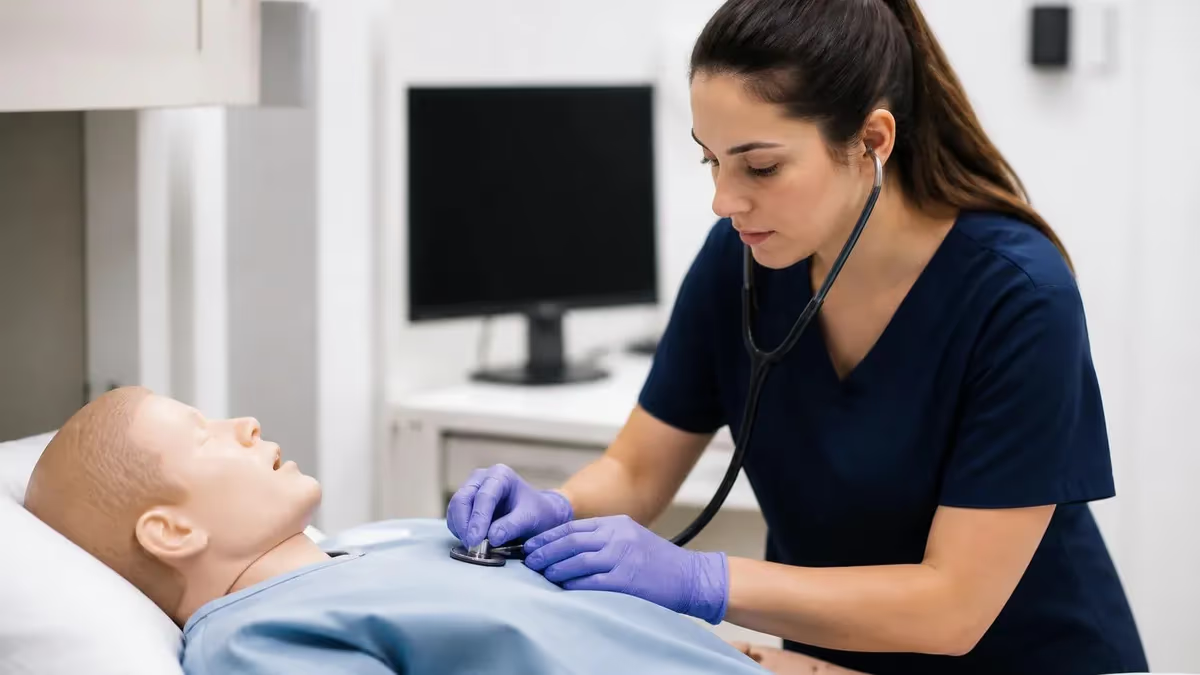
One more often-missed comparison: Georgia's investment in nursing simulation labs has accelerated since 2020. Emory, Mercer, Augusta, and Kennesaw all rebuilt simulation centers with high-fidelity manikins (SimMan 3G, HAL S2025) that simulate cardiac events, OB emergencies, and trauma codes. National nursing-education research shows simulation-heavy programs produce graduates with 10-15% higher confidence scores in their first clinical year. State schools that haven't yet upgraded their sim labs (most fall in the 7-10 range of our ranking) tend to lag in graduate-confidence surveys.
Top 5 schools — deeper look
Located in Atlanta. 96% NCLEX pass rate, 100% job placement, Magnet-affiliated clinical sites at Emory Healthcare and Children's Healthcare of Atlanta. Strong global health focus — Carter Center partnership. Sticker $61,000/year, average aid covers 70% of need.
Pros and cons of nursing school in Georgia
- +HOPE/Zell Miller Scholarship covers in-state public BSN tuition for 3.0+ GPA students
- +Strong Magnet hospital ecosystem in Atlanta — multiple competing employers for new grads
- +NLC compact license — work in 41 states without additional licensure
- +Lower cost of living than CA/NY/MA with comparable purchasing power
- +Multiple program tiers: $7K state schools to $61K Emory — fits every budget
- −Top programs (Emory, Mercer) are highly competitive — 3.7+ GPA + TEAS 80+ required
- −Rural areas have fewer clinical placement options — online students may drive 90+ min
- −Lower median wage than CA, HI, OR (although COL-adjusted gap is small)
- −Some lower-ranked Georgia programs have NCLEX pass rates under 75% — avoid these
- −No true online pre-licensure RN path — hybrid is the closest alternative
Beyond the top 10 — also-rans worth a look
BSN + RN-to-BSN. 80% NCLEX. $7,800 in-state. Smaller cohort, more personal attention.
BSN + MSN tracks. 82% NCLEX. $7,500 in-state. Strong public health focus.
BSN + accelerated BSN. 85% NCLEX. $9,200 in-state. Honors-college integration.
BSN only. Private. 78% NCLEX. $42K/year. Accelerated path for non-nursing bachelor's.
Private BSN + RN-to-BSN. 76% NCLEX. $40K/year. National chain with hospital partnerships.
ASN + BSN tracks. 79% NCLEX. $43K total. Strong job placement in non-Magnet hospitals.
If you have HOPE/Zell Miller eligibility + 3.5 GPA → apply to Georgia State, Augusta, or Kennesaw State for in-state value. If you have 3.7+ GPA + TEAS 80+ → apply to Emory and Mercer for the prestige and placement boost. If you already hold a non-nursing bachelor's → look at Emory ABSN, Mercer ABSN, or Kennesaw ABSN for 12-15 month completion. Always apply to 4-6 programs to spread admission risk.
Nursing Questions and Answers




About the Author

Registered Nurse & Healthcare Educator
Johns Hopkins University School of NursingDr. Sarah Mitchell is a board-certified registered nurse with over 15 years of clinical and academic experience. She completed her PhD in Nursing Science at Johns Hopkins University and has taught NCLEX preparation and clinical skills courses for nursing students across the United States. Her research focuses on evidence-based exam preparation strategies for healthcare certification candidates.
Join the Discussion
Connect with other students preparing for this exam. Share tips, ask questions, and get advice from people who have been there.
View discussion (8 replies)