
Telehealth Nurse Practitioner Jobs: Complete 2026 October Career Guide
🏆 Telehealth nurse practitioner jobs guide: salary ranges, state licensing, top employers, and the skills that get you hired in remote NP roles.
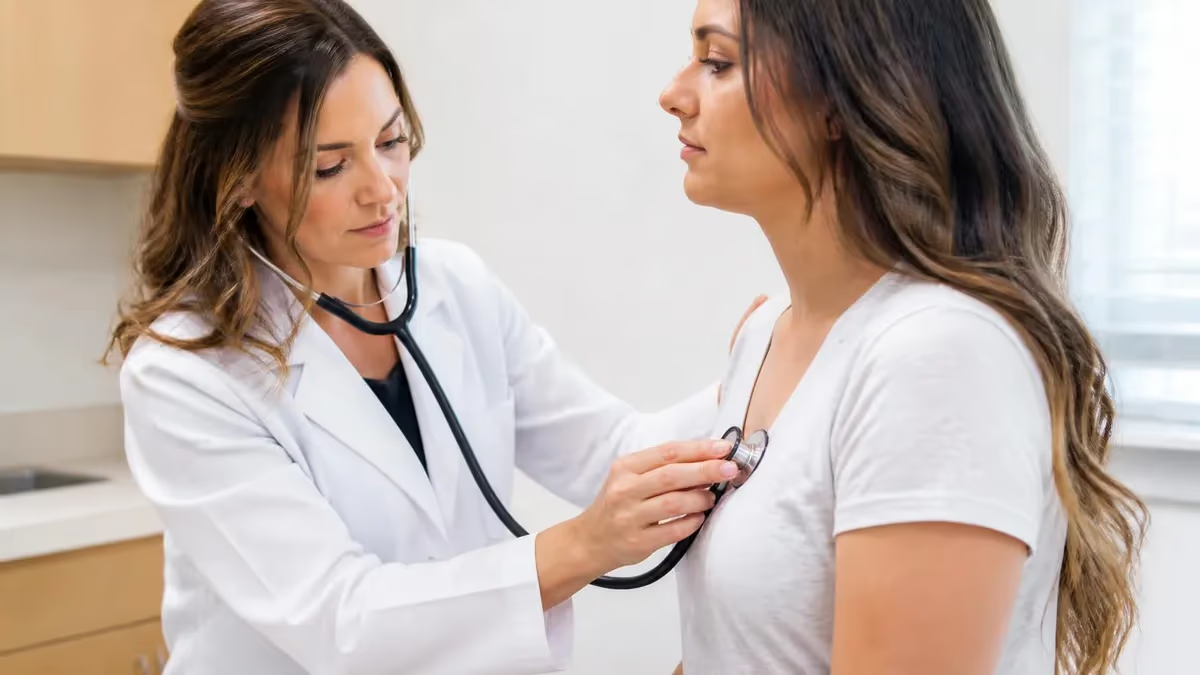
Telehealth nurse practitioner jobs have moved from pandemic-era stopgap to mainstream career path. Hospital systems, primary care groups, mental health startups, and chronic care platforms now hire NPs to deliver care over video and phone, often with full prescriptive authority. Demand keeps climbing because telehealth lets one NP cover patients across multiple counties without the windshield time.
If you're an experienced NP wondering whether remote practice is realistic, or a new grad asking whether you can start telehealth straight out of school, the short answer is yes. But the path matters. Some employers want two years of in-person experience first. Others, particularly mental health platforms, hire new grads with the right collaborating physician structure.
Pay ranges from roughly $95,000 for part-time async work to $180,000 plus for full-time psychiatric mental health NPs covering complex caseloads. This guide walks through what telehealth NP work actually looks like day to day, which credentials and state licenses you need, the salary ranges by specialty, and how to position yourself during interviews.
We'll cover the Nurse Licensure Compact, Interstate Medical Licensure for collaborating physicians, charting platforms like Athena and Epic, and the productivity metrics most companies measure. By the end you'll know whether telehealth fits your career and exactly what to do next to land your first remote role.
Telehealth NP Job Market Snapshot
Those numbers tell a story but they hide variation. A psychiatric mental health nurse practitioner working for a venture-backed mental health platform might clear $190,000 with bonuses, while a family NP doing urgent care triage for a regional hospital network sits closer to $115,000.
Geography still matters because your license has to match the patient's state at the moment of the visit — not where you live. NPs who hold five or six state licenses often command premium pay because employers can route patient volume to them across time zones.
The growth is real but it's specialty-weighted. Mental health, primary care, weight management, hormone therapy, dermatology consults, and chronic disease coaching dominate the listings. Procedure-heavy specialties like wound care or surgical follow-up rarely translate to pure telehealth. Knowing which clinical niches translate, and which don't, saves months of fruitless applications.
Many NPs are surprised by how structured the workflow becomes. The platforms standardize chart templates, message scripts, and triage rules. That structure protects you legally but it also means your clinical judgment lives inside guardrails. Embrace that and you'll thrive; resent it and you'll quit within six months.

Quick Reality Check
Telehealth NP work is not "easy money from your couch." The best-paying remote NP jobs measure productivity by patients-per-hour, chart-closure time, and patient satisfaction scores. You'll work harder than you think — just without the commute, the scrubs, and the sticky waiting-room chairs.
Let's start with what telehealth NP jobs actually look like once you're hired. Most employers fall into one of four buckets, and the day-to-day experience varies wildly between them.
Mental health platforms like Talkiatry, Cerebral, Brightside, and SonderMind typically schedule 45 to 60 minute initial intakes and 25 to 30 minute follow-ups. The pace is calmer than urgent care but the documentation expectations are heavier because psychiatric notes require risk assessment, medication reconciliation, and clear safety planning on every visit.
Primary care companies like Included Health, Carbon Health, and One Medical lean toward 15 to 20 minute synchronous visits with async messaging in between. The throughput is higher and the chief complaints range from medication refills to acute illness triage. Chronic care platforms such as Omada and Virta blend coaching with prescribing, often pairing the NP with a health coach who handles behavior-change conversations.
Large hospital systems use telehealth as a triage layer, often paired with a brick-and-mortar location you may visit occasionally. These hybrid models can be the best on-ramp for new telehealth NPs because you keep one foot in conventional practice while learning the remote workflow.
Your scope of practice on the platform will mirror your state's NP regulations. In full-practice authority states like Washington, Oregon, Colorado, New Mexico, and Arizona, you can evaluate, diagnose, prescribe, and bill without a collaborating physician. In reduced-practice states like Ohio, Pennsylvania, and Texas you'll need a documented collaborative agreement. Restricted-practice states like California, Georgia, and South Carolina require physician supervision for most independent decisions. The platform absorbs the paperwork but the underlying rules don't change just because the visit is virtual.
Four Common Telehealth NP Roles
Med management for depression, anxiety, ADHD, bipolar. Highest demand, highest pay. Requires PMHNP certification and DEA registration.
Urgent care triage, chronic disease management, refills, sick visits. Largest job pool. Often paired with after-hours coverage.
Chronic care, hypertension, diabetes, post-discharge follow-up. Heavy use of remote patient monitoring data and care plans.
Contraception consults, hormone therapy, menopause management, UTI treatment. Growing niche on platforms like Hims and Nurx.
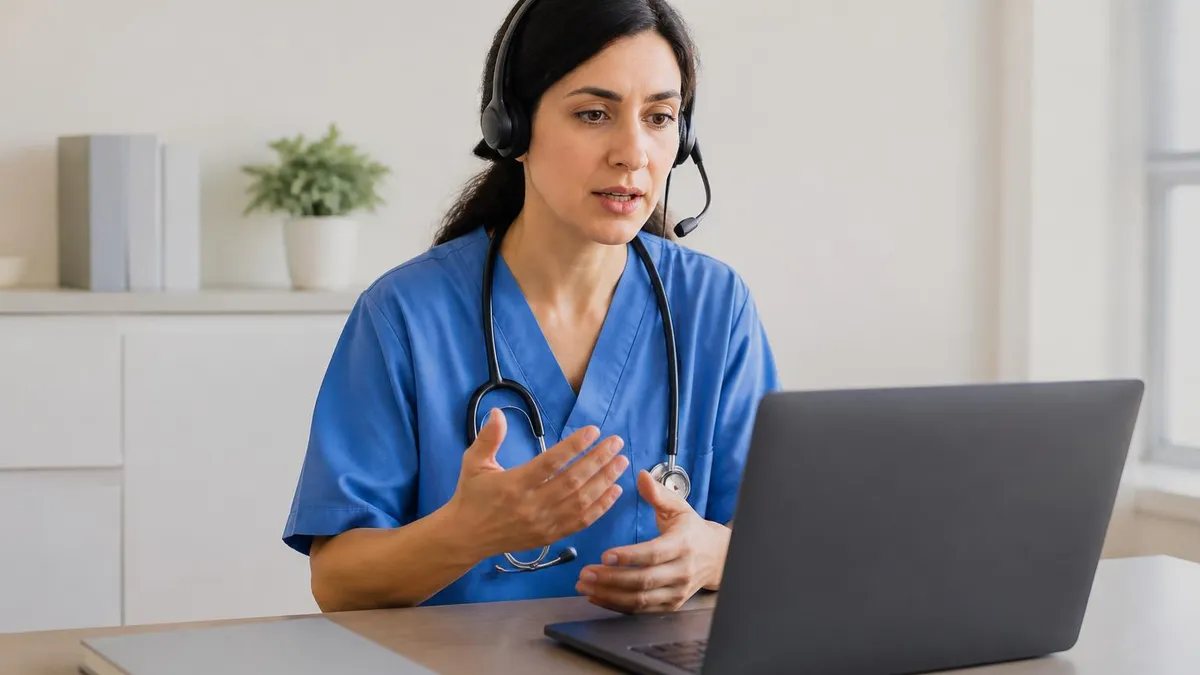
Within each role the daily rhythm depends on whether the employer schedules synchronous appointments or async messaging. Synchronous work means back-to-back video visits with a 5 minute buffer between, very similar to a busy clinic day. The mental model is the same as in-person practice: room one, room two, room three — except the rooms are video tiles.
Async work, sometimes called text-based or store-and-forward care, means patients submit a questionnaire and photos. You review when you have time and respond in writing. Async pays per case rather than per hour, with experienced NPs handling 8 to 15 cases per hour for routine refills and 3 to 5 for new evaluations. The economics favor NPs who can read fast, write clearly, and make confident decisions without seeing the patient's face.
Most full-time telehealth NPs work a hybrid: scheduled blocks of synchronous visits in the morning, async case review in the afternoon. You'll close charts inside the platform's EHR — Athena, Epic, eClinicalWorks, or a proprietary build — and your closure time becomes a tracked metric. Companies expect 90% of charts closed within 24 hours, with refill requests turned around in two business days.
The unwritten skill that separates top earners from the rest is template discipline. The platforms give you note templates, message scripts, and pre-built education snippets. NPs who customize and reuse them consistently spend half the time charting compared to NPs who type fresh notes from scratch.
Telehealth NP Salary by Specialty (2026 Estimates)
PMHNPs earn the most in telehealth: $145,000 to $210,000 base, with platforms like Talkiatry offering W-2 employment plus equity and benefits. 1099 contractors on Cerebral or Done can clear $200K but absorb their own malpractice and self-employment tax. Demand is highest for ADHD, anxiety, and major depression panels.

Beyond base pay, look closely at productivity bonuses, paid time off, malpractice coverage, and license reimbursement. The headline number on a job board rarely tells the full compensation story. A $140,000 W-2 role with full benefits, $5,000 CME budget, and reimbursed multistate licenses can easily out-earn a $165,000 1099 role where you absorb self-employment tax, health insurance, and seven state license renewals every two years.
Equally important: ask whether the employer caps your patient panel size, enforces minimum visit lengths, and gives you autonomy to refer out complex cases. Telehealth platforms vary dramatically on how much pressure they apply. Some treat NPs as clinicians making clinical decisions; others treat them as throughput engines optimizing for visit volume.
If you've never read an offer letter critically before, this is the moment to start. Total comp math should include: base, productivity bonus structure, sign-on, equity, retirement match, paid CME, malpractice with tail coverage, PTO accrual cap, state license reimbursement, and reimbursed home-office stipend. Add those up before comparing offers.
The Nurse Licensure Compact (NLC) covers your RN license across 41 states — but it does NOT cover your APRN/NP license. The APRN Compact is separate, exists in legislation but has only been activated in a handful of states, and most telehealth roles still require individual NP licensure in each patient's state. Budget $150 to $400 per state plus 4 to 12 weeks of processing time per license.
Now to the practical mechanics. To work telehealth as an NP you need, at minimum, an active RN license in your state of residence (compact preferred), an APRN/NP license in each state where your patients are physically located at the time of the visit, national certification (AANP, ANCC, or NCC depending on your specialty), DEA registration if you'll prescribe controlled substances, and malpractice insurance with telehealth coverage explicitly named. Most employers also require BLS or ACLS depending on the population.
Multistate licensure is the lever that determines how much you can earn. NPs licensed in 6 to 10 states fill more patient demand and command higher per-hour rates. Start with your home state, add high-population neighboring states (Texas, Florida, California, New York), then prioritize states where the employer has heavy demand.
Some companies will sponsor and pay for additional state licenses after you're hired — always ask before signing. License renewal costs can quietly become a $3,000 to $5,000 annual line item if you don't negotiate reimbursement up front.
Verify your DEA registration matches every state you practice in. The DEA requires a separate registration in each state where you prescribe controlled substances. Some telehealth companies handle the multi-state DEA paperwork; others leave it entirely to you. Read the fine print and don't sign until you understand which side carries that load.
Telehealth NP Application Checklist
- ✓Active RN license in your state of residence (NLC compact preferred)
- ✓APRN/NP license in your state of residence with no disciplinary history
- ✓National certification through AANP, ANCC, NCC, or PNCB
- ✓DEA registration active and not restricted (for prescribing)
- ✓Malpractice insurance with explicit telehealth coverage clause
- ✓Reliable high-speed internet (25 Mbps download minimum) and HIPAA-secure workspace
- ✓Updated CV listing telehealth or remote work experience if any
- ✓Two clinical references plus one supervisor reference
- ✓BLS certification current; ACLS if applying to acute care or PMHNP roles
- ✓List of states you're willing to add licensure for over the next 12 months
Interview prep is where strong candidates separate from the pack. Hiring managers at telehealth platforms ask three categories of questions: clinical reasoning under telehealth constraints, technology comfort and EHR workflow, and patient communication when you can't physically examine someone.
They want to know that you can triage red flags without laying hands on a patient, that you'll escalate when symptoms exceed virtual scope, and that you can document defensibly when the visit is recorded. Walk into the interview prepared to describe the exact moment you'd convert a video call into a 911 referral.
Expect at least one case scenario where the patient describes vague symptoms that could be benign or life-threatening — chest tightness, sudden severe headache, postpartum depression with passive ideation. Walk through your differential out loud. Name the questions you'd ask, the red flags that would trigger ER referral, the medications you'd avoid, and how you'd document the encounter. Reviewers grade on whether you sound safe and structured, not whether you arrive at one specific diagnosis.
Technology questions are easier than candidates expect. The platform will train you on its EHR. What they really want to hear is that you can troubleshoot a dropped call without panicking, that you have a backup phone line, and that your home office is HIPAA-compliant with no roommates wandering through the background.
Telehealth NP Pros and Cons
- +No commute, flexible scheduling, and you can practice from any HIPAA-secure location
- +Higher hourly equivalents than most in-person roles, especially for PMHNPs
- +Lower exposure to infectious disease and physical demand
- +Easier work-life balance with structured visit blocks and clear end-of-shift
- +Access to patient panels across multiple states grows your clinical experience faster
- +Often includes equity or bonuses at venture-backed startups
- −Multistate licensure costs $1,500 to $4,000 annually plus continuing education in each state
- −Productivity metrics can feel like a call center on busy days
- −Limited physical exam means more diagnostic uncertainty and defensive charting
- −Isolation: no clinic coworkers, less informal mentorship, fewer hallway consults
- −Technology failures — dropped video, EHR outages — happen and you absorb the schedule pain
- −Some malpractice insurers charge higher premiums for telehealth-heavy practice
Common mistakes new telehealth NPs make include underestimating administrative load, accepting roles without verifying physician collaboration arrangements, and forgetting that controlled substance prescribing rules differ by state.
The Ryan Haight Act and post-pandemic DEA telehealth flexibilities are evolving. Stimulants and benzodiazepines often require an in-person visit at some point in the patient relationship, depending on the state and the specific schedule. Before you accept a PMHNP telehealth role, ask exactly how the employer handles initial in-person requirements and what happens if the rules tighten.
The smartest telehealth NPs treat their first role like a launchpad. Spend 12 to 18 months at a platform with strong training and clear protocols. Build a portfolio of state licenses funded by that employer. Document patient outcomes, satisfaction scores, and chart-closure metrics. Then either negotiate a major raise at renewal or move to a higher-paying platform with the proof in hand.
The ones who try to optimize for highest hourly rate on day one tend to land at chaotic operations and burn out within a year. Pace yourself. The platforms aren't going anywhere and the demand for remote NPs is structural, not cyclical.
NP Questions and Answers
Telehealth NP Career Snapshot
One topic candidates often overlook is the contracting model. W-2 versus 1099 is not a paperwork detail; it changes how you experience the job. W-2 employees get tax withholding, employer-paid malpractice, group health insurance, retirement matching, paid CME, and protected PTO. The hourly rate looks lower on the offer letter but the total package usually wins, especially once you account for self-employment tax (15.3%) and health insurance premiums on the open market.
1099 contractor roles look attractive because the per-visit or per-hour rates appear 20 to 40% higher. Then you write your own quarterly estimated taxes, fund your own retirement, buy your own malpractice with telehealth endorsements, and pay $700 to $1,800 per month for individual health insurance. Run the actual math on three different offers and you'll see which model fits your life. NPs supporting a family with no other insurance source almost always prefer W-2. NPs with a spouse's benefits or a per-diem in-person role on the side often prefer 1099 for the flexibility.
Finally, plan your exit before you accept the offer. Telehealth platforms come and go. Tail malpractice coverage, non-compete clauses, restrictive covenants on patient lists, and intellectual property terms all matter when you eventually move on. Read the contract slowly, ask your state nursing association for sample language, and negotiate any term that feels one-sided. Most platforms expect negotiation and will quietly improve the offer when you push back politely.
Telehealth nurse practitioner jobs aren't going away. The post-pandemic infrastructure is built, patients prefer remote visits for many conditions, and employers love the geography flexibility. What's changing is the maturity of the market: fewer fly-by-night startups, more established platforms with clear training, defined protocols, and real benefits.
That's good news for NPs who want a stable remote career and bad news for anyone hoping to coast through low-effort visits. The bar is rising as the field consolidates. Platforms now invest in onboarding, peer review, and outcome tracking. Showing up prepared is what wins offers.
If you're serious about moving into telehealth, start now. Get your home state license renewed and clean. Pick one neighboring state to add this quarter. Update your CV to highlight any remote work, EHR proficiency, or independent decision-making. Apply to two or three platforms and ask each one specifically about their training, scheduling, and state license sponsorship. Within 90 days you can have multiple interviews scheduled. Within six months you can be working full-time telehealth with the autonomy you've been looking for.
The NPs landing the best telehealth roles share three habits. They study the platform's clinical model before interviewing. They answer scenario questions with structured reasoning rather than memorized algorithms. And they negotiate state license sponsorship into their offer letters. Do those three things and you'll have your pick of telehealth NP jobs in the specialty and pay range you want.
One last note: build a peer network early. Telehealth feels isolating without coworkers in the next room. Join AANP forums, specialty subreddits, and your platform's clinician Slack channels. The clinical questions you'd normally ask a hallway colleague have to find another path, and the NPs who deliberately build that network outlast the ones who try to go it alone.
About the Author

Registered Nurse & Healthcare Educator
Johns Hopkins University School of NursingDr. Sarah Mitchell is a board-certified registered nurse with over 15 years of clinical and academic experience. She completed her PhD in Nursing Science at Johns Hopkins University and has taught NCLEX preparation and clinical skills courses for nursing students across the United States. Her research focuses on evidence-based exam preparation strategies for healthcare certification candidates.