
Nurse Practitioner Jobs Near Me: Find Local NP Openings, Salary, and How to Apply
🔎 Find nurse practitioner jobs near me with this practical guide. Local salary ranges, top employers, application tips, and where NPs really get hired.
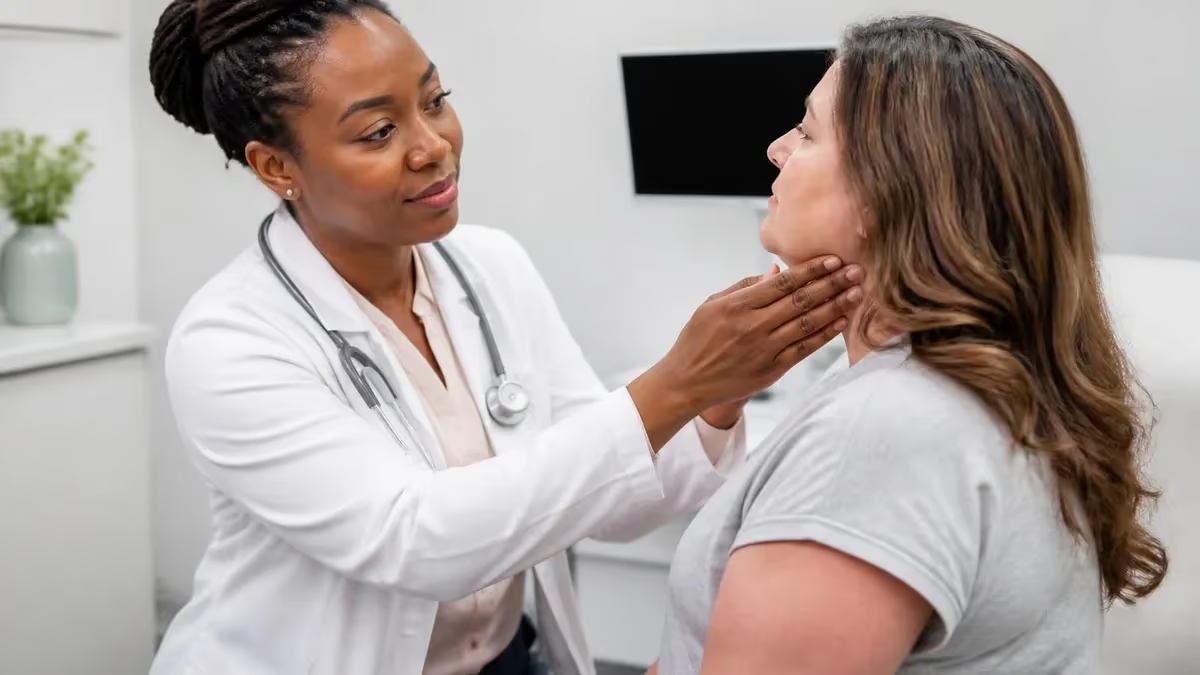
Searching for nurse practitioner jobs near me is the smartest first move. Most NPs want a commute under 45 minutes. Local searches return live openings within roughly 50 miles. That's where the real hiring happens. Employers prefer local hires — no relocation costs, faster start dates, stronger community ties.
You'll get more callbacks locally than from national boards. Why? Hospitals fill local roles fast. Recruiters skip candidates who need to move. If you're eyeing a long nurse practitioner career, anchoring your search to ZIP code or city gives you live openings instead of stale national listings.
Local also means faster onboarding. A hospital ten minutes from your house gets you credentialed in weeks. A role across the country takes months — state licensure, housing, family logistics. Smart NPs filter every job board by ZIP first. They expand the radius only if local options run dry.
Another reason locals win? Reference checks move quicker when your former preceptors live in the same metro. Hiring managers love that. They can text someone they know about you. That kind of warm signal converts applications into interviews faster than any cover letter ever will.
Start on Indeed, layer in LinkedIn and your state NP association board, apply within 24 hours of a posting going live, and negotiate 5-15% above the first offer — that is the playbook that lands most NPs a job within 4 to 8 weeks.
Not every job board is the same. Indeed pulls the most traffic and postings. LinkedIn Jobs is where recruiters actively message NPs. Specialty boards like NursingJobs.com and HospitalCareers.com surface roles you won't find elsewhere. AANP Career Center is goldmine territory for serious openings.
Don't skip Glassdoor — pairs listings with salary intel. State NP association boards quietly post the best local roles. Hospital websites? Worth a weekly check. Specialty practice sites often hide the highest-paying jobs. Cast a wide net. Check each one weekly.
ZipRecruiter and Monster still have decent NP postings, especially for travel and locum tenens roles. NurseFly and Vivian Health dominate the travel space if you want to try $2,500-$3,500 weekly contracts. Health-eCareers serves the physician-adjacent market and pulls in specialty NP listings hospitals won't post anywhere else.
Set up email alerts on three to five boards. Filter by your specialty, your ZIP, and a 25-mile radius. Check Monday mornings — that's when most postings go live. New listings get the most applicant attention in the first 48 hours. Speed of application matters more than most NPs realize.

NP Work Settings: Where the Jobs Live
Hospitals offer full-time hours, structured shifts, robust benefits, and rapid skill-building. You will see acute care, surgical recovery, ICU, and ER roles. Salaries trend higher — often $130K to $160K — with strong retirement matching and tuition reimbursement. Downside? 12-hour shifts and rotating weekends are common. New graduates often start here for the breadth of exposure.
Average NP Salary by State (2025)
Geography drives your nurse practitioner salary more than almost any other factor. California pays the highest gross numbers, but cost of living eats much of the gain. Texas and Florida pay less on paper, but your dollar stretches further. Rural areas often beat urban centers because hospitals there pay premiums to attract talent.
Federal jobs — VA, Indian Health Service, military — fall in the $115K to $155K band but include lifetime benefits, pension, and federal holidays. Government work is underrated. Pension alone can add $30K-$50K of effective compensation per year once you factor in long-term value. Many federal NPs retire at 55 with a steady check.
State income tax matters too. Texas, Florida, Tennessee, Nevada, Washington — no state income tax. That can be a $10K-$15K swing versus high-tax states like California or New York. When you compare offers across states, always calculate net pay after taxes, housing, and commute costs. The headline number lies.
Don't forget the local healthcare market dynamics. Cities with one dominant employer pay less because there's no competition. Metros with multiple competing hospital systems — Boston, Houston, Denver — pay more because they fight for NP talent. Check how many big employers operate in your target city before accepting any offer.
NP Salary by Specialty
- Salary range: $135K-$160K
- Setting: Hospital/ICU
- Demand: High
- Salary range: $115K-$130K
- Setting: Primary care clinic
- Demand: Very high
- Salary range: $125K-$155K
- Setting: Outpatient/telehealth
- Demand: Extremely high
- Salary range: $108K-$120K
- Setting: Pediatric clinic/hospital
- Demand: Moderate
- Salary range: $115K-$135K
- Setting: Long-term care/clinic
- Demand: High
- Salary range: $130K-$155K
- Setting: ER/urgent care
- Demand: High
- Salary range: $115K-$130K
- Setting: OB/GYN practice
- Demand: Moderate
Big healthcare employers — HCA, Tenet, Ascension, Mayo Clinic — likely have a facility within driving distance. Health systems like Kaiser, Cleveland Clinic, and Sutter Health run massive NP hiring pipelines. VA and military jobs are federal gold with lifetime benefits. Private practice gives smaller teams and intimate patient panels.
Multi-specialty groups offer variety without ER chaos. Telehealth giants — Teladoc, Amwell, Doctor on Demand — hire NPs nationwide if you hold the right state licenses. Travel agencies like Aya, Cross Country, and Trustaff pay $2,500-$3,500 per week. Each path fits a different lifestyle.
Federally Qualified Health Centers (FQHCs) deserve special attention. They serve underserved communities and qualify for loan forgiveness through NHSC. Pay sits around $105K-$120K but loan repayment of $50K over two years effectively adds $25K per year. Plus the work feels meaningful — real impact on real patients.
Don't sleep on physician-owned specialty groups either. They're often desperate for NPs to offload patient volume. Compensation can include profit sharing or productivity bonuses that push total comp into $150K+ territory. Smaller employers also negotiate more flexibly on schedule, PTO, and remote days than big corporate systems.
Specialty Practice Opportunities
Cardiology NPs earn $140K+ and work hospital-based or in cath labs. You will run stress tests, manage heart failure, and follow post-MI patients. Oncology NPs earn $130K+ in infusion centers managing chemo regimens and survivorship care. Both specialties require strong pharmacology skills and offer clear career growth into leadership.

NP Job Application Process Step by Step
Step 1: Polish your resume
Step 2: Build LinkedIn
Step 3: Activate state license
Step 4: Search weekly
Step 5: Tailor cover letters
Step 6: Apply within 24 hours
Step 7: Reference prep
Step 8: Phone screen with HR
Step 9: In-person or video interview
Step 10: Negotiate the offer
What Employers Look For on Your Application
- ✓Active state RN and NP licenses
- ✓Board certification through AANP-CB or ANCC
- ✓DEA license for prescribing controlled substances
- ✓Documented clinical hours (1,500+ for new NPs)
- ✓Specialty experience matching the role
- ✓Collaboration agreement readiness if your state requires one
- ✓Clean background check and drug screen
- ✓EMR proficiency (Epic, Cerner, or athenahealth)
- ✓Strong professional references
- ✓Cultural fit and team-oriented mindset
State practice rules shape your options more than most NPs realize. Twenty-seven full-practice states — Arizona, California, Colorado, Washington, Oregon — let you practice independently. No physician supervision. No collaboration agreement. You can open your own clinic if that's your goal.
Reduced-practice states like Pennsylvania, New Jersey, Illinois require a collaboration agreement with a physician. Restricted-practice states — Florida, Texas, Georgia — require ongoing physician supervision for prescribing or specific tasks. The NLC compact lets you hold one RN license across 41 states.
Knowing how to become a nurse practitioner in your state matters before applying. If you trained in California (full practice) and want to move to Florida (restricted), you'll need a collaborating physician arrangement. Some employers handle this for you. Some don't. Ask early in the interview.
The APRN compact for NP-specific multi-state practice is rolling out slowly. Once it covers more states, NPs will have the same mobility RNs enjoy today. For now, plan to hold multiple state licenses if you want flexibility. Telehealth NPs commonly hold 8-15 state licenses to maximize available shifts and pay.
Application Tips That Actually Land Callbacks
- ✓Apply within 24 hours of the job posting going live
- ✓Mirror the exact job title from the listing in your resume
- ✓Include documented clinical hours — 1,500+ for new NPs is the bar
- ✓Name your specific EMR experience (Epic, Cerner, athenahealth)
- ✓Quantify achievements — '1,200 patients seen in clinic rotation'
- ✓List languages spoken fluently, especially Spanish or ASL
- ✓Highlight continuing education and specialty certifications
- ✓Include PALS, ACLS, NRP, and other relevant certs
- ✓Send a follow-up email within 7 days of applying
- ✓Connect with the recruiter on LinkedIn after applying
Experience drives the biggest jumps — expect $5K to $15K bumps every 3 to 5 years. Specialty matters too. Dermatology, cardiology, or psych add $10K to $30K. Hospital settings pay more than clinics by $5K-$15K. Geographic premiums apply in high-cost cities, sometimes adding 20% or more to base pay.
Sign-on bonuses run $5K to $25K — often negotiable, especially for hard-to-fill roles. Tuition reimbursement adds $2,500-$10K per year. Relocation packages run $5K-$15K. Don't forget benefits — health insurance, retirement match, malpractice, PTO total $25K-$35K of real value. Always count benefits when comparing offers.
Negotiation works best when you have a competing offer. Even a verbal offer from another employer gives you leverage. If you only have one offer, use Glassdoor, Salary.com, and AANP salary surveys to anchor your counter. Show data, not emotion. Recruiters respect candidates who come prepared with market numbers.
Timing matters too. The best time to negotiate is after they extend the offer but before you sign. That's your maximum leverage window. Once you accept, your only remaining lever is annual review — which typically caps at 3-5% increases. The starting number sets your trajectory for years.
First offers are almost never the ceiling. Employers expect a counter-offer 5 to 15% above the initial number. Walking away with the first number leaves real money on the table. Even if you cannot move the salary, push for higher sign-on, more PTO, CME budget, or relocation funds. Silence is the most underused negotiating tool — let the recruiter respond first.
San Francisco Bay Area leads with $160K+ averages, though cost of living is brutal. NYC metro pays $150K+. Boston and Seattle both clear $140K+ with strong hospital systems. DC metro hits $140K+ with federal opportunities. Phoenix runs $115K+ with growing populations. Houston is a massive hub at $120K+ — Texas Medical Center alone employs thousands.
Atlanta hits $115K+ and growing fast. Chicago $125K+ with Northwestern, Rush, UChicago Medicine. Smaller metros — Nashville, Denver, Portland, Minneapolis — offer competitive pay and lower cost of living. Run the math on take-home pay after taxes and housing, not just gross salary.
Mid-sized cities deserve a closer look. Raleigh-Durham hits $125K+ thanks to the research triangle. Salt Lake City pays $120K+ with Intermountain Healthcare. Indianapolis runs $115K+. These markets often have lower housing costs and shorter commutes, which translates to better real take-home than coastal cities once you factor everything in.
Rural and small-city NP roles get overlooked but pay well. Towns under 50,000 people often offer $130K+ to attract NPs, plus housing stipends, loan forgiveness, and sign-on bonuses. If lifestyle matters more than nightlife, rural NP work can be a goldmine. Slower pace, better autonomy, longer patient relationships.

Remote NP Opportunities
Telehealth has exploded. 30-50% of new NP postings now offer some remote work. Companies like Teladoc, Amwell, MDLive, and Doctor on Demand hire NPs nationally if you hold the right state licenses. Most common specialties going remote: primary care, urgent care, and psychiatric NP. Some are 100% remote. Many are hybrid.
PSLF wipes federal student loan debt after 120 qualifying payments — 10 years at a nonprofit or government employer. National Health Service Corps offers up to $50,000 for a 2-year commitment in an underserved area. NURSE Corps funds nurses in critical shortage facilities at similar rates.
Indian Health Service pays up to $40K per year of loan repayment. VA loan repayment can hit $200K over an extended career. Many states run NP shortage programs — California, Texas, Florida all have variants. Stack with employer tuition reimbursement. Clear $100K+ of debt in 3-5 years.
The Health Resources and Services Administration (HRSA) runs the master list of approved programs. Check their site quarterly because new funding cycles open often. Some states match federal programs dollar-for-dollar, effectively doubling your loan repayment if you serve in their priority shortage areas.
Public-sector jobs do more than wipe debt. Your years count toward PSLF the moment you start. If you're three years out of school carrying $120K in loans, taking a job at a nonprofit hospital starts your 10-year clock. Even if you switch employers later, those years count as long as the next employer also qualifies.
Networking Strategies for NPs
- ✓Join your state NP association — most have local chapters
- ✓Attend AANP or ANCC annual conferences
- ✓Find local NP meetups through LinkedIn or Meetup.com
- ✓Stay in touch with NP program faculty and classmates
- ✓Reach out to former clinical preceptors — they often offer first jobs
- ✓Go to specialty conferences (cardiology, peds, psych) for niche connections
- ✓Attend hospital grand rounds and lecture series in your area
- ✓Request LinkedIn endorsements from physicians and former managers
- ✓Engage with NP content creators and recruiters online
- ✓Volunteer for local health fairs to meet community providers
NP Job Market Outlook 2026
New graduate NPs typically land $100K-$115K. Onboarding runs 6-12 months — orientation, shadowing, gradually building patient load. Year 2-3 brings a salary jump to $115K-$130K as you handle full panels. By year 5, senior NPs hit $125K-$160K. Leadership roles push into $150K-$200K+ territory.
Specialty fellowships add $5K-$10K to starting offers and accelerate your career trajectory. First-job tip: prioritize learning environment and mentorship over starting salary. A great first job pays in skills that compound for decades. A high-paying first job in the deep end can stall growth.
Year-over-year raises matter more than starting pay. Look for employers offering 3-5% annual increases plus merit bonuses. Some systems cap raises at 2% which means your salary slowly erodes against inflation. Ask about typical raises during the interview. Recruiters will tell you if pressed.
Pay transparency laws now require many employers to post salary ranges. Use this to your advantage. If the range is $110K-$140K and they offer $115K, you know they have room to move. Anchoring to the top of the range — with data backing your ask — works better than picking a random higher number.
Don't chase the highest salary out of school. A high-paying first job with weak mentorship can stall your career. The first 12-18 months should be about volume, variety, and exposure — pick employers with structured onboarding, dedicated preceptors, and rotation through different patient populations. The pay catches up by year 3.
Smart NPs negotiate the whole package, not just base pay. CME budgets of $2,500-$5,000 fund conferences and certifications. Most employers cover 1-2 paid trips annually. Association dues should be employer-paid. Malpractice must be covered with tail coverage included for the time after you leave.
Health insurance, retirement match (4-6%), and 20-30 PTO days are silent compensation. CEU days — 5-10 paid days separate from vacation — should be standard. Sign-on, relocation, and tuition reimbursement add tens of thousands of dollars over 5 years. For specialty info, see the family nurse practitioner career path.
Other levers worth pushing: flexible scheduling, four-day weeks, remote charting days, board certification renewal fees, parking or transit passes, and licensure renewal coverage. None of these cost the employer much. They make your life dramatically better. Most recruiters say yes to small asks just to close the deal faster.
If salary is locked, push hard on PTO. Twenty days versus 30 days is two weeks of extra freedom per year. Over a 30-year career, that's 60 weeks — more than a full year of life back. PTO compounds in a way that base salary doesn't. Underrated and easy to negotiate up.
Pros and Cons of an NP Career
- +Strong six-figure salary averaging $120K+
- +Excellent job security with 38% projected growth
- +Work autonomy in 27 full-practice states
- +Varied settings — hospital, clinic, telehealth, specialty
- +Direct patient impact and meaningful work
- +No medical school debt compared to MDs
- +Prescribing authority and clinical decision-making
- +Leadership pathway to chief of advanced practice roles
- +Federal benefits and pension available via VA/military
- −Long shifts and rotating weekends in hospital settings
- −Malpractice risk requires ongoing insurance and tail coverage
- −Heavy charting and documentation burden
- −Physician supervision rules in restricted-practice states
- −After-hours calls common in primary care and specialty
- −Physical exhaustion from 12-hour shifts
- −Employer politics and corporate medicine pressure
- −Continuing education hours required every cycle
Nurse Practitioner Jobs Near Me Questions and Answers
Searching for nurse practitioner jobs near you starts with Indeed, LinkedIn, and your state NP association. Average pay $120K, with variation by specialty ($108K-$160K) and location ($105K-$165K). Hospital and specialty roles pay more than primary care clinics. Apply within 24 hours of postings going live. Negotiate 5-15% above the first offer.
Full-practice states — California, Arizona, Colorado, Washington — offer the most autonomy and often the best pay. PSLF, NHSC, or state programs wipe $50K-$200K of debt over a decade. The market grows 38% through 2034 — strong job security for years. Set up job alerts today, polish your resume this weekend, apply to three local roles this week.
One last reminder: the NP job market favors candidates who hustle. Postings get hundreds of applications. The ones that land interviews submitted fast, customized their resume to the exact job title, named the right EMR system, and quantified clinical experience with real numbers. Vague applications get filtered out. Specific applications get phone screens.
Build your local network now, even before you start applying. Reconnect with preceptors. Join your state NP association. Show up at one networking event per month. Half of NP jobs get filled through warm referrals before they ever hit a public job board. Being known beats being qualified — and being both is unstoppable.
Track every application in a spreadsheet. Date applied, job title, employer, salary range, contact name, status. After three weeks you'll see patterns. Some employers ghost. Some respond fast. Some pay what they post. Some lowball. The data tells you where to focus next. Smart NPs treat the job hunt like a project. Disciplined NPs land offers faster than talented ones. Plan two months of focused applications, ten roles per week, and weekly follow-ups on anything that goes quiet. Most offers come in waves. You'll get two or three at once after weeks of nothing. Be ready when that happens.
About the Author

Registered Nurse & Healthcare Educator
Johns Hopkins University School of NursingDr. Sarah Mitchell is a board-certified registered nurse with over 15 years of clinical and academic experience. She completed her PhD in Nursing Science at Johns Hopkins University and has taught NCLEX preparation and clinical skills courses for nursing students across the United States. Her research focuses on evidence-based exam preparation strategies for healthcare certification candidates.