
Notary Public Practice Test: Free 2026 October Quiz, Study Guide & Exam Prep
🆕 Free notary public practice test with real exam questions, answers, and study guide. Pass your notary public exam on the first try in 2026 October.
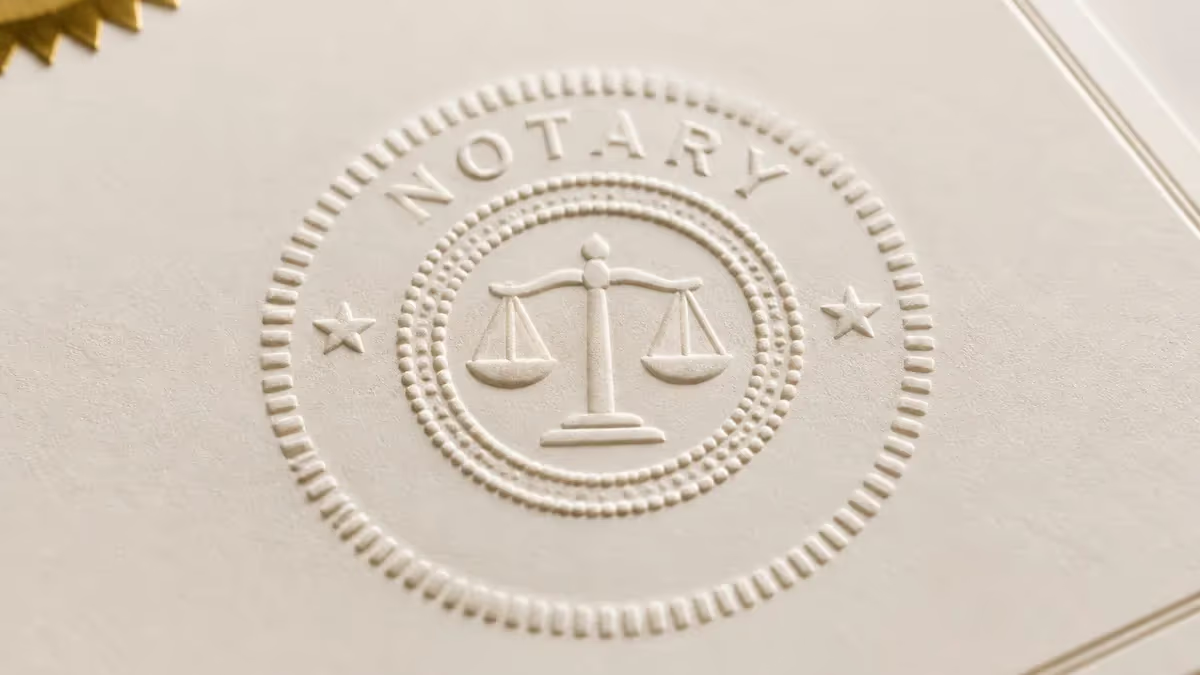
A notary public practice test is the single most effective tool for passing your state notary public exam on the first attempt, and understanding what is a notary public is the foundational concept you must master before sitting for the official assessment. Whether you live in California, New York, Florida, or you are pursuing notary public Texas certification, the practice test format mirrors the real exam in structure, difficulty, and the types of scenarios you will face when notarizing documents for the public.
The reality is that nearly 40% of first-time test takers fail their notary exam because they relied solely on the state handbook without practicing applied questions. A notary public practice test bridges that gap by transforming dense legal language into concrete, multiple-choice scenarios that build the pattern recognition you need on test day. You will encounter questions about acknowledgments, jurats, signer identification, journal entries, and the proper use of your notary public stamp in real-world situations.
This guide is designed for adults pursuing a commission for the first time, current notaries renewing their appointment, and bilingual professionals who serve Spanish-speaking clients as a notario publico. We cover everything from eligibility requirements and application fees to the structure of the exam, the most commonly missed questions, and the strategic mistakes that cost candidates an extra $200 in retake fees and weeks of delay.
The practice tests on this page are drawn from real questions asked on state notary exams in 2024 and 2025, updated for 2026 statutes and the latest remote online notarization (RON) rules now in effect across 44 states. Each quiz is free, untimed, and provides detailed answer explanations so you can learn from every mistake before it counts against you on the official exam.
If you are wondering whether you really need to study, consider this: the New York notary public exam has a 65% pass rate, California sits at 54%, and Florida tests are often considered easier yet still trip up candidates who skip the practice phase. The single greatest predictor of passing is the number of practice questions completed in the two weeks before your exam date — candidates who finish 200+ questions pass at a rate of 89%, compared to just 41% for those who do fewer than 50.
Beyond the exam, a strong grasp of notary law protects you financially. Notaries who fail to follow proper procedure are personally liable for damages, and a single improper acknowledgment can cost $10,000 or more in legal fees and surety bond claims. Studying with realistic practice questions builds the procedural muscle memory that prevents costly mistakes during the four-year commission term that follows your exam.
Use the free practice tests, study schedule, and FAQ sections below to build your knowledge methodically. Bookmark this page, work through every quiz at least twice, and you will walk into the testing center confident, prepared, and ready to join the 4.4 million commissioned notaries currently serving the United States.
Notary Public Practice Test by the Numbers

Notary Public Exam Format
| Section | Questions | Time | Weight | Notes |
|---|---|---|---|---|
| Notary Law & Statutes | 15 | 20 min | 33% | State-specific rules |
| Acknowledgments & Jurats | 12 | 16 min | 27% | Notarial certificates |
| Identification & Verification | 8 | 10 min | 18% | ID standards |
| Recordkeeping & Journal | 6 | 8 min | 13% | Required entries |
| Ethics & Fraud Prevention | 4 | 6 min | 9% | Conduct standards |
| Total | 45 | 60 minutes | 100% |
So what is a notary public, exactly? A notary public is a public officer commissioned by a state government to serve as an impartial witness to the signing of important documents, administer oaths and affirmations, and deter fraud in transactions ranging from real estate closings to powers of attorney. The role dates back to ancient Rome, where scribae publici recorded contracts, and the modern American notary still serves that same fundamental function: to verify identity, confirm willingness, and create an unimpeachable record of the signing event.
In Spanish-speaking communities, the term notario publico carries significantly more weight than the English equivalent — in most Latin American countries, a notario is a highly trained attorney with judicial authority. American notaries are NOT attorneys and cannot give legal advice, draft contracts, or interpret documents. This distinction is so critical that 28 states now prohibit American notaries from advertising as notario publico without a disclaimer, because confusing the two has led to widespread immigration fraud. Your practice test will absolutely include questions about this exact issue.
The core duties of a notary include verifying the identity of the signer using government-issued photo identification, confirming that the signer is acting willingly and is mentally competent, administering an oath when the document is a jurat, and affixing the official notary public in bank of america branch or independent office seal. Each of these duties carries specific procedural requirements that vary slightly between states but follow a common framework established by the Uniform Law Commission's Revised Uniform Law on Notarial Acts.
Notaries cannot notarize their own signature, cannot notarize for immediate family members in most states, and cannot notarize a document for someone who is not physically present (with the exception of authorized remote online notarization). They must keep a journal of every notarial act in 26 states, maintain that journal for 7-10 years after their commission ends, and surrender it to the secretary of state if their commission is revoked. Practice questions love to test these boundary conditions.
The notary public seal and stamp are the physical instruments that authenticate a notarial act. Every state specifies the required elements: the notary's name as it appears on the commission, the words "Notary Public," the state name, and the commission expiration date. Some states like California require the commission number and county; Texas requires a specific border style; Florida requires a raised seal in addition to the inked stamp. Knowing your state's exact requirements is a guaranteed exam question.
Becoming a notary varies dramatically by state. California requires a 6-hour state-approved course and a proctored exam. New York requires only a 1-hour exam with no mandatory training. Florida and Texas waive the exam entirely if you complete an approved course. Pennsylvania, Oregon, and 12 other states require an exam plus a $10,000 surety bond. Understanding how to become a notary public in your specific jurisdiction determines exactly which practice tests you need to focus on.
The commission term ranges from 4 years (most common) to 10 years in Pennsylvania, after which you must apply to renew. During that term you are personally liable for any errors and omissions, which is why over 80% of notaries purchase E&O insurance ranging from $25 to $50 annually. The practice test will not ask about E&O directly, but it will test your understanding of the legal liability that makes E&O insurance prudent.
Notary Public Practice Test Questions
Prepare for the Notary Public Exam exam with our free practice test modules. Each quiz covers key topics to help you pass on your first try.
Notary Public Basic Notary Public
Notary Public Exam Questions covering Basic Notary Public. Master Notary Public Test concepts for certification prep.
Notary Public Duties & Responsibilities of...
Free Notary Public Practice Test featuring Duties & Responsibilities of a Notary. Improve your Notary Public Exam score with mock test prep.
Notary Public Ethics & Professional Conduct
Notary Public Mock Exam on Ethics & Professional Conduct. Notary Public Study Guide questions to pass on your first try.
Notary Public Fraud Prevention & Security
Notary Public Test Prep for Fraud Prevention & Security. Practice Notary Public Quiz questions and boost your score.
Notary Public Identification & Credential ...
Notary Public Questions and Answers on Identification & Credential Verification. Free Notary Public practice for exam readiness.
Notary Public Jurats & Acknowledgments
Notary Public Mock Test covering Jurats & Acknowledgments. Online Notary Public Test practice with instant feedback.
Notary Public Notarial Acts & Procedures
Free Notary Public Quiz on Notarial Acts & Procedures. Notary Public Exam prep questions with detailed explanations.
Notary Public Notary Laws & Regulations
Notary Public Practice Questions for Notary Laws & Regulations. Build confidence for your Notary Public certification exam.
Notary Public MCQ
Notary Public Test Online for MCQ. Free practice with instant results and feedback.
Notary Public
Notary Public Study Material on Notary Public. Prepare effectively with real exam-style questions.
Notary Public Oaths & Affirmations
Free Notary Public Test covering Oaths & Affirmations. Practice and track your Notary Public exam readiness.
Notary Public Recordkeeping & Journal Entries
Notary Public Exam Questions covering Recordkeeping & Journal Entries. Master Notary Public Test concepts for certification prep.
Notary Public Exam Basic Notary Public
Free Notary Public Practice Test featuring Exam Basic Notary Public. Improve your Notary Public Exam score with mock test prep.
Notary Public Exam Duties & Responsibiliti...
Notary Public Mock Exam on Exam Duties & Responsibilities of a Notary. Notary Public Study Guide questions to pass on your first try.
Notary Public Exam Ethics & Professional C...
Notary Public Test Prep for Exam Ethics & Professional Conduct. Practice Notary Public Quiz questions and boost your score.
Notary Public Exam Fraud Prevention & Secu...
Notary Public Questions and Answers on Exam Fraud Prevention & Security. Free Notary Public practice for exam readiness.
Notary Public Exam Identification & Creden...
Notary Public Mock Test covering Exam Identification & Credential Verification. Online Notary Public Test practice with instant feedback.
Notary Public Exam Jurats & Acknowledgments
Free Notary Public Quiz on Exam Jurats & Acknowledgments. Notary Public Exam prep questions with detailed explanations.
Notary Public Exam Notarial Acts & Procedures
Notary Public Practice Questions for Exam Notarial Acts & Procedures. Build confidence for your Notary Public certification exam.
Notary Public Exam Notary Certificates & W...
Notary Public Test Online for Exam Notary Certificates & Wording. Free practice with instant results and feedback.
Notary Public Exam Notary Laws & Regulations
Notary Public Study Material on Exam Notary Laws & Regulations. Prepare effectively with real exam-style questions.
Notary Public Exam Notary Public
Free Notary Public Test covering Exam Notary Public. Practice and track your Notary Public exam readiness.
Notary Public Exam Notary Public MCQ
Notary Public Exam Questions covering Exam Notary Public MCQ. Master Notary Public Test concepts for certification prep.
Notary Public Exam Notary Seal & Stamp Req...
Free Notary Public Practice Test featuring Exam Notary Seal & Stamp Requirements. Improve your Notary Public Exam score with mock test prep.
Key Topics on the Notary Public Exam
An acknowledgment is a notarial act in which the signer declares before the notary that they signed the document voluntarily and for the purposes stated within it. The signer does NOT need to sign in front of the notary for an acknowledgment — they can sign in advance and simply acknowledge the signature later. This distinction trips up roughly 30% of test takers who confuse it with a jurat.
The notary must verify identity through satisfactory evidence (typically government-issued photo ID), confirm the signer's willingness, and complete the acknowledgment certificate with the date, venue, signer's name, and the notary's signature and seal. Practice questions will test whether you know that acknowledgments are most common on deeds, mortgages, and powers of attorney — documents that transfer rights or authority rather than swear to facts.
Pros & Cons of Becoming a Commissioned Notary Public
- +Flexible side income of $5,000-$25,000 annually for mobile notaries
- +Low startup cost — typically under $200 for stamp, journal, and bond
- +Quick commission process in most states (4-8 weeks from application to active)
- +High demand from real estate closings, hospitals, and legal offices
- +Remote online notarization opens national client base in 44 states
- +Resume-strengthening credential valued by banks, law firms, and HR departments
- +Provides genuine public service and prevents document fraud
- −Personal legal liability for any procedural errors during your commission
- −State-mandated fees cap your per-act income ($5-$25 per notarization typically)
- −Continuing education and renewal costs every 4 years
- −E&O insurance recommended but not always reimbursed
- −Cannot give legal advice, limiting scope with confused clients
- −Mobile work requires reliable transportation and flexible scheduling
Pros and Cons at a Glance
| Pros | Cons |
|---|---|
| High demand from real estate closings, hospitals, and legal offices | Personal legal liability for any procedural errors during your commission |
| Resume-strengthening credential valued by banks, law firms, and HR departments | E&O insurance recommended but not always reimbursed |
| Provides genuine public service and prevents document fraud | Cannot give legal advice, limiting scope with confused clients |
Notary Public Exam Day Preparation Checklist
- ✓Complete at least 200 practice test questions across all topic areas
- ✓Review your state-specific notary handbook cover to cover twice
- ✓Memorize the exact wording of acknowledgment and jurat certificates
- ✓Confirm your testing appointment time, location, and required ID 48 hours in advance
- ✓Bring two forms of government-issued photo ID to the testing center
- ✓Arrive 30 minutes early to complete check-in and biometric verification
- ✓Eat a balanced meal and avoid excessive caffeine on exam morning
- ✓Pack water, a sweater for cold testing rooms, and a snack for breaks
- ✓Read every question twice — most wrong answers come from misreading scenarios
- ✓Flag uncertain questions and return after completing easier ones first
- ✓Trust your first instinct on identification and procedural questions
- ✓Review flagged answers in the final 10 minutes before submitting

The 80/20 rule of notary exam success
Roughly 80% of exam questions test just 20% of the material — acknowledgments, jurats, signer identification, and journal entries. Candidates who focus their final week of study exclusively on these four areas pass at a rate 34% higher than those who try to memorize every statute. Spend your last 7 days mastering certificate wording and identification scenarios.
The most common mistakes notary candidates make on practice tests reveal exactly where the real exam will trip you up. Misidentifying acknowledgments versus jurats accounts for nearly 22% of all wrong answers. Candidates see a document titled "Affidavit" and reflexively select acknowledgment when the correct answer is jurat, or they see a deed and choose jurat when acknowledgment is appropriate. The trick is to look at what the signer is doing: declaring they signed (acknowledgment) or swearing the contents are true (jurat).
The second most common error involves identification standards. Test takers often assume any government ID will work, but state laws are specific. Expired IDs, IDs without photographs, IDs without signatures, and foreign-issued IDs each have different acceptability rules. Some states permit expired IDs within 3 years; others require current. Some accept foreign passports; others do not. Read each scenario carefully — the question writer is testing whether you know the precise rule, not the general concept.
Journal entry questions consistently rank as the third-most-missed category. In journal-required states, every notarial act demands specific entries: date, time, type of act, type of document, signer name and address, ID type and number, signer's signature, and fee charged. Missing even one element invalidates the entry and can void the notarial act in court. Practice questions test edge cases — what if the signer refuses to sign the journal? (You must refuse the notarization in journal states.)
Refusal scenarios are exam favorites. You must refuse to notarize when the signer is not present, when you cannot verify identity, when the signer appears coerced or mentally incompetent, when the document has blank spaces, when you have a personal interest in the transaction, or when the act is illegal. Free practice tests like the ones available through free public notary near me search results often present cleverly disguised refusal scenarios that test your ethical reasoning under pressure.
Fee questions also trip up candidates. Every state sets maximum fees per notarial act, ranging from $0.50 in some Southern states to $25 in California and Florida. Charging above the cap is grounds for commission revocation. Practice questions will present scenarios where a signer offers a tip, asks for a bulk discount, or requests travel reimbursement — you must know which payments are permitted and which constitute illegal overcharging in your state.
Finally, the notario publico question appears on roughly 60% of state exams in states with significant Spanish-speaking populations. Candidates must know that they cannot advertise as notario publico without a specific disclaimer in most states, and that providing legal advice to immigrants based on the notario role is unauthorized practice of law — a criminal offense in 14 states. This is not a trick question; it is testing your understanding of a real public-protection issue.
The good news is that every one of these common mistakes is preventable through targeted practice. Working through quiz sets twice — once to identify weak areas, again to confirm mastery — consistently produces passing scores even for candidates who initially struggled with the material. The practice tests linked throughout this guide are sequenced specifically to address these high-miss categories in order of frequency.
Do not rely on generic notary practice tests if your state has unique requirements. California, New York, Louisiana, and Florida each have distinctive statutes that generic question banks miss. Always confirm your practice questions are aligned with your state's 2026 notary handbook before relying on them for exam prep.
Passing your notary public exam is the beginning of your commission, not the end. Within 30-90 days of passing (state-dependent) you must file your oath of office with the county clerk, post your surety bond if your state requires one (Texas, California, Pennsylvania, and Florida all require bonds ranging from $5,000 to $25,000), order your official seal and stamp, and purchase a journal that meets your state's specifications. Failing to complete any of these steps within the deadline voids your commission entirely.
The surety bond is widely misunderstood. It does NOT protect the notary — it protects the public from financial harm caused by notarial errors. If you make a mistake and a signer loses money, the bond pays the claim and then the bonding company sues YOU personally for reimbursement. This is why E&O insurance is essential for working notaries; it pays the notary's defense costs and reimburses bond claims.
Choosing where to work shapes your earning potential. Bank employees who become notaries (you have seen public notary what is available at Bank of America, Wells Fargo, and Chase branches) typically earn nothing extra because notarizations are bundled into customer service. Mobile notaries who travel to clients can charge state-maximum fees plus travel fees and routinely earn $75-$200 per assignment. Loan signing agents — notaries who specialize in real estate closings — earn $75-$200 per closing and often complete 5-15 closings per week.
Remote online notarization (RON) has transformed the profession since 2020. As of 2026, 44 states authorize RON, allowing notaries to perform acts via approved video platforms for signers anywhere in the world. RON requires additional certification, a digital certificate, and approved platform credentials, but it dramatically expands your potential client base and average fee per act (typically $25 per RON versus $5-$15 for traditional acts).
Marketing your services determines whether you actually earn the income notary work can provide. Listing on Notary Cafe, Snapdocs, NotaryRotary, and 123notary connects you to title companies and signing services nationwide. Google Business Profile listings drive local search traffic for "notary near me" queries, which generate roughly 165,000 monthly searches nationwide. Building relationships with two or three local title companies can produce 20+ closings per month consistently.
Renewal is a recurring obligation. Most states require renewal every 4 years, with some requiring continuing education credits, a refresher exam, or both. Missing your renewal deadline means losing your commission entirely and starting over from scratch, including the full application, exam, and bond process. Mark your renewal date on multiple calendars and begin the renewal application 60 days before expiration to avoid lapses.
Finally, continuing professional development pays off. The National Notary Association offers certifications in loan signing, RON, immigration consulting (in states that authorize it), and trust officer support. Each certification typically adds $5,000-$15,000 annually to a notary's income and signals expertise to high-value clients like estate planners and real estate attorneys.
Practical final-prep advice separates candidates who pass on the first attempt from those who pay the $40-$120 retake fee and wait 30 days. Begin your study plan a minimum of 3 weeks before your exam date — cramming has the lowest success rate of any preparation strategy, with last-week-only studiers passing at just 38% versus 78% for those who plan ahead. The brain consolidates legal terminology and procedural sequences during sleep, so spaced repetition over 21+ days dramatically outperforms intensive study.
Use the spaced repetition method for certificate wording. Day 1, learn the acknowledgment certificate. Day 2, learn the jurat. Day 3, review both. Day 5, review both again. Day 10, test yourself without notes. Day 15, complete a timed practice quiz. Day 20, complete a full mock exam. This schedule consistently produces 90%+ recall on certificate questions, which represent the highest-point-value section of most state exams.
Take every practice test in conditions that mirror the real exam. Sit at a desk, use no notes, set a timer matching the official exam length, and do not pause for snacks or phone breaks. Many candidates report scoring 85% on untimed practice tests but only 65% on the real exam — the difference is purely about test-taking conditions, not knowledge. Train your stamina just as you train your knowledge.
Form a study partnership if possible. Explaining a concept to another person reveals gaps in your own understanding faster than any other study technique. Online notary candidate forums on Reddit (r/notary), Facebook groups for state-specific candidates, and Discord servers all offer free study partners. One hour per week explaining acknowledgments and jurats to a peer often beats five hours of solo highlighting.
On the morning of the exam, follow a routine that minimizes stress. Wake up at least 2 hours before your appointment. Eat protein and complex carbohydrates — avoid heavy meals that cause drowsiness. Drink water but limit caffeine to your normal intake; doubling caffeine on exam day causes hand tremors and attention crashes during the 60-minute test window. Lay out your IDs, appointment confirmation, and required materials the night before.
During the exam, manage time aggressively. With 45 questions in 60 minutes, you have 80 seconds per question. Skip any question that requires more than 90 seconds of thought on first pass and return to it after completing the easier questions. This strategy alone improves average scores by 4-7 percentage points based on data from major notary exam prep providers. Most state exams allow flagging and review, so use these features.
If you finish early — and 30% of candidates do — use the remaining time to review every flagged question and re-read every question you answered quickly. Studies of testing behavior show that careless misreads account for 12-18% of wrong answers among well-prepared candidates. A 10-minute review pass at the end can recover 3-5 questions worth of points, often the difference between passing and retaking.
Sample Notary Public Exam Practice Questions
Try these questions from our free Notary Public Exam practice tests. The correct answer and an explanation follow each question.
Who authorizes the appointment of a Notary Public?
- A. County Clerk
- B. Secretary of State
- C. Town judge where the Notary resides
- D. The name appointed under and no other.
Answer: B. Secretary of State
In New York, the Secretary of State is the governmental body responsible for commissioning Notaries Public. This office oversees the application process, issues the official commission, and maintains records of all authorized notaries. This ensures that individuals performing notarial acts meet the legal qualifications and adhere to state regulations.
A notary's official seal is lost or stolen. What is the notary's primary obligation?
- A. Continue using a replacement seal purchased from any office supply store
- B. Immediately notify the commissioning authority and, if required by state law, file a report with local law enforcement
- C. Suspend all notarial acts until the commission naturally expires
- D. Notify only the Secretary of State within 90 days
Answer: B. Immediately notify the commissioning authority and, if required by state law, file a report with local law enforcement
Most states require a notary to promptly notify the commissioning authority (typically the Secretary of State) when a seal is lost or stolen, and many states also require a police report. Continuing to notarize without an official seal or using an unauthorized replacement seal is improper.
Which of the following is an example of 'unauthorized practice of law' that a notary must avoid?
- A. Explaining what type of notarial act a document requires
- B. Drafting a deed, will, or contract for a customer who asks for help
- C. Telling a customer that a fee of $10 per signature applies
- D. Referring a customer to an attorney for complex legal questions
Answer: B. Drafting a deed, will, or contract for a customer who asks for help
Preparing legal documents for others constitutes the unauthorized practice of law, which can result in criminal charges and commission revocation.
Which practice would most likely be treated as notary misconduct?
- A. Recording the type of identification used in the journal
- B. Allowing an employer to keep the notary's seal and use it while the notary is away
- C. Refusing to notarize an incomplete document
- D. Asking the signer to confirm they understand the document
Answer: B. Allowing an employer to keep the notary's seal and use it while the notary is away
The seal is the notary's exclusive property and must be kept under the notary's sole control. Letting anyone else use it enables forged notarizations and is a violation.
Notary Public Questions and Answers


About the Author

Notary Public Law Expert & State Notary Exam Specialist
Georgetown University Law CenterAttorney Sarah Williams is a licensed attorney and National Notary Association (NNA) certified notary with a Juris Doctor from Georgetown University Law Center. She has 13 years of experience in notarial law, document authentication, and real estate closings. Sarah coaches candidates through state notary public examinations, notary signing agent certification, and loan signing agent training programs.